
Data Pipeline Automation: An Enterprise Guide
Most pipeline failures never throw an error: the cron job runs clean while the source schema shifts underneath it, and nobody notices the incomplete records until a consumer does.
That is what data pipeline automation exists to fix, and the load keeps growing: 77% of 400 senior data and technology executives surveyed by MIT Technology Review Insights (October 2025) reported rising data engineer workloads.
There are six steps every enterprise data team should work through before calling a pipeline automated. Landscape first, then the framework, the tools, and the decision they force: you can then run the six steps on your own stack and make the build-vs-partner call.
Quick Digest
- What automation covers: software owns scheduling, dependencies, validation, and alerting; a timer script does not qualify.
- The five components: ingestion (external sources included), transformation, delivery, orchestration, monitoring with QA.
- The five requirements: delivery SLAs, capacity, quality thresholds, ownership, resilience to source change.
- The six steps: map sources and SLAs, choose architecture, automate ingestion and validation, orchestrate, monitor forever.
- Build vs partner: build in-house for stable internal sources; go managed when external sources dominate.
What Is Data Pipeline Automation?
Data pipeline automation is the use of software to orchestrate the movement, transformation, and delivery of data with minimal human intervention. A pipeline is automated when scheduling, dependency management, validation, and alerting run without a human in the execution path.
A nightly cron script is scheduled, not automated: no retries, no validation, no alert when the output is wrong. Orchestration is only one layer, the dependency-and-retry layer; validation and monitoring are separate layers, added last and needed first. A pipeline is not ETL (extract, transform, load) either; the pipeline vs ETL differences have their own guide.
Fortune Business Insights’ 2026 forecast projects the data pipeline tools market growing at a 26.4% CAGR from roughly $24.4 billion in 2026; sizings diverge across analysts, the growth rate does not.
What Are the Components of an Automated Data Pipeline?
The definition of data pipeline automation implies five components.
- Ingestion and extraction: databases, SaaS APIs, event streams, plus the set every diagram omits, external sources such as websites, documents, and portals. Change data capture (CDC) covers incremental sync.
- Transformation: cleaning, deduplicating, normalizing into consumable schemas.
- Delivery and loading: into Snowflake, BigQuery, or Redshift.
- Orchestration: the dependency-and-retry brain sequencing the rest.
- Monitoring and QA: freshness, volume, and schema drift detection plus quality checks.
A pipeline diagram without a monitoring layer is a diagram of a future incident; unmonitored pipelines fail silently.
25% of IT leaders now sit at the highest data-streaming maturity level, up from 8% in 2024 (Confluent 2025 Data Streaming Report, n=4,175).
53% of data and analytics leaders have implemented data observability tools; 43% more plan to within 18 months, per Gartner’s 2025 State of AI-Ready Data Survey, cited in its February 2026 Market Guide for Data Observability Tools.
What Enterprise Pipelines Actually Need
Components describe the machine; requirements are what real data teams get paged about. Five: delivery SLAs (service-level agreements), capacity to absorb new sources, quality thresholds, clear ownership (data governance in practice), and resilience to source change. A data freshness SLA is your contract with downstream consumers; ownership means a named engineer per pipeline.
$12.9 million per year. The average cost of poor data quality to organizations, because downstream decisions run on stale data. Source: Gartner, 2021.
Common misconception: Automation does not mean no maintenance. Automated pipelines still break, through schema drift, source structure changes, and API deprecations; automation shifts the work from moving data to maintaining resilience.
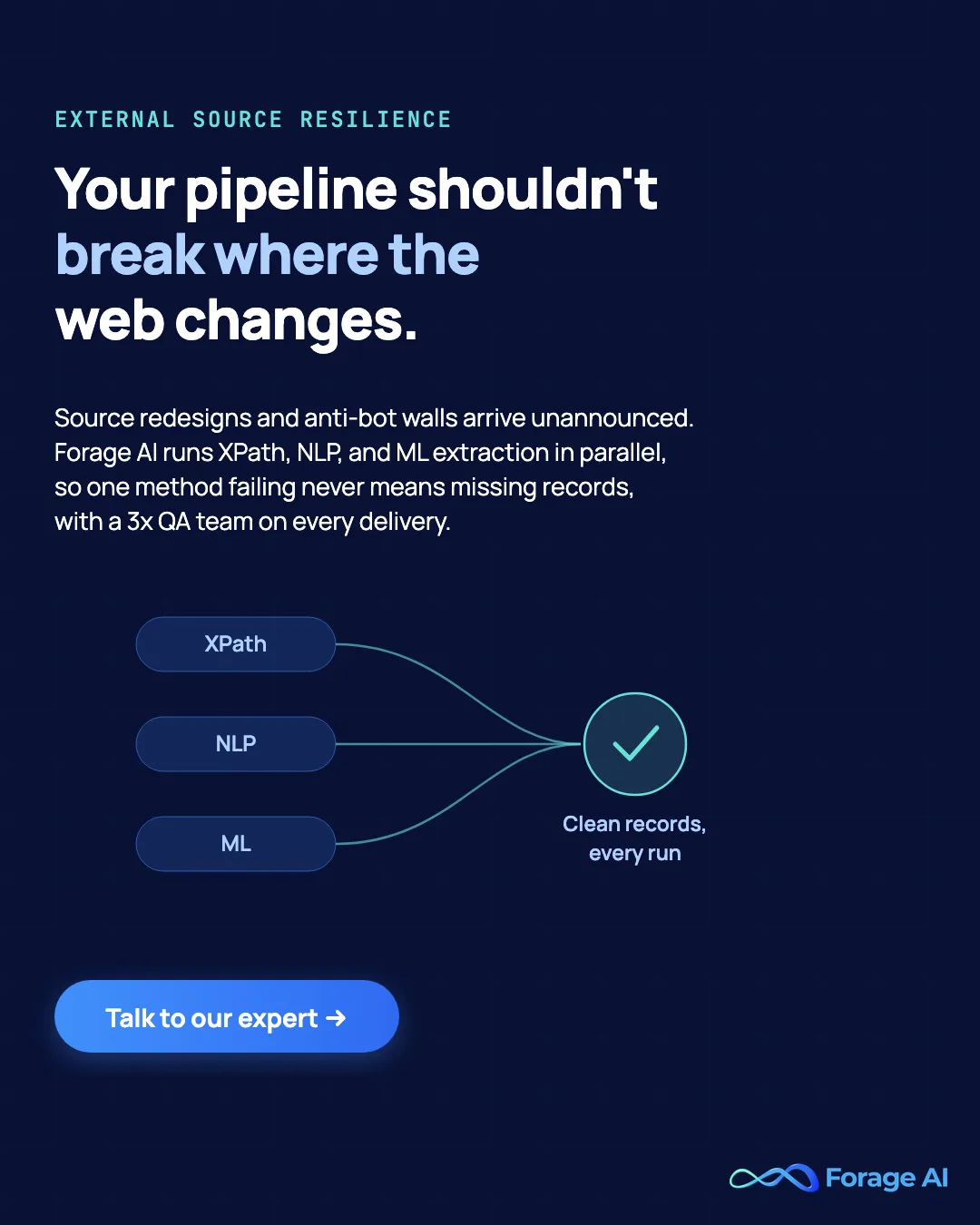
The failure mode is rarely the first build; it is month six, when a source changes, nobody owns the fix, and the unowned pipeline compounds into technical debt. The burden peaks with external sources, where redesigns and anti-bot systems arrive unannounced; that is why enterprise pipelines break at the source.
Benefits of Data Pipeline Automation
If the requirements are what you get paged about, the benefits are the return on meeting them, each with a mechanism.
- Quality: validation runs every time, not when someone remembers.
- Scale: the orchestrator absorbs new sources; headcount does not.
- Team time: engineers go back to shipping, not babysitting jobs.
- Fewer errors: retries and idempotency absorb transient failures.
- Visibility: you find out before the consumer does.
These compound; each automated pipeline frees hours that fund the next, though none of it materializes unless validation is designed in (Step 4).
44% of IT leaders report 5x returns on data streaming investments (Confluent, May 2025).
How to Automate Your Data Pipelines: A Six-Step Framework
Here’s how it actually works: six steps, each with its failure mode.
Step 1: Map sources and define SLAs. Inventory every source, including the external websites and documents your diagrams omit; set freshness and completeness SLAs per consumer. What goes wrong: teams automate what they can see and meet undocumented sources at incident time.
Step 2: Choose the architecture. The trade-offs decide, not fashion:
| Dimension | Batch | Streaming |
|---|---|---|
| Latency | Minutes to hours | Seconds |
| Cost | Lower; scheduled compute | Higher; always-on infrastructure |
| Complexity | Lower; easy to debug and replay | Higher; ordering, state, backfill |
| When to choose | SLAs tolerate hourly/daily refresh | The SLA demands sub-minute data |
Verdict: ELT (extract, load, transform) over ETL in cloud warehouses, provided the bill can carry raw loading. What goes wrong: choosing streaming for status, then paying its complexity tax against an SLA batch would have met. Among Confluent’s 4,175 surveyed IT leaders, most sit below the top streaming-maturity tier.
Step 3: Automate extraction and ingestion. Connectors and CDC handle internal sources; external sources are the hard tier, needing multi-method resilience because structures change without notice. This is where Forage AI’s multi-method extraction (XPath, NLP, ML in parallel) earns its keep, absorbing selector drift, anti-bot evolution, and schema changes as part of the service. Our data extraction automation guide covers that layer. What goes wrong: hardcoded selectors that turn every source change into a ticket.
Step 4: Automate transformation and validation. Run transformation as versioned code (dbt) with schema, volume, and distribution checks at every stage via Great Expectations. What goes wrong: automating a broken process reproduces its defects at machine speed.
Common misconception: Automation without QA just ships bad data faster. Validation gets designed in at Step 4, not after the first incident.
Step 5: Orchestrate and schedule. A DAG (directed acyclic graph) based orchestrator owns sequencing, dependencies, and retries; as of Airflow 3 (April 2025), event-driven scheduling and DAG versioning are native, so pipelines can trigger on data arrival, not clock time. Astronomer’s 5,000+ surveyed practitioners overwhelmingly call the orchestrator critical; the DAG shows why:
from airflow.sdk import dag, task
from datetime import datetime, timedelta

@dag(
    schedule="@hourly",
    start_date=datetime(2026, 1, 1),
    catchup=False,
    default_args={"retries": 3, "retry_delay": timedelta(minutes=5)},
)
def sales_data_pipeline():
    @task
    def ingest():
        # pull raw records from source API / files
        return extract_from_source("s3://raw/sales/")

    @task
    def transform(raw):
        # validate, deduplicate, normalize schema
        return clean_and_normalize(raw)

    @task
    def deliver(clean):
        # load into the warehouse for downstream consumers
        load_to_warehouse(clean, table="analytics.sales")

    deliver(transform(ingest()))

sales_data_pipeline()
Hourly ingest-transform-deliver DAG with retries (Airflow 3.x TaskFlow API; helpers are stubs).
What goes wrong: adopting an orchestrator below a handful of stable sources, where tooling overhead exceeds the cron it replaced.
Step 6: Monitor, alert, maintain. Alert on freshness, volume, schema drift, and distribution, with thresholds tied to SLAs, a named owner who gets paged, and a bounded blast radius; observability tools for external pipelines surface drift before consumers do. What goes wrong: error-only alerting, which misses degraded mode, the silent failures that return clean status codes and wrong data. This step is a loop, not an endpoint; it never finishes, by design.
Quick Summary
Q: What are the six steps to automate a data pipeline?
A: Map every source and set freshness and completeness SLAs per consumer. Choose batch or streaming on latency and cost, not on fashion. Automate extraction and ingestion, where external sources are the hard tier. Automate transformation and validation as versioned code with schema, volume and distribution checks at every stage. Orchestrate with a DAG-based scheduler that owns sequencing, dependencies and retries. Then monitor on freshness, volume, schema drift and distribution, with thresholds tied to SLAs and a named owner who gets paged. The last step is a loop, not a finish line.
Data Pipeline Automation Tools and Technologies
The framework needs tooling, chosen by pipeline layer rather than from a flat list of logos.
| Pipeline layer | Reference tools | What it handles |
|---|---|---|
| Orchestration | Apache Airflow, Prefect, Dagster | Scheduling, dependencies, retries |
| Transformation | dbt, Apache Spark | Versioned transformation at scale |
| Streaming ingestion | Apache Kafka, Apache Flink | Real-time event capture |
| Storage | Snowflake, BigQuery, Redshift | Warehouse destinations |
| Data quality | Great Expectations | Schema, volume, distribution checks |
| Monitoring | Prometheus, Datadog | Metrics, alerting, pipeline health |
Airflow remains the default orchestrator in 2026; Prefect and Dagster earn evaluation for developer experience and asset-based lineage; managed versions of each layer trade control for less upkeep. Airflow 3.0 (GA April 2025) marks the direction: event-driven scheduling over clock-based batch.
Expert Insights
Apache Airflow reached 77,000+ organizations as of November 2024, up from roughly 25,000 in 2020; over 90% of 5,000+ surveyed practitioners call it critical (Astronomer, State of Airflow 2025).
“Several years ago, Airflow use was limited to supporting internal dashboards, often requiring frequent manual intervention… data teams have leveraged Airflow to… power everything from continuous compliance in regulated industries, to production-grade AI deployed at enterprise scale.” Vikram Koka, CSO at Astronomer, Apache Airflow PMC member, April 2025.
Common misconception: Buying tools is not the same as having an automated pipeline. The stack still needs an owner for assembly and upkeep, or the “automated” pipeline gains a full-time human dependency.
Enterprise Use Cases for Automated Pipelines
With the stack chosen, the remaining question is where automated pipelines earn their budget:
- Analytics and BI feeds. The stress is freshness; stale dashboards misprice decisions.
- AI and RAG data supply. The fastest-growing destination: RAG (retrieval-augmented generation) adds unstructured parsing and refresh cadence, with LLM-assisted parsing now in production. The catch: RAG inherits every upstream defect, turning bad data into confident wrong answers; see why RAG pipelines fail in production.
- Market and competitive intelligence. External web data; the stress is source resilience, since competitors do not announce redesigns.
- Healthcare provider data. Accuracy plus compliance; provider records feed regulated decisions.
Data engineers’ time on AI projects nearly doubled, 19% in 2023 to 37% in 2025, with 61% expected by 2027, per the October 2025 MIT Technology Review Insights survey (n=400).
Should You Build In-House or Use a Managed Partner?
The framework’s last call: whose team runs it.
| Signal | Automate in-house | Use a managed partner |
|---|---|---|
| Source types | Internal databases, stable SaaS APIs | External websites, documents, portals |
| Source count and churn | Few sources, stable schemas | High counts, structures change unannounced |
| Team | Existing platform team with capacity | No specialized extraction capacity |
| Refresh and SLAs | Daily or weekly refresh suffices | High-frequency refresh, contractual SLAs |
| Engineering time | Pipeline work is near your product | Engineers needed on the product itself |
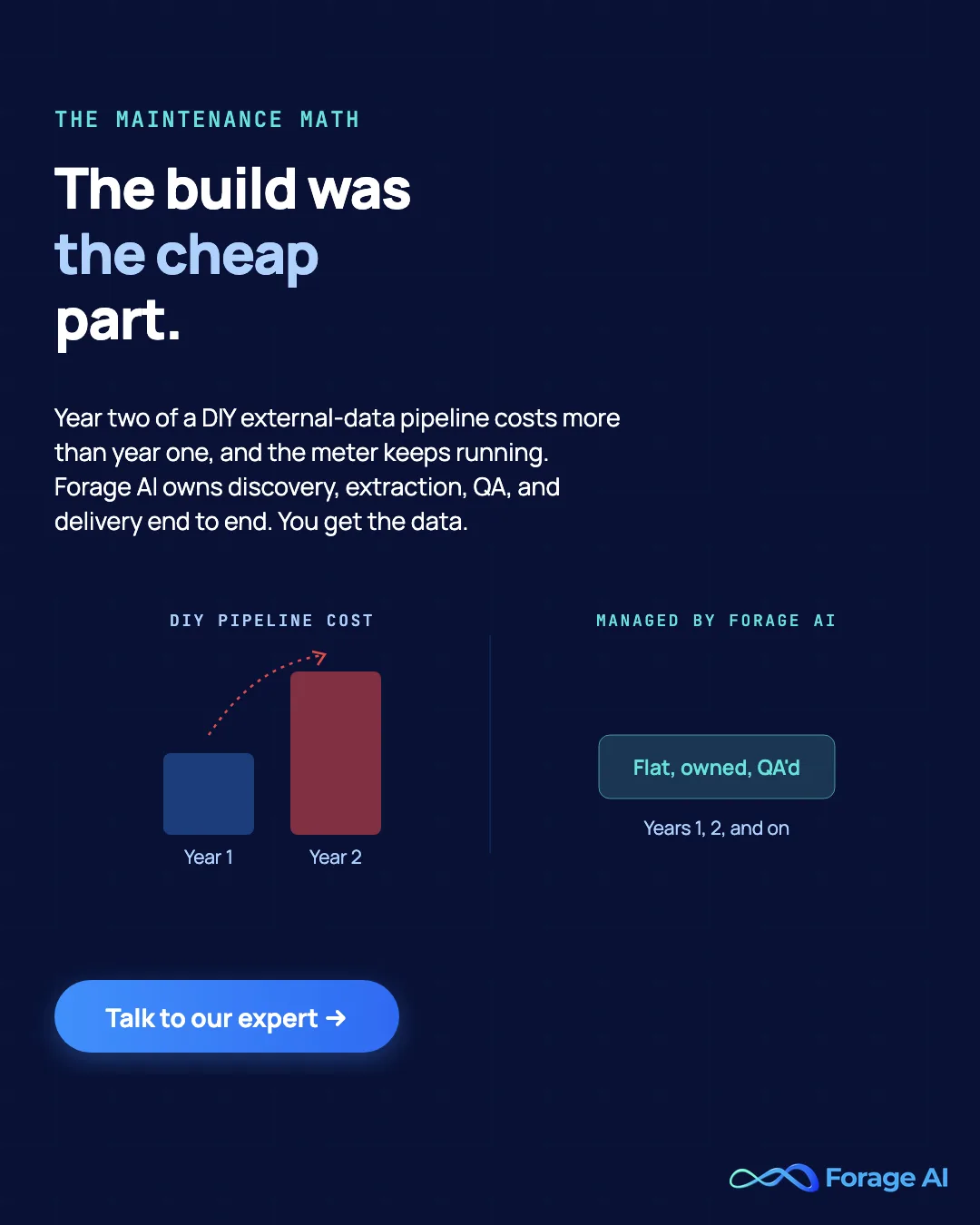
With internal, stable sources and a platform team, build in-house. The deciding variable is ongoing maintenance cost, not build cost: year two of a DIY external-data pipeline costs more than year one, because the build was the cheap part. For external sources, that favors the managed path. Forage AI delivers the data, not just the pipeline: discovery, extraction, QA, and delivery owned end to end. Behind that: 500M+ websites crawled, 10M+ documents parsed, 12+ years, and a 3x QA team on every delivery.
Expert Insights
The maintenance argument is not a vendor talking point, it is a documented pattern in production data systems. A Google research team led by D. Sculley found that "it is common to incur massive ongoing maintenance costs in real-world ML systems", naming data dependencies, pipeline jungles and changes in the external world as the sources of that debt (Hidden Technical Debt in Machine Learning Systems, NeurIPS 2015). Price year two of an external-source pipeline on that basis rather than on the cost of the first build.
77% of senior data and technology executives report growing data engineer workloads (MIT Technology Review Insights, October 2025, n=400); this call decides where that capacity goes.
Quick Start: Your First 30 Days
Whichever path wins, month one is the same:
- Audit your sources, including the external ones missing from the diagrams.
- Prioritize the one pipeline that hurts most. Momentum funds the roadmap.
- Define its SLAs with its consumers.
- Pilot automation on it: the six steps in miniature.
- Measure and expand: incidents, freshness adherence, hours reclaimed.
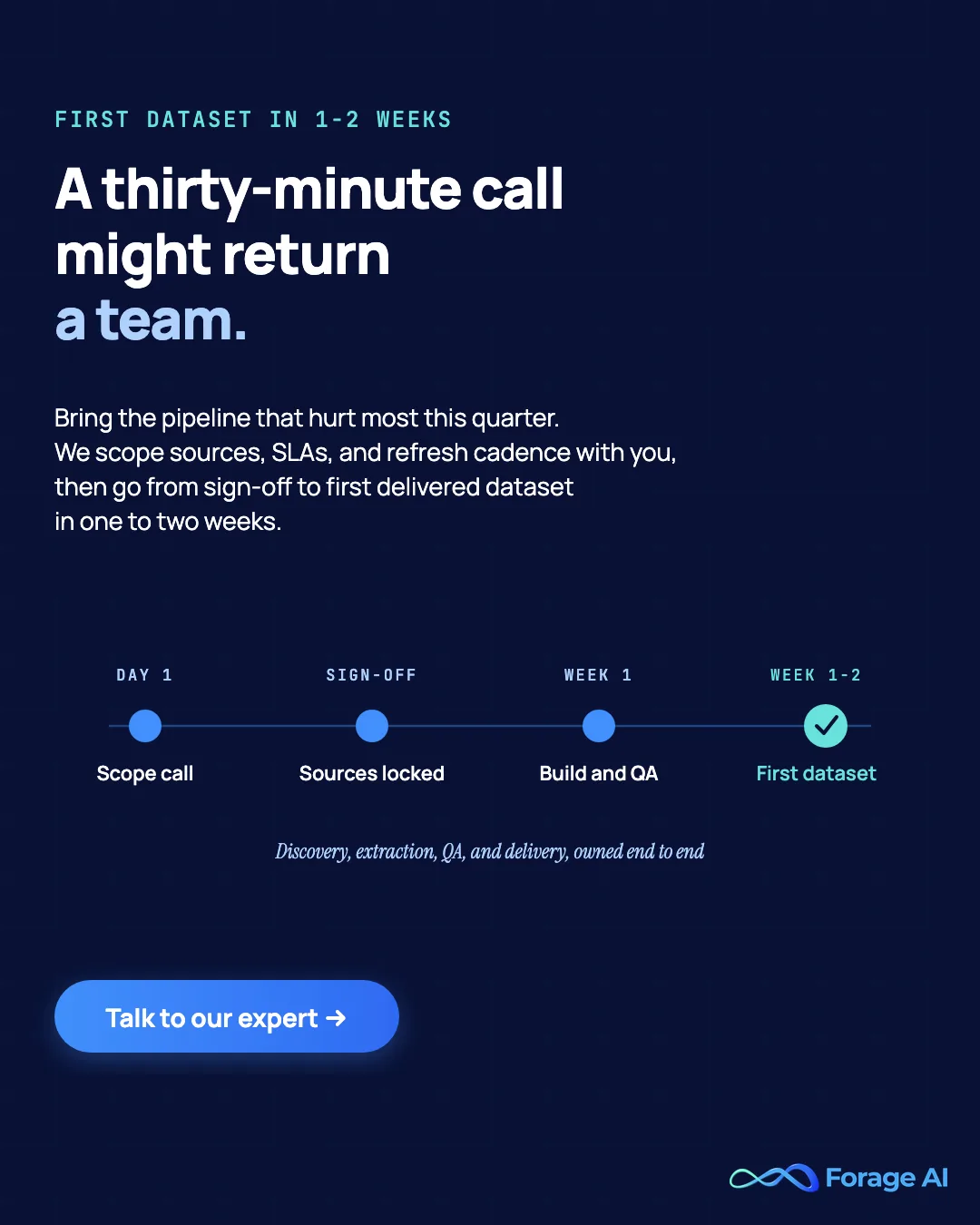
A pilot lands in weeks; the capability takes months. Do not start by procuring an orchestrator; tool-first starts stall. If the audit surfaces mostly external sources, the fastest first month is a partner conversation; Forage AI goes from sign-off to first dataset in 1-2 weeks.
Over 85% of surveyed Airflow users expect more revenue-generating solutions on their orchestration layer within a year (Astronomer, February 2025, n=5,000+): orchestration is turning into revenue infrastructure.
Frequently Asked Questions
How long does it take to implement data pipeline automation?
A pilot lands in weeks; a dependable capability takes months, driven by source count, mix, and team time. Treat flat multi-week promises with suspicion.
Do we need real-time pipelines, or is batch enough?
Let the latency SLA decide: batch when consumers act hourly or daily, streaming only for a genuine sub-minute SLA.
How do automated pipelines handle source and schema changes?
Detection first (drift, volume, and freshness monitoring), then response: retries for transient failures, owned fixes for structural ones.
How do you measure pipeline automation success?
Freshness SLA adherence, incident count and MTTR, engineer hours reclaimed, and quality pass rates; if none move in two quarters, revisit Step 1.
Can data pipelines be fully automated?
No. Automation covers execution and detection; humans still own responses to novel breakage and validation of high-stakes data.
Automation Is a Capability You Sustain
The sixth step never finishes, and that is the point. Data pipeline automation is an operating capability you sustain, not a project you close out: orchestration, validation, and monitoring carry the load, while your team maintains resilience instead of moving data by hand.
So pick the pipeline that hurt most this quarter and run the six steps against it, then read the build-vs-partner table with real maintenance hours. If your sources are mostly external, talk to a partner who runs this every day; that conversation costs thirty minutes and might return a team.
Related Articles
- Data Extraction Automation: From Fragile Scripts to Resilient Managed Pipelines: How the extraction layer of your pipeline gets automated and maintained.
- Automated Data Collection: How Enterprise Teams Build Reliable Extraction Pipelines: Reference architecture for the collection side of the pipeline.
- Why Most Enterprise Data Pipelines Break and How to Fix It: The failure modes behind the maintenance argument in this guide.
- Data Pipeline vs ETL: Key Differences (2026): The definitional comparison this article links instead of repeating.
- Best Data Observability Tools for External Data Pipelines: Tool options for Step 6 of the framework.
Sai is a data infrastructure enthusiast who has spent the past two to three years following the AI space closely, from the infrastructure layer to the fast-growing world of data for AI. He is genuinely curious about how modern data pipelines get built and where the data industry is heading, and he writes insightful pieces on the core topics that shape this niche.