
Data Pipeline vs ETL: Key Differences (2026)
Data pipeline versus ETL is the wrong fight. The two are not competing options you choose between, because one contains the other: ETL is a kind of data pipeline, not an alternative to one. Asking “should we use a data pipeline or ETL” is a bit like asking “should we drive a vehicle or a sedan.” The useful question is different and more practical: what kind of pipeline does this job actually need, and that is exactly what the differences below decide.
The confusion is understandable. For years, moving data was ETL, a nightly batch job that pulled records, cleaned them, and loaded them into a warehouse. Then streaming, cloud warehouses, and ELT arrived, the term “data pipeline” widened to cover all of it, and the two words started getting used as if they were interchangeable. They are not. Getting the relationship right is what makes the rest of the decision easy.
So this guide does four things, in order: defines both plainly, lays out the key differences in a single comparison you can actually use, grounds it in worked examples, and ends with a decision framework for picking the right pattern. We will also be honest about the part most explainers skip, that the hardest piece of a real pipeline is usually not the transform, it is reliably getting data out of messy external sources in the first place.
Quick Digest
- The category: A data pipeline is the umbrella term for any process that moves data from one or more sources to one or more destinations, with processing optional along the way.
- The pattern: ETL is one specific pipeline pattern, extract then transform then load, and the transformation always happens before the load.
- Not a rivalry: ETL sits inside the pipeline category rather than opposite it, so the real decision is which pattern fits the job in front of you.
- The sibling: ELT flips the last two steps and transforms the data inside the destination, usually a cloud warehouse, which is why it reads as a third option but is not one.
- The deciding axis: Latency settles most cases, and the hardest part of a pipeline is rarely the transform, it is reliable extraction from messy, changing external sources.
What Is a Data Pipeline?
A data pipeline is the umbrella term for any process that moves data from one or more sources to one or more destinations, with optional processing along the way. That is deliberately broad, because the category is broad. A pipeline might transform data heavily or barely at all. It might run as a scheduled batch or stream continuously in real time. Its destination might be a data warehouse, a data lake, an application, an ML feature store, or another pipeline. Some pipelines never really “finish”, they keep moving data and triggering downstream actions as events arrive.
Data pipeline at a glance
| What it is | The general system for moving data from source to destination |
| Transformation | Optional, can move raw data or process it |
| Processing mode | Batch or streaming / real-time |
| Destination | Warehouse, lake, app, ML store, another system |
| Patterns it includes | ETL, ELT, streaming, replication / CDC |
| Typical tools | Airflow, Kafka, Spark, Flink, Fivetran, custom code |
| Best for | Analytics, ML, app integration, real-time operations |
What Is ETL?
ETL is a specific pipeline pattern: Extract, Transform, Load. You extract data from source systems, transform it (clean, standardize, deduplicate, aggregate) while it is in transit, and then load the finished result into a structured destination, classically a data warehouse built for analytics and reporting. The defining trait is the order: the transform happens before the load. ETL has historically run as a scheduled batch, which is why it is associated with overnight jobs and morning dashboards.
ETL at a glance
| What it is | A specific Extract, Transform, Load process |
| Transformation | Always, and it happens before the load |
| Processing mode | Traditionally scheduled batch |
| Destination | Typically a structured data warehouse |
| Sequence | Strict: extract, then transform, then load |
| Typical tools | Informatica, Talend, SSIS, AWS Glue |
| Best for | Structured analytics, BI, regulated reporting |
Data pipeline vs ETL: the key differences
Because ETL sits inside the broader category, the differences are really about how a generic pipeline can differ from the specific ETL pattern. The picture below is the mental model: the data pipeline is the umbrella, and ETL, ELT, and streaming are patterns underneath it.
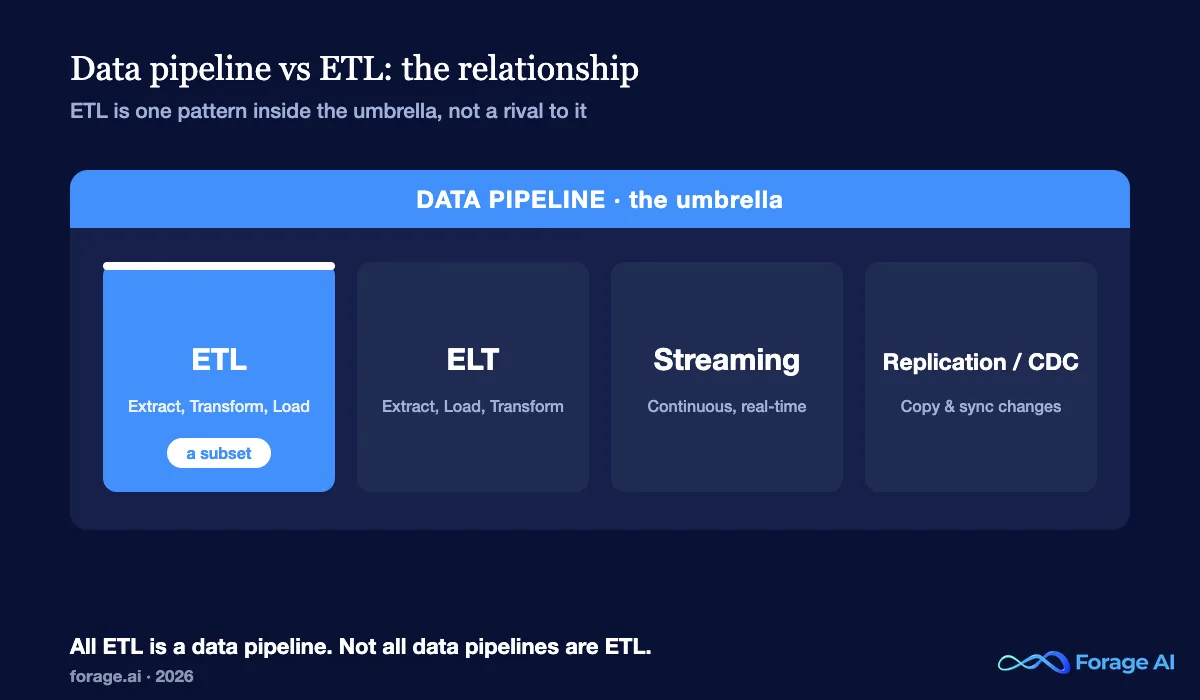
The full comparison runs across ten dimensions. Read it as the difference between the category and one pattern in it, not as two rival tools.
Data pipeline vs ETL, across ten dimensions
| Dimension | Data pipeline | ETL |
|---|---|---|
| Scope | Broad umbrella for any data movement | One specific extract-transform-load process |
| Transformation | Optional, can move raw data | Always, transformation is the point |
| Sequence | Any order (ETL, ELT, or none) | Strict: extract, transform, load |
| Processing mode | Batch or streaming / real-time | Traditionally scheduled batch |
| Latency | Can be low-latency or real-time | Typically higher, on a schedule |
| Destination | Warehouse, lake, app, ML store, system | Typically a structured data warehouse |
| Endpoint behavior | May run continuously and trigger actions | Ends with a load |
| Primary use | Analytics, ML, app integration, real-time ops | Structured analytics, BI, reporting |
| Relationship | The superset (the category) | A subset (one pattern within it) |
| Example tools | Airflow, Kafka, Spark, Flink, Fivetran | Informatica, Talend, SSIS, AWS Glue |
Three of those rows do most of the work. The first is transformation: a pipeline may move raw data untouched, while ETL always transforms before loading. The second is processing mode and latency: a pipeline can stream in real time, while classic ETL runs in scheduled batches. The third is the destination and purpose: ETL aims data at a warehouse for BI, while a pipeline can feed an app, an ML model, or another system entirely. Everything else follows from those three.
Where Does ELT Fit In?
There is a third term you will hit immediately, and it matters: ELT, Extract, Load, Transform. ELT flips the last two steps of ETL. Instead of transforming data in transit and then loading the finished product, you load the raw data into the destination first and transform it there, inside a modern cloud warehouse like Snowflake or BigQuery, often with a tool like dbt. It became popular because cloud warehouses are powerful and cheap enough to do the heavy transformation themselves.
Expert Insights
The two patterns now routinely sit in the same stack, and the seams between them are where the cost lands. Michael Armbrust, Ali Ghodsi, Reynold Xin and Matei Zaharia describe the current industry default in "Lakehouse: A New Generation of Open Platforms that Unify Data Warehousing and Advanced Analytics" (CIDR, 2021), a two-tier design they observed "used at virtually all Fortune 500 enterprises". Their summary of it is blunt: "In today's architectures, data is first ETLed into lakes, and then again ELTed into warehouses, creating complexity, delays, and new failure modes." They add that "Each ETL step also risks incurring failures or introducing bugs that reduce data quality." Choosing between ETL and ELT is therefore less interesting than counting how many times a given record is moved and rewritten before anyone reads it.
For our purposes, ELT is the clearest proof of the whole point: it is another pattern under the data-pipeline umbrella, a sibling of ETL, not a rival of “pipelines.” A given data flow can be built as ETL, as ELT, or as a streaming pipeline, and they all qualify as data pipelines, though for third-party sources the ETL vs ELT call is best made source by source rather than once for the whole stack.
“Data pipeline vs ETL” is a false binary. They are not competing choices, one contains the other. The real decision is which pattern fits the job, ETL or ELT for warehouse analytics, a streaming pipeline for real-time data, based on your latency, destination, and how much transformation you need and where.
Typical Examples of Each Pattern
The distinction gets concrete fast once you look at real flows.
A classic ETL job: every night, a process pulls sales records from a CRM and an ERP, cleans and standardizes them, aggregates them into the metrics finance cares about, and loads the result into a data warehouse. In the morning, the BI dashboards reflect yesterday. Scheduled, transform-before-load, warehouse destination, this is ETL in its textbook form.
A streaming data pipeline: clickstream events from a web app, or sensor readings from equipment, flow continuously through a system like Kafka or Flink into a real-time store or an ML feature store. There is little upfront transformation, no nightly batch, and no final “load and done”, the pipeline runs continuously and triggers actions as data arrives. It is unmistakably a data pipeline, and just as unmistakably not ETL.
An external-data pipeline: a process continuously extracts competitor prices and product details from across the web, structures them, and feeds them into a pricing application and a warehouse. Here the transformation is modest but the extraction is the hard part, sources change, rate-limit, and break, which is the case that most “pipeline vs ETL” explainers never mention.
Which Pattern Do You Actually Need?
Since ETL is one option inside the pipeline category, the practical question is which pattern to build. A handful of factors settle it.
Choosing the right pattern
| If you need… | Lean toward |
|---|---|
| Real-time or low-latency data | A streaming pipeline (Kafka, Flink) |
| Scheduled analytics into a warehouse | ETL or ELT |
| Heavy transformation before use | ETL (transform in transit) |
| Raw data loaded fast, transformed later | ELT (transform in-warehouse) |
| To feed an app, ML model, or another system | A broader data pipeline, not classic ETL |
| Varied, messy, or external sources | A pipeline with a strong ingestion layer |
Latency is usually the deciding axis. If the business needs data now, that rules out nightly ETL and points to streaming. If yesterday’s data in a clean warehouse is fine, ETL or ELT is simpler and cheaper. After latency, the questions are where the data lands and who consumes it, how much transformation is required and where it should happen, and how stable and clean the sources are, because varied external sources change the calculus more than anything else.
Expert Insights
Latency is a trade, not a setting, and the streaming literature is unusually honest about that. Tyler Akidau and colleagues at Google, writing in "The Dataflow Model" (Proceedings of the VLDB Endowment, 2015), start from the position that "practicality dictates that one can never fully optimize along all dimensions of correctness, latency, and cost for these types of input", and argue the field "must stop trying to groom unbounded datasets into finite pools of information that eventually become complete". For anyone weighing nightly ETL against a streaming pipeline, that is the useful framing: you are not picking the better architecture, you are deciding which of correctness, latency and cost you are willing to give ground on.
The hardest part of most pipelines is not the transform, it is reliable extraction from messy, changing sources. External and web sources break, rate-limit, and shift schemas, and underestimating that ingestion burden is where pipeline projects quietly stall. Budget for the extract, not just the transform.
Managed External Data Ingestion
Whichever pattern you choose, a pipeline is only as good as the data entering it, and for external and web sources that extract step is the part that breaks most. This is where Forage AI fits: we run the external-data ingestion layer at the front of your pipeline. You tell us the sources and the schema; we handle the extraction, the anti-detection, the structuring, and the maintenance, then deliver clean, structured, continuously-updated data into your warehouse, lake, or application, in batch or as a stream. Your engineers keep their pattern, ETL, ELT, or streaming, and skip the part that usually stalls the project.
Frequently asked questions
Is ETL a data pipeline?
Yes. ETL is one specific type of data pipeline. A data pipeline is the general category for moving data from source to destination, and ETL is a pattern within it that extracts data, transforms it, and then loads it, usually in batch into a warehouse. Every ETL process is a data pipeline, but many data pipelines are not ETL.
What is the difference between ETL and a data pipeline?
A data pipeline is the broad term for any data movement and can be batch or streaming, may or may not transform data, and can land anywhere. ETL is a specific pattern that always transforms data before loading it, runs traditionally in batch, and typically targets a data warehouse. The difference is category versus a single pattern within that category.
What is the difference between ETL and ELT?
ETL transforms data before loading it into the destination; ELT loads the raw data first and transforms it inside the destination, usually a cloud warehouse. ELT has become common because modern warehouses are powerful enough to handle transformation themselves. Both are patterns under the data-pipeline umbrella.
Is a data pipeline always real-time?
No. A data pipeline can be batch or real-time. Streaming pipelines process data continuously with low latency, while batch pipelines, including most ETL, run on a schedule. “Data pipeline” describes the movement of data, not its speed, so the timing depends on the pattern you build.
Do I need ETL or a data pipeline?
You need a data pipeline, and ETL may or may not be the right pattern for it. Use ETL or ELT for scheduled analytics flowing into a warehouse, and a streaming pipeline when you need real-time data feeding applications or machine learning. Let latency, destination, and transformation requirements make the call.