
Harnessing Professional Data with AI in Healthcare
Every day, hospitals generate more data than they can absorb, yet critical decisions still rely on outdated or incomplete information. From electronic health records (EHRs) and clinical trial results to healthcare professional data, organizations generate massive volumes of information daily. However, most of this value remains locked away because healthcare data is scattered across incompatible systems, formats, and platforms that rarely communicate with one another.
No matter where you operate in the healthcare ecosystem; provider, payer, legal services, or health-tech, your success increasingly depends on how effectively you use healthcare data. Yet raw healthcare data in its unprocessed form is complex, fragmented, and siloed. This is where healthcare data extraction and AI-powered data pipelines for healthcare become critical infrastructure rather than optional tools.
McKinsey estimates that healthcare data will grow by 36% annually through 2025, , yet only 20–30% of it is actually used. To close this gap, organizations need scalable, compliant, and intelligent approaches to healthcare data automation, healthcare document processing, and privacy-safe healthcare data extraction.
To understand why healthcare struggles with data today, it’s important to first understand why this data matters.
Quick Digest
- The gap: McKinsey estimates healthcare data will grow 36% annually through 2025, yet only 20-30% of it is actually used.
- Five data types: Patient, provider, clinical, operational, and public health data each need their own pipelines and management.
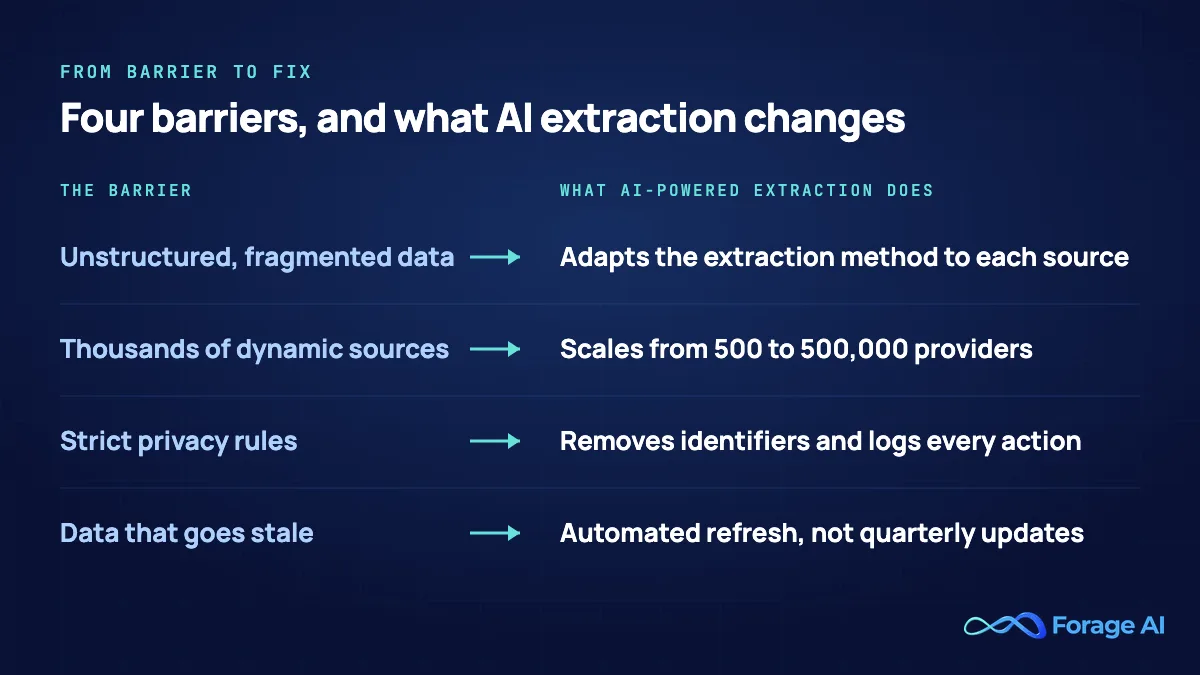
- What gets in the way: Unstructured and fragmented records, thousands of dynamic sources, strict privacy regulation, and data that goes stale quickly.
- What AI changes: Extraction adapts to each source, scales from 500 providers to 500,000 without more manual work, removes identifiers, and refreshes data automatically.
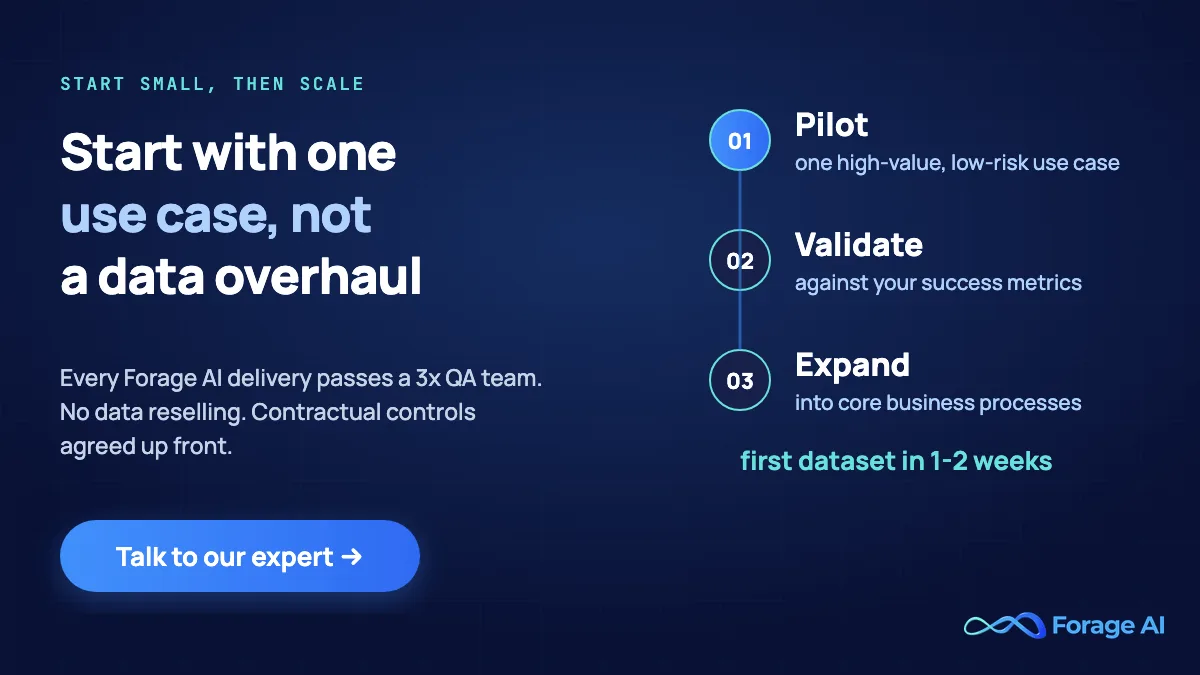
- How to start: Assess your sources and use cases, standardize data models and governance, then pilot a high-value, low-risk use case before expanding.
Why Does Healthcare Data Matter More Than Ever?
Every operational, clinical, and financial decision in healthcare relies on data, but only when that data is accurate, validated, and accessible. Modern healthcare organizations manage multiple data categories, each requiring specialized healthcare data pipelines and effective healthcare data management:
- Patient Data: Includes information collected through Electronic Health Records (EHRs), clinical notes, test results, and diagnoses, which are crucial for patient care.
- Provider Data: Information about healthcare professionals, such as their specialties, qualifications, experience, locations, and even aspects like disciplinary actions or complaint records, is vital for organizations looking to engage the right experts.
- Clinical Data: Insights from medical imaging, lab results, and clinical trials that inform diagnoses, treatments, and research.
- Operational Data: Information regarding hospital systems, inventory management, staff, and financial records that helps organizations run efficiently.
- Public Health Data: Data from government agencies and health organizations, which provides insights into public health trends, disease outbreaks, and more.
Despite the sheer volume of data available, healthcare teams still struggle to answer practical, high-impact questions like:
- Which licensed cardiologists were newly onboarded across our network in the past 30 days?
- Which regions lack adequate specialist coverage relative to patient demand?
This disconnect isn’t caused by a lack of data, it stems from fragmented systems, unstructured records, and limited visibility across sources. The result is missed insights, delayed decisions, and lost opportunities to improve care delivery, workforce planning, and operational efficiency.
Understanding why this gap persists requires a closer look at the structural, technical, and organizational barriers that prevent healthcare organizations from fully using the data they already have.
What Stops Healthcare From Using Its Data?
Healthcare data extraction is often seen as a complicated, time-consuming task, and for good reason. The challenges faced by healthcare organizations in utilizing their data are substantial:
1. Unstructured and Fragmented Data
Healthcare data arrives in dozens of formats: PDFs, scans, spreadsheets, portals, EHR notes, and public listings, none of which follow a shared structure. Medical records, clinical notes, and provider profiles are typically stored across multiple platforms with no standard structure. Digitizing clinical documents into a consistent, machine-readable form is the first step before any of this fragmented data can be consolidated, analyzed, and turned into insights.
2. Scalability and Complexity
Unlike other industries, where data extraction might involve pulling information from 50 or 100 sources, healthcare data comes from thousands of diverse and dynamic sources. Websites, hospital portals, provider directories, and clinical notes each follow different formats and structures, requiring customized extraction methods for each source. Extracting from a few sources is manageable; extracting from thousands of dynamic sources requires automation and intelligence.
3. Regulatory Compliance
In healthcare, compliance with regulations such as HIPAA (Health Insurance Portability and Accountability Act) is a non-negotiable requirement. Organizations must take extra precautions to ensure that any extracted data is de-identified and handled in accordance with strict data privacy laws. Failure to comply can lead to severe penalties and reputational damage.
4. Data Freshness and Accuracy
Healthcare data is dynamic and needs to be kept up-to-date regularly. However, the process of keeping data fresh and accurate can be resource-intensive. Healthcare organizations often struggle to update their data quickly, leading to outdated information that could impact decision-making and patient care.
Expert Insights
Provider directories show how slowly data errors get fixed. In a 2024 Health Affairs Scholar study, researchers Simon F. Haeder and Jane M. Zhu re-surveyed 5,170 Pennsylvania providers whose directory listings had been flagged as inaccurate, 117 to 280 days after the first survey. Only 11.6% were listed accurately at follow-up and 44.8% still showed at least one inaccuracy. If your team relies on directory data, set your own refresh cycle instead of trusting the source to update.
These challenges would be overwhelming with traditional methods, but AI changes what’s possible at scale.
Leveraging AI-Powered Data Extraction for Healthcare
In recent years, AI-powered extraction has brought consistency to a system where every source looks different, behaves differently, and changes frequently. These advanced solutions are designed to address the various challenges mentioned above and offer significant benefits to organizations looking to harness the power of their healthcare data.
Expert Insights
Clinicians are adopting AI quickly, which raises the bar for the data underneath it. An American Medical Association survey of nearly 1,200 physicians found that 66% used health care AI in 2024, up from 38% in 2023. "The AMA survey illustrates that physicians are increasingly intrigued by the assistive role of health AI and the potential of AI-enable tools to reduce administrative burdens, enhance diagnostic accuracy, and personalize treatments," said Jesse M. Ehrenfeld, MD, MPH, Immediate Past President of the AMA (AMA, 2025). Those tools are only as reliable as the provider, clinical, and operational data fed into them.
1. Intelligent Data Extraction from Diverse Sources
AI-powered data extraction platforms are capable of automatically determining the best extraction method for each type of data source. Whether the data comes from directories, EHR notes, or independent clinic sites, AI adapts to each structure automatically. This adaptability allows organizations to efficiently extract and integrate data from a wide range of sources, regardless of the source’s structure or complexity.
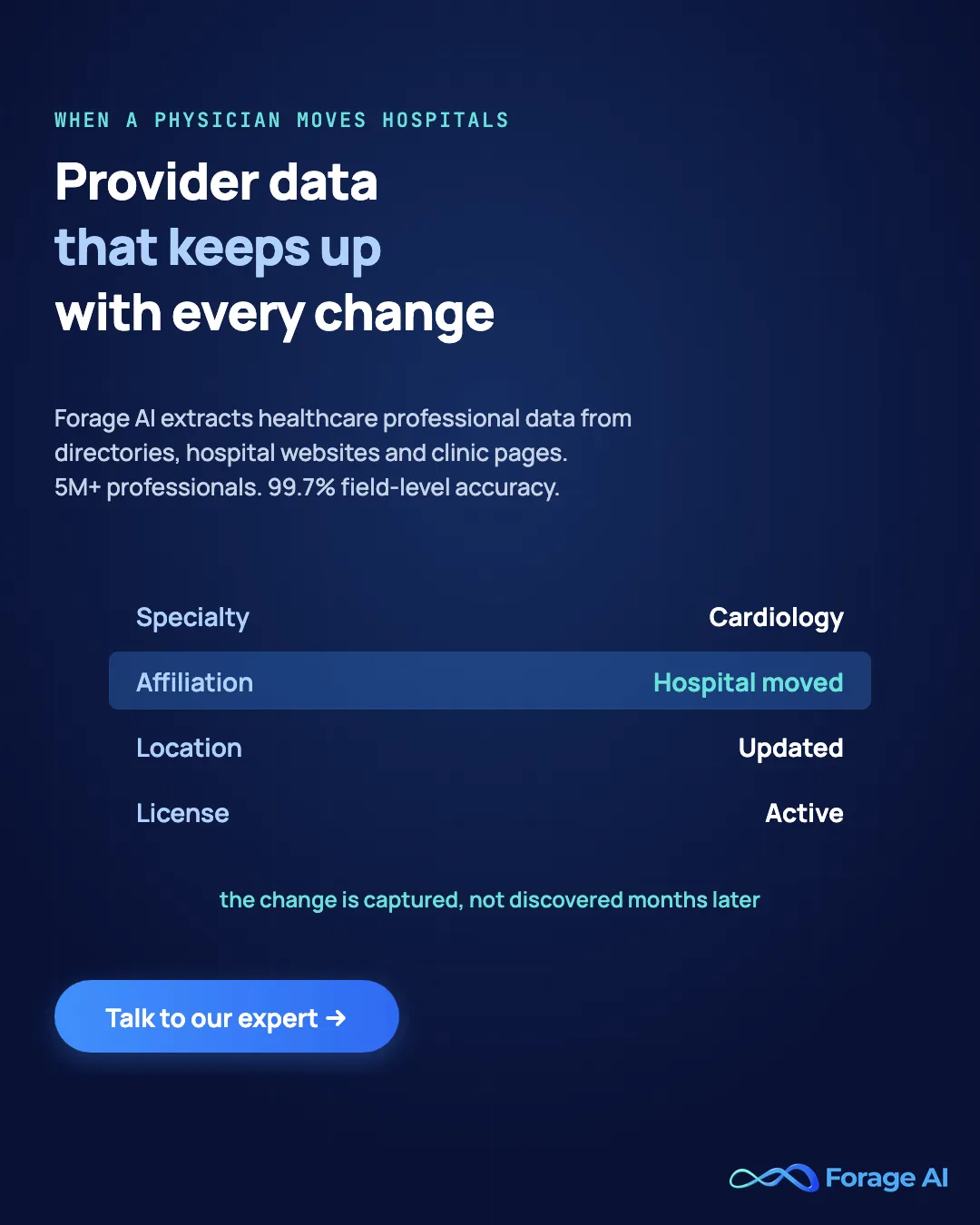
For example, when a physician updates their specialty or moves hospitals, AI detects and records the change within hours, preventing months of stale data.
2. Scalable Data Extraction
One of the most significant challenges in healthcare data extraction is scalability. As healthcare organizations expand their data needs, the complexity and costs of managing data extraction grow. Traditional methods often fail to scale without adding substantial resources and costs.
AI systems scale automatically, whether you’re tracking 500 providers or 500,000, without increasing manual workload. For instance, a platform can process millions of healthcare provider profiles monthly, ensuring that data extraction operations can grow with the business. With intelligent automation, these platforms can reduce manual intervention, streamline data integration, and lower the costs associated with scaling.
3. Ensuring Regulatory Compliance
Well-built extraction systems are designed to support HIPAA obligations from the start, automatically removing identifiers and storing audit logs for every action. AI technologies ensure that all sensitive data, such as patient health information (PHI), is automatically de-identified, reducing the risk of privacy violations. Moreover, AI systems maintain compliance automatically by removing identifiers, logging every action, and validating data before it enters your system.
4. Improved Data Freshness and Accuracy
Since provider affiliations, specialties, and locations change constantly, healthcare organizations need automated refresh cycles, not quarterly or annual updates. AI-powered extraction systems can provide real-time data updates, ensuring that healthcare professionals and decision-makers always have access to the most current information. By automating the data refresh process, these systems also minimize human error and ensure data accuracy across large datasets.
Once healthcare data becomes structured, accurate, and continuously refreshed, the business impact becomes impossible to ignore.
Why Healthcare Data Is Critical for Business
Healthcare generates vast amounts of data: from electronic health records (EHRs) to claims, medical devices, and clinical notes. But without proper handling, much of this data remains untapped. Here’s why healthcare data should be central to your strategy:
- Better Decision-Making & Efficiency: Data-driven insights help optimize operations, staffing, and resource allocation, leading to cost savings and better care delivery. This is where healthcare data analytics on external sources turns raw records into decisions leaders can act on.
- Improved Patient Outcomes: By integrating data from various sources, you can tailor treatments, predict risks, and improve overall patient care.
- Revenue Optimization: Proper data extraction helps eliminate inefficiencies like billing errors, claim denials, and under-reimbursements through automated claims processing, boosting your bottom line.
- New Business Models: With the right data, you can explore value-based care, remote patient monitoring, and digital health solutions that open up new revenue streams.
- Compliance & Risk Management: Accurate data reduces compliance failures, claim disputes, and credentialing errors.
- Enhanced Expert & Client Targeting: Identify and engage the most relevant experts and clients, allowing for more precise matchmaking and optimized relationship-building across your network.
- Reputation & Risk Assessment: Complaint histories, disciplinary actions, and malpractice filings help organizations make informed decisions when engaging healthcare professionals. These insights play a crucial role in legal document processing, insurance, credentialing, and risk management processes.
However, unlocking this value isn’t just about technology; it requires a thoughtful implementation strategy.
How Should You Plan an AI-Powered Healthcare Data Program?
Implementing AI-powered data solutions in healthcare requires a strategic approach:
Assessment and Planning
Successful implementations begin with a thorough assessment:
- Inventory of existing data sources and systems
- Identification of high-value use cases
- Evaluation of compliance requirements
- Development of clear success metrics
Data Integration and Preparation
Effective AI implementation requires robust data preparation:
- Development of standardized data models
- Implementation of data quality improvement processes
- Creation of secure data integration pipelines
- Establishment of governance frameworks
Phased Implementation Approach
Successful healthcare organizations typically follow a phased approach:
- Pilot projects focused on high-value, low-risk use cases
- Validation against established success metrics
- Iterative expansion to additional use cases
- Integration into core business processes
The Business Impact of AI-Powered Healthcare Data
AI-driven data pipelines are already reshaping hospital operations, payer networks, compliance workflows, and provider management. By leveraging AI to streamline financial operations, enhance resource allocation, and improve compliance, healthcare organizations are achieving substantial improvements in both their bottom lines and operational efficiencies.
Use Case: Expanding Services for an Expert Witness Leader
To illustrate the impact of AI-powered data extraction, let’s see a case where Forage AI helped an expert witness company use healthcare data to grow its business.
The Challenge
The client, a prominent expert witness service provider, wanted to expand their offerings by identifying the right specialists to recommend to their clients in various legal cases. They needed a comprehensive, accurate database of healthcare professionals that included detailed information about their specialties, experience, and connections with other professionals and clients.
However, the client faced challenges in obtaining and organizing this data. The information they needed was scattered across different sources, medical directories, hospital websites, independent clinics, and more, each with varying formats and standards.
The Solution
Through fully managed AI-powered data extraction, the client was able to:
- Build a comprehensive database of healthcare professionals, including key details like specialties, qualifications, experience, and client relationships.
- Ensure the data is regularly updated to reflect the latest information, keeping the database accurate and reliable.
- Integrate and organize the data from multiple sources into a single structured dataset delivered into their systems.
The result was a robust database that enabled the expert witness company to match the right specialists with the ri
ght cases, significantly enhancing their service offerings.
The Impact
With the ready-to-use datasets, the client expanded its business by offering more tailored, precise specialist recommendations. This enabled faster expert identification, expansion of new services, higher client satisfaction, and a significant competitive advantage.
This is just one example of what becomes possible when organizations treat data as core infrastructure rather than a by-product.
Conclusion: The Future of AI-Powered Healthcare Data
The organizations that win this decade will be the ones that treat data not as a by-product of operations, but as a core business asset powered by AI. By addressing the unique challenges of healthcare data: volume, complexity, fragmentation, and compliance requirements, AI technologies are unlocking unprecedented value from information assets that have long been underutilized.
As AI technologies continue to evolve, organizations that develop robust strategies for data extraction, analysis, and insight generation will gain significant competitive advantages. The future belongs to those who can effectively harness the power of professional data with AI, transforming information into insights that drive growth, improve patient outcomes, and optimize operations.
With Forage AI’s fully managed AI-powered healthcare data extraction services, companies can streamline data processing, automate key workflows, and uncover hidden opportunities within healthcare professional data. Forage AI’s state-of-the-art pipeline enables seamless integration and real-time processing of both structured and unstructured data, ensuring organizations can stay ahead in a rapidly evolving market. Through intelligent automation and advanced natural language processing (NLP) capabilities, we empower businesses to generate meaningful insights from vast datasets, enhance decision-making, and optimize operations.
If you want high-quality, reliable provider data, faster insights, and scalable compliance, a tailored AI assessment is the fastest way to begin. Discover how Forage AI’s advanced healthcare data extraction solutions streamline your processes. Schedule a personalized assessment to explore data opportunities and implementation timelines tailored to your needs.
By Krittika Arora