
Document Digitization: How Enterprises Convert Physical Records to Searchable Data
The IT director walks into the procurement meeting carrying three months of audit-prep panic. The state regulator is asking for 14 years of policyholder correspondence, half of it on paper in an off-site facility, the other half scanned years ago into a folder structure nobody remembers maintaining. The board wants a number by Friday: how fast can the firm go from 40,000 cubic feet of physical records to a queryable, audit-defensible digital archive?
This is what document digitization is supposed to fix. The promise sounds clean: scan the paper, run OCR, extract the structured fields, drop everything into the document management system, and search for anything in seconds. The promise is also where most enterprise digitization projects quietly fail. Not because the scanners don’t scan, but because the QA layer is a black box, the accuracy looks fine in the demo, and the customer-facing bug surfaces 3 months later when a regulator asks about a field that was mis-extracted in 1.8% of records.
This guide is for the Head of Data Ops at a regulated enterprise (healthcare, legal, finance, insurance) who has tried basic scanning and OCR, hit accuracy and volume walls, and now has to defend a digitization budget to the CFO or COO. We will cover what document digitization actually is in 2026, the full physical-to-searchable pipeline, the QA black-box failure mode that breaks most projects after the demo, the four accuracy regimes hidden inside every real archive, the hybrid HDR-OCR plus ML plus human-review architecture that survives them, the audit-grade lineage regulated industries require, the ROI math for the CFO, and the eight evaluation criteria that separate digitization partners who hold up from those who demo well.
Quick Digest
- Document digitization is a five-stage pipeline, not a scan-then-OCR step. Capture, OCR, IDP extraction, validation, and system delivery each have distinct failure modes. The QA layer at stage four is where most projects fail.
- The market is real and big. Document digitization sits at ~$50B in 2025, projected to ~$150B by 2033 at a 15% CAGR. 63% of Fortune 250 companies have implemented IDP, with the financial sector leading at 71%.
- The QA black box is the differentiator. Demo accuracy looks fine. The 2% mis-extracted rows are hidden within the document-level average. The customer-facing bug arrives months later inside a regulator-driven export.
- Real archives contain four accuracy regimes, not one: clean born-digital PDF (98 to 99.85%), clean scan (95 to 98%), low-res or older scan (85 to 94% with HDR-OCR), and handwriting or degraded archive (60 to 85% raw, close to 95%+ with human-in-the-loop review).
- The hybrid architecture is the only defensible one. HDR-OCR plus ML extraction per document family, plus rule validation, plus human-in-the-loop QA, plus DMS write-back. No single layer carries the accuracy on its own.
What is document digitization in 2026?
A working definition. Document digitization is the end-to-end process of converting physical records into structured, searchable, audit-defensible digital data. It is not scanning. It is not OCR. It is the full pipeline that starts with a physical document and ends with a structured row inside a document management system or a data warehouse, with audit-grade lineage attached to every extracted value.
Most teams come into this work having tried basic scanning or off-the-shelf OCR and discovered the same wall: the scans are fine, and the data is still wrong. The scanner did its job. The OCR engine returned characters. But the policy number on the legacy form is now sitting in the wrong field, the table on page 47 of the multi-policy archive imported as a string of comma-separated values, and the handwritten patient notes in the medical records archive are unreadable in the way that matters most: structurally. Document digitization in 2026 is the discipline that closes those gaps. Readers new to the underlying technology will get a faster orientation from our OCR vs IDP comparison; this guide assumes you already know why plain OCR is not enough.
The 2026 environment makes the work both more valuable and more demanding in three structural ways. Regulatory mandates have moved past discretion. Healthcare, finance, insurance, and legal teams now face explicit requirements that historical records be searchable, auditable, and digital within defined timelines. AI projects need historical data. Every enterprise model-training or RAG project has uncovered the same gap: the most valuable training data sits inside paper archives that nobody has fully digitized. The cost of doing nothing has compounded. Physical storage costs have risen to $9 to $13 per square foot annually, and the staff time spent retrieving and refilling records is no longer a hidden line item.
The full physical-to-searchable pipeline
Most digitization content stops at “scan the paper, run OCR, you are done.” That is the first 40% of the actual pipeline, and the easy 40%. The full pipeline runs five stages, and the failure surface widens as you move downstream.
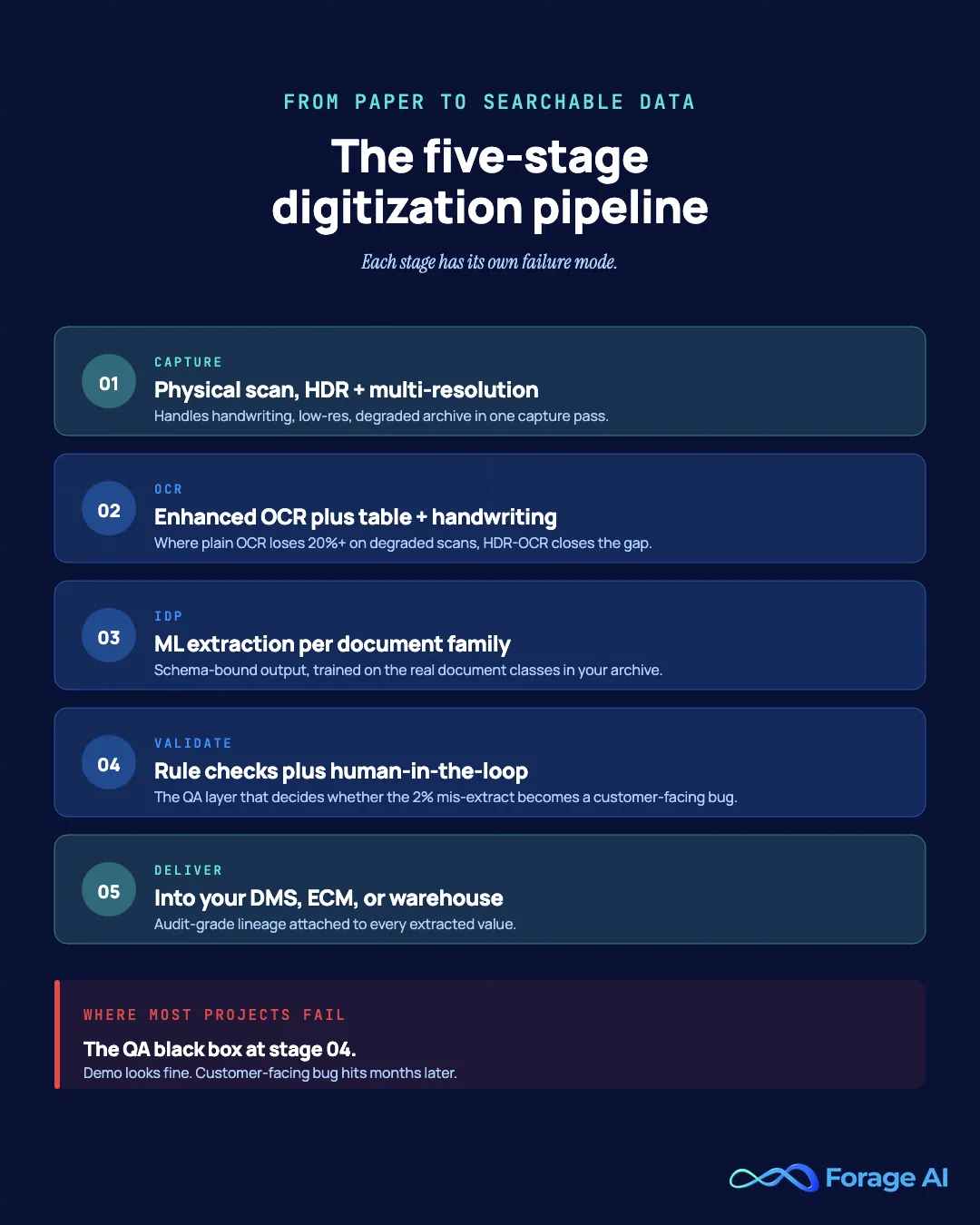
- Capture. Physical scan into an image format. Modern HDR multi-resolution scanning handles handwriting, low-res originals, and degraded archives in a single capture pass. Older single-resolution scanners produce images that downstream stages cannot recover from.
- OCR. Convert image pixels into machine-readable characters. Enhanced OCR with handwriting recognition, table detection, and signature or stamp recognition closes the gap on degraded scans. Plain OCR loses 20%+ accuracy here on real legacy documents.
- IDP extraction. Machine learning models trained per document family extract structured fields from OCR text. This is where “clause 4.2 lives at coordinates (x, y) on page 12 and contains the indemnification value” stops being a paragraph of text and starts being a row in a database.
- Validation. Rule-based checks against the schema (jurisdiction, dates, party names, numeric ranges, cross-references between fields), with human-in-the-loop review on exceptions. This is the QA layer where most digitization projects either earn their accuracy claim or quietly fail to do so.
- System delivery. Write back into your document management system, enterprise content management platform, or data warehouse, with full audit-grade lineage attached to every extracted value. For the orchestration layer that sits around all five stages, see our document workflow automation guide.
Each stage has its own failure mode. Most vendors are great at one or two stages. The full pipeline is what produces audit-defensible output, and missing any single stage shows up downstream as either a customer-facing bug or a regulator-driven rework.
Which QA gap breaks digitization projects after the demo?
This is the section most vendor pitches skip, and the one enterprise digitization audits keep flagging. The QA black box is where the demo and production diverge. A vendor demos 99% accuracy on a sample, the proof-of-concept passes, the rollout begins, and three months later, a customer-facing system surfaces a wrong field, a regulator asks for an export that exposes mis-extracted rows, or a downstream AI model trained on the archive produces confidently wrong outputs because the training data was structurally noisy.
The failure pattern is consistent. 2% of fields are mis-extracted. The demo sample, often hand-picked, does not contain that 2%. The full archive does. The vendor’s confidence score is averaged at the document level, so the 2% bad rows are included in the same average as the 98% clean rows. The team accepts the rollout. The bad rows propagate into downstream systems. The customer-facing bug surfaces at exactly the worst possible moment.
Expert Insights
The downstream cost of a small extraction error is now measurable. Junyuan Zhang and colleagues built OHRBench, released in December 2024, to test what OCR noise does to retrieval-augmented generation, and reported that a comprehensive evaluation of current OCR solutions "reveal that none is competent for constructing high-quality knowledge bases for RAG systems". A 2% field error rate is not a rounding error once the archive is feeding search and models.
The root cause is not the OCR engine. It is the absence of field-level lineage and the absence of a human-in-the-loop review on the long tail. Most digitization SaaS products produce a confidence score and a log file. Neither tells you which span on which page produced the extracted value. Neither retains a tamper-evident history of what a human reviewer changed and when. The 2% bad rows are mathematically invisible until they cause damage.
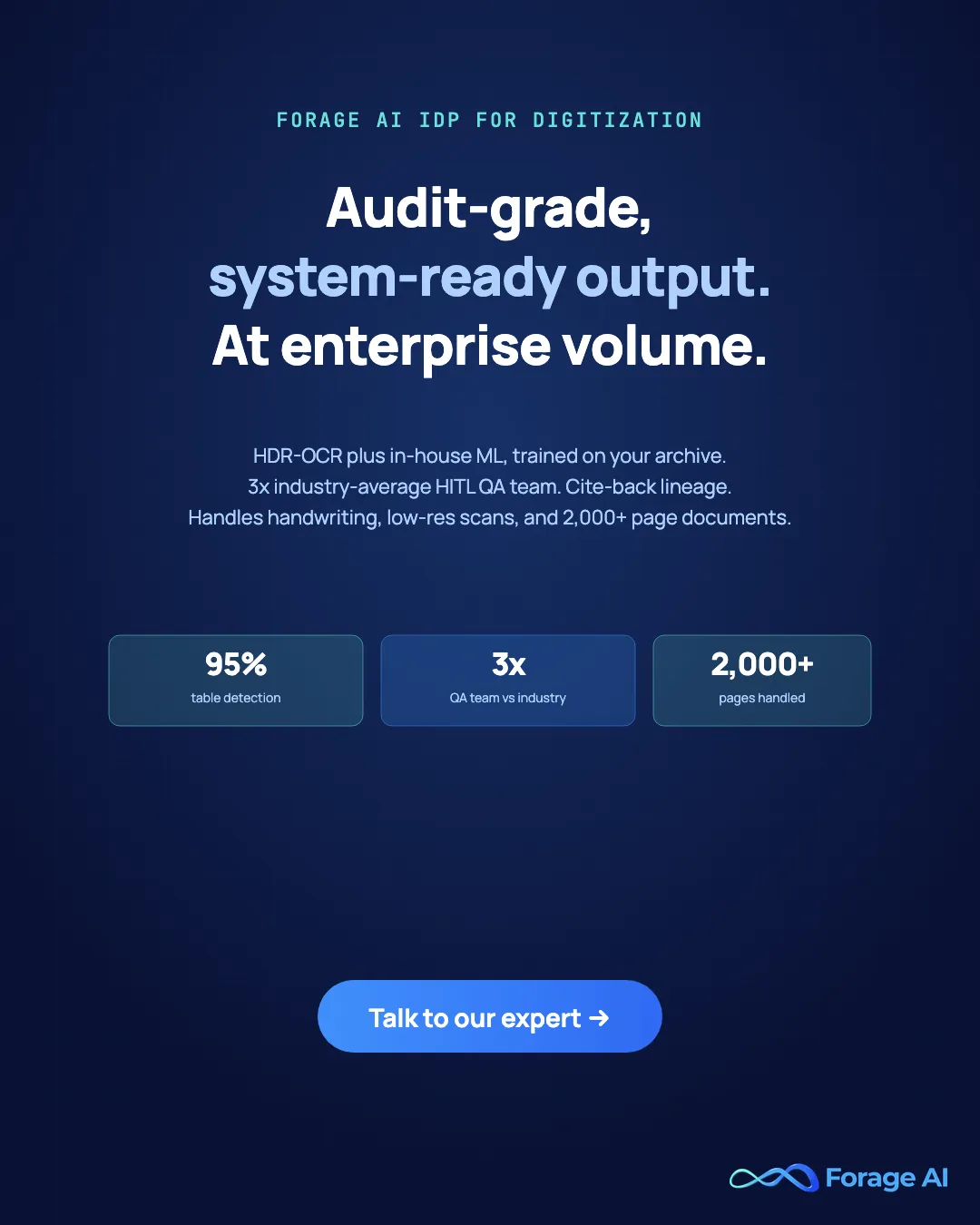
The defensible answer is structural, not cosmetic. Cite-back lineage per field ties every extracted value to its document, page, bounding box, and the specific extraction model version that produced it. Human-in-the-loop QA on every exception, not just on a sample, catches the long-tail variance that rules and models cannot specify. Forage AI runs this with a QA team sized at three times the industry average relative to delivery, because the cost of catching the 2% downstream is multiples higher than the cost of catching it at intake.
The four accuracy regimes hidden inside every real archive
A vendor reporting “98% accuracy” on a single number is hiding the structural reality that real enterprise archives contain four very different accuracy regimes, and a single vendor model is unlikely to perform equally well across all four. The four regimes drive the architecture decision more than any other variable.
- Clean born-digital PDF, the easiest regime. Structured, consistent formats: modern invoices, born-digital filings, current contracts. The accuracy ceiling is 98-99.85% for consistent formats. Most vendor demos run here.
- Clean scan, well-lit, printed documents. Recent contracts, current archives, modern scanner output. Accuracy ranges from 95 to 98%. Achievable with most modern OCR stacks. Still misses tables, multi-column layouts, and footnotes if extraction is OCR-only without IDP.
- Low-resolution or older scan. Legacy filings, faxed forms, photocopies of photocopies. Accuracy drops to 85-94% with HDR-OCR, and even lower with vanilla OCR. This is the regime where the vendor demo and your archive diverge.
- Handwriting or degraded archive. Doctor notes, historical insurance forms with handwritten annotations, and archived loan files with margin notes. Raw accuracy ranges from 60% to 85%. A human-in-the-loop review of exceptions brings this to 95%+. Pure-ML stacks without HITL plateau here.
Your archive is some mix of all four regimes. A vendor demoing 99% on a clean PDF is structurally hiding regimes three and four. The right operational question is not “what is your accuracy?” but “what is your accuracy on each of the four regimes, separately, on documents from our archive specifically?” This regime split is exactly why insurance carriers building automated claims processing pipelines cannot rely on a single global accuracy number: a claim file mixes born-digital ACORD forms, scanned adjuster reports, and handwritten loss notes inside a single matter.
The number that lands hardest in an enterprise digitization evaluation is the regime-four accuracy after HITL closure. Vendors that can name a number (95%+ with HITL, 70-80% without) and back it with a real sample have a defensible operating model. Vendors that quote a single global accuracy number rarely do.
The hybrid model: HDR-OCR + ML + human-in-the-loop QA
The architecture that survives all four accuracy regimes is hybrid by design. No single technology layer provides accuracy on its own; each layer addresses a different failure mode. This is the only architecture we have seen survive the enterprise-scale digitization of regulated archives.
HDR-OCR with handwriting and table detection handles the capture and first-pass extraction across all four regimes. It is the lower bound of the stack, and the layer most vendors implement reasonably well. Machine learning extraction per document family reads clause-level and table-level content using models trained on the document classes that actually exist in your archive, not generic models trained on public data. Rule-based validation catches the cases where the ML is confidently wrong: a date in the future where the schema expects a historical record, a party name that does not match the matter index, a numeric field outside the valid range. Human-in-the-loop review handles the long tail of edge cases that no rule set can specify: the handwritten margin note, the unusual policy endorsement, the post-merger document that mixes both companies’ templates. Finally, delivery writes the validated structured record into the DMS or ECM, with audit-grade lineage attached to every value.
The reason hybrid wins is not that any layer is unusually strong. It is that the layers cover each other’s failure modes. ML catches what templates miss. Rules catch what ML hallucinates. Humans catch what rules cannot specify. And the human corrections compound back into the next quarter’s model. Single-model stacks have to be perfect on day one and degrade from there. Hybrid stacks accumulate institutional memory from every reviewer’s correction. For the deep dive into the underlying table-extraction technique, see our work on IDP table extraction at scale.
Forage AI has built this model using 10+ million parsed documents across financial, legal, and healthcare workflows. The QA team is sized at roughly three times the industry average relative to delivery. The architecture supports handwriting, low-resolution scans, and 2,000+ page documents within a single delivery contract. Legal teams running this stack against MSAs, NDAs, and vendor agreements see the same pattern documented in our guide to automated contract extraction: ML per document family, rule validation against the clause schema, and HITL on the exception tail.
The compounding effect of the human-review layer is the asset most enterprise teams undervalue. After 12 months on a single archive, the reviewer corrections have seen every edge case three times, and the per-document family model is materially more accurate than it was at go-live. Stacks without a human layer never accumulate this asset.
Audit-grade lineage for regulated industries
Regulated industries are judged twice on every digitized record: once at intake (does the structured value match the source document?) and once during an audit (can you prove where it came from?). The second judgment is unforgiving. The answer “the IDP extracted it” does not survive an FDA inspection, an OCC examination, or a state insurance regulator’s audit. This is why AI-powered document processing earns its keep in the most heavily regulated settings, healthcare among them, only when the extraction is built to be defended record by record.
The cite-back spec is three layers deep. Page-level anchor ties every extracted value to a document ID, a page number, and bounding-box coordinates. A compliance officer can reopen the source span in one click. Model and version lineage records, which extraction model version, which rule set, and which validation outcome produced the value. Human-review log records the reviewer ID, timestamp, what changed, what was confirmed, and what was overridden. The whole chain is tamper-evident.
Expert Insights
The U.S. National Archives and Records Administration wrote that documentation burden into regulation. Under 36 CFR 1236.44, effective 5 June 2023, "Agencies must create digital documentation when digitizing permanent source records", and the agency must retain it alongside the digitized records until the transfer is accepted. Separate sections of the same subpart cover quality management, metadata and validating digitized records, which is the same three-layer shape described above.
The operational test is simple. Pick any closed batch from six months ago. Try to reconstruct, in 60 seconds, the source span for the three most decision-relevant extracted values in that batch. If you cannot, the system lacks an audit trail. It has a logfile. The distinction matters at exactly the worst possible time: the audit-prep deadline.
The ROI case for the CFO and the COO
Heads of Data Ops do not get the budget approved for accuracy charts. The CFO and COO buy into storage cost reduction, audit-prep efficiency, compliance penalty avoidance, and AI-readiness unlock. Each one has a real dollar number behind it.
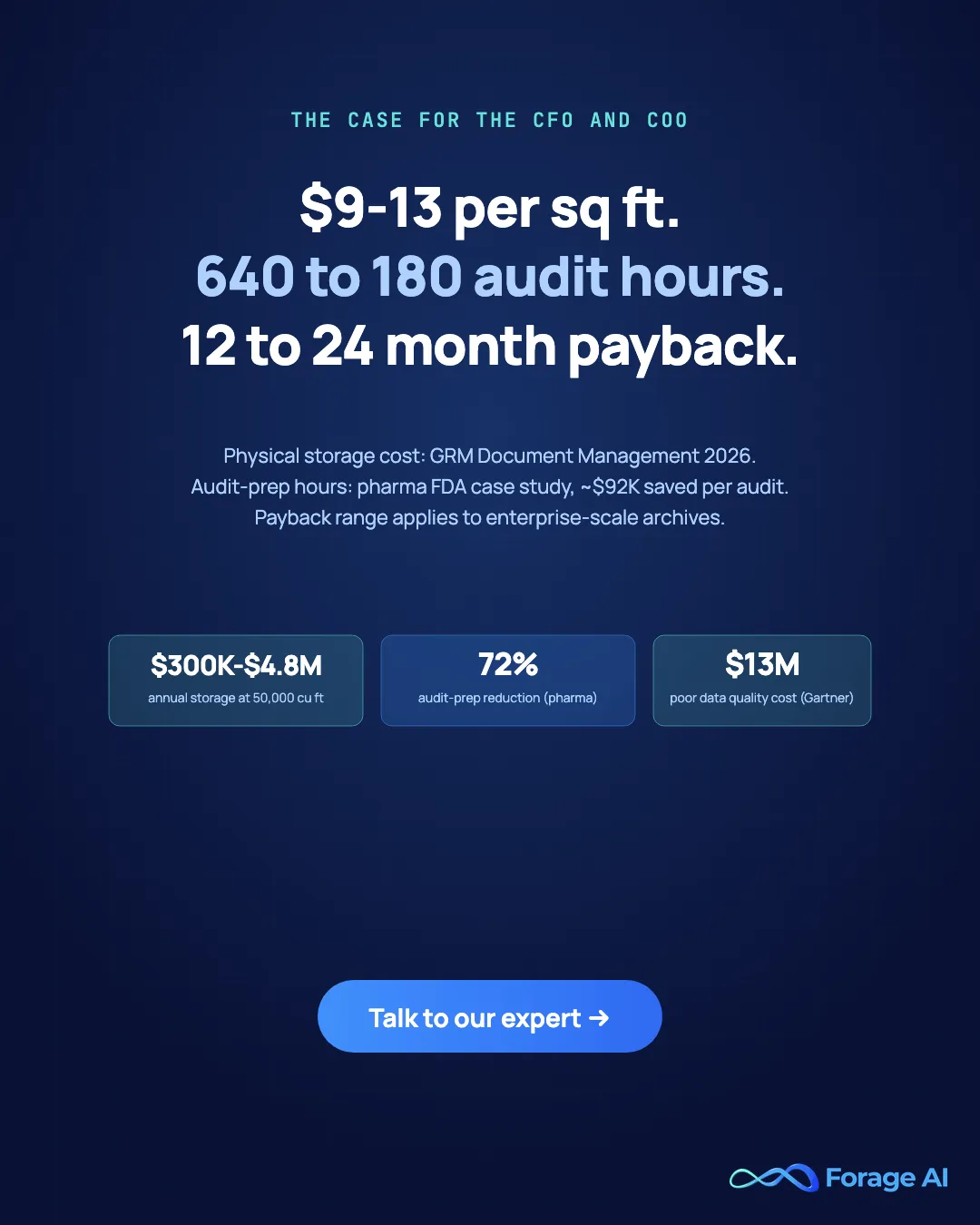
Physical storage costs $9 to $13 per square foot annually, not counting off-site retrieval fees and staff time spent locating and refilling records. For a typical regulated enterprise maintaining 50,000 cubic feet of compliance records, this is $300,000 to $4.8 million per year, depending on the facility type. Digitization removes this line item over the program’s runway.
Audit-prep hours are the line that lands hardest in a CFO conversation. A pharmaceutical company case study reports that FDA audit preparation time dropped from 640 staff hours to 180 hours, a 72% reduction that represents approximately $92,000 in savings per audit cycle. For an enterprise running multiple audit cycles per year across multiple regulatory bodies, this scales fast.
Compliance penalty avoidance is the line nobody wants to put a number on until it has already cost them. Gartner estimates that poor data quality, often a byproduct of manual paper-based workflows, costs organizations roughly $13 million annually. Most of that cost surfaces during audits, regulatory inquiries, or downstream system errors that propagate from misextracted source documents.
AI-readiness is the newest line on the CFO model, and the one teams are increasingly using to close the case. Every enterprise model-training, RAG, or AI-agent project surfaces the same insight: the most valuable training data sits inside paper archives that have not been digitized. Until they are, those projects either skip them entirely or train on synthetic substitutes. Digitization unlocks the historical corpus. The enterprises pulling ahead are the ones turning document processing into competitive advantage rather than treating it as a back-office cost line.
Typical payback runs 12 to 24 months for enterprise programs at the volumes regulated industries care about. The opener in the CFO conversation is not cost. It is the avoidable cost of the next audit cycle, the next AI project that cannot find its training data, and the next regulator inquiry that demands a record nobody can find.
Which eight questions should you ask a digitization partner?
When the field of vendors narrows and the evaluation moves into procurement, these criteria separate digitization partners who hold up at enterprise volume from partners who demo well on hand-picked samples.
| Criterion | What to ask | Red flag |
|---|---|---|
| Table-detection accuracy | Named percentage on real legacy formats from your archive. | “We are great at tables” with no number |
| Handwriting + low-res accuracy | Named the QA team size relative to the delivery team. Not “AI-powered QA.” | Single global accuracy number |
| Volume ceiling | Separate from the clean-document baseline. Score regime 03 and 04 on real samples. | Pilot-scale capability only |
| HITL QA ratio | “Generic REST API, you build it.” | No human review layer at all |
| Cite-back audit trail | Page, span, model version, reviewer ID. Reconstruct any closed batch in 60 seconds. | Logs only, no chain of custody |
| DMS / ECM integration | Named systems (iManage, NetDocuments, SharePoint, OpenText, Box, Documentum). | “Generic REST API, you build it” |
| Data ownership | Client owns extracted data, no resale, on-prem option for sensitive archives. | Vague answers on data handling |
| Indemnification | If a mis-extraction triggers a regulatory fine downstream, who pays? | Boilerplate carve-outs, silence |
The criteria are uneven on purpose. Audit-trail granularity and HITL QA ratio outweigh integration in importance for regulated industries. A vendor that integrates fast but fails the audit-trail test will cost the enterprise more in compliance findings than the integration ever saved.
How Forage AI approaches enterprise document digitization
Forage AI is not a scanning service, a DMS, or an off-the-shelf SaaS portal. We act as the managed extraction layer that turns the physical-to-searchable pipeline into a structured-data deliverable. Counsel, compliance, and the AI team consume the output. We run the work.
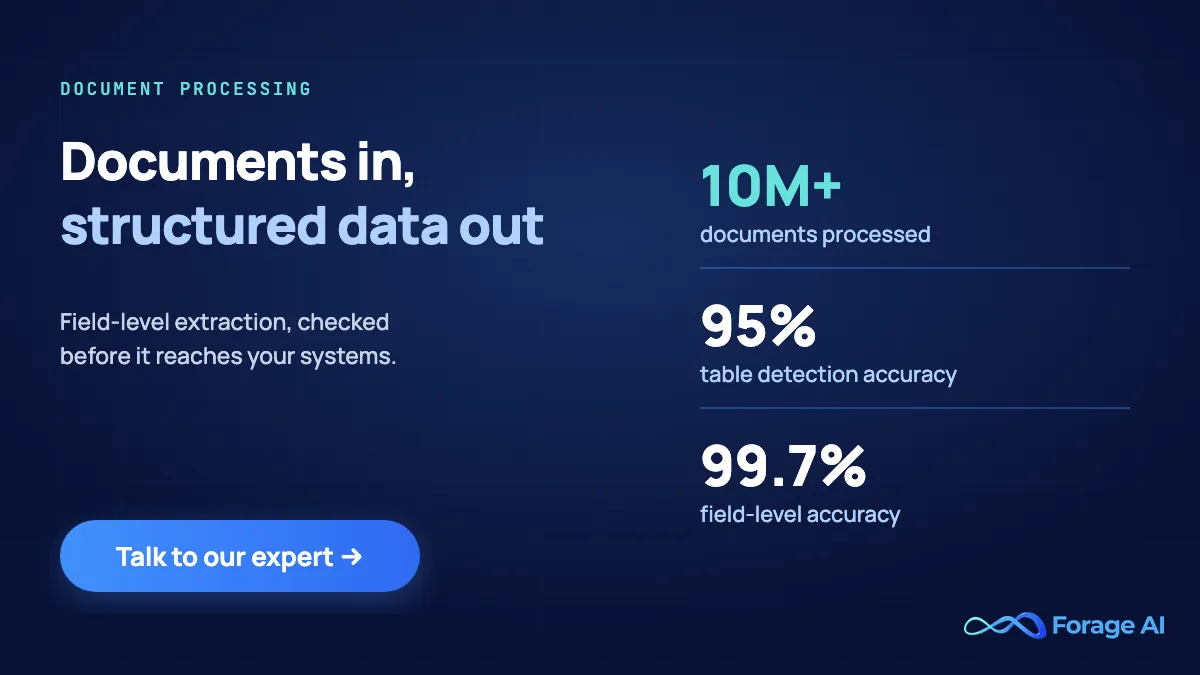
Our approach combines HDR-OCR with handwriting and table detection, in-house ML models trained per document family in the archive, rule-based validation against schema, and a 3x industry-average HITL QA team. We have parsed more than 10 million documents across financial, legal, and healthcare workflows. The architecture handles the four accuracy regimes (clean PDF, clean scan, low-res, handwriting, and degraded archive) within a single delivery contract and produces cite-back lineage for every extracted value.
Concrete capability: 95% table detection on complex layouts, including multi-column, nested, and footnoted tables. 2,000+ page documents processed inside the same volume-pricing tier as 50-page documents. Audit-grade lineage attached to every value, exportable in the format the regulator expects. On-premises deployment available when the archive must remain within the enterprise’s perimeter. Contractual handling controls are not configuration options; they are how the service is built. For a worked example of the same architecture inside a vertical use case, see our invoice automation deep dive.
Onboarding typically takes one to two weeks per document family. The team is dedicated, not a ticket queue. The acquisition layer is yours. The team operating it is ours.
Frequently Asked Questions
What is the difference between scanning and document digitization?
Scanning is one of five stages in the digitization pipeline. It converts physical documents to images. Digitization is the full pipeline that includes capture, OCR, IDP extraction, human-in-the-loop validation, and system delivery. The output of scanning is an image. The output of digitization is structured, searchable, audit-defensible data inside a system of record.
How accurate is enterprise document digitization in 2026?
Honest accuracy claims are split by regime. 98 to 99.85% on clean born-digital PDFs. 95 to 98% on clean scans of printed documents. 85 to 94% on low-resolution or older scans with HDR-OCR. 60 to 85% raw on handwriting or degraded archives, close to 95%+ with human-in-the-loop review on exceptions. A vendor quoting a single global accuracy number is hiding the regime mix.
How long does enterprise digitization take?
For a single document family inside an existing archive, one to two weeks from brief to live with a competent partner. For a full multi-family archive integrated with the DMS or ECM, three to twelve months, depending on volume and complexity. Most of the timeline is dedicated to integration, schema design, and document-family coverage expansion, not to the underlying extraction technology.
Does document digitization include OCR?
Yes. OCR is one of the five stages, sitting between physical capture and IDP extraction. OCR alone is not sufficient for enterprise digitization because it produces unstructured text. The downstream stages (IDP extraction, validation, and system delivery) produce the structured, audit-defensible output.
Can we digitize handwritten and degraded archives?
Yes, but with realistic expectations for accuracy. Raw extraction of handwriting and degraded archives lands in the 60-85% range. A human-in-the-loop review of exceptions closes the gap to 95%+. Vendors who claim 98%+ raw accuracy on regime-four archives without HITL are quoting numbers that do not hold up to a real audit.
Related Articles
- AI-Powered Intelligent Document Processing Solutions 2025, broader overview of how AI-powered IDP works across regulated industries.