
Enterprise Document Processing at Scale: A Practical Guide for Operations Teams
Most document automation programs do not fail at the extraction step. They fail three months later, when volume triples and the review queue quietly becomes the whole operation.
The pilot looked fine. A few hundred invoices, a few hundred claim forms, accuracy that everyone signed off on. Then intake grows, document types multiply, one supplier changes a layout, and the team that was going to be freed up is now staffed against a backlog nobody planned for.
There are three things every team running documents at enterprise volume has to get right: the volume tier they are actually designing for, the pipeline stages they can measure, and the exception queue that decides their throughput. Get those three right and the automation rate climbs on its own. Get them wrong and you buy a faster way to produce work for people.
This guide walks the operating model end to end: what breaks at each volume tier, the seven pipeline stages, how to measure accuracy when nobody can read every document, how to design the review desk, the controls that keep the whole thing auditable, who should run it, and the metrics that tell you it is healthy.
Quick Digest
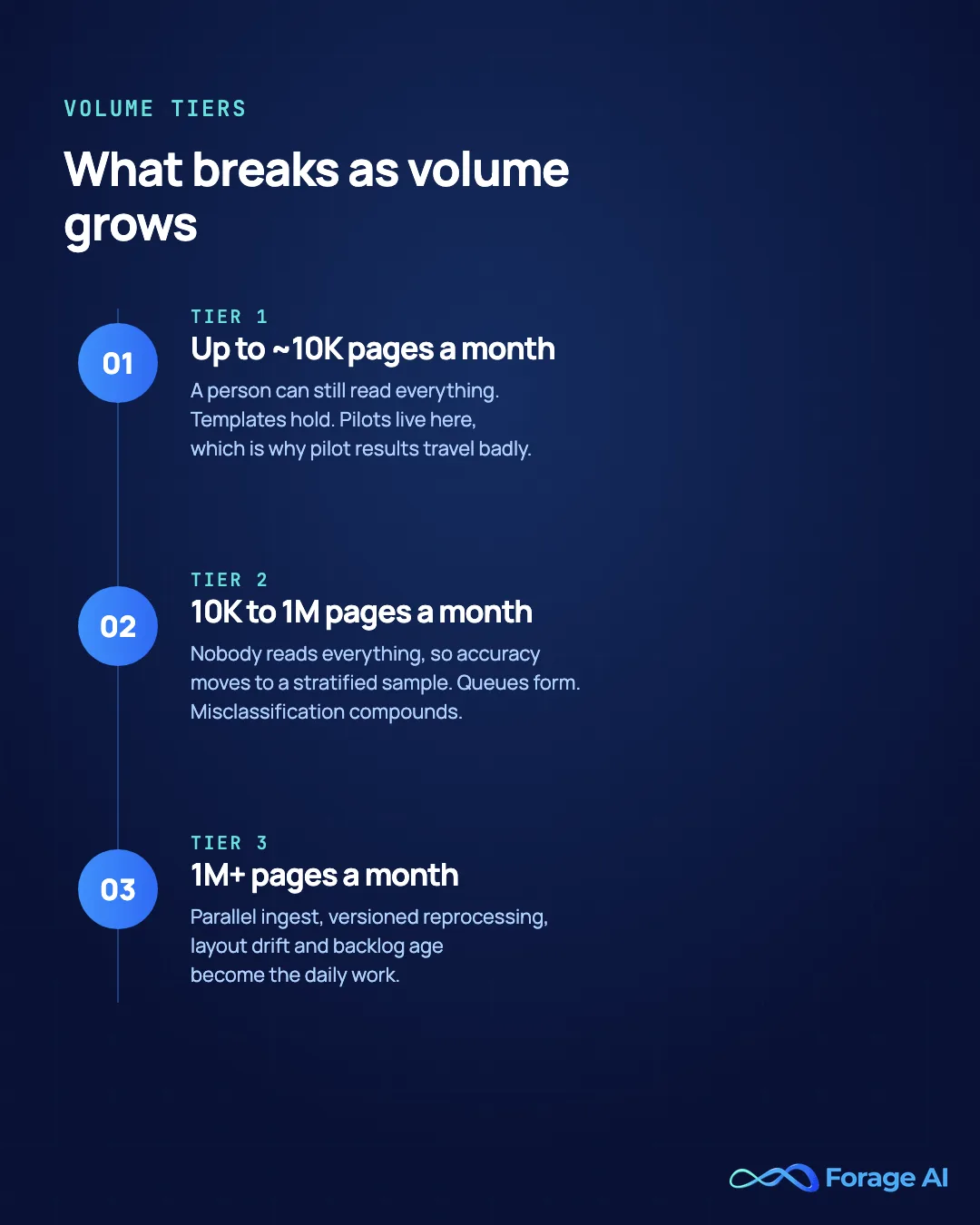
- Volume tiers: "At scale" has breakpoints. Up to roughly 10,000 pages a month, templates and full human review still work. Between 10,000 and a million, sampling and queue design take over. Past a million, reprocessing, drift and backlog age become the daily work.
- The seven-stage pipeline: Ingest and normalise, split and classify, extract, validate, route by confidence, human review, deliver and feed back. Every stage needs its own measurement, or failures surface only at delivery.
- Decomposition beats one big prompt: Asking a single model call to pull everything from a long document loses items as length and field count grow. Research on complex document pipelines found that decomposing the data and the task produced outputs 25 to 80% more accurate than well engineered single-call baselines (Shankar et al., VLDB 2025).
- Measurement: Accuracy is field-level, measured on a golden set with a stratified sample. At 99% per-field accuracy across 40 fields, only about two documents in three come out fully correct.
- The exception queue sets throughput: Above the first tier, reviewer capacity and routing thresholds, not model quality, determine how many documents clear per day.
What Changes When Document Volume Goes From Thousands to Millions of Pages?
Scale is not one condition. It arrives in tiers, and each tier breaks something the previous tier let you ignore.
In the first tier, up to roughly 10,000 pages a month, a person can still see everything. Document types are countable, layouts are stable, and a template-driven setup with full human verification holds up. Accuracy failures are visible because somebody reads every file. Most pilots live here, which is exactly why pilot results travel so badly.
The second tier, somewhere between 10,000 and a million pages a month, is where the operating model has to change. Nobody reads everything any more, so you measure on a sample instead. Classification errors start to compound, because a misrouted document is not one wrong record, it is a record that lands in the wrong validation rules entirely. Queues form. The team stops asking "is the model good" and starts asking "which documents do humans actually need to see".
Past a million pages a month, the work becomes throughput, reprocessing and drift. Ingestion runs in parallel, so ordering and duplicate detection matter. A model or prompt change means deciding whether to reprocess history and how to version what you already delivered. Layout drift at one source is no longer an anecdote, it is a measurable dip in a weekly number.
Treat those boundaries as working rules of thumb rather than industry constants. The useful part is the shape: the binding constraint moves from extraction accuracy to reviewer capacity, and then to queue and reprocessing behaviour.
Two conditions do not change with volume, and both are worth saying plainly. Paper does not disappear. In AIIM's 2025 survey of 600 enterprises across the United States, Germany, Austria and Switzerland, 61% of intelligent document processing workflows still included paper, and 48% expected paper volumes to rise. And the document mix keeps widening, which is why document digitization programs and live extraction pipelines usually end up as one operation rather than two. If you need the underlying category explained first, our comprehensive guide to intelligent document processing covers the definitions this guide assumes.
Expert Insights
The category itself is in motion, which is part of why last year's design stops fitting. AIIM's 2025 study with Deep Analysis, covering 600 enterprises, found 78% already operational with AI for document processing and 66% of new projects planning to replace an existing system rather than automate something new. "The rise of GenAI and LLMs has disrupted the market," said Tori Miller Liu, CIP, President and CEO of AIIM. Replacement, not greenfield, is the common starting position.
The Seven-Stage Pipeline Behind Document Processing at Scale
A document pipeline that survives volume has seven stages, and each one needs its own measurement. When teams skip the instrumentation, every failure shows up at the same place, which is delivery, long after it is cheap to fix.
Stage 1, ingest and normalise. Collect from every channel the operation actually uses: scanner output, email attachments, portal uploads, partner feeds. Normalise to a consistent internal format, deduplicate, and stamp each file with a source, a received time and an identifier you can trace later. Skipping identifiers here is what makes lineage impossible three stages down.
Stage 2, split and classify. Batches arrive stapled together. A 400-page scan is often forty documents. Split first, then classify each piece by type, because classification drives which extraction schema and which validation rules apply. Misclassification is the most expensive quiet error in the pipeline, since the record looks complete and lands in the wrong checks.
Stage 3, extract, by decomposition rather than one large request. This is where scale punishes the obvious design. Asking one model call to pull every field from a long document loses items as the document grows and the number of target values rises. Research from UC Berkeley on complex document pipelines, published at VLDB 2025, built the fix into the system: split the data, split the task, or refine outputs in stages. Their optimizer produced outputs 25 to 80% more accurate than well engineered baselines across four real document analysis tasks. In practice that means chunking long files with enough surrounding context to keep meaning intact, running narrow extraction calls per field group, then reconciling.
Expert Insights
The accuracy ceiling is usually a design choice, not a model limit. Shreya Shankar, the UC Berkeley researcher behind the DocETL system, describes building the naive version first in her 2025 research statement: "I implemented it and expected the main challenge at scale to be cost optimization, as in traditional databases. But accuracy was the bottleneck, even with powerful LLMs like Gemini-2.5-Pro." Her worked example is the one every operations team eventually hits: "Asking it to extract 50+ locations from a 200 page document in one call often leads to misses." The problem that drove the work was Berkeley journalists needing to analyse 1.5 million pages of public records.
Stage 4, validate against business rules. Check formats, cross-field arithmetic, and references against systems you already trust: a purchase order, a policy record, a provider directory. Validation is where a plausible-looking wrong value gets caught, because the model rarely flags it on its own.
Stage 5, route by confidence. Every field carries a score. The routing table decides what posts automatically, what gets a one-field check, and what a human reads in full. This stage is the subject of the next section, and it deserves the attention.
Stage 6, human review. A queue, a screen that shows the source page next to the extracted value, and a correction path that takes seconds rather than minutes.
Stage 7, deliver and feed back. Push structured output into the systems that consume it, through the ERP, CRM or database integration the business already runs, and return every human correction to the extraction layer so the same error gets cheaper over time. Teams that stop at delivery rebuild the same fix every quarter. Our guides to document workflow automation and integrating IDP with existing enterprise systems go deeper on the orchestration and handoff layers, and the move from OCR to document intelligence covers why stage 3 stopped being character recognition.
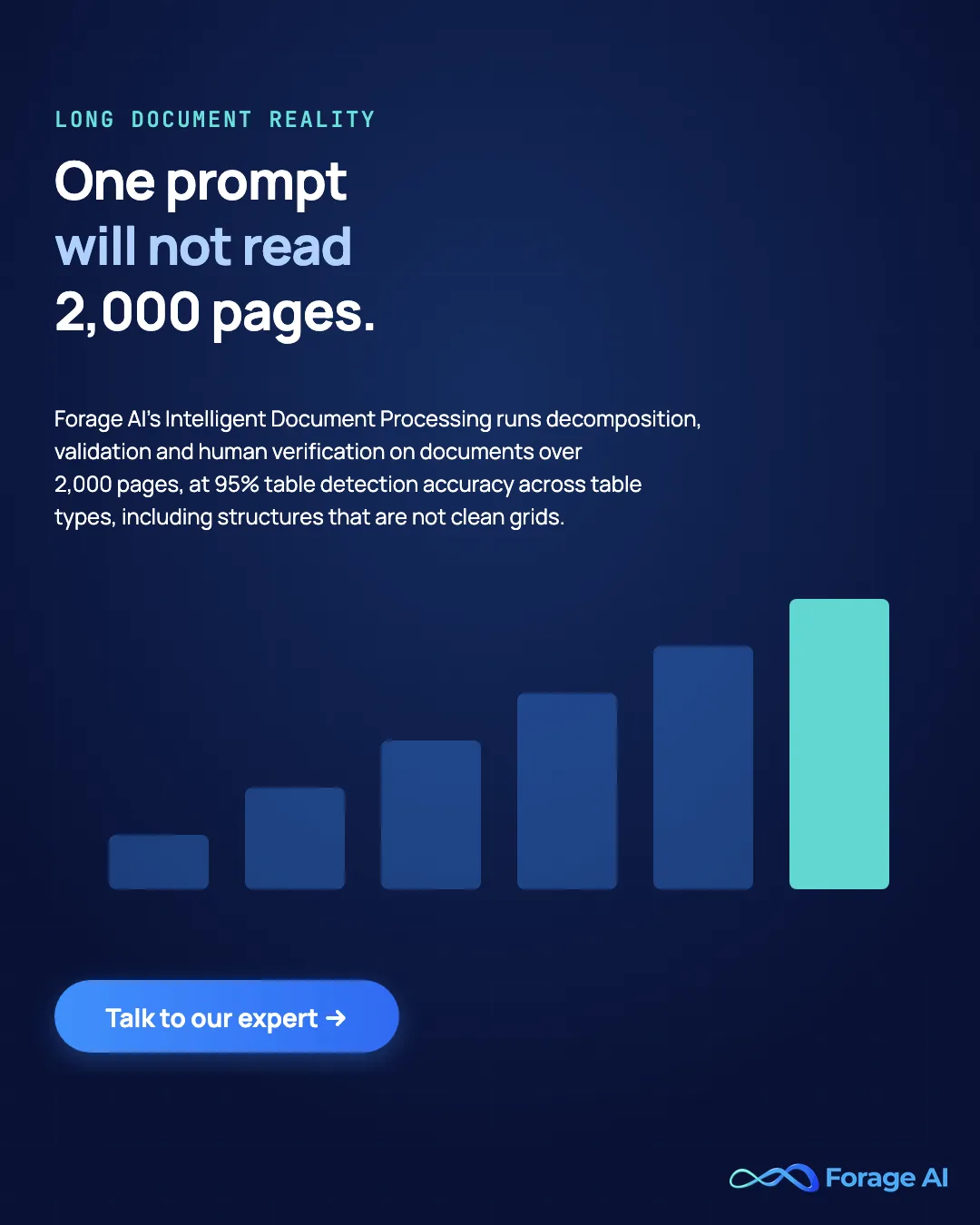
Long files are their own design constraint. Forage AI's Intelligent Document Processing handles documents over 2,000 pages and runs at 95% table detection accuracy across table types, including structures that are not clean grids, which is the usual failure point on filings and technical reports.
Quick Summary
Q: How do enterprises process documents at scale?
A: Through seven measured stages: ingest and normalise, split and classify, extract by decomposition, validate against business rules, route by confidence, human review, then deliver and feed corrections back. The stage that separates working pipelines from stalled ones is extraction by decomposition, because single-call extraction loses items as documents lengthen, and routing by confidence, because it decides how much human attention each document consumes.
How Do You Measure Accuracy When Nobody Can Read Every Document?
Once volume passes the first tier, accuracy stops being something you observe and becomes something you sample. Three decisions make that measurement honest.
Decide the unit first, and make it field-level. Document-level accuracy sounds like the number the business wants, but it compounds badly and it hides which field is failing. Per-field accuracy tells you that the invoice total is fine and the line-item dates are not, which is a fix you can actually assign.
The arithmetic is worth sitting with. Take a document with 40 extracted fields and a genuine 99% accuracy on each one. If those errors are independent, the whole document is correct about 67% of the time. That is illustrative arithmetic rather than a benchmark, and it is why a vendor number quoted without a unit, a sample and a document mix tells you almost nothing.
Build a golden set, and stratify the sample. A golden set is a fixed collection of documents with human-verified correct values for every field. Stratify it the way the real intake is shaped: by document type, by source, by layout family, and by the ugly categories nobody volunteers for, which are handwriting, faded scans and unusual page sizes. Sample against it on a schedule, not only after a change.
Expect your own standards to move. In a study of nine expert users published at UIST 2024, researchers named a pattern they called criteria drift: people refine what counts as correct as they grade more output. That is not sloppiness, it is what happens when a rubric meets real documents. Plan a re-grading pass and version the rubric alongside the pipeline.
The same discipline holds in regulated work where every extracted clause has to survive an audit, which is the pattern we walk through in contract data extraction.
Design the Exception Queue Before You Scale the Extractor
Here is the part most programs discover late. Above the first volume tier, the exception queue sets throughput, not the model. If 8% of documents need a human and each takes four minutes, then a million pages a month is a staffing plan, not a model upgrade.
Set thresholds per field, and weight them by business impact. A misread reference number on a low-value record is not the same risk as a misread payment amount, and one routing threshold for the whole document ignores that. The practical shape is three lanes: post automatically, check a single flagged field, or read the document in full.
Give the queue a discipline. Age, value and document type all belong in the ordering, because a queue sorted only by arrival time ages its most expensive items quietly. Track the age of the oldest item in the queue as a first-class number.
Make the correction path cheap. The reviewer needs the source page beside the extracted value, keyboard-first correction, and no context switching between systems. Seconds per correction versus minutes per correction is the difference between a review desk that scales and one that becomes a second backlog.
Then close the loop. Every correction is training signal. Forage AI runs a 200% QA approach, where every extraction passes automated checks and human verification, with a QA team 3x the industry average size, and corrections feed back into the models rather than dying in a spreadsheet. The same pattern drives the review design in invoice automation and claims processing automation, where exception routing is most of the operational work.
A routing table is easier to reason about when it is written down:
{
  "invoice_total":    { "auto_post": 0.98, "single_field_check": 0.90, "full_review": "below" },
  "supplier_name":    { "auto_post": 0.95, "single_field_check": 0.85, "full_review": "below" },
  "line_item_dates":  { "auto_post": 0.97, "single_field_check": 0.88, "full_review": "below" },
  "queue_order":      ["oldest_first_within_value_band", "value_desc", "doc_type"],
  "review_sla_hours": { "high_value": 4, "standard": 24 }
}
That is an illustrative configuration, not a recommended set of thresholds. Yours come from your own sampled accuracy per field and the cost of being wrong.
One design warning, and it is the one people resist. A review desk can make results worse if it is built to agree. Reviewers who see a pre-filled answer approve it. The EU AI Act names the pattern directly in its human oversight article, requiring that people assigned to oversight be able to "remain aware of the possible tendency of automatically relying or over-relying on the output produced by a high-risk AI system (automation bias)". The obligation applies to high-risk systems, and the design principle applies to every review desk: show the source, make disagreement easy, and audit reviewer agreement rates the way you audit the model.
Quick Summary
Q: How should you design the exception queue for document processing at scale?
A: Treat it as the throughput limit, because above the first volume tier reviewer capacity, not the model, decides how many documents clear. Set routing thresholds per field weighted by business impact, with three lanes: post automatically, check one flagged field, or read the document in full. Order the queue by age, value and document type, show the source page beside each extracted value, and feed every correction back into the models. Build the desk so reviewers can disagree, since a desk that always agrees with the model stops being a control.
Regulators have already written down the failure mode that operations teams learn the hard way. The EU AI Act's human oversight article requires that oversight staff can "decide, in any particular situation, not to use the high-risk AI system or to otherwise disregard, override or reverse the output of the high-risk AI system" (Regulation (EU) 2024/1689, Article 14(4)). Read as design guidance rather than paperwork, that means a review desk needs a real override path, a reason captured with it, and enough context on screen for disagreement to be possible.
How Do Enterprises Reduce Risk in Automated Document Processing?
Risk controls are not the brake on automation. They are what lets you raise the automation rate without arguing about it every quarter.
Keep lineage from the delivered field back to the page it came from. Every output value should resolve to a document, a page, a stage and a model or rule version. When finance disputes a number eleven months later, lineage is the difference between an answer and an investigation.
Version everything and decide reprocessing deliberately. A prompt change, a model change and a rule change are all releases. Record which version produced which record, and make reprocessing history an explicit decision with a written scope, because silently re-running six months of documents creates two versions of the truth in downstream systems.
Minimise before you send. Redact or mask what a processing step does not need, especially before anything leaves your boundary. Where a managed partner is involved, the handling terms belong in the contract up front: terms that cover your own GDPR and CCPA obligations, no reselling of client data, and on-premise or private-cloud deployment when documents cannot leave the building.
Treat every document as untrusted input. This is the control most pipelines are still missing. A document is not only data to a model that reads it, it is potentially instructions. The OWASP GenAI Security Project's 2025 list puts it first: "Indirect prompt injections occur when an LLM accepts input from external sources, such as websites or files." A supplier invoice with text engineered to alter model behaviour is an attack path, and the mitigations are boring and effective: constrain output to a schema, never let extracted text execute an action directly, and validate against systems of record rather than against the document's own assertions.
Note: Human review is not a control if the reviewer cannot see the source page. An approval screen that shows only the extracted values is a rubber stamp with an audit trail.
The broader pattern of silent failure, drift and missing observability in production data pipelines is the same one we diagnose in why enterprise data pipelines break.
Who Should Run the Pipeline at Each Volume Tier
Build, buy a platform, or hand the operation to a managed partner. The honest version of this decision is not a feature comparison. It is a question about who absorbs maintenance, exception staffing and drift, and whether your engineers should be spending their quarters there.
Building makes sense when documents are your product. If the extraction logic is the differentiator, you want it in-house, and you should plan for the review desk, the golden set and the on-call rotation as permanent line items rather than project costs.
Buying a platform fits teams with stable, high-volume document types and engineering capacity to integrate. The part to be clear-eyed about: a platform moves the extraction work, and leaves you the review desk. Exception staffing, threshold tuning and the golden set stay yours.
A managed operation fits when volume is real, document types are messy, and the internal team's time is worth more elsewhere. This is where Forage AI sits: managed Intelligent Document Processing across 10M+ documents, with pipeline design, extraction, QA and delivery owned end to end, and typical onboarding of 1 to 2 weeks from brief to live pipeline.
Vendor selection itself is a separate exercise, meaning the capability criteria, the market trends and the provider-by-provider view, and we keep it in one place: AI-powered document processing, trends and how to evaluate solutions. If you want the service specifics instead, they live on the Intelligent Document Processing page.
Analysts are seeing the same decision reopen across the market. In Forrester's November 2025 assessment of how AI is changing the document processing market, Vice President and Principal Analyst Boris Evelson writes that generative and agentic AI is "becoming an equalizer that challenges vendors' ability to differentiate" and is "forcing buyers to reconsider buy vs. build options". When raw extraction capability converges, the durable differences sit in workflow, governance and who handles the documents the model gets wrong.
The Metrics That Tell You the Operation Is Healthy
A document operation needs a small scorecard that the team actually reads every week. Seven numbers cover it.
| Metric | What it tells you | What to do when it moves |
|---|---|---|
| Straight-through processing rate | Share of documents delivered with no human touch | Falling rate usually means a new layout or a drifting threshold, not a worse model |
| Exception rate by document type | Where human attention is going | One type dominating points at a schema or classification fix, not a staffing fix |
| Sampled field-level accuracy | Whether quality holds on the golden set | A drop in one field group points at the extraction stage for that group |
| Queue backlog age (oldest item) | Whether the review desk is keeping up | Rising age with flat volume means routing sends too much to full review |
| Cost per document | Whether automation is paying | Rising cost at flat volume points at retries, reprocessing or oversized model calls |
| End-to-end latency | Time from intake to delivered record | Spikes usually trace to a single stage, which is why per-stage timing matters |
| Reprocessing rate | Share of documents run more than once | Persistent reprocessing is a validation-rule gap surfacing late |
Site reliability practice has a useful frame here. The four golden signals set out by Rob Ewaschuk in Google's SRE book are latency, traffic, errors and saturation, and the definition of errors transfers almost directly to documents: failures that are explicit, implicit, or by policy. An implicit error is the document equivalent of a clean extraction with the wrong value, which is exactly what validation and sampling exist to catch, because nothing else will.
A reasonable first 90 days. Instrument the queue before improving the model, because you cannot tune routing you cannot see. Build the golden set next, stratified by document type and source, and run the first sampled accuracy pass against it. Then, and only then, start raising the automation rate one field group at a time, watching exception rate and sampled accuracy together. Teams that run that sequence tend to keep their gains, because every later change is measured against a baseline they trust.
Volume tiers are the part where practice varies most, and honestly, the thresholds in this guide are working numbers rather than settled ones. If your operation hits its breakpoints at different volumes, that comparison is worth having, and it is the sort of detail this field still learns from one another.
The most useful monitoring idea for document operations comes from site reliability engineering. In Google's SRE book, Rob Ewaschuk defines errors as "the rate of requests that fail, either explicitly (e.g., HTTP 500s), implicitly (for example, an HTTP 200 success response, but coupled with the wrong content), or by policy." The implicit case is the one document teams underweight: a pipeline that reports success while delivering the wrong value. Sampling against a golden set is the only thing that surfaces it.
Frequently Asked Questions
How do enterprises process documents at scale?
Through a staged pipeline with measurement at each stage: ingest and normalise, split and classify, extract by decomposition, validate against business rules, route by confidence, human review, then deliver and feed corrections back. At enterprise volume the design centre is the routing and review step, because that is what determines how much human time each thousand documents consumes.
Is AI document processing scalable for enterprise use?
Yes, with the caveat that the scaling constraint is rarely the model. Extraction quality holds up when long documents are decomposed rather than pushed through a single call, and throughput then depends on confidence routing, reviewer capacity and queue design. Teams that scale the extractor without designing the exception queue end up with a faster pipeline and a growing backlog.
How accurate is automated document processing at enterprise volume?
It depends on what is being measured, which is why a bare "99% accuracy" claim says little. Ask for the unit (field-level or document-level), the sample, and the document mix it was measured on. Field-level accuracy compounds: at 99% per field across 40 fields, only about two documents in three are fully correct, so the honest answer is always a number attached to a golden set.
What does human in the loop actually mean at scale?
It means a routed queue, not a person watching everything. Documents flow into three lanes by confidence and business impact: auto-post, a single-field check, or full review. The design details that matter are showing the source page beside the extracted value, capturing a reason on override, and auditing reviewer agreement rates, since a desk that always agrees with the model has stopped being a control.
Do you have to build a document processing pipeline in-house?
No, and for most teams the question is which parts to own. Building fits when extraction logic is the product. Buying a platform relocates extraction work but leaves exception staffing, threshold tuning and the golden set with your team. A managed operation fits when volume is real and document types are messy enough that maintenance would otherwise consume the internal roadmap.
Sai is a data infrastructure enthusiast who has spent the past two to three years following the AI space closely, from the infrastructure layer to the fast-growing world of data for AI. He is genuinely curious about how modern data pipelines get built and where the data industry is heading, and he writes insightful pieces on the core topics that shape this niche.