
IDP Market Map 2026: Intelligent Document Processing Companies by Category
Sooner or later, document volume outgrows manual keying or a basic OCR tool, and the question becomes: buy software, call an API, build on open source, or hand it to someone? This IDP market map covers the ways a company turns documents it already holds into structured data: 54 intelligent document processing companies in four categories, checked as of 16 October 2026, that differ in who does the work after a document is read and how it is bought. ◆ marks our own listing. By the end, you can name the route that fits your documents, what it leaves with your team and whom to shortlist.
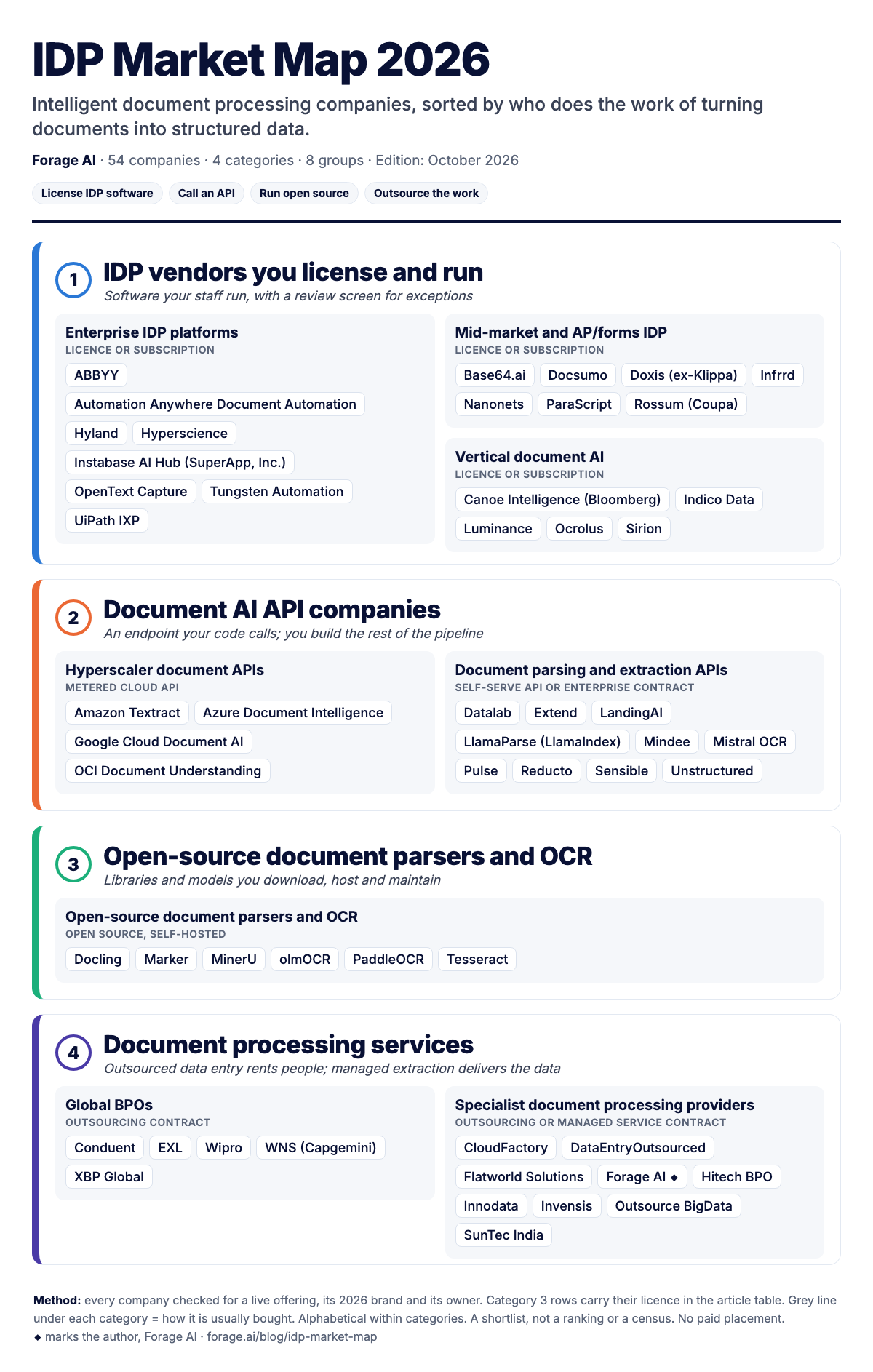
Download the full-resolution map (PNG), the print version (PDF) or the company list (CSV). You are welcome to share the map with credit to Forage AI.
Outsourced data entry: you rent people. You still own the process, the quality standard and the fixes, and they key what you send.
Managed extraction: you buy the finished data. The provider owns the pipeline, the checking and the upkeep, and you still own the field spec and the acceptance check.
- The market: the ways a company turns documents it already holds into structured data, in four categories: licensed IDP products, document AI APIs, open-source parsers and OCR, and services.
- The real difference: every route leaves checking, exceptions, matching and upkeep with somebody; the categories differ in who owns that work and how it is bought.
- Services are two different purchases: outsourced data entry rents people to your standard, while managed extraction delivers finished data against your field spec.
- The method: 54 companies checked live as of 16 October 2026, listed alphabetically, with no ranking, no pricing and no paid placement; ◆ marks the author.
Intelligent document processing companies at a glance
Each row is a route, and each answers one question: who does the work after a document is read? Services take two rows because renting people and buying finished data leave you owning different work. The last column uses one closed label set: licence or subscription, metered cloud API, self-serve API or enterprise contract, open source (self-hosted), outsourcing contract, and managed service contract. "Who it suits" is our classification.
| Route | What it is | Who it suits | What you still own | Who checks the output | How it's bought |
|---|---|---|---|---|---|
| Licensed IDP products Enterprise, mid-market and vertical IDP | Software that reads documents and gives your staff a review screen | Ops teams with steady document types, often already on an automation suite | Setup and tuning per new layout, matching rules, monitoring after go-live | Your reviewers, in the product | Licence or subscription |
| Document AI APIs Hyperscaler APIs; parsing and extraction APIs | An endpoint your code calls for text, layout or fields | Teams with engineers building pipelines, apps or RAG | Schema, validation, exception routing, matching, drift | You; you build the review step | Metered cloud API; self-serve API or enterprise contract |
| Open-source parsers and OCR Parsers, OCR engines and models | Libraries and models you download and host | Engineers who want control or must keep documents in-house | Everything in the API row, plus hosting, GPUs, upgrades, licence review | You | Open source, self-hosted (code and weights licences can differ) |
| Services: outsourced data entry Global BPOs; specialist outsourcers | People, tool-assisted, who key and check documents you send | Steady high volume, including paper and handwriting | Process design, QA standard, integration, fixes | Their staff, to your standard; you audit | Outsourcing contract |
| Services: managed document extraction Specialist providers | A provider builds and runs the pipeline and delivers structured data | Messy, multi-format, high volume, no team to run a pipeline | Field spec, acceptance checks, matching to your master data | Provider runs QA; you run acceptance checks | Managed service contract |
"What you still own" is never empty. The rows differ in who staffs the review step and who keeps up with new layouts.
What market does this IDP market map cover?
A company makes this map if it sells a product or service that turns documents a company already holds into structured data, has a live page and trades under its 2026 brand. Intelligent document processing (IDP) is the software side of that job: it classifies documents and extracts their fields, a step past OCR, which only turns an image into text. For more, see where OCR stops and IDP starts. Four kinds of company sit outside the line. AP and e-invoicing networks remove the document instead of reading it. RPA and content suites appear only through their named IDP products. General model labs are out, although teams also prompt general models directly. Web data has its own external data market map.
Gartner, as quoted by PEX Network, expects the IDP market to reach US$2.09 billion by 2026, while IMARC puts it at US$3.3 billion in 2025; they disagree because they draw the boundary differently, which is why this map defines the market by outcome.
IDP companies by category
The four categories below are buying routes, not technologies, so pick the route before you compare IDP vendors. Forrester calls the wider space document mining and analytics platforms (DMAP), with IDP as its most common use case, and puts the category choice before the vendor choice.
"Before choosing a DMAP platform, buyers must focus on the category of vendors that fits their use cases…"
Boris Evelson, VP and Principal Analyst, Forrester, in AI Changes The Intelligent Document Processing Market, November 2025
A provider's technology can sit behind several routes, so each company appears once, in the place you would buy it.
1. IDP vendors you license and run
This route covers the enterprise suites, mid-market AP and forms products, and a short list of vertical specialists. You get a review screen, and you run it yourself. Someone tunes the product for each new layout, and someone staffs the screen. In practice, the vendor's demo layouts are not your layouts, and a suite's IDP module assumes you already run the suite.
| Company | Best use case | What they do |
|---|---|---|
| Enterprise IDP platforms · usually bought as a licence or subscription | ||
| ABBYY | OCR and capture across multilingual, high-volume back offices | OCR and intelligent document processing |
| Automation Anywhere Document Automation | Document intake feeding Automation Anywhere bots and workflows | Extract, validate and route data from any document into workflows |
| Hyland | Content-management estates adding document capture and extraction | AI-powered document capture, separation, classification, extraction and enrichment (Hyland IDP) |
| Hyperscience | Handwritten and messy forms in regulated, human-in-the-loop operations | Document process automation |
| Instabase AI Hub (SuperApp, Inc.) | Complex multi-document workflows in banks and insurers | AI for document-heavy workflows. Instabase became SuperApp, Inc. in August 2026; AI Hub remains supported |
| OpenText Capture | OpenText content-suite customers digitising inbound paper and email | Intelligent capture software converting scanned and digital files into structured information |
| Tungsten Automation | Capture-plus-workflow for large AP, mailroom and onboarding operations | AI-powered workflow automation solutions for global enterprises. Formerly Kofax (renamed January 2024) |
| UiPath IXP | Document steps inside existing UiPath automation estates | Turns documents and communications into data your agents can act on |
| Mid-market and AP/forms IDP · usually bought as a licence or subscription | ||
| Base64.ai | Broad long-tail document types without training custom models | Document intelligence platform converting PDFs, images, DOCX and other files into JSON |
| Docsumo | Lending and insurance intake with cross-document checks | AI agents that extract and cross-check bank statements, ACORD forms and Medicaid packets |
| Doxis (ex-Klippa) | Receipt, invoice and ID capture with document-fraud checks in the EU | Doxis AI.dp: document processing platform with OCR, classification, verification and fraud detection. SER Group acquired Klippa in March 2025 and renamed itself Doxis in January 2026 |
| Infrrd | Mortgage, insurance and engineering documents | Document processing for complex documents, plus an Accuracy Guarantee Program delivering ready-to-use data |
| Nanonets | AP, claims and order processing pushed into SAP or Salesforce | AI document processing |
| ParaScript | Check, payment and handwritten-form processing with fraud screening | AI-based data extraction and check fraud detection |
| Rossum (Coupa) | Accounts-payable invoice capture feeding source-to-pay | AI document processing for transactional workflows. Coupa completed its acquisition on 12 May 2026 |
| Vertical document AI · usually bought as a licence or subscription | ||
| Canoe Intelligence (Bloomberg) | Private-markets fund documents for allocators and wealth managers | Automated document collection and data management for alternative investments. Bloomberg completed its acquisition on 1 October 2026 |
| Indico Data | Commercial insurance submission and claims intake | Intake and orchestration platform turning insurance claims and submissions into insights |
| Luminance | Legal contract review and negotiation at scale | Contract intelligence platform that reads and analyses legal agreements |
| Ocrolus | Bank-statement and income analysis for SMB and mortgage lending | AI workflow and analytics platform for lenders, automating financial document analysis |
| Sirion | Contract and financial-document extraction for banks and enterprises | Contract lifecycle management platform with Eigen's document AI for contracts and other business documents. Sirion acquired Eigen Technologies in June 2024 |
Gartner published its second Magic Quadrant for Intelligent Document Processing on 8 September 2026. Gartner says it does not endorse any vendor it depicts, and we do not re-rank anyone; for a ranked view, see our IDP solutions compared.
2. Document AI API companies
An endpoint your code calls belongs here, whatever model sits behind it. The split between the two groups is a buying difference. Hyperscaler APIs run through your cloud account and bill by metered use, while parsing and extraction APIs offer a self-serve sign-up alongside an enterprise contract.
| Company | Best use case | What they do |
|---|---|---|
| Hyperscaler document APIs · usually bought as a metered cloud API | ||
| Amazon Textract | AWS-native OCR of forms and tables; Bedrock Data Automation for GenAI extraction | ML service extracting text, handwriting and data from scanned documents, forms and tables. Amazon Bedrock Data Automation, generally available since March 2025, covers generative extraction |
| Azure Document Intelligence (part of Azure Content Understanding) | Azure shops; containers for on-prem or air-gapped extraction | Extract document text, structure and fields with AI models. Now part of Azure Content Understanding, generally available since November 2025 |
| Google Cloud Document AI | GCP teams wanting Gemini-backed layout parsing and custom extraction | Pretrained processors, Workbench for custom models and Warehouse to search and store documents |
| OCI Document Understanding | Oracle Cloud and Oracle ERP customers | Extract text, tables and key data from documents through APIs and CLI tools |
| Document parsing and extraction APIs · usually bought as a self-serve API or an enterprise contract | ||
| Datalab | Hosted Marker and Chandra OCR when self-hosting is too much | Hosted document conversion and OCR APIs from the makers of Marker and Surya. Also sells VPC and on-prem deployment |
| Extend | Production extraction pipelines behind AI agents and apps | Document processing infrastructure to parse, extract and split hard documents |
| LandingAI | Extraction API that links each field back to its place on the page | Document extraction APIs that make documents computable for enterprise developers |
| LlamaParse (LlamaIndex) | Parsing complex PDFs with tables, charts and handwriting | AI parsing of complex documents. LlamaIndex is renaming LlamaCloud to LlamaParse (2026) |
| Mindee | Developers adding invoice, receipt and ID capture to apps | Document extraction APIs |
| Mistral OCR | High-volume OCR of forms, scans and handwriting | OCR model returning markdown with reconstructed tables, available through Mistral's API |
| Pulse | Enterprise teams parsing complex PDFs and scans under security review | Turns complex PDFs and scans into structured data |
| Reducto | Parsing complex documents into structured data for production AI apps | Document parsing platform for AI teams |
| Sensible | Insurance and finance PDFs needing deterministic, rules-checked output | Combines AI extraction with deterministic rules |
| Unstructured | Multi-format ingestion into vector stores for RAG; open-source library also available (Apache-2.0) | Parses PDFs, tables, forms and scans into structured inputs for LLM and RAG pipelines |
A 2026 review quoted on the independent IDP-Software directory calls one parser a "parsing and extraction API, not a workflow platform", and that is the honest shape of this whole route. You build validation, the review step and exception routing yourself. Model-based parsers, the engines behind most LLM data extraction, fail differently rather than less: they can return confident, well-formatted output that is wrong. No endpoint returns finished, matched data. The review step moves into your code instead of going away.
3. Open-source document parsers and OCR
Open source is free to license, not free to run. Hosting, GPUs, upgrades and the licence review all stay with you. The code licence is not always the model-weights licence, so every row below names both where they differ.
| Company | Best use case | What they do |
|---|---|---|
| Open-source document parsers and OCR · usually bought as open source you host yourself; code and model licences can differ | ||
| Docling | Self-hosted, open-source document conversion for RAG pipelines | Document conversion (IBM-originated). IBM contributed it to the LF AI & Data Foundation in 2025. Licence: MIT code; models under Apache-2.0 or CDLA-Permissive-2.0 |
| Marker | Bulk PDF-to-markdown conversion for LLM ingestion | Converts PDFs to markdown and JSON quickly. Licence: Apache-2.0 code; weights under a modified OpenRAIL-M licence, free only below a funding and revenue threshold |
| MinerU | Scientific and technical PDFs with formulas and tables | Transforms PDFs and Office documents into markdown and JSON for LLM use. From OpenDataLab. Licence: MinerU Open Source License (Apache-2.0 plus extra terms, including a commercial licence at large scale) |
| olmOCR | GPU batch conversion of large PDF collections to text | Toolkit for linearizing PDFs for LLM datasets and training. From Ai2. Licence: Apache-2.0 code and weights; Ai2 marks the model for research and educational use |
| PaddleOCR | Self-hosted OCR across many languages, including CJK documents | OCR and document-parsing toolkit turning PDFs and images into structured data. From Baidu's PaddlePaddle. Licence: Apache-2.0 code and models |
| Tesseract | Baseline CPU OCR for clean printed text | Open source OCR engine. Licence: Apache-2.0 |
The usual trap is optimism. A Hacker News commenter who founded a document-extraction startup says they have heard "we'll build this internally in 3 weeks" many times. Another commenter benchmarked about 25 PDF libraries and found that only three could process all 2,500 test files. Then comes the pilot corpus: a parser that handled the documents picked for the trial meets production documents nobody picked. Building retrieval on top? Our guide to RAG data ingestion covers what the parser feeds.
Open source is a licence, not a clearance. Code and model weights can carry different terms, and some weights are free only below a funding or revenue threshold. Read both before you ship.
4. Document processing services: outsourced data entry and managed extraction
Document processing services are already in this market, though unlabelled. Avasant's Intelligent Document Processing Platforms 2024-2025 RadarView scores two BPO firms, EXL and Sutherland, among the platform vendors. Here they get their own category and the ownership test: with an outsourced data-entry firm you rent people to your standard, and with managed extraction you buy finished data against your field spec. Both use people and software. The choice turns on who checks the output and who keeps up with new layouts, not on whether humans are involved.
| Company | Best use case | What they do |
|---|---|---|
| Global BPOs · usually bought as an outsourcing contract | ||
| Conduent | High-volume government, healthcare and claims document intake | Document processing services that digitize, extract, index and store documents |
| EXL | Insurance and financial document extraction inside a broader operations deal | Intelligent document processing on its XTRAKTO.AI platform, alongside data and AI operations |
| Wipro | Document processing bundled into a wider IT and business-process contract | Business process services for document processing built on OCR, ML and NLP |
| WNS (Capgemini) | Claims, shipping and lab documents processed inside a process-outsourcing contract | Process outsourcing plus SKENSE, its AI-powered, human-led platform for extracting unstructured document data. Capgemini completed its acquisition of WNS on 17 October 2025 |
| XBP Global | High-volume capture, digitization and IDP for paper-heavy operations | AI-powered document processing blending technology, deployment and service, with human exception handling. Formed when XBP Europe combined with Exela's BPA business in July 2025 |
| Specialist document processing providers · usually bought as an outsourcing contract or a managed service contract | ||
| CloudFactory | OCR verification and invoice processing behind finance software platforms | Human-in-the-loop document transcription, moderation and processing at scale for financial and insurance software platforms |
| DataEntryOutsourced | Governed high-volume data entry with structured validation | Managed high-volume data entry |
| Flatworld Solutions | Industry-specific offshore data entry, such as banking and benefits | Data entry services with multi-format support for high-volume, industry-specific workflows |
| Forage AI ◆ | Custom, high-volume document extraction, including handwritten and 2,000+ page documents, built to your fields and delivered to your systems | Custom web and document data pipelines, fully managed |
| Hitech BPO | Offshore data entry and document data extraction at volume | Outsourced data extraction and processing |
| Innodata | Teams wanting a document extraction platform backed by vendor validation services | Document intelligence platform with human-in-the-loop and SME validation services |
| Invensis | Invoice data entry and document indexing outsourcing | Outsourced data entry for digitizing and managing business information |
| Outsource BigData | Document data entry and web data work from one vendor | Outsourced data entry and data processing services |
| SunTec India | Data entry, document conversion and scanning-and-indexing projects | Outsourced data processing |
The table has two groups. Global BPOs sell document work inside wider outsourcing contracts. The specialist group mixes buying models: most are data-entry outsourcers, Innodata pairs a platform you run with human-in-the-loop and SME validation services, and the listing marked ◆ sells managed extraction. That makes managed extraction the thinnest shortlist on this map: of the providers we checked, few say on their own pages that they deliver checked data rather than staff or a platform. If it is your route, put two questions to every services row before you shortlist it: who checks the output before it reaches you, and who changes the pipeline when a new layout arrives? Paper and handwriting are a standing lane for outsourced data entry, not a leftover. Neither model is a fallback for failed automation, and outsourcing does not move accountability for the quality standard unless the contract says so. Even with a managed provider, you still own the field spec and the acceptance check. Weighing the move? Read when to outsource data extraction.
Why document extraction stays hard on every route
Whichever route you choose, the same failures follow the documents, and they come in classes, not sizes. OCRBench v2, a NeurIPS 2025 benchmark led by Huazhong University of Science and Technology researchers, with co-authors from ByteDance, found that large multimodal models share five kinds of limitation, among them layout perception and parsing complex elements such as tables and charts. It tests text in images, not your forms, and that is the point: the weak spots are structural. OmniDocBench (CVPR 2025) adds that earlier parsing benchmarks covered a narrow range of document types, and its own sources, such as academic papers, textbooks, handwritten notes and newspapers, are not invoices or claims. A public score says little about your pile.
The harder part comes after the read. Output must match your systems, exceptions need routing, new layouts keep arriving. In accounts payable, a sponsored 2025 Ardent Partners survey found that exceptions had become the top challenge. Invoice findings do not transfer to every document type, but the shape is familiar. No route removes the review step; each one only changes who staffs it, which is why "What you still own" is never empty in the master table.
What changed in the IDP market in 2025 and 2026?
Once you know the route, check who owns the vendor, because IDP keeps getting folded into bigger platforms: spend management, automation suites, data terminals. Forrester makes the same point when it lists the few IDP specialists left. These were the ownership changes that touch this map.
- Coupa completed its acquisition of Rossum on 12 May 2026.
- Instabase's company became SuperApp, Inc. in August 2026; Instabase AI Hub remains supported.
- Azure Document Intelligence is now part of Azure Content Understanding, generally available since November 2025.
- Bloomberg completed its acquisition of Canoe Intelligence on 1 October 2026.
- Capgemini completed its acquisition of WNS on 17 October 2025.
- SER Group, which bought Klippa in March 2025, renamed itself Doxis in January 2026; Klippa's product is now Doxis AI.dp.
Where Forage AI fits in the IDP market
Forage AI sits in category 4, in the specialist providers group, as the managed-extraction listing. It is an end-to-end managed data pipeline that automates discovery, extraction, structuring, quality checks and delivery, built to the client's own fields and systems. That makes it a service that uses AI, not an IDP product you license. Forage AI checks the data before delivery; you keep the field spec and the final acceptance check. The honest trade-off: it is slower to first row, and slower to change, than a self-serve API. If that trade fits, see how managed document extraction works.
How we built this IDP market map
Every company on this IDP market map passed the inclusion rule in the scope section. Each was checked on 16 October 2026 for a live homepage, its 2026 brand and its owner. How-bought labels come from each vendor's own pages: a sign-up button or a contact-sales form. Rows are alphabetical, one per company, so Textract's line carries Bedrock Data Automation. There is no ranking, no pricing and no paid placement; ◆ marks the author.
The limits: this is a shortlist, not a census or an evaluation. The split between outsourced data entry and managed extraction is our structural test, not a term buyers use. We review the map quarterly, and if a listing is out of date, tell us through our contact page.
Verdict: which IDP route fits your documents?
Match your documents and your team to a route, read its master-table row for the work that stays with you, then shortlist from its category table.
- Few document types, standard forms (invoices, receipts, IDs): a mid-market IDP product or an extraction API.
- Already on an automation or content suite: its IDP module or an enterprise IDP vendor, with reviewers budgeted.
- Engineers who want control: a document AI API. Open source only if you will also own hosting, upgrades and the licence review.
- Feeding RAG or training: a parsing API or an open-source parser, tested on your own hardest documents.
- Steady high volume, including paper and handwriting, where you will set and audit the quality standard: outsourced data entry.
- Messy, multi-format documents at high volume, with a strict quality bar and no team to run a pipeline: managed extraction. You still own the field spec and the acceptance check.
Re-check the route when your document mix or volume changes. Shortlisted? Test them with the IDP software evaluation checklist.
Frequently asked questions
Who are the main intelligent document processing companies?
The main intelligent document processing companies fall into four routes. Licensed IDP products include ABBYY, Hyperscience and UiPath IXP. Document AI APIs include Amazon Textract, Google Cloud Document AI and Reducto. Open-source parsers include Docling, PaddleOCR and Tesseract. Services include EXL, Innodata and Wipro. The tables above list all 54 alphabetically.
Should I license IDP, call an API, or use open source?
License an IDP product if you have few, standard document types and staff to run a review screen. Call an API if your engineers will build validation and exception routing around it. Choose open source only if you will also own hosting, upgrades and the licence review.
Are Textract, Google Document AI and Azure Document Intelligence IDP products?
Not in the licensed sense. They are metered APIs your code calls, and you build the review step around them. IDC's 2025-2026 MarketScape for IDP software, as reported by PEX Network, scores Google, AWS and Microsoft alongside full suites, which blurs the line. This map places them in category 2.
What is the difference between outsourced data entry and managed extraction?
Outsourced data entry rents people who key and check documents to your standard; you own the process and the fixes. Managed extraction delivers finished data against your field spec, and the provider owns the pipeline and its upkeep. Either way, you own the acceptance check.
Can AI document processing run without human review?
Rarely, and not at first. Review is neither failure nor the whole answer. Extend's founder, a vendor on this map, wrote on Hacker News that "anyone who goes in expecting 100% automation is in for a surprise". Measure confidence scores on your own documents before routing on them. See human-in-the-loop extraction.
Which document parsers work for RAG?
Parsing APIs like LlamaParse, Reducto and Unstructured, or self-hosted Docling, Marker and MinerU. Keep tables structured, since chunking breaks row and column binding, and add metadata at ingestion. OHRBench (ICCV 2025), published by OpenDataLab, the team behind MinerU, found OCR noise lowers RAG answer quality. See RAG data ingestion best practices.
How current is this IDP market map?
It was checked as of 16 October 2026. Ownership notes in the tables carry dates, the 2025 and 2026 changes are listed above, and we review the map quarterly. If a listing is out of date or a company has changed hands, tell us and we will correct it.
Related articles
- External data market map
- IDP software evaluation checklist
- From OCR to IDP: how document intelligence evolved
- When to outsource data extraction
- Invoice automation
- Claims processing automation
Sai is a data infrastructure enthusiast who has spent the past two to three years following the AI space closely, from the infrastructure layer to the fast-growing world of data for AI. He is genuinely curious about how modern data pipelines get built and where the data industry is heading, and he writes insightful pieces on the core topics that shape this niche.