
Large Scale Web Scraping: The Stages, the Failures and the Fixes
The crawler that ran fine against ten thousand pages does not announce itself when you point it at a million. It keeps finishing. It keeps exiting zero. It keeps writing rows into a table that nobody has any way to check.
Large scale web scraping gets described as a volume problem, and the published accounts of it read like build instructions: discover, fetch, parse, store, monitor. We read the eleven pages that rank for the term in November 2026. Eight of them print a stage list. Not one of those lists has a stage where somebody asks whether the collection was complete. That gap is survivable while a person still eyeballs the output. It stops being survivable at volume, because at volume nobody is looking.
What follows is the job as it runs: the ten stages, the six failures that get worse as volume climbs with the strategy that answers each one, the coverage question that belongs in the sequence and is not in anybody’s, and the three kinds of provider you can hand parts of it to. By the end you should be able to take a failure you are living with right now, name the stage it belongs to, and do one thing about it this week.
- The job has ten stages. The published accounts of it have nine, and the missing one is coverage.
- At volume the loud failures get cheaper and the silent ones get more expensive.
- A success rate without a named target class is not a number.
- Use the model to write the extractor, not to be the extractor.
- What you buy from a provider is a layer of the job, not a quantity of pages.
What counts as large scale web scraping?
Six of those eleven ranking pages define scale by volume alone: a page count, a record count, a number of requests per day. That definition is easy to write and tells you nothing useful, because it does not predict which parts of your setup are about to stop working.
Three axes do, and you can measure all three on your own pipeline this afternoon.
Source count. One website to a thousand is a bigger jump than ten thousand pages to a million. A million pages from one source is one layout and one failure mode, repeated. A thousand sources is a thousand layouts, each changing on its own schedule.
Refresh frequency. A dataset collected once is a project. The same dataset collected weekly is an operation, and everything that can drift now drifts on a clock.
Target difficulty mix. The axis teams miss. One genuinely hard target can cost more than a thousand easy ones, because the expensive rung is priced per request and the hard target needs it every time. Difficulty is not spread evenly across a source list, and almost nobody measures how it is distributed.
There is a sharper test than all three. If your failures are things that stop the job, you are not yet at scale. A HTTP 403 stops the job. You see it, you fix it, and fixing gets cheaper as you get better at it. If your failures are things that let the job finish and change the answer, you are at scale, and the economics have inverted. Our enterprise web scraping buyer’s guide takes that from the procurement side.
One pattern is worth noticing this early, because the whole article turns on it. Five separate 2026 measurements of how many websites disallow AI crawlers in robots.txt put the figure between 8.3% and 39.9%. The websites did not change between those studies. The definitions did: which crawlers count, which domains were sampled, whether a partial disallow counts. Two of the five come from vendors with a product in the answer, and on one fixed population of 10,894 domains re-run against the same list, blocking went down rather than up. Five numbers, one reality, and the spread belongs to the method rather than to the web.
The stages of a large scale scraping job
This is a process, not a stack. Listing proxies, headless browsers, queues and object storage gives you a parts inventory, and a parts inventory cannot tell you where a failure lives. If you want the components, our piece on the infrastructure behind reliable web data extraction is the one that owns them.
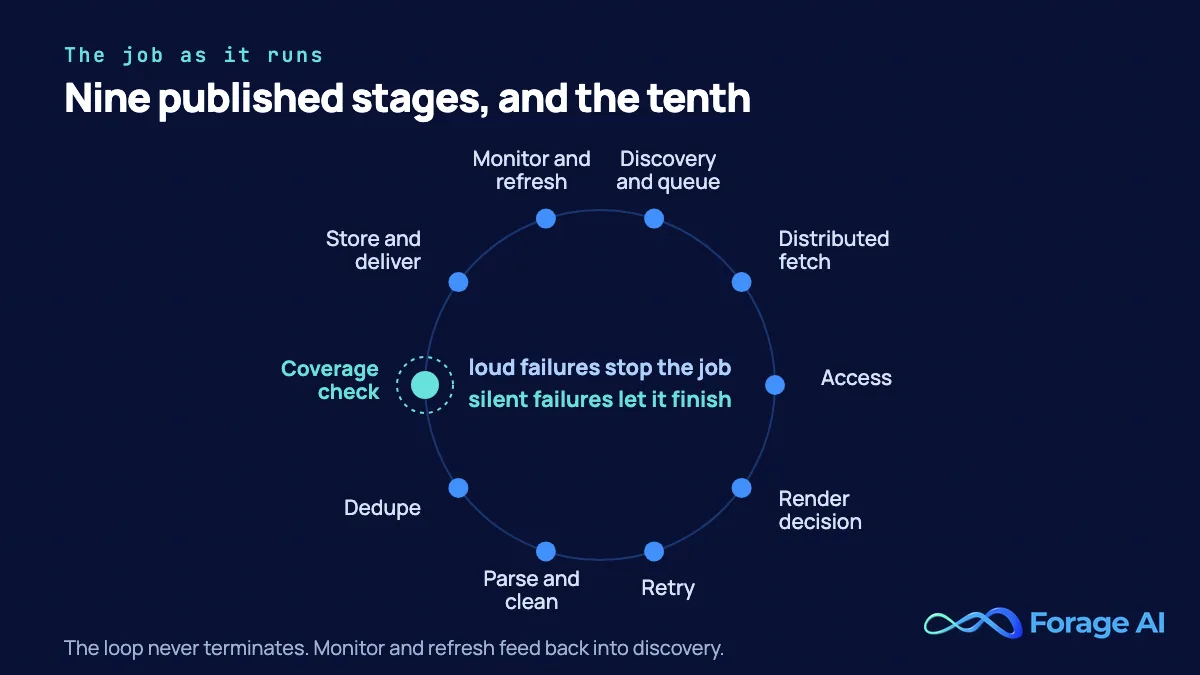
Nine stages appear across the published accounts, in roughly this order.
- Discovery and queue. Which URLs exist and are worth fetching, held in a frontier.
- Distributed fetch. Getting the bytes, at concurrency, from more than one machine.
- Access. Surviving whatever stands between the request and the response.
- Render decision. Per target: is plain HTTP enough, or is a browser required?
- Retry. What counts as a failure, and how often to try again.
- Parse and clean. Turning a page into fields.
- Dedupe. Deciding when two records are one record.
- Store and deliver. Committing to somewhere a consumer reads from.
- Monitor and refresh. Watching the running system and going round again.
Access is the only stage in all eight of the published lists. Monitoring is last in seven of the eight, which matters more than it looks, because last means after the commit.
The lists converge and the primary sources do not. Across nine of them only "fetch" and "parse" carry the same name. A crawler architecture paper, two open source crawler pipelines and one named engineering leader’s six step account describe an ordered sequence; the two most used scraping frameworks document components and never stages at all; and a third framing groups the work by altitude, page then session then dataset, insisting it runs in loops and chains rather than silos.
The peer-reviewed reason the lists differ is better than any of the lists. Job boundaries are not drawn from a universal lifecycle. They are drawn from the target website’s own master and detail structure, and they are drawn where you need to be able to tell what failed.
Stefan Huber, Fabio Knoll and Mario Döller of the University of Applied Sciences Kufstein, writing on a production scraping architecture, put the design rule plainly: "The granularity of a job implementation is guided by the ability of error detection and maintainability." Their stated payoff is root cause identification, because when a job maps onto one part of the task, it is evident which part the error occurred in.
Source: Huber, Knoll and Döller, ICSOFT 2022. Cited as a method and framework source; the architecture is from 2022.
So the stage boundary is where you instrument, and not the middle of a stage, where you cannot tell whether what you are looking at arrived broken or broke here.
None of those three framings has a coverage stage. Discovery is treated as an input, something that happens and is then finished, rather than as something with a completeness problem of its own, and quality checking appears at the end if it appears at all, after the data is somewhere a consumer can read it. The tenth stage goes between dedupe and commit, and it asks one question: did we get what we were supposed to get? The rest of this article is mostly about why nobody asking that costs more than anything else on the list.
For the reliability-at-scale framing of the same loop, our guide to the most reliable ways to automate large scale web data extraction takes it from the uptime side.
The six failures that get worse at volume
The usual shape of this section elsewhere is a list of challenges followed by a separate list of solutions, with different cardinality and no mapping between them. Seven challenges, five solutions, and the reader guesses which answers what.
So each of these six is one stage, one loud failure, one silent failure and one action, in stage order rather than by severity, because the point is for you to find yourself on the list.
Access: it works locally and 403s in production
Nine of the eleven ranking pages are mostly about this stage, which is why this one is short. Detection is layered and evaluated from the bottom up: the network and TLS handshake, then the HTTP framing, then the headers, then behaviour across a session. "Same headers, same cookies, still blocked" is diagnostic, and what it diagnoses is a layer below the one you are looking at. Naming the layer that refused you is effectively the whole move, because the fix differs at every layer.
The loud failure is the 403 you can see. The silent failure is the soft block that returns a 200 with a thinner page, so a 200 is not evidence you got the content. A block also raises the engineering skill floor on your team rather than converting access into a purchase.
The action, and it is measurable by Friday: log the response length alongside the status code for a week, then count how many 200s came back under the expected content length for that template. That count is your soft-block rate, and most teams have never seen it.
The ladder itself belongs to our piece on web scraping without getting blocked.
Render: paying browser prices for plain HTML
The render decision is a per-target decision and it gets made once for the whole job. Browser rendering costs multiples of a plain HTTP fetch at the same provider and difficulty tier, so escalating the entire pipeline to cover the fraction of targets that need a browser is the most common way to be overcharged at scale.
The loud failure is a blank page from a JavaScript-rendered website. The silent failure is a bill that tracks runtime rather than records.
The action: measure what share of your own targets needs the expensive rung, record it per domain, and re-check on a schedule, because targets change. Nobody publishes that ratio. We looked for it repeatedly, and the absence is the finding rather than a hole to fill with a vendor’s number. The closest thing that exists is one peer-reviewed account of a continuous operation at this scale, sixteen portals and up to two thousand pages a day across five weeks, which publishes its retry policy and a per-website exception threshold and routes sub-threshold failures to clerks who extract by hand. It designs the human rung in deliberately, and it still publishes no ratio.
Extraction: the field the model invented
Practitioners reached the mature pattern here before the research confirmed it. Use the model once, to produce a selector or a small program, then replay that deterministically on every page. Keep the compiled artefact under version control, so a change to it shows up as a diff rather than as a difference in behaviour.
The cost belongs in the same breath as the benefit: the compiled selector still breaks when the layout changes, and something has to notice. That is a monitoring obligation, not a saving. The smallest version that notices is a per-field fill check on replay:
def replay(page_html):
    """No model in this path: same input, same output, every run."""
    spec = json.loads(ARTEFACT.read_text())      # the compiled, committed selector
    rows = extract(page_html, spec)
    for field in spec["fields"]:
        fill = sum(1 for r in rows if r[field]) / len(rows) if rows else 0.0
        if fill < MIN_FILL:                      # 0.95
            raise SystemExit(f"DRIFT: '{field}' fill {fill:.0%} - recompile and diff")
    return rows
Change one class name on the page from price to amount and the row count never moves: three rows in, three rows out, green on any monitor that counts rows. The field fill drops to zero, and the check is the only thing that says so.
The loud failure is a parse that throws. The silent failure is schema compliance mistaken for correctness, because a response can validate against your JSON schema and be wrong in every field. On the benchmark that reports both, the two separate by 15 to 25 percentage points across 21 models, with the caveat that its authors sell structured output rather than study it neutrally.
Where a model belongs in the pipeline is owned by our piece on LLM scraping myths.
Success rates: the number your targets change
A success rate without a named target class is not a number. The cleanest demonstration comes from one reviewer who ran two tests in the same cycle on the same thirteen providers.
Against a roughly 6KB endpoint on a global CDN, over 3.6 million requests across 21 days, the median residential proxy success rate was 99.28%. Against Amazon, Google and Instagram, over 5,200 requests, the median was 74.43%. The same report puts the difference between the best and worst provider on that second test at about ten points. So 25 points between two published numbers for one vendor, and ten points between vendors.
Proxyway, data collected March and April 2026.
The reviewer says so themselves: the second test "has too many variables, such as the scraper’s quality and changes in bot protection, to be reliable on its own," participants had the methodology in advance, and these are therefore best-case configurations rather than defaults. Both caveats are real, and the comparison survives them.
The loud failure is a published rate you believed. The silent failure is a rate you compute yourself that counts soft blocks as successes.
No industry body exists here and no neutral publisher that vendors submit to, so nobody is lying and nobody is comparable. Ask for four things together rather than for a rate: the target class, the retry policy, the concurrency and the time window. A rate without all four is not false. It is undefined.
Monitoring: the run succeeded, the data did not
The near-universal setup is schema validation, row count monitoring and a manual spot check. All three are blind to the most common failure at volume, because row counts hold steady while field accuracy falls. The fear is already general: in dbt Labs’ 2026 State of Analytics Engineering survey, fielded to 363 data practitioners between December 2025 and February 2026, hallucinated or incorrect data reaching stakeholders was a top concern. The instrumentation has not caught up with the fear.
Data observability tools are not the answer on their own: they watch the table after it lands rather than the source it came from, and cannot fix a producer they have no write access to.
The action: instrument field fill per source per run rather than total row count. The attested version is the per-website exception count from that same peer-reviewed operation, counted daily against a threshold set for that website, with a spike read as a systematic change rather than bad luck. That is a per-source baseline, and almost nobody has one.
The thresholds and the release gate belong to our automated web scraping QA workflows piece; diagnosing a pipeline that has already broken belongs to why enterprise data extraction pipelines break.
Cost: the bill tracks the rung, not the rows
Billing units here are derived rather than natural: credits, compute units, 30-second browser blocks, gigabytes. None of them is a page, and the conversion depends on the target website, which is why several providers publish difficulty multipliers of their own. Only four of the eleven ranking pages give any actionable number at all.
The range inside a single rate card is wider than most buyers expect. One web-unblocking API publishes five difficulty tiers for plain HTTP requests and five more for browser-rendered ones, per thousand successful responses. Read in November 2026, its cheapest cell is $0.13 and its dearest $16.08, about 124 times, and the span is almost identical at its $500 monthly commitment, so this is target difficulty and render mode rather than a volume discount. The buyer cannot see which tier a website lands in before starting, because the vendor assigns it per website and revisits the assignments quarterly.
The loud failure is an invoice nobody forecast. The silent failure is a cheap bill, produced by a pipeline that quietly stopped collecting the expensive half of the inventory.
The action: price your own target mix in the provider’s unit before signing, not the headline rate. Then put the question nobody answers in print in writing: on a fixed-scope contract, who absorbs a source getting harder mid-term, the vendor’s margin or a scope amendment? Forage AI scopes and quotes per project rather than publishing a rate card, which makes that answerable at signing rather than at renewal.
Which of these six should I fix first?
The one whose stage you can name from your own symptoms. The order above is the stage order, not a priority list, and the diagnostic value is in locating yourself rather than in ranking the six.
Can you measure your own coverage?
Three words get used interchangeably here and they are not synonyms. Recall is the measurable quantity: of the things that should have been collected, the share that was. Coverage is the claim you make about recall. Completeness is the colloquial word for the feeling that you have it all. Only the first is a number.
That is what makes it structurally hard. Recall needs a register of what should have been collected, and extraction is usually commissioned precisely because no register exists. You cannot compute recall from inside your own collector, because the collector’s output is the thing in question. A team that has never measured against something external does not know its own recall, and neither does its vendor.
Greg Lindahl, Chief Technology Officer of the Common Crawl Foundation, asked the same question of the largest public web crawl in existence and found it harder than it looks. Because the crawler deliberately revisits slow-changing pages less often, "it makes it hard to understand how complete the dataset is." The organisation with the best crawl infrastructure anywhere cannot read completeness off its own crawl.
Source: Greg Lindahl, Measuring Crawled Coverage of a Website in Common Crawl, Common Crawl Foundation, July 2026.
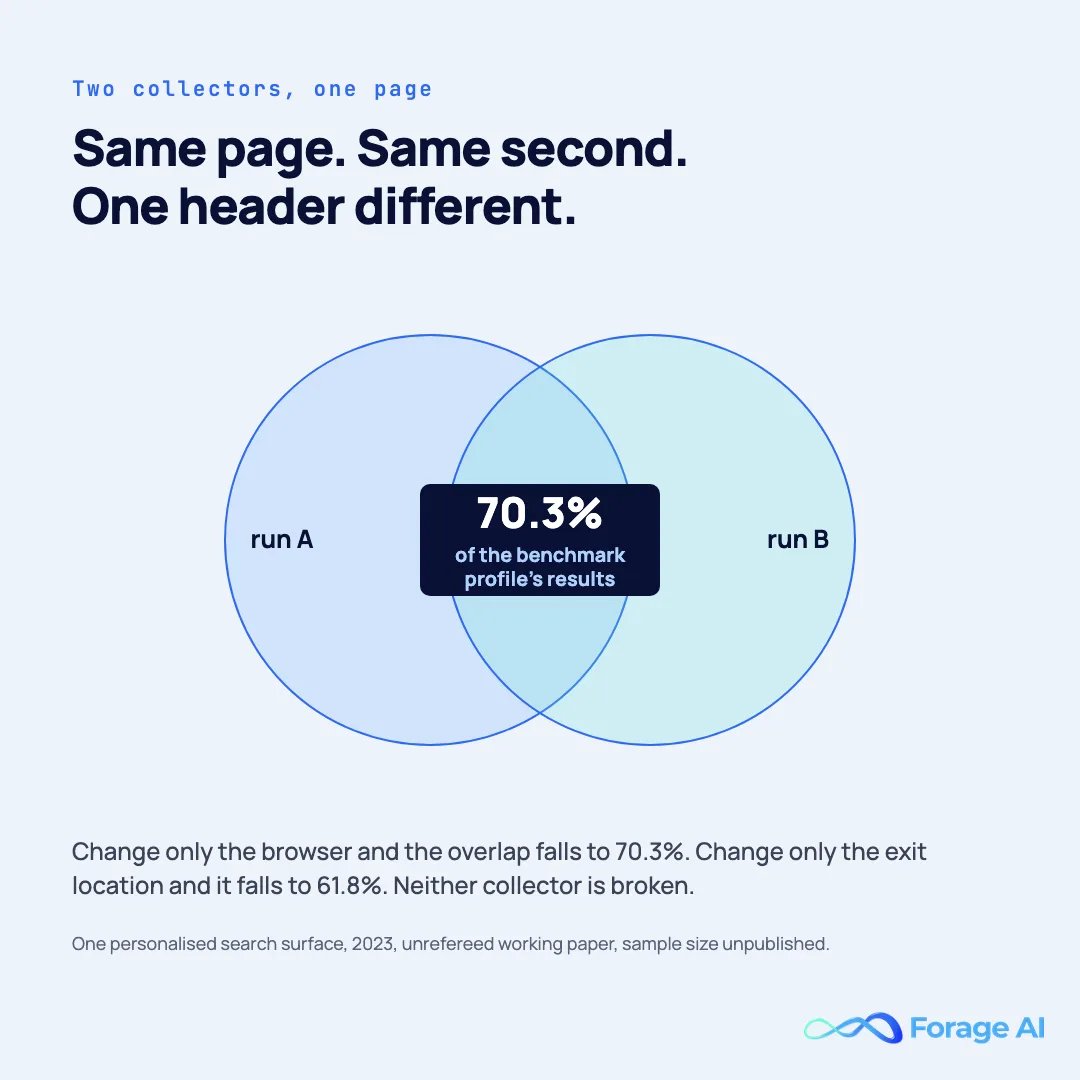
Here is how little it takes for two competent collectors to disagree. In a 2023 working paper, Jens Foerderer of TU Munich ran six collection profiles in parallel at the same time of day against one video-sharing platform’s search interface, each differing from a benchmark profile in exactly one request header. Changing only the browser returned 70.3% of the benchmark’s results. Changing only the accept-language header returned 73.7%, and changing only the exit location between 61.8% and 69.2%. Four things have to be said with those figures. The paper publishes no sample size, and this article would be failing its own test if it printed them without that. It is one unrefereed working paper, one platform, one author, 2023. The surface tested is a personalised search interface, not a static website. And coverage there is measured against the benchmark profile rather than against truth, so 70.3% does not mean anything was "missed" in an absolute sense.
The consequence is more useful than the number: two competent collectors hitting the same page at the same second can legitimately return different sets, so a bake-off between two providers is partly measuring personalisation rather than capability.
The same paper has the demonstration that survives scrutiny best. Three collectors ran against the same few hundred products and differed only in how they enumerated the catalogue. They covered 5.8%, 54.0% and 32.4% of it, and all three over-sampled the popular, well-reviewed items. The coverage you get is a property of how you decided to enumerate, not of the website. The paper’s own framing is that naive scraping procedures can lead to sampling bias in the collected data, which is the right scope for it. (Foerderer, arXiv:2308.02231)
Three things you can do without a register, and the first is cheap enough to run this week.
Cross-check against what the website publishes about itself. Fetch /sitemap.xml, follow the index one level into child sitemaps, collect every loc, filter to the pattern your collector covers, dedupe, and record the date you fetched it, because the register is a claim with an age. Export the canonical URLs your collector stored over the same window and diff both directions: in the register and not collected is your recall gap, and collected but not in the register is either register staleness or discovery that went further than the sitemap. Both are findings. Compute recall as the intersection over the register, per source per run, so it becomes a series. Then read the misses rather than counting them, because seven on one template is a selector bug and seven scattered across templates is a discovery bug. Against a live sitemap of 223 URLs with seven absent on the collector side, that is thirty lines of standard library and it reported 96.9% in seconds.
Run two differently-configured collectors over the same window and compare the overlap. Change one thing: accept-language, exit location, logged in against not. That is the Foerderer experiment on your own targets, and the overlap is your own personalisation floor.
Hold out a small externally-sourced list, fifty to a hundred items you know exist, from a trade directory, a press release or a partner’s export, and check whether the pipeline found them.
All three measure against something outside the collector, which is the only place a recall number can come from. Registers drift too, so give yours a last-verified date and an owner: a sitemap is the website’s claim about itself, not the truth, and it omits pages, lists dead ones and goes stale.
The arithmetic for recall and fill rate is set out with the SQL in our data quality dimensions piece.
Who can you buy large scale scraping from?
The useful axis is not which vendor is best. It is which layer of the job you are outsourcing, because that decides what you still have to staff.
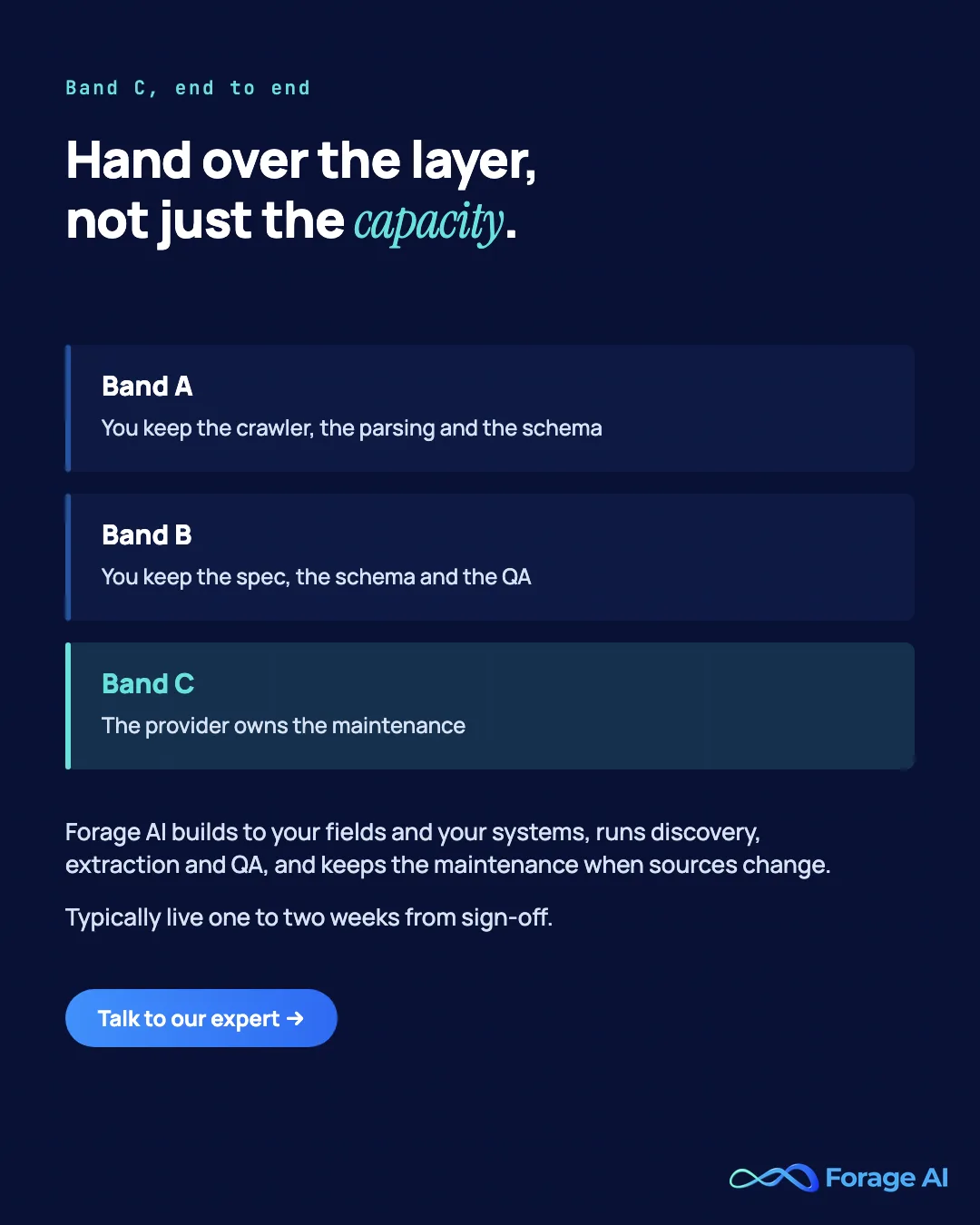
Band A sells you access. You keep the crawler, the parsing and the schema. Band B sells you the running of the scrapers. You keep the spec, the schema and the QA. Band C sells you the delivered dataset, and the provider owns the maintenance. Several providers straddle two bands, and the table says so rather than forcing them into one.
Read the billing unit column first. It is the column that decides what a quote means, and it is why the common mistake here is so expensive: comparing headline rates across providers whose units are not the same object. A credit, a compute unit, a 30-second browser block and a gigabyte are four different things, and not one of them is a page.
If you cannot staff the access stage, Band A does not help you, because you are buying capacity for a job you cannot run. If you can staff everything except the maintenance, Band C is what you are actually buying, and paying Band A prices for it will feel cheap and cost more. A few providers sell a managed add-on alongside a self-serve product at a different price per unit, so the band is a description of the engagement rather than of the company.
This is an orientation table rather than a ranking. Every cell was verified from the provider’s own live page in November 2026. Where a provider publishes nothing, the cell says so rather than guessing. For the ranked view, our top web scraping service companies roster does that job.
One thing the columns cannot show: two of these are in the same corporate group. Oxylabs’ group acquired ScrapingBee, announced in June 2025, so a shortlist holding both is less diversified than it looks. Worth checking ownership on any provider you are using as your second source.
| Provider | Band | What you are actually buying | Billing unit | Pricing published? | Best suited to |
|---|---|---|---|---|---|
| Bright Data | A, straddles B | Residential, ISP and datacentre proxy networks plus an unblocking layer for requests you originate | Per GB for proxies, per 1,000 successful requests for unblocking | Per product, yes; no figures at the top level | Teams already running a crawler that need a large geo-targetable pool |
| Oxylabs | A, straddles B | Proxy capacity and an unblocking layer, with per-target scraping APIs as separate line items | Per GB, per IP, or per 1,000 results by product | Yes, with volume breaks visible before any sales call | Buyers who want the whole access ladder priced in public |
| ScraperAPI | A, straddles B | A request endpoint that handles rotation, retries and bypass and returns the page | API credits, one per standard page request | Yes, to the top published tier | Teams that want blocking handled behind one HTTP call |
| Zyte | A and B | Per-request access with proxy and bypass selection made for you, plus hosted crawl infrastructure | Per 1,000 successful responses, by access type and five difficulty tiers | Yes, including the difficulty tiers | Scrapy-native teams keeping their spiders and buying only access |
| Crawlbase | A, straddles B | Per-request crawling access with anti-bot handling on a graduated volume ladder | Per 1,000 successful requests, with published difficulty multipliers | Yes, including the multipliers | Teams that want no commitment and a ladder that falls with volume |
| Decodo | A | Residential proxy capacity sold by bandwidth | Per GB | Yes, every tier | Buyers who want bandwidth priced in public and nothing bundled |
| ScrapingBee | A, straddles B | A request API handling rotation, headless rendering and premium proxies | API credits, from one per request, no rollover | Yes, including enterprise tiers | Small and mid-size teams that want every tier visible |
| ZenRows | A, straddles B | Successful-request access with rendering and premium-proxy options | Credits: 1 standard, 5 rendered, 10 premium, 25 both | Yes, fifteen public tiers | Buyers modelling cost against their own target mix before signing |
| Apify | B | A hosted platform for running scrapers you own or adapt, with scheduling, storage and proxies | Compute units, one being a GB of memory for an hour | Yes | Teams owning the extraction logic in code but not the infrastructure |
| Firecrawl | B | An API that turns URLs and whole websites into clean page content | Credits, one per page scraped or crawled | Yes | Retrieval pipelines whose consumer is a model rather than a schema |
| Octoparse | B, managed add-ons sold separately | A no-code builder with cloud extraction, scheduling and a template library | Subscription tiers with row-volume caps; add-ons quoted outside | Yes for the tiers, no for the add-ons | Non-engineering teams standing up extractions themselves |
| Browse AI | B | Robots pointed at a page by demonstration, extracting rows and watching for changes | Credits, one per ten rows extracted | Yes, to the top self-serve tier | Business users watching a handful of websites |
| Diffbot | B | Extraction APIs plus a knowledge graph, where the unit is a parsed entity | Credits per action, from one per page to a hundred per facet query record | Yes | Teams that want entities and relationships rather than page content |
| Kadoa | B | An extraction platform in two plans with consumption-based usage | Not stated by vendor | No. Not stated by vendor. | Buyers willing to scope through a conversation to get a number |
| PromptCloud | C | A scoped pipeline the provider builds, runs and delivers | Scoped per project against sources, volume, frequency and complexity | No, by explicit statement; a sample delivery is offered first | Buyers who want the job scoped and a pilot before committing |
| Grepsr | C, with a platform component | Managed collection with platform access included at the entry pack | Records at the entry pack, frequency and volume above it | Partly; one starting figure, the rest custom | Buyers wanting a managed arrangement with a self-service view of it |
| ScrapeHero | C, straddles B | Full-service collection per website, plus a self-serve cloud product | Per website per refresh or per month, per-million-page rates above | Partly; starting figures the vendor calls a baseline | Buyers who want a managed price anchor before the first call |
| Datahut | C | Managed collection with published per-website monthly prices and record caps | Per website per month, with monthly record caps | Yes for two tiers, custom above them | Mid-market buyers with few sources and predictable volume |
| X-Byte | C | A quoted managed crawl programme | Not stated by vendor | No, by explicit statement; a pilot run is offered | Buyers comfortable scoping entirely through a sales process |
| Datamam | C | A quoted managed service | Not stated by vendor | No. Not stated by vendor. | Buyers who want a consultation-first engagement |
| Forage AI | C | An end-to-end managed pipeline built to your own fields and your own systems, where discovery, extraction, QA and delivery are run for you | Scoped per project | No. Quoted per scope. | Teams whose schema is settled, whose source set keeps growing, and where maintenance has become someone’s whole job |
When to hand the job to a managed provider
This stops being an engineering project under three conditions, and none of them is about capability.
The source set keeps growing while the schema stays fixed. That is the shape where the work scales with the outside world rather than with your roadmap, and no amount of internal skill changes the arithmetic.
The maintenance load has become someone’s whole job. Not a sprint, not a rotation: a person whose week is selector drift and access changes.
Nobody owns the coverage question. If you cannot name who would notice a source quietly dropping half its inventory, the answer is nobody, and that is the failure this article is about.
What a managed arrangement absorbs is specific: selector drift, anti-bot evolution, schema changes on the source side, and QA before delivery rather than after it. Forage AI works end to end on that basis, with quality checks run before the data is handed over and a first dataset typically one to two weeks from sign-off.
Handing it over does not remove the coverage question. It moves it into the contract, which is exactly why the mid-term hardening question belongs in writing before you sign. And if what you need is throughput on targets you already handle, that is Band A and you should keep your pipeline.
Frequently asked questions
What is considered large scale web scraping?
Not a page count. Measure three things instead: how many distinct sources you collect from, how often you refresh them, and what share need the expensive access rung. A thousand sources refreshed weekly is a larger problem than a million pages from one website collected once. The sharper test is what your failures look like: if they stop the job you are not there yet, and if they let it finish and change the answer, you are.
How many pages can you scrape in a day?
There is no honest universal number, and anyone who gives you one has quietly assumed a target mix. Infrastructure that sustains millions of requests a day against easy endpoints can struggle with a few thousand against a well-defended consumer website. Measure your own ceiling per target class, with the retry policy and concurrency stated.
Is large scale web scraping legal?
This is not legal advice. The answer depends on your jurisdiction, your sources and your use, and there is no settled universal one. robots.txt is a floor rather than a safe harbour, and the decision belongs per source, before collection, with your counsel involved. Our overview of US web scraping laws is the starting point for the US position.
Should you build or buy a large scale scraping pipeline?
Decide it as a layer question. If you can staff the access stage and the maintenance, buy access and keep the pipeline. If you can staff the schema and the QA but not the running, buy the platform. If maintenance has become a job and the source set keeps growing, buy the delivered dataset. The expensive mistake is buying one layer and finding out you needed another.
How do you know your scraper collected everything?
You cannot know from inside the collector, because its output is the thing in question. You measure against something outside it, and the cheapest version takes an afternoon: build a register from the website’s own sitemap, diff it both ways against the canonical URLs you stored over the same window, compute the intersection over the register, then read the misses rather than counting them.
The question still open
You can now take a failure you are living with, put it on a stage, and tell whether it is the kind that stops the job or the kind that lets the job finish and changes the answer. If you only do one thing this week, run the sitemap cross-check on your noisiest source. It is thirty lines and it gives you a recall number you did not have.
Two things in this piece are not answered anywhere, including by us. Nobody publishes what share of targets actually needs browser rendering, which means every team buying for the whole pipeline is guessing. And nobody publishes who absorbs a source getting harder mid-term on a fixed-scope contract. We have asked that question in print twice now and have not seen an answer.
If you measure either one on your own pipeline, the number is worth more than any benchmark in this market, because it will be the only one with a method attached. Tell us what you got.
Related articles
- Enterprise web scraping companies: the same decision taken from the procurement side
- Infrastructure behind reliable web data extraction: the components behind the stages on this page
- Web scraping without getting blocked: the access ladder, layer by layer
- Data quality dimensions: the arithmetic for recall and fill rate, with the SQL
Sai is a data infrastructure enthusiast who has spent the past two to three years following the AI space closely, from the infrastructure layer to the fast-growing world of data for AI. He is genuinely curious about how modern data pipelines get built and where the data industry is heading, and he writes insightful pieces on the core topics that shape this niche.