
Top Enterprise Web Scraping Companies (2026 Buyer’s Guide)
Quick Digest
- What buyers need now: Structured, delivery-ready datasets with documented lineage, not raw HTML from a script.
- Evaluation: Custom extraction, scale capacity, success rates, quality assurance and documentation decide the shortlist.
- The tiers: Fully managed partners, infrastructure providers, developer platforms and a newer AI-native tier.
- Pricing: Managed contracts run higher per source but convert variable engineering cost into predictable spend.
- Regulation: Training-data transparency rules make provenance documentation a procurement question rather than a detail.
Why Enterprise Web Scraping Changed in 2026
The digital economy has shifted from data accumulation to high-fidelity data integration. For enterprise organizations, the ability to extract, normalize, and ingest public web data is now fundamental infrastructure. It powers products and technologies: Generative AI (GenAI), Large Language Models (LLMs), and automated decision engines.
Simplistic “crawl and scrape” methods from the early 2020s, relying on basic scripts and static IPs, are obsolete. Today’s enterprise buyer needs more than raw HTML. They require strategic partners capable of delivering AI-ready or “Product-ready” datasets with guaranteed accuracy and lineage transparency. The 2026 enterprise web scraping market sits between $512M and $1.17B depending on scope (Intel Market Research; Mordor Intelligence), and roughly 65% of enterprises now use scraped data to feed AI/ML pipelines (2026 industry survey). At the enterprise level, web scraping has transitioned from a shadow IT activity to a boardroom-level strategic capability. The volume of data required to train RAG systems or fine-tune foundational models has forced providers to evolve into full-stack data refineries.
Expert Insights
Managed services are growing at 15.1% CAGR vs software at 14.2%: enterprises are outsourcing complex compliance and anti-bot tuning rather than building it in-house. Source: Intel Market Research, 2026.
65% of enterprises now use scraped data in AI/ML pipelines; training-data scrutiny has become the dominant procurement question. Source: 2026 industry survey.
In Forage AI’s experience extracting data across 500M+ websites and 15+ industries over 12+ years, the procurement question has shifted from “can we get the data” to “can we document its lineage.” Source: Forage AI company context.
Before the vendor list, this guide walks the eight-point evaluation framework that procurement, engineering, and data teams should agree on, and the legal landscape (newly material in 2026) that determines which of those eight points your vendor must document.
How Do You Evaluate an Enterprise Scraping Partner?
Selecting a partner for a mission-critical, enterprise web scraping operation requires rigorous due diligence.
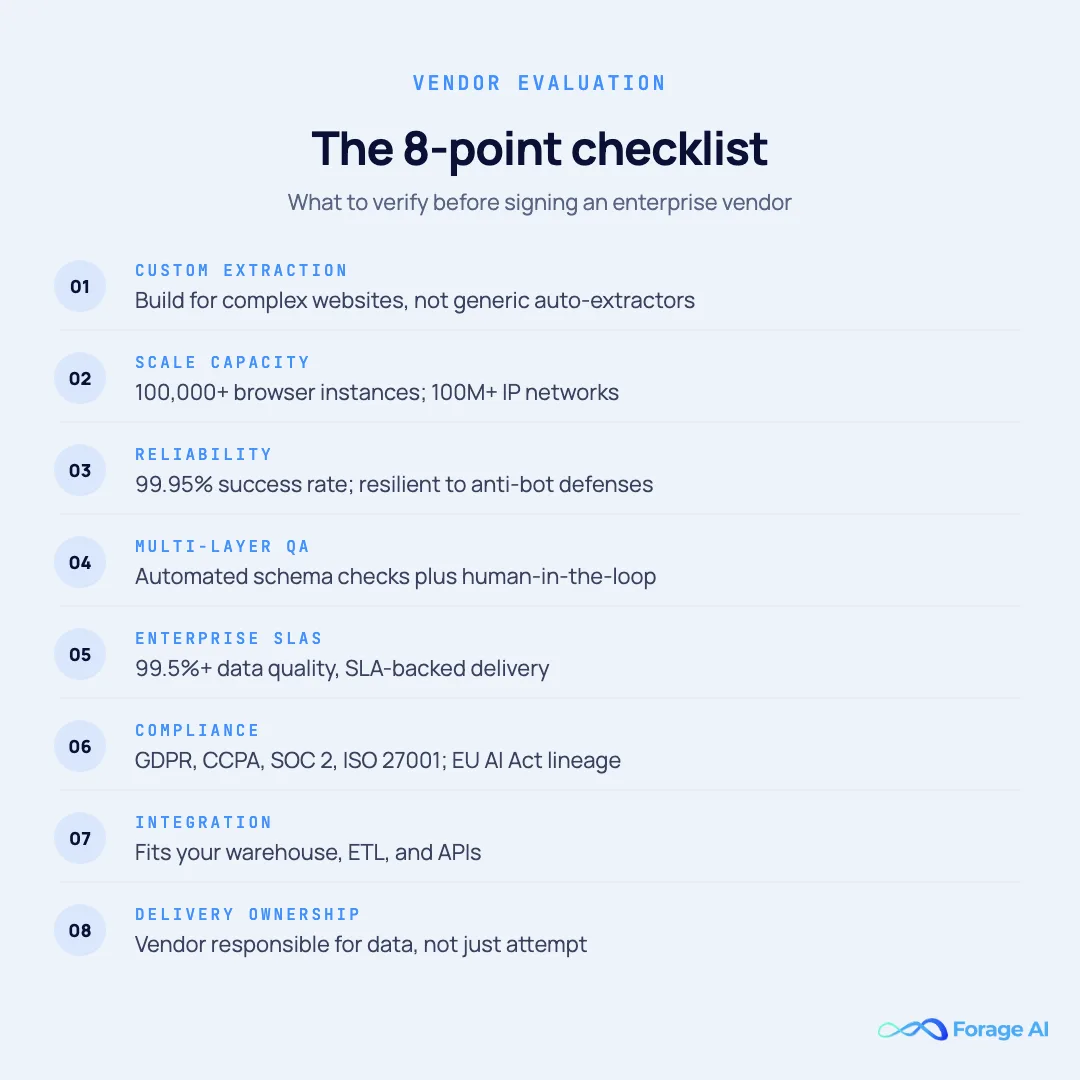
Use this checklist:
- Custom extraction: Does the vendor build custom scrapers for complex websites required for your use case (Shadow DOMs, dynamic loading), or rely on generic auto-extractors?
- Scale capacity: Can they spin up 100,000+ browser instances instantly? Do they have a proxy network large enough (100M+ IPs) to prevent subnet bans?
- Reliability and success rates: Do they have a dependable tech stack to navigate pages, or brittle CSS selectors? Do they handle antibots, TLS fingerprinting, and browser attestation satisfactorily? Independent 2026 testing shows top-tier proxy networks hitting roughly 99.95% success rate and 0.6s response time (AIMultiple, 2026).
- Multi-layer data QA: Look for automated schema checks combined with Human-in-the-Loop (HITL) review for critical datasets.
- Enterprise SLAs and uptime: Demand guarantees on data quality (99.5%+) and delivery timeliness, backed by financial penalties.
- Compliance, governance, and security: The vendor must provide indemnification, PII redaction, and “Legitimate Interest” assessments. At the enterprise tier, that also means documented posture against GDPR, CCPA, SOC 2, ISO 27001, and (where applicable) HIPAA. See the Legal and Compliance section below for the full EU AI Act and case-law landscape.
- Integration with your existing pipeline: Ensure integrations with your data warehouse, ETL pipelines, and APIs.
- Reliable and dependable: The vendor should take responsibility for the data delivery, not just the attempt.
AIMultiple’s 2026 benchmark recorded Oxylabs at 99.95% success rate and 0.6s response time. Source: AIMultiple, 2026.
Top scraping APIs detect only around 60% of Google AI Overview structured elements, the gap between marketing claims and field reality. Source: Scrape.do, 2026.
Forage AI’s QA team is sized at roughly 3x the industry average relative to delivery, the operational backbone behind the “multi-layer QA” item. Source: Forage AI differentiators.
Top Enterprise Web Scraping Companies (2026)
Below are the leading providers based on infrastructure, enterprise adoption, scalability, and managed service capabilities.
1. Forage AI
| Forage AI: at a glance | |
|---|---|
| Type | Fully Managed Service |
| Best For | Mid-large enterprises building AI products |
| Scalability | Very High (Elastic Cloud) |
| QA | Multi-Layer (AI + HITL) |
| Compliance | Enterprise / Custom |
| AI-Ready Data | Very High (Custom Cleaning) |
| SLAs | Data Quality and Delivery |
Positioning: The strategic partner for fully managed web scraping.
Best For: Mission-critical, high-complexity custom extraction pipelines where accuracy and compliance are paramount.
Forage AI is a managed web scraping provider delivering accurate, reliable data tailored to your business needs. With a team of 100+ data experts and project managers, you don’t just get data, you get a partner to solve your data problems end-to-end. Forage AI has crawled 500M+ websites across 15+ industries over 12+ years; the QA team is sized at roughly 3x the industry average relative to delivery.
- Core Capabilities: AI agents, NLP, and custom-trained ML models running in parallel to crawl and structure relevant, accurate data.
- Infrastructure: Scalable, resilient infrastructure built to handle any website at any scale and frequency. As a managed services provider, there is no need to build any scraping infrastructure in-house.
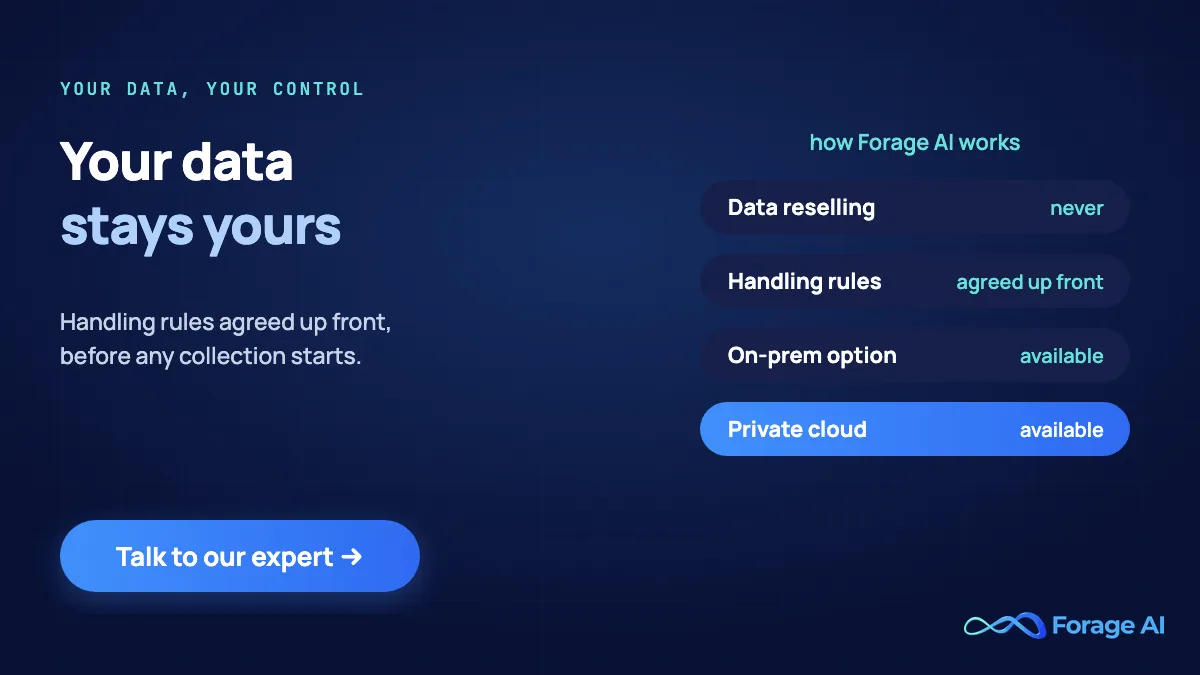
- QA and Governance: Multi-layer QA process with Human-in-the-Loop verification, with contractual controls and client-specific handling rules agreed up front. Source-specific due diligence to mitigate copyright and privacy risks.
- Consultancy: Project and account managers actively monitor each pipeline to optimize processes and offer guidance on future expansions and the legal landscape.
2. Bright Data
| Bright Data: at a glance | |
|---|---|
| Type | Hybrid (Infra + Data) |
| Best For | Infrastructure |
| Scalability | Very High (Massive Infra) |
| QA | Automated |
| Compliance | KYC / Network Focus |
| AI-Ready Data | High (Datasets) |
| SLAs | Uptime and Success Rate |
Positioning: The Infrastructure Giant.
Best For: Engineering-led organizations needing massive, raw proxy access.
Bright Data sets the standard for infrastructure reach with 150M+ ethically sourced residential IPs across 195 countries. The network serves 20,000+ organizations including 14 of the top 20 global LLM labs, and the business crossed $300M ARR in 2025 (Bright Data public disclosures, May 2026).
- Core Capabilities: Full-stack scraping infrastructure with proxies, scraping APIs, and tooling.
- “Web Unlocker” technology for automated unblocking and a vast marketplace of pre-scraped datasets (e.g., Amazon catalog).
- Unmatched proxy network.
- Downside: More expensive than smaller providers like Massive Proxies. Implementation complexity is high. Requires in-house resources.
3. Zyte
| Zyte: at a glance | |
|---|---|
| Type | API and Tooling |
| Best For | Scrapy Teams and Compliance |
| Scalability | High (API based) |
| QA | Automated |
| Compliance | Legal / EWDCI Leader |
| AI-Ready Data | Medium (Auto Extract) |
| SLAs | Response Time |
Positioning: Developer-friendly enterprise scraping infrastructure.
Zyte offers enterprise scraping APIs, proxies, and automation tools. It is built on Scrapy, one of the most widely used scraping frameworks.
- Core Capabilities: AI-based automatic extraction for news and e-commerce, and strong legal indemnification as a founder of the Ethical Web Data Collection Initiative (EWDCI).
- Powerful scraping APIs and proxy management.
- Ideal for technical teams building custom scraping pipelines.
- Downside: Developer-centric; requires internal technical resources.
4. Oxylabs
| Oxylabs: at a glance | |
|---|---|
| Type | Hybrid (Proxy + API) |
| Best For | E-commerce Intelligence |
| Scalability | Very High (Proxy Network) |
| QA | Automated |
| Compliance | Network Focus |
| AI-Ready Data | Medium (Scraper API) |
| SLAs | Uptime and Success Rate |
Positioning: Enterprise scraping powered by automation and AI infrastructure.
Oxylabs competes on raw performance with a 100M+ proxy IP network across 195 countries and specialized Scraper APIs for retail, a bar that shapes every shortlist of alternatives to Oxylabs. In independent 2026 testing, Oxylabs hit 99.95% success rate and 0.6s response time (AIMultiple).
- Core Capabilities: Access to 100M+ proxy IPs, scraping APIs, Web Unblocker tools, and AI-assisted crawling infrastructure.
- “OxyCopilot” AI assistant for pipeline control and AI-driven proxy rotation to avoid subnet bans.
- Strong compliance posture and enterprise support.
- Downside: Internal team required for technical integration and management.
5. Diffbot
| Diffbot: at a glance | |
|---|---|
| Type | Knowledge Graph |
| Best For | Entity Extraction |
| Scalability | High (Pre-crawled) |
| QA | AI-Visual |
| Compliance | Public Web Focus |
| AI-Ready Data | High (Structured Graph) |
| SLAs | Uptime |
Positioning: Structure-first knowledge graph.
Diffbot uses computer vision to “read” pages and builds a large pre-existing Knowledge Graph of entities.
- Core Capabilities: Visual extraction that is immune to many DOM changes and a queryable database of billions of entities.
6. Apify
| Apify: at a glance | |
|---|---|
| Type | PaaS |
| Best For | Engineering teams and startups |
| Scalability | High (Cloud Actors) |
| QA | Automated |
| Compliance | Public Web Focus |
| AI-Ready Data | Medium (Actor outputs) |
| SLAs | Uptime |
Positioning: The cloud platform for developers.
Best For: Engineering teams and startups needing a flexible PaaS.
Apify provides a cloud platform and marketplace of “Actors” (serverless scripts) for scraping.
- Core Capabilities: A vast store of ready-to-use scrapers and resilient cloud infrastructure for deploying custom Node.js/Python code.
7. The AI-Native Tier: Firecrawl, Kadoa, Crawl4AI
Beyond the six enterprise-grade providers above, a fourth category has emerged: the AI-native tier, purpose-built for developer teams shipping AI features. It is worth understanding where this tier fits before the decision framework.
- Firecrawl: Markdown-first output for LLM pipelines; enterprise tiers typically run roughly $500-$5,000/month.
- Kadoa: Self-healing extraction with SLAs, audit logs, and change detection.
- Crawl4AI: Open-source Python framework with 50K+ GitHub stars and pattern-learning algorithms.
These tools are the right call for developer-led teams shipping AI products without enterprise compliance scope. They hit ceilings on volume, custom schemas, and procurement-grade documentation.
Quick Summary
Q: Which web scraping companies dominate the 2026 enterprise tier? Forage AI fits teams that want fully managed extraction; Bright Data and Oxylabs anchor the infrastructure tier with 150M+ and 100M+ IP networks; Zyte, Diffbot, and Apify serve developer-led teams; an AI-native middle tier (Firecrawl, Kadoa, Crawl4AI) has emerged for LLM-pipeline use cases.
A:
Bright Data crossed $300M ARR in 2025, growing 50%+ YoY: infrastructure-tier revenue is consolidating at the top. Source: Bright Data public disclosures.
Oxylabs hit 99.95% success rate and 0.6s response time in May 2026 independent benchmarking. Source: AIMultiple.
Crawl4AI has crossed 50K GitHub stars, a signal of open-source AI-native momentum. Source: Crawl4AI / Capsolver comparison.
Compare Enterprise Scraping Providers
| Company | Type | Best For | Scalability | QA | Compliance | AI-Ready Data | SLAs |
|---|---|---|---|---|---|---|---|
| Forage AI | Fully Managed Service | Mid-large enterprises building AI products | Very High (Elastic Cloud) | Multi-Layer (AI + HITL) | Enterprise / Custom | Very High (Custom Cleaning) | Data Quality and Delivery |
| Bright Data | Hybrid (Infra + Data) | Infrastructure | Very High (Massive Infra) | Automated | KYC / Network Focus | High (Datasets) | Uptime and Success Rate |
| Zyte | API and Tooling | Scrapy Teams and Compliance | High (API based) | Automated | Legal / EWDCI Leader | Medium (Auto Extract) | Response Time |
| Oxylabs | Hybrid (Proxy + API) | E-commerce Intelligence | Very High (Proxy Network) | Automated | Network Focus | Medium (Scraper API) | Uptime and Success Rate |
| Diffbot | Knowledge Graph | Entity Extraction | High (Pre-crawled) | AI-Visual | Public Web Focus | High (Structured Graph) | Uptime |
| Apify | PaaS | Engineering teams and startups | High (Cloud Actors) | Automated | Public Web Focus | Medium (Actor outputs) | Uptime |
| AI-Native (Firecrawl/Kadoa) | Developer Tools | AI-product teams without enterprise compliance scope | Medium | Automated | Public Web Focus | High (Markdown-ready) | Best-effort |
Pricing Overview for Enterprise Web Scraping (2026)
Pricing models have matured to align with value and predictability.
- Value-based: You pay for the data delivered; everything else is fully managed by the partner. This shifts the risk of failure to the vendor. If the scraper breaks, it is not your problem. Enterprise managed contracts typically range from roughly $25K-$150K+/month depending on scale, custom field depth, and compliance scope.
- Per-page / per-request: Standard for infrastructure providers (Bright Data, Oxylabs). You pay for bandwidth or requests. Typical enterprise infrastructure spend lands around $5K-$25K/month for proxy and scraping API access; costs spike when anti-bot defenses force heavy bandwidth. Risk: costs can balloon when anti-bot defenses require heavy bandwidth to bypass.
- Subscription-based: Typical for data feeds (Webz.io, Diffbot). A recurring fee for access to a firehose or graph, generally $2K-$15K/month at enterprise tier.
- Dedicated engineering models: A monthly retainer for the engineering team plus variable compute costs, typically $30K-$200K+/month depending on team size.
- AI-native developer tools: Markdown-first outputs and developer SaaS sit at the lower end, around $500-$5,000/month, with usage-based metering.
Cost drivers: Site complexity (anti-bot difficulty), frequency (real-time vs. daily), and data volume.
TCO framing: Headline price is rarely the right comparison. Add internal engineering cost (1-3 FTE at $150K-$250K loaded for DIY pipelines), monitoring and maintenance, anti-bot retainers, and the cost of a single missed-data incident in an enterprise context. The variable-to-fixed cost conversion is the structural appeal of managed.
Managed vs Infrastructure Providers: What’s the Difference?
| Feature | Infrastructure (Bright Data / Oxylabs) | Managed Precision (Forage AI) | Strategic Implication |
|---|---|---|---|
| Data Ownership | Vendor Resells Data (Marketplace) | Client Owns Data (Exclusivity available) | High Impact: Exclusivity preserves Alpha. |
| Maintenance | Client Responsibility (DIY) | Vendor Responsibility (Managed) | High Impact: Reduces internal TCO and risk. |
| Compliance | Infrastructure-Level (Blind) | Documented sources and client-specific handling rules agreed up front | High Impact: Essential for the EU AI Act (see Legal and Compliance below). |
| Extraction Tech | Selectors / Scripts | AI Agents / LAMs | Medium Impact: Determines pipeline uptime. |
| Pricing Model | Usage-Based (Volatile) | Outcome-Based (Predictable) | Medium Impact: Budget stability. |
Pricing is one half of the procurement conversation. The other half, newly material in 2026, is the regulatory framework that determines what “compliant” means when scraped data flows into AI training or enterprise decision systems.
Managed-service CAGR (15.1%) outpaces software CAGR (14.2%): enterprises are paying premiums to offload compliance and anti-bot work. Source: Intel Market Research, 2026.
Bright Data’s $300M ARR in 2025 signals enterprise consolidation toward top-tier vendors. Source: Bright Data public disclosures.
Outcome-based pricing converts variable cost to fixed OpEx, the structural pattern of the managed-precision category. Source: Forage AI differentiators.
What Does the 2026 Legal Landscape Require?
In 2026, the legal floor for enterprise scraping is clearer than it has ever been, and the regulatory ceiling is lower. Meta v. Bright Data (N.D. Cal., Jan 2024) closed the decade’s most-watched scraping suit with summary judgment for the scraper; Meta abandoned the case Feb 23, 2024. hiQ Labs v. LinkedIn (Ninth Circuit) had already affirmed that scraping logged-out, publicly visible data falls outside CFAA reach. The combined effect: a defensible legal baseline for scraping public web data.
What changed in 2026 is the regulatory layer. The EU AI Act’s GPAI training-data provisions went live on August 2, 2025, with a mandatory training-data disclosure template finalized in July 2025. Providers must publish summaries of training data including the top 10% of scraped internet domains by content size (5% for SMEs). Enforcement begins August 2, 2026; the existing-GPAI compliance deadline lands August 2, 2027. The TDM Reservation Protocol (TDMRep) has emerged as the machine-readable standard for rightsholder opt-outs, and the GPAI Code of Practice (July 2025) requires compliance with it.
Expert Insights
The European Commission published its template for the public summary of training content on 24 July 2025, stating that “the public summary will provide a comprehensive overview of the data used to train a model, list main data collections and explain other sources used.” For a buyer, that is what turns provenance from a nice-to-have into a question with a filing deadline behind it, and it is worth asking any vendor how they would answer it on your behalf.
For procurement and legal teams, that compresses into a three-layer 2026 Compliance Stack:
- Legal floor: case law (hiQ v. LinkedIn; Meta v. Bright Data). Public, logged-out data is not CFAA reach.
- Regional regulation: EU AI Act + GPAI Code of Practice, GDPR Art. 6, CCPA.
- Vendor governance: SOC 2, ISO 27001, HIPAA where applicable, no-resell guarantees, data-ownership posture, lineage documentation.
The trouble zones are familiar: creating fake accounts to scrape gated data; ignoring robots.txt on websites that have asserted TDMRep opt-outs; using scraped data for AI training without lineage documentation for the EU market. Procurement-grade vendors document each of these.
With the regulatory floor mapped, the choice between providers comes down to matching your team’s maturity, use case, and compliance scope to the right tier.
Which Enterprise Web Scraping Company Is Right for You?
In 2026, the market has bifurcated and then cracked into a tetrad: Infrastructure Providers (selling the shovel), Managed Data Partners (delivering the gold), Developer PaaS (a flexible cloud floor), and an AI-Native Tier (purpose-built for AI product teams). Your choice depends on your internal engineering maturity, your use case, and your compliance scope.
- Choose Forage AI if: You need a strategic data partner, not just a tool. You require “AI-ready” or “product-ready” data with strict SLAs on accuracy and compliance. This is the ideal choice for enterprises that want to offload the entire complexity to a dedicated team. Best fit when your data team is 5-20 people, you need 100K-millions of records refreshed weekly or more frequently, and compliance documentation is a procurement-grade requirement.
- Choose Bright Data or Oxylabs if: You are an engineering-led organization with a 10+ person data engineering team that wants to own scraper logic and integrate proxies directly into your stack. If your primary constraint is raw request volume and you need access to massive residential proxy networks to route your own traffic, these infrastructure giants offer the foundation your in-house engineers can build upon, and this side-by-side breakdown settles which of the two to sign once both quotes are in the procurement queue.
- Choose Zyte or Apify if: You are a Scrapy-fluent developer-centric startup or a technical team comfortable maintaining your own pipeline code. If you want a cloud platform to deploy your own Python/Node.js scripts, these platforms offer excellent PaaS environments. They bridge the gap between raw infrastructure and tools, perfect for teams that want to code but do not want to manage servers.
- Choose Firecrawl, Kadoa, or Crawl4AI if: You are a product team building AI features who needs markdown-ready output from tens to hundreds of sources, without procurement-grade compliance scope. The AI-native tier is the honest choice when your use case doesn’t demand the documentation, governance, or scale that managed precision exists to deliver.
In 2026, clean, compliant, and structured data is the refined fuel. The winners of 2026 will be the enterprises that partner with vendors capable of refining that fuel at scale, against the right tier for their team and use case.
Bright Data’s 150M+ IP network and $300M ARR position the infrastructure tier as the consolidation winner for engineering-led buyers. Source: Bright Data public disclosures.
Oxylabs benchmarked at 99.95% success and 0.6s response in 2026 independent testing: a credible second infrastructure tier choice. Source: AIMultiple.
AI-native tools (Firecrawl, Kadoa, Crawl4AI) have matured fast: 50K+ GitHub stars on Crawl4AI alone, with markdown-first outputs designed for LLM pipelines. Source: Crawl4AI / Capsolver comparison.
Why Do Enterprises Prefer Fully Managed Partners?
Managed web scraping is the fastest-growing category in the 2026 data-extraction stack: services growing at 15.1% CAGR vs 14.2% for software (Intel Market Research, 2026). 65% of enterprises now use scraped data in AI/ML pipelines, and the procurement question has shifted from “can we get the data” to “can we document its lineage” (2026 industry survey).
- Removes maintenance burden: The “self-healing” capability of managed services eliminates the Monday-morning fire drill when target sites change layouts.
- Higher reliability: Redundant infrastructure ensures SLA-backed uptime that internal teams typically cannot match.
- Better data quality: Dedicated providers use sophisticated cleaning pipelines and Human-in-the-Loop verification.
- Predictable delivery: Contracts convert variable engineering costs into fixed operational expenses.
- Ready for AI/ML pipelines: Data is delivered as clean text or vectors, saving data science teams months of cleaning work.
- Support: Fully managed partners provide dedicated account managers and data engineers. You get proactive monitoring and a direct line to experts who understand your specific business use case, not just the underlying tech.
- No in-house teams: A managed partner acts as an instant extension of your organization. This frees up your highly-paid internal data scientists and software engineers to focus on your core product.
- Regulatory documentation pre-built: Managed providers maintain training-data lineage records that downstream enterprises need for EU AI Act compliance. See the Legal and Compliance section above.
Managed is not the right call when your team’s primary constraint is raw request volume and you have the engineering depth to own anti-bot tuning. The companies-vs-tools failure mode comparison walks through that branch in detail.
Before you decide, here are the questions enterprise buyers consistently ask, and what the 2026 best-answer looks like.
Frequently Asked Questions
What is enterprise web scraping?
Enterprise web scraping is the large-scale, continuously maintained extraction of public web data, structured and delivered for AI training, competitive intelligence, or commercial data products. In 2026, the market sits between $512M and $1.17B depending on scope, with managed services growing faster than software.
How much does enterprise web scraping cost in 2026?
Managed services typically run $25K-$150K+/month; infrastructure-tier (proxy and API) runs $5K-$25K/month; data-feed subscriptions sit around $2K-$15K/month; AI-native developer tools $500-$5,000/month. TCO matters more than headline price: internal engineering, monitoring, and missed-data risk often dwarf vendor fees.
Is enterprise web scraping legal?
Yes, for publicly visible data, with caveats. hiQ Labs v. LinkedIn (Ninth Circuit) and Meta v. Bright Data (N.D. Cal., Jan 2024) both affirm that scraping logged-out public web data falls outside CFAA reach. The EU AI Act’s GPAI provisions (effective August 2, 2025; enforcement begins August 2, 2026) require enterprises sourcing AI training data to document lineage and respect rightsholder opt-outs.
What’s the difference between web scraping software and managed services?
Software (proxies, scraping APIs, PaaS) gives you the tools; you own the pipeline, the QA, and the compliance documentation. Managed services own the entire pipeline: source discovery, extraction, QA, lineage, and delivery. The Managed vs Infrastructure comparison table above maps the structural differences across data ownership, maintenance, compliance, extraction tech, and pricing model.
Which is the best web scraping service for enterprise?
There is no single answer. The right tier depends on team maturity, use case, and compliance scope. Forage AI fits procurement-grade managed precision; Bright Data and Oxylabs fit infrastructure scale; Zyte and Apify fit developer PaaS; Firecrawl and Kadoa fit AI-product teams without enterprise compliance scope.
How does the EU AI Act affect web scraping?
The EU AI Act’s GPAI training-data provisions went live August 2, 2025. Providers using scraped data to train or source AI training data must publish training-data summaries including the top 10% of scraped domains by content size (5% for SMEs), respect rightsholder opt-outs (TDMRep), and document lineage. Enforcement begins August 2, 2026; the existing-GPAI compliance deadline lands August 2, 2027.
Related Content
Related Blogs:
- AI Training Data: An Operational Playbook for Data PMs and ML Engineers – Sai S, 5 min read
- Web Scraping Legal Compliance: Code Patterns That Survive Legal Review – Sai S, 5 min read
- Why RAG Pipelines Fail in Production: A Data Quality Diagnosis – Punit Y, 5 min read
- Web Scraping Companies vs Tools: A Failure-Mode Comparison – Sai S, 5 min read
By Punith Y