
Best Multilingual Data Collection Services That Build to Your Spec
Last updated November 2026
Check the open corpora for the language you are launching in and the index looks fine. Open the files and there is almost nothing usable, or what is there was machine translated from English. If you have not checked yet, start with our comparison of multilingual datasets.
If you have, you need multilingual data collection services: providers that build custom multilingual data to your spec. Their homepages lead with 200+, 500+ or 1,000+, but the method matters more than the count. We sorted the multilingual AI data providers we read by method and quoted each one's own page, so you finish with a shortlist of two or three, five checks to get in writing, and a sample request to send.
- Two methods: a provider either extracts text already published in your language or commissions native speakers to create new speech and text.
- Native-speaker collection: we read 18 vendors that state native-speaker collection to spec on their own pages.
- In-language extraction: in our read of 17 web-data providers' own pages besides our own, on 11 November 2026, two described building in-language corpora to a client's spec.
- Order of decisions: pick the method first, then the provider; no provider publishes delivered per-language volume, so ask for it in writing.
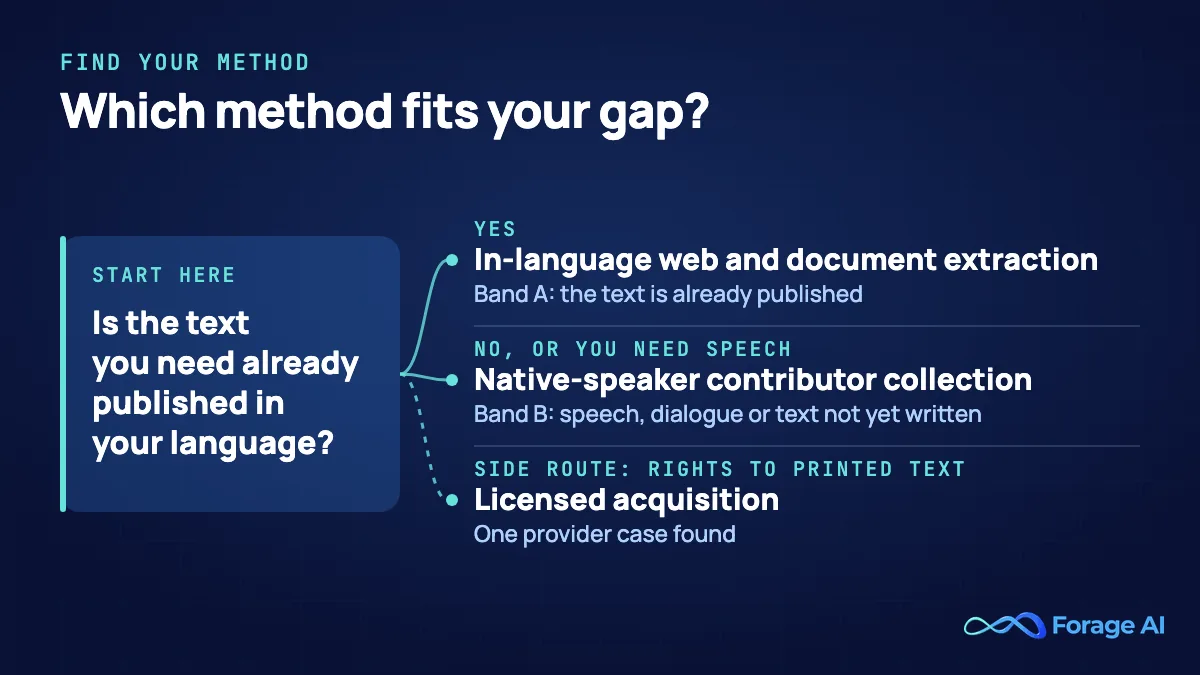
Which method fits your gap?
- Speech, dialogue or text nobody has written yet → native-speaker contributor collection (band B)
- A large text corpus in a language published online or in documents → in-language web and document extraction (band A)
- Rights to text that already exists in print → licensed acquisition; we found one provider case, listed in the native-speaker band
Every provider statement below was read on its own page on 11 November 2026 and is quoted as that vendor's claim. Nobody paid for placement. Forage AI publishes this guide. It is our own service, listed first in its band by house convention, not by evidence rank. Zyte and Import.io publish more specific language evidence than Forage AI's own page does.
Multilingual data collection services at a glance
The shortlist on one screen, grouped by method and unranked. "Best for" states fit, not quality; language counts sit in the comparison table as vendor claims.
Multilingual data collection services at a glance (pages read 11 November 2026)
| Provider | Method | Best for |
|---|---|---|
| Forage AI (publisher) | Extraction | Managed builds from in-language web and document sources to your fields |
| Import.io | Extraction | Domain text corpora to your source, language and dedup spec |
| Zyte | Extraction | Managed feeds from named websites, including a Hindi-sources case |
| Andovar | Contributors | Custom speech recordings |
| Appen | Contributors | Remote, supervised and device settings, including code-switched speech |
| Argos Multilingual | Contributors | In-market contributors, dedicated low-resource offer |
| Defined.ai | Contributors | Crowd collection to spec, text and speech |
| Digital Divide Data | Contributors | Low-resource languages in Africa and Southeast Asia, impact sourcing |
| Lionbridge AI Data Services | Contributors | Rare-locale collection with native-speaker sourcing |
| LXT | Contributors | Freshly recorded speech and text, remote to studio |
| RWS TrainAI | Contributors (plus a licensed-acquisition case) | Community collection to spec |
| Shaip | Contributors | Speech and text with a pilot, including licensed source text |
| Stepes | Contributors | Native text, speech, prompts and conversations |
| TELUS Digital | Contributors | Managed crowd, remote to field operations |
| Ulatus | Contributors | Speech, text, image and video from scratch |
| Welo Data | Contributors | Recruited speakers and linguist-level writing, client ownership stated |
Five more vendors appear as one-liners at the end of the native-speaker band: DataForce, HumanSignal, Innodata, Pangeanic and Sigma.AI. Vendors we read and left out are under "Why these providers are not on the list".
How we chose these multilingual data collection services
A vendor made the list on evidence from its own website, not reputation: a page offering language data collection or extraction built to the client's spec, with the method stated. We read more than 40 vendor pages on 11 November 2026; pages that refused automated reads are listed as unread. Nothing was tested hands-on or ranked. If you are still deciding which of the four kinds of AI training data supplier you need, start there.
| Criterion | What each entry records |
|---|---|
| Builds to spec | The vendor's offer to collect to your spec |
| Method and modalities | How the data is made; text, speech, image or video |
| Languages (vendor claim) | The figure as printed, or "different totals on different pages" |
| Consent and origin (as stated) | Native or freshly created, and the consent wording |
| Ownership (as stated) | The clause, quoted, or "Not stated; ask for the clause" |
| Pricing and timeline (as published) | A published unit, range or timeline, or "Quote" |
| Watch-out | What to raise on the first call |
- Vendor figures are vendor claims.
- "Not stated" means the vendor's pages do not say it.
- Numbers are for reference, not rank.
Few vendors publish delivery formats or per-record fields; check 4 tells you what to ask for. We found no buyer reviews of these specific services, and company-wide ratings are not used. Forage AI publishes this guide; it is listed first in its band by house convention, not by evidence rank.
The best multilingual data collection services by method
Two bands and one route. "Not stated" means the vendor's page is silent, not that the vendor cannot do it.
In-language web and document extraction
When the text exists in your language (regional news, government portals, forums, documents) but is buried in a general crawl or missing from open corpora, the job is a targeted extraction build, not a recording project. Filtering a crawl harder does not fix it: in the Kreutzer et al. audit (TACL 2022), language-ID filtering lifted median precision "from 13.8% pre-filter to 43.9% post-filter" at "a steep cost of 77.5% loss in recall".
Nor can filtering add documents the crawl never sampled. MaCoCu crawled Malta's national domain and collected 347.9 million Maltese words, comparable to or more than the 286.5 million FineWeb-2 keeps from 96 Common Crawl snapshots, though it took a four-institution consortium. See how data extraction services work, or build the corpus yourself.
In our read of 17 web-data providers' own pages besides our own, on 11 November 2026, two described building in-language corpora to a client's spec.
Extraction is not a way to create language data. It collects what is already published, so it cannot create speech, or new text in a language that is thin online.
Most languages are thin online: Joshi et al. (ACL 2020) placed 2,191 of 2,485 languages in the lowest resource class. Targeted crawls skew too. The MADLAD-400 audit (Google, 2023) found 141 languages with significant Bible data, and "Five datasets were found to be in the wrong language." For speech or unwritten text, go to the native-speaker band.
1. Forage AI
Forage AI, publisher of this guide: managed builds from in-language web and document sources to your fields.
| Attribute | Detail |
|---|---|
| Builds to spec | "We map the source universe by region, language, publisher, and document type, including long-tail sources beyond the initial list." |
| Method and modalities | Managed extraction from in-language web and document sources to your fields, schema and refresh cadence; pipeline maintained as sources change |
| Languages (vendor claim) | No count. "Multilingual and multimodal inputs can be included where the source and intended use are feasible." Coverage and limits "are confirmed during discovery" |
| Consent and origin (as stated) | Inherits the source, so origin is a filter you specify. Records can carry source URL, collection timestamp, language and version |
| Ownership (as stated) | Clients own the data; Forage AI never resells it |
| Pricing and timeline (as published) | Quoted per scope; tested "on a representative sample before production" |
| Watch-out | Its page names no specific languages or scripts |
It fits teams that need to "add geographies, languages, domains, or document classes without building a separate acquisition operation for each one". Coverage, recall and field completion are measured separately from accuracy, and source access, licensing, permitted use and retention are reviewed before the build: a scoping step, not a rights guarantee.
Zyte and Import.io publish more specific language evidence than Forage AI's own page does. Not for: Forage AI builds from sources that already exist on the web and in documents; if you need new recordings or text written by native speakers, that is a band B provider's job.
Pros: ownership stated outright; source discovery by region and language is part of the build. Cons: no named languages, scripts or volumes on its page.
2. Import.io
Builds domain text corpora to a source, language and quality specification you write.
| Attribute | Detail |
|---|---|
| Builds to spec | "Domain corpora built to your specification: sources, languages, date ranges, exclusions, deduplication thresholds and quality filters you define." |
| Method and modalities | Managed web extraction, text; "Language ID with confidence, boilerplate removal, encoding repair, exact and MinHash near-duplicate removal" |
| Languages (vendor claim) | "Any script and locale"; its evaluation sample states "30 · min 50k docs each" |
| Consent and origin (as stated) | Per-document "source URL, fetch timestamp, content hash, language, license signal and robots status" |
| Ownership (as stated) | Not stated; ask for the clause |
| Pricing and timeline (as published) | "priced per corpus"; managed feeds "Per source maintained ... Not per row"; first delivery "two to three weeks from signature" |
| Watch-out | "Sample releases are licensed for evaluation and research"; the per-language floor is not a delivery commitment |
Import.io publishes the most specific multilingual spec on any extraction page we read, with fields you can lift into your own request: "language ID ≥ 0.95" and "dedupe exact + near-dup (MinHash, 0.85)". Per-record language with confidence matters because a page in your language can be a machine translation; the manifest lets you filter after delivery.
The sample-versus-delivery gap disqualifies it only if you need a contractual per-language minimum on day one. Not for: speech, or languages with little published text.
Pros: spec fields you can copy; provenance on every document. Cons: ownership not stated.
3. Zyte (Zyte Data)
Managed extraction feeds built from the websites and fields you name, with one published Hindi-sources case.
| Attribute | Detail |
|---|---|
| Builds to spec | "You tell us the sites, the fields and how often you need the data." |
| Method and modalities | Managed extraction, text; an inLanguage field "to count and audit training data for linguistic diversity" |
| Languages (vendor claim) | No count. The vendor reports a client seeking "custom extraction pipelines specifically for Hindi-language sources" (Zyte blog, 9 June 2026) |
| Consent and origin (as stated) | Inherits the source; Not stated beyond the language field |
| Ownership (as stated) | Not stated; ask for the clause |
| Pricing and timeline (as published) | "a custom feed from a single source typically starts around $500 a month, and each additional source on the same feed adds about $200 a month" (November 2026); a sample "within one day" for simple feeds |
| Watch-out | One vendor-reported language case; the service page is language-neutral |
Zyte is the one band A provider with a published per-source price. By our arithmetic on that rule of thumb, 20 regional sources come to about $4,300 a month and 200 to about $40,300, so a tail-language corpus is priced by source count, not volume. The $500 minimum on its pricing page belongs to its API tier, a different product.
Zyte's line that what you collect "stays your decision" describes use, not ownership. Not for: speech, or buyers who need a multilingual commitment on the service page.
Pros: published per-source pricing; a sample in your schema within a day. Cons: one case, not a language programme; ownership not stated.
PromptCloud has a 2022 page (updated 2025) saying it extracted Chinese and Japanese text from websites for clients; it states no multilingual-corpus offer.
Whichever band A provider you shortlist, ask how it handles six things:
- Finding the sources: a register per language (national domains, news, government, forums, documents).
- Language ID: weakest on short lines and close relatives. In a 2026 preprint test on short posts, GlotLID's precision for Bosnian was 16.95% (Fedorova et al., OpenLID-v3).
- Script and encoding: script per document, delivered as JSONL or Parquet in UTF-8, since CSV cannot declare an encoding.
- Boilerplate and duplicates: both inflate a language's count; ask for counts after dedup.
- Machine-translated pages: volunteers estimated 40% to 60% of articles in four African-language Wikipedias were uncorrected machine translations (MIT Technology Review, 2025). A collector can flag suspected translation, not certify native origin.
- Robots and terms: a floor, not a licence; France's CNIL (January 2026) treats ignoring robots.txt as defeating a legitimate-interest basis. Lawfulness turns on the data, the access and the use; see the legal and ethical questions in web scraping.
Native-speaker contributor collection
Native-speaker contributor collection is the only route for speech, dialogue and languages with little written text. "African languages are not as often recorded, including on the internet," write Vukosi Marivate, Ife Adebara and Lilian Wanzare of African Next Voices (The Conversation, 16 October 2025). Volunteer collection does not close the gap: Mozilla's Common Voice v27.0 (September 2026) lists 295 locales, and 108 have under 10 validated hours.
We read 18 vendors that pass our test; none publishes per-language contributor counts or delivered volume, though figures can come under a non-disclosure agreement. Entries describe collection only, even where a vendor also translates, labels or transcribes.
4. Andovar
Custom speech recordings by native speakers, studio or scenario-matched.
| Attribute | Detail |
|---|---|
| Builds to spec | "build custom voice datasets to your exact specifications" |
| Method and modalities | Native-speaker recordings, speech only; WAV, FLAC, MP3 or OGG with JSON, CSV or TextGrid transcripts |
| Languages (vendor claim) | "200+ languages with native speakers" |
| Consent and origin (as stated) | "All speakers provide explicit consent for AI training use." |
| Ownership (as stated) | "Full commercial license with perpetual usage rights for AI/ML training. You own the data." |
| Pricing and timeline (as published) | "Pricing is per hour of recorded audio" (no figure); "2-4 weeks for standard projects"; a quote and sample data within 24 hours |
| Watch-out | No per-language speaker counts |
Andovar is one of two native-speaker vendors that state client ownership, though the same answer calls it a licence first: the page is not the contract. The hour rate varies "by language complexity, recording environment, and annotation depth", so a low-resource language will not price like Spanish. Not for: text corpora.
Pros: ownership and a sample offer on the page. Cons: speech only; no price figure.
5. Appen
Contributor collection across supervised facilities, homes, cars and devices, including code-switched speech.
| Attribute | Detail |
|---|---|
| Builds to spec | "custom AI data collection tailored to your needs" |
| Method and modalities | Supervised sessions at facilities, customer sites, studios, "rented home environments, or in-car environments", plus remote and device collection |
| Languages (vendor claim) | States different totals on different pages (235+, 80+ and 100 languages; 500+ locales) |
| Consent and origin (as stated) | "ethically collected" (low-resource programmes); consent terms Not stated |
| Ownership (as stated) | Not stated; ask for the clause |
| Pricing and timeline (as published) | Quote |
| Watch-out | Locales are not languages |
Appen names code-switched recordings "between language pairs including English-Spanish, Hindi-English, Arabic-French, and Mandarin-Cantonese", useful if your users switch mid-sentence. Its totals differ across pages, so the only number worth having is the one for your language. Not for: buyers who need ownership in writing before scoping.
Pros: code-switched speech named; controlled recording settings. Cons: no published terms.
6. Argos Multilingual
In-market contributor collection with a dedicated low-resource offer.
| Attribute | Detail |
|---|---|
| Builds to spec | "We define contributor criteria, data requirements, validation rules, and delivery structure before collection begins" |
| Method and modalities | "Recruiting and vetting in-market contributors"; prompts, utterances, queries and conversations |
| Languages (vendor claim) | No count stated |
| Consent and origin (as stated) | Contrasts itself with "generic or translated corpora"; consent standards named, not described |
| Ownership (as stated) | Not stated; ask for the clause |
| Pricing and timeline (as published) | Quote |
| Watch-out | No language count or volume published |
Argos Multilingual's origin claim is one to test with check 2. Not for: buyers who need a published unit price.
Pros: spec fixed before collection. Cons: no ownership or price stated.
7. Defined.ai
Crowd collection to spec for text and speech.
| Attribute | Detail |
|---|---|
| Builds to spec | "Custom data collection for high-quality AI training datasets" |
| Method and modalities | A "vetted global crowd"; text and speech |
| Languages (vendor claim) | "contributors in 150+ countries speaking 500+ languages" |
| Consent and origin (as stated) | Its claim: "fully consented, copyright-cleared, and privacy-compliant" |
| Ownership (as stated) | Its public licence for catalogue data keeps ownership with Defined.ai; custom terms not published, ask |
| Pricing and timeline (as published) | Quote |
| Watch-out | A default licence is not ownership |
Defined.ai's Data License Agreement for catalogue data (effective 30 November 2022) says "Licensor owns all rights, title, and interest ... in and to the Data." Custom terms may differ but are not published. Not for: buyers who cannot negotiate a custom ownership clause.
Pros: consent claim on the page. Cons: ownership defaults to the vendor unless the statement of work (SOW) says otherwise.
8. Digital Divide Data
Non-profit, impact-sourcing collector of low-resource language data in Africa and Southeast Asia.
| Attribute | Detail |
|---|---|
| Builds to spec | "Align business goals, language coverage, data modalities, volumes, and quality benchmarks." |
| Method and modalities | "Recruit native speakers and train them"; text, speech and multimodal via web, mobile or on-site |
| Languages (vendor claim) | No count stated; scope is "low-resource languages across Africa and Southeast Asia" |
| Consent and origin (as stated) | Not stated |
| Ownership (as stated) | Not stated; ask for the clause |
| Pricing and timeline (as published) | Quote |
| Watch-out | Also sells transcription and datasets; only collection is listed here |
Digital Divide Data trains the speakers it recruits rather than drawing on an open crowd. Its language list did not render in our read, so ask for it. Not for: high-resource language volume.
Pros: dedicated low-resource offer. Cons: terms unpublished.
9. Lionbridge AI Data Services
Custom data creation with native-speaker sourcing, shown in rare-locale cases.
| Attribute | Detail |
|---|---|
| Builds to spec | "custom data set creation, evaluation, and human feedback" |
| Method and modalities | Native-speaker sourcing; the vendor reports it "Sourced and trained 4,000 native speakers" |
| Languages (vendor claim) | No company-wide count; the vendor reports "paired datasets in 50+ ultra-rare locales" |
| Consent and origin (as stated) | Not stated |
| Ownership (as stated) | Not stated; ask for the clause |
| Pricing and timeline (as published) | Quote |
| Watch-out | Case figures are vendor-reported |
Lionbridge and TELUS Digital are separate companies today; TELUS bought Lionbridge's AI unit in 2020. Not for: buyers who need published pricing.
Pros: rare-locale sourcing shown in a case. Cons: no terms or units published.
10. LXT
Freshly recorded or created speech and text, collected remotely, on mobile or in studios.
| Attribute | Detail |
|---|---|
| Builds to spec | Datasets "created to match your model goals, demographics, and technical requirements" |
| Method and modalities | Remote, on-site via app, or in studios and LXT centres; clickworker is its crowd |
| Languages (vendor claim) | "1,000+ locales"; "100+ languages" on its speech recognition page |
| Consent and origin (as stated) | "All data is freshly recorded or created by contributors who consent to each task" |
| Ownership (as stated) | Not stated; ask for the clause |
| Pricing and timeline (as published) | "Most projects range from $15K for focused domain datasets (50-200 hours) to $150K+ for large multi-accent, multi-environment collections exceeding 1,000 hours"; a proposal "within 48 hours" |
| Watch-out | The range covers speech recognition data, not text |
LXT is the one native-speaker vendor with a published price range. By our arithmetic, $15K for 50 to 200 hours is roughly $75 to $300 per recorded hour, and $150K for 1,000+ hours is $150 or less. Its page mentions "minimum speaker counts per variant" without the figures; ask for them. Not for: buyers who need ownership on the page.
Pros: price range published. Cons: ownership not stated; no per-language numbers.
11. RWS TrainAI
Community collection to your spec, plus the one licensed-acquisition case we found.
| Attribute | Detail |
|---|---|
| Builds to spec | Data collected "by our TrainAI community ... based on your specific ML project requirements" |
| Method and modalities | Community sourcing of "text, audio or speech, image, and video data" |
| Languages (vendor claim) | "any language" (no count) |
| Consent and origin (as stated) | Not stated |
| Ownership (as stated) | In the case below, licences went to the client; community terms Not stated |
| Pricing and timeline (as published) | Quote |
| Watch-out | The licensed-acquisition result is one vendor-reported case |
This entry defines the third route. The vendor reports a client that needed "monolingual data from published texts" in Wolof and Oromo: publications "were sourced, their rightsholders contacted, and license transfers arranged between rightsholders, RWS, and the client". The result was "a corpus of more than 40,000 sentences". One case, but it shows the route exists for text that lives in print. Not for: speech at volume on a published unit.
Pros: a documented route for text that exists only in print. Cons: community terms not published.
12. Shaip
Speech and text collection to spec, starting with a pilot.
| Attribute | Detail |
|---|---|
| Builds to spec | "we can customize the audio collection services to suit your needs" |
| Method and modalities | Native speakers in studio and natural environments; text via "Recruit vetted contributors or license source text" |
| Languages (vendor claim) | States different totals on different pages (60+, 65+, 100+ and 150+) |
| Consent and origin (as stated) | "Usage rights are secured and documented, contributor consent is captured" |
| Ownership (as stated) | Not stated as a clause |
| Pricing and timeline (as published) | Quote; "can start with a pilot"; speech delivered as .wav plus .json |
| Watch-out | Rights and consent are not ownership |
Shaip publishes its speech delivery format, and the pilot makes a first sample easy to request. Secured usage rights describe how the data was gathered, not who owns it afterwards. Not for: buyers who need one stated language figure.
Pros: pilot stated; delivery format published. Cons: no ownership clause.
13. Stepes
Language-service provider that creates or collects native text, speech, prompts and conversations.
| Attribute | Detail |
|---|---|
| Builds to spec | "Define languages, use cases, data structures, taxonomies, evaluation criteria, quality thresholds, and delivery requirements." |
| Method and modalities | "Create or collect native text, speech, prompts, conversations"; "Professional Native Linguists" |
| Languages (vendor claim) | "100+ languages" |
| Consent and origin (as stated) | Native creation stated; consent Not stated |
| Ownership (as stated) | Not stated; ask for the clause |
| Pricing and timeline (as published) | Quote |
| Watch-out | The same page sells "Translated and Localized Datasets"; ask what share is translated |
Prompts and conversations suit assistant or evaluation data more than speech recognition. Not for: buyers who need a contributor count per language.
Pros: prompts and conversations named. Cons: no terms or price.
14. TELUS Digital
Managed crowd collection, from remote tasks to complex field operations.
| Attribute | Detail |
|---|---|
| Builds to spec | "bespoke datasets for unique project requirements" |
| Method and modalities | "managed crowd, remote, in-facility and hybrid" and "complex field operations"; "image, video, speech, text and survey data" |
| Languages (vendor claim) | "500+ Languages and dialects"; "450 Locales" |
| Consent and origin (as stated) | Not stated |
| Ownership (as stated) | Not stated; ask for the clause |
| Pricing and timeline (as published) | "Contact sales" (Quote) |
| Watch-out | Languages and dialects are counted together |
Field operations fit collection that cannot happen on a phone at home. TELUS Digital is a separate company from Lionbridge today. Not for: buyers who need published units.
Pros: field operations for hard-to-reach settings. Cons: no published terms.
15. Ulatus
Language-service provider collecting speech, text, image and video from scratch with native contributors.
| Attribute | Detail |
|---|---|
| Builds to spec | "custom image, video, audio, and text datasets built to your specification" |
| Method and modalities | Datasets "from scratch, collected by native contributors in 125+ countries" |
| Languages (vendor claim) | "200+ languages and regional variants" |
| Consent and origin (as stated) | "consent-backed"; "100% Consent Audited" (its claim) |
| Ownership (as stated) | Not stated as a clause |
| Pricing and timeline (as published) | Quote |
| Watch-out | "Your training data is your IP" sits in a security paragraph, not an ownership clause |
The vendor reports "400+ contributors across 26 locales within two months" producing "650+ hours of natural conversational audio". Divided out (our arithmetic), that is about 25 hours and 15 contributors per locale: the per-language question in practice. Not for: buyers treating a security statement as rights.
Pros: a volume-and-time case to calibrate against. Cons: no ownership clause.
16. Welo Data
Recruited speakers and linguist-level writing to spec, with client ownership stated.
| Attribute | Detail |
|---|---|
| Builds to spec | "You scope the need. We deliver the data." |
| Method and modalities | "demographically precise recruitment"; text "written and reviewed at linguist level, not crowd level" |
| Languages (vendor claim) | "155+ locales with native-speaker access and dialect coverage" |
| Consent and origin (as stated) | "Data consent, participant privacy, and handling protocols finalized before collection begins." |
| Ownership (as stated) | "All collected data belongs to you." |
| Pricing and timeline (as published) | Quote; "Pilot samples and calibration rounds run before full-scale collection." |
| Watch-out | 155+ counts locales, not languages |
Welo Data states ownership without qualification. Do not confuse it with "FULL PROGRAM OWNERSHIP" elsewhere on the page, which means Welo runs the programme. Not for: buyers who need a published price.
Pros: ownership and pilot stated. Cons: no price or per-language volume.
Also offer custom multilingual collection:
- DataForce (TransPerfect): "over 250 languages and dialects" on its collection page, "over 200 languages" for speech on its homepage; contributors "explicitly opt-in".
- HumanSignal: "We recruit native speakers by language, region, dialect"; the same page sells translation and transcription, so only its collection counts here.
- Innodata: "end-to-end AI data collection services for text, speech, audio, image, video, and sensor data, customized to your model's exact requirements"; no language count rendered.
- Pangeanic: "Commission new datasets for specific domains, languages, accents, channels"; speech collection stated, its text method is not.
- Sigma.AI: "Native speakers across 700+ languages and dialects"; its page does not separate new-data collection from annotation.
Why these providers are not on the list
Each vendor below was read and left out for a stated reason.
- Translation or localisation, not collection: Gengo, LangLink, Acolad, Vistatec, Hybrid Lynx; Qualitest states no collection method and sells "translation-based augmentation".
- Catalogue or pre-built: Magic Data; Webz.io and Bright Data, where language is a filter on pre-collected data.
- Annotation-only: iMerit, Sama, CloudFactory and Scale AI; see data labeling companies.
- Translation as the language answer: Apify Professional Services is managed, but its language answer is translation tooling.
- Other web-data companies: the rest we read state no in-language build offer, sell a pre-built feed, or are self-serve tools; see web scraping companies for AI data.
- Could not read (11 November 2026): DATAmundi (formerly Summa Linguae), Sapien, Mindy Support, PoliLingua and Fuzu Atlas refused automated reads; Toloka has no to-spec collection page we could find.
- Not a service: CLEAR Global does non-profit research.
How do these multilingual data collection services compare?
The side-by-side for the shortlist meeting. Watch the two columns the pages leave blank: per-language volume and ownership.
In our read of 18 native-speaker collection vendors' own pages on 11 November 2026, none published per-language contributor counts or delivered volumes.
As stated on vendors' own pages, 11 November 2026
| Provider | Band | Languages (vendor claim) | Per-language volume published | Client ownership stated | Pricing published |
|---|---|---|---|---|---|
| Forage AI (publisher) | A | No count | Not published | Yes | Quoted per scope |
| Import.io | A | "Any script and locale" | Evaluation sample only | Not stated | Per corpus; per source maintained |
| Zyte | A | No count | Not published | Not stated | About $500 a month, plus about $200 per added source |
| Andovar | B | 200+ | Not published | Yes, quoted | Per recorded audio hour (no figure) |
| Appen | B | Different totals on different pages | Not published | Not stated | Quote |
| Argos Multilingual | B | No count | Not published | Not stated | Quote |
| Defined.ai | B | 500+ | Not published | Licence keeps ownership with vendor (catalogue) | Quote |
| Digital Divide Data | B | No count | Not published | Not stated | Quote |
| Lionbridge AI Data Services | B | No count | Not published | Not stated | Quote |
| LXT | B | 1,000+ locales; 100+ languages (speech recognition) | Not published | Not stated | $15K to $150K+ (speech recognition) |
| RWS TrainAI | B | "Any language" | Not published | Case: licence transferred | Quote |
| Shaip | B | Different totals on different pages | Not published | Not stated | Quote (pilot) |
| Stepes | B | 100+ | Not published | Not stated | Quote |
| TELUS Digital | B | 500+ languages and dialects | Not published | Not stated | Quote |
| Ulatus | B | 200+ | Not published | Not stated as a clause | Quote |
| Welo Data | B | 155+ locales | Not published | Yes, quoted | Quote |
Appen, Shaip and DataForce state different language totals on different pages. That is a finding about their pages, not a judgment of their capacity.
What should you check before signing with a provider?
A locale count does not tell you a vendor can deliver your language. Five written answers do, each mapped to a row in the entries.
-
The per-language number, in writing, in the unit you will pay for. Hours and distinct speakers for speech; documents and tokens after dedup for text. For scale, Meta's Omnilingual ASR team set out "to commission the collection of 10 hours of speech from 10 different native speakers" per language, reaching 3,350 hours across 348 languages. From a band A provider, ask for the source register per language.
-
The native versus translated or post-edited share. When the Global-MMLU team (Singh et al., ACL 2025) had reviewers check machine-translated questions, edits touched "36.9% of the samples reviewed".
Expert Insights"The multilinguality achieved through the translation of English datasets does not guarantee multiculturality." The Global-MMLU authors reached that view after reviewers corrected machine-translated exam questions. A count built on translation says nothing about how speakers of that language write, ask and reason.
Translated text is not worthless: a 2025 preprint on Indonesian and Tamil (Velasco and Roque) found "adapting MT-pretrained models on native text often yields better performance than native-only models". Know the share and use it on purpose; extraction inherits the source's origin, so this applies to band A too.
-
The ownership clause in the SOW, not the marketing page. Two of 18 native-speaker vendors state that the client owns the data (Welo Data and Andovar). Published terms can default the other way. Turing's Standard Terms (updated 24 February 2026) license paid Deliverables "for its internal testing purposes and for any other purpose specified in the Order Form", and Turing "retains all right and ownership in the Turing Materials, including the Deliverables licensed to Client hereunder." Under that default, training has to be named in the order form. Licence, ownership and permission to train are separate clauses; the licence clauses to check covers them.
-
A sample in your hardest language, language-checked. The IndicVoices team (Javed et al., Findings of ACL 2024) did not trust one supplier type with 22 Indian languages.
Expert InsightsFor Dogri, Manipuri and Santali, "suitable commercial agencies often lack the necessary local presence and capabilities," the IndicVoices team wrote. They split the 22 languages across agencies (10), foundations (5), universities (3) and social-sector professionals (4). The vendor that covers your easy languages may not be the one for your hardest.
Then check the language labels themselves. Meta's team validated language codes on 206 languages and found misattributed codes in 20. Run a language-ID screen over the sample (GlotLID is one open tool), then have a native speaker read the flagged lines, especially near a sister language. From a band A provider, ask for per-record source URL, collection time, language code with confidence, script, and the robots or licence signal checked.
-
Consent, orthography and dialect defined before collection. A Google audit of public speech datasets (Lau et al., ACL 2025) found defects "typically stem from inadequate quality control, supervision, or management during data collection and curation", and recommends fixing orthography and dialect boundaries first. Those were public datasets, not vendor deliveries. On consent, African Next Voices sets its bar as "informed consent, fair compensation and clear data-rights terms"; ask a vendor to state all three. From a band A provider, ask who notices and fixes a source that changes or blocks. The records to ask a data vendor for are listed separately.
An example of what to send:
{
  "languages": [
    {"code": "mlt_Latn", "unit": "documents", "volume_requested": 50000, "per_language_minimum": true},
    {"code": "yor_Latn", "unit": "audio_hours", "volume_requested": 10, "distinct_native_speakers": 10}
  ],
  "method": "native_speaker_collection | web_document_extraction | licensed_acquisition",
  "origin_disclosure": ["natively_written_or_spoken", "human_translated", "machine_translated_post_edited"],
  "per_record_fields": ["source_or_speaker_id", "language_code", "script", "dialect", "consent_reference", "collection_date"],
  "orthography_and_dialect_spec": "attached before collection starts",
  "sample": {"language": "hardest_on_list", "size": "500 records or 1 hour", "turnaround_days": 10},
  "ownership_clause": "client owns deliverables; no resale; vendor retains no training rights",
  "permitted_uses": ["training", "evaluation"]
}
The 10 hours from 10 speakers mirrors Meta's commission target, and 50,000 documents mirrors Import.io's evaluation-sample floor. Both are examples, not recommendations.
Which multilingual data collection service should you shortlist?
The shortlist follows the gap, not a ranking.
- Speech or text-to-speech (TTS) data in a low-resource language: start with Argos Multilingual and Digital Divide Data (dedicated low-resource offers) and Andovar (speech).
- Text in a language published online or in documents: start with the band A providers.
- You must own the output outright: start with Welo Data and Andovar, then ask the rest for the clause.
Send the sample request to two or three and compare the written answers, not the homepages. The biggest crowd is not the right fit by default.
Pages and counts change, so re-ask for the per-language number at renewal. And if a provider's own page now states in-language collection to spec and we missed it, tell us and we will re-read it.
Why Forage AI for multilingual data collection services
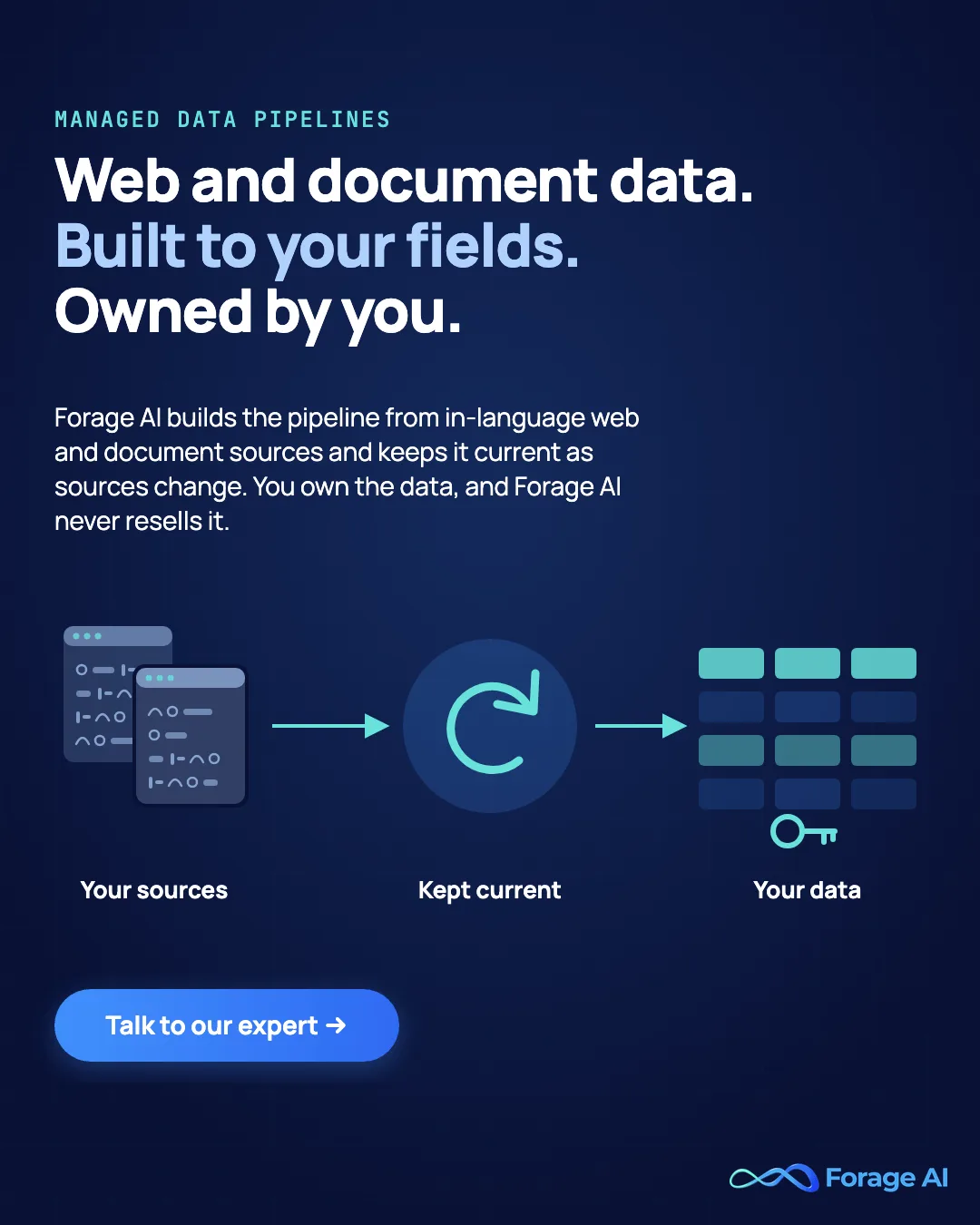
Forage AI runs an end-to-end managed data pipeline built to the client's own fields and systems. For multilingual work, that means mapping in-language web and document sources by region, language, publisher and document type, extracting and structuring them to your schema, and keeping the pipeline current as sources change. Clients own the data. Forage AI never resells it.
Choose Forage AI if the text you need already exists in your languages on the web and in documents, and you need it found, extracted, structured to your fields, kept current and owned by you.
Choose a native-speaker data collection provider if you need new recordings, speech or text written by native speakers.
Talk to us about your languages and sources.
FAQs about multilingual data collection services
Which vendors offer multilingual data collection as a managed service?
For in-language extraction: Forage AI (publisher of this guide), Import.io and Zyte. For native-speaker collection: Andovar, Appen and Argos Multilingual, among 18. Managed means the provider recruits or crawls, checks and delivers while you write the spec; that separates multilingual AI data providers from self-serve tools.
Who owns custom-collected multilingual data?
Whoever the contract says. Two of 18 native-speaker vendors state that the client owns it. A default licence can also be limited to internal testing unless the order form names training, so ask for permitted uses as well as ownership.
How do I confirm a vendor covers my language?
Ask for the per-language number in writing, then a sample in your hardest language. Ask for distinct speakers, not hours alone: ten hours from one speaker is a different dataset from Meta's target of 10 hours from 10 native speakers.
Can you build multilingual training data from web sources instead of recording speakers?
Yes for languages with enough published text, no for speech; in our read of 17 web-data providers' own pages besides our own, two described building in-language corpora to a client's spec. Web text inherits whatever origin it had, including machine translation, so multilingual AI training data services built this way still need the origin check.
How is custom multilingual data collection priced?
Published units: per recorded audio hour (Andovar), per feed and source (Zyte), per corpus or source maintained (Import.io), and LXT's $15K to $150K+ range for speech recognition. The rest quote. Labour drives speech costs: transcribing one hour of Bambara took 30 labour-hours in the lab and 36 in the field (Diarra et al., 2025 preprint). Published timelines run from Zyte's one-day sample to Andovar's 2 to 4 weeks.
Is multilingual data collection the same as translation?
No. Collection produces data written or spoken natively in the language; translation converts it from another. Translated web text also contaminates corpora: in a 6.4-billion-sentence study, 57.1% of translated sentences on the web appeared in three or more languages, mostly machine translated (Thompson et al., Findings of ACL 2024). A translation agency's language count is not a collection capacity.
Related articles
- Best Multilingual Training Data Sources (2026): 20 Compared: when an existing dataset may already cover your language.
- AI Training Data Providers and Services: 19 Compared (2026): the four kinds of supplier and when each one fits.
- Forage AI vs a Pre-Built Dataset: custom versus pre-built for one dataset, with the licence clauses to check.
- Scale AI Alternatives (2026): Labels, Experts, Tools, Data: where to go for labelling, experts, tooling and the data itself.