
Top 10 Oxylabs Alternatives: Name the Friction, Pick the Fix (2026)
The renewal email usually lands on a quiet afternoon. Someone on your team opens the Oxylabs dashboard for the first time in a few weeks, looks at the per-gigabyte line, and asks the question that probably brought you to this page: are we getting value out of this, or have we just gotten good at paying for it?
We run managed data extraction for a living, which means we sit downstream of this exact decision several times a quarter, and we can tell you the uncomfortable part up front: half the teams asking that question should stay right where they are. Oxylabs is genuinely good infrastructure. The teams that should leave are usually not unhappy with the proxies at all. They are unhappy with one of five specific frictions, and each of the five has a different fix.
So that is how we have organised this guide to Oxylabs alternatives: five documented frictions, pulled from what reviewers actually wrote rather than what vendors say about each other, each routed to the class of provider that structurally resolves it. Along the way we will show you two things the pages currently ranking for this keyword leave out: an ownership map connecting two of the most-recommended “alternatives” back to Oxylabs’ own corporate family, and one vendor you should strike off any list you are holding. Every rating here is printed with its sample size, and every price comes from the vendor’s own page, dated.
Quick Digest
- Why teams leave a 4.5: Oxylabs rates 4.5/5 on G2 (n=428) and 3.7/5 on Trustpilot (n≈724). The gap is a segmentation, not a contradiction: the enterprise motion earns the first score, the self-serve motion earns the second.
- The five frictions: premium pricing at small scale, self-serve billing mechanics, complexity built for proxy-literate teams, KYC verification delays, and the structural one, you still own the whole pipeline. Each traces to reviewer quotes plus a first-party Oxylabs page.
- The ownership map nobody prints: Decodo (ex-Smartproxy) shares Oxylabs’ corporate family, and Webshare has been Oxylabs-owned since 2022. Five of six ranking lists recommend Decodo as an “alternative”; none disclose the relationship.
- One name to strike: NetNut’s domains were seized by the FBI on 2 July 2026, and it is still being recommended top-three on pages ranking for this keyword today.
- The 10 alternatives: one managed extraction partner, five proxy platforms, four scraping APIs, each mapped to the friction it answers, each carrying twin tables: published pricing and review evidence with its sample size.
Why do G2 and Trustpilot disagree on Oxylabs?
Before you evaluate a single alternative, sit with this gap for a minute, because it tells you whether you should be leaving at all.
Oxylabs is premium web-scraping infrastructure: 175M+ residential IPs across 195+ countries, a Web Scraper API from $49/mo, and one of the strictest compliance postures in the proxy market (oxylabs.io, August 2026). On G2, where reviews skew toward evaluated B2B purchases with account managers and negotiated contracts, that infrastructure scores 4.5 out of 5 across 428 reviews. Reliability, pool quality, success on hard targets. When our own customers arrive from Oxylabs, they rarely have a bad word for the proxies themselves, and we tell them so.
Expert Insights
“The pricing is quite expensive for small users.”
G2 reviewer, Oxylabs review record (accessed August 2026)
“The dashboard is clean and enterprise-grade, but it can be overwhelming if you’ve never configured proxies before.”
G2 reviewer, Oxylabs review record (accessed August 2026)
Two reviewers in the Oxylabs Review Record describing the same fact from different seats: a product engineered for the enterprise segment, experienced from outside it.
Trustpilot tells the other half of the story, because it captures the self-serve customer. Auto-renewal is the default: “when you buy a proxy you subscribe to auto-renewal automatically, there is no option to buy for a month! When I tried to get my money back when I was charged again support says it’s not possible!” (Trustpilot reviewer, 2025). Refund requests are reported denied outside a narrow reported three-day/20%-of-traffic window. One business reported being overcharged by nearly 270% since July 2025. And here is the nuance worth keeping: the same record praises the support staff as patient and knowledgeable. The complaints target the billing machinery, not the humans running it.
We all know how this evaluation usually goes wrong: a team reads ten reviews from the wrong door, concludes the vendor is either flawless or a trap, and switches to something that reproduces their exact problem under a new logo. The honest frame is fit, not failure. If you are an enterprise buyer with an account manager and 100GB a month, the 4.5 is describing your likely experience, and the most useful thing this page can do is talk you out of an unnecessary migration. The five frictions below live almost entirely on the self-serve side of the house.
Which Oxylabs friction are you actually leaving?
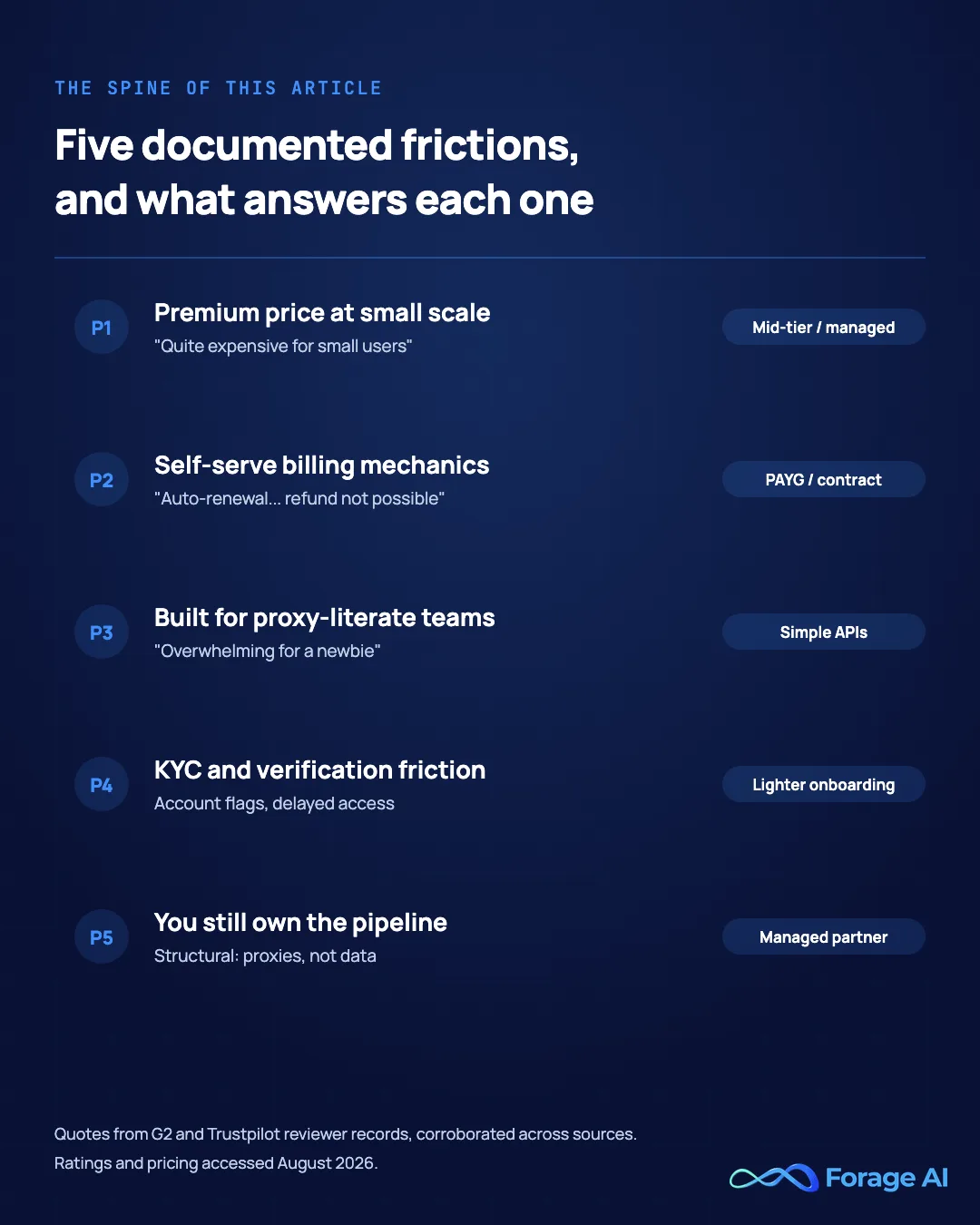
In practice, five frictions account for nearly everything in the public review record. Work down this list and stop at the first row that sounds like your team’s last retro. Each carries the reviewer evidence and the first-party fact that makes it structural rather than one person’s bad week.
| Friction | What the record shows | What structurally fixes it |
|---|---|---|
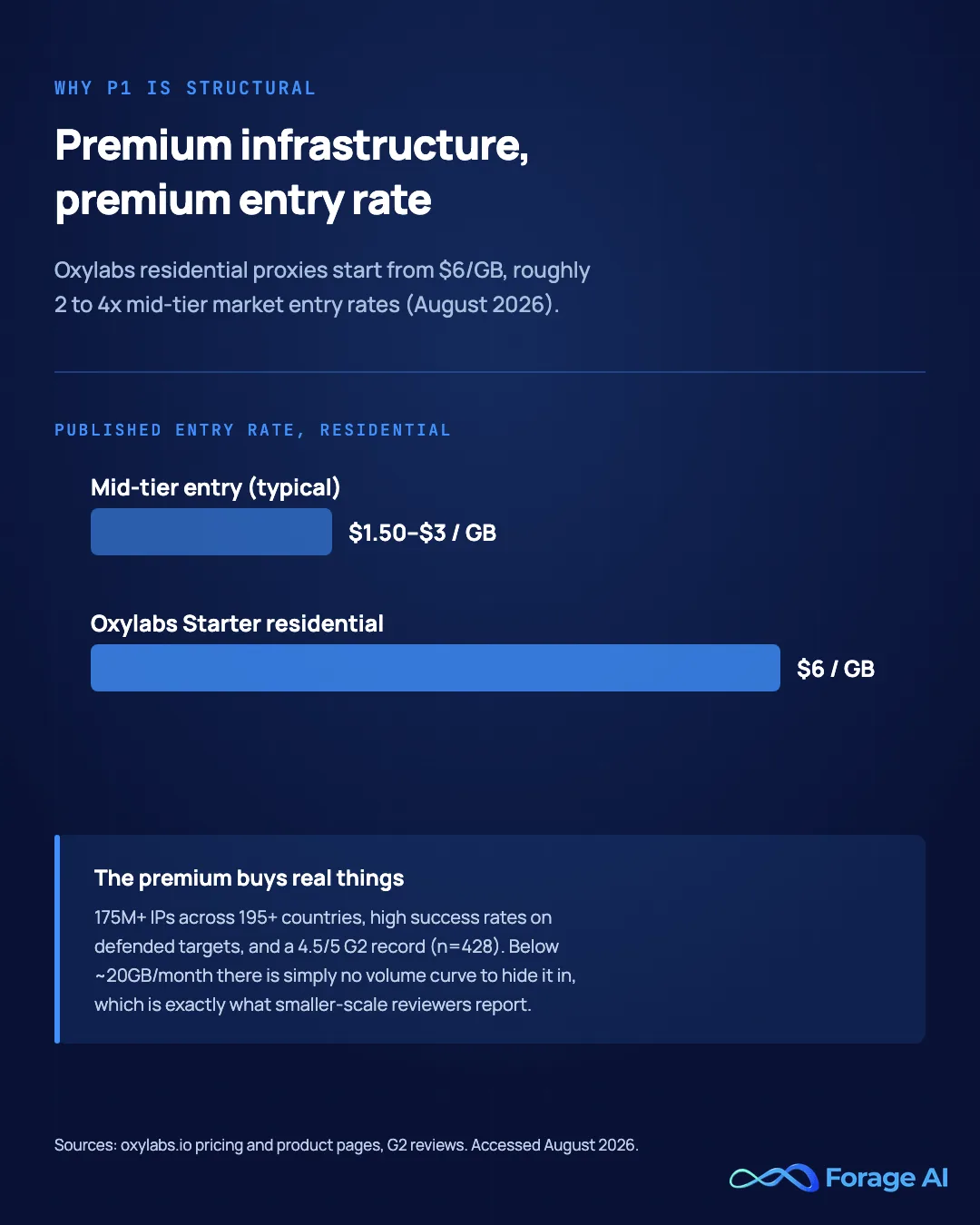
| P1. Premium price at small scale | “Quite expensive for small users”; “steep if you want to scale up” (G2). First-party: residential from $6/GB, roughly 2-4x mid-tier entry rates (oxylabs.io, Aug 2026) | Mid-tier proxy platforms; or a contract-scoped managed service where $/GB stops being the metric |
| P2. Self-serve billing mechanics | Auto-renewal by default, refunds reported denied outside a narrow window, a reported ~270% overcharge dispute (Trustpilot, 2025-2026) | True pay-as-you-go with no subscription default; or contract billing with a named owner |
| P3. Built for proxy-literate teams | “Overwhelming… for a newbie”; “complex setup process… often requiring customer support” (G2) | Single-endpoint scraping APIs; or fully managed delivery with no dashboard at all |
| P4. KYC and verification friction | Account flags, geographic verification requests, delayed access to some targets until identity checks complete (review record) | Lighter self-serve onboarding; or a managed partner where compliance is contract-to-contract. July 2026 changed how this one reads, see the NetNut section |
| P5. You still own the pipeline | Structural, not a complaint: Oxylabs sells proxies and APIs. Parsing, schema, QA, retries, breakage response and monitoring remain yours | A managed extraction partner, where the deliverable is the data |
Notice what all five have in common. Oxylabs is enterprise infrastructure sold through a self-serve door. The premium rate, the strict KYC, the proxy-literate dashboard, the subscription machinery: each is a defensible choice for the enterprise segment the product is engineered for. Walk in through the self-serve door at 10GB a month and each one lands as friction. We see the downstream of this constantly: the frustration is real, and it is almost never the product’s competence in question.
Expert Insights
“When you buy a proxy you subscribe to auto-renewal automatically, there is no option to buy for a month!”
Trustpilot reviewer, 2025 (corroborated-via-secondary)
The most repeated complaint shape in the Oxylabs Trustpilot record. Notice what it is not: nobody in these threads says the proxies failed. The product works; the purchase mechanics are what generate the 3.7.
That is why the fix has to start from the friction, not the vendor list. A cost friction points at mid-tier proxies. A complexity friction points at APIs. A pipeline friction points out of the category entirely. Three different directions. Pick the direction first and the shortlist mostly builds itself.
How we picked these alternatives
We held ourselves to four rules while building this roster, and we are sharing them because you should hold every comparison page you read, including this one, to the same standard.
One. A vendor earns a slot by answering a named friction, P1 through P5 above. Not by star rating, not by affiliate payout. If it does not resolve a documented complaint, it is not an alternative, it is an advertisement.
Two. Every rating is printed with its sample size, and platforms are named. A 4.4 across 2,000 Trustpilot reviews and a 3.9 across 147 are not comparable quantities. G2 and Trustpilot both return HTTP 403 to automated fetch, so figures from them are labelled corroborated-via-secondary; where a sample size could not be corroborated at all, we print no star figure rather than borrow one from an aggregator.
Three. Every price is first-party and date-stamped. Each figure below comes from the vendor’s own pricing page, accessed August 2026. The ranking pages for this keyword are still arguing with a stale “$8/GB” Oxylabs figure; the vendor’s page has said $6/GB entry all year. In practice this is the fastest tell for whether a comparison was maintained or abandoned: check one price against the vendor’s page before trusting the rest.
Four. Ownership is disclosed. This turns out to be the SERP’s biggest hole, and it deserves its own map.
The ownership map nobody prints
Two of the most-recommended “Oxylabs alternatives” are, in ownership terms, Oxylabs. Decodo, formerly Smartproxy, sits in the same Lithuanian corporate family (Tesonet) that stands behind Oxylabs, a relationship documented on Tesonet’s own site, and Oxylabs even publishes a comparison page against its sibling brand. Webshare has been an Oxylabs company since September 2022, announced on both companies’ blogs.
Both brands still earn their slots below, with the disclosure attached. What disqualifies a vendor is being dead, not being related, and this SERP has one of those too: see the NetNut section after the roster.
Top 10 Oxylabs alternatives, mapped to the friction each one answers
Three bands, ten entries. Find your friction in the fourth column and start there, not at the top of the table.
| # | Alternative | Band | Frictions answered | Published entry price |
|---|---|---|---|---|
| 1 | Forage AI | A. Managed | P5 (and P1-P4 structurally) | Contract-scoped, not published |
| 2 | Bright Data | B. Proxies | P1 entry, partial P2 | $4/GB PAYG residential |
| 3 | Decodo ⚠ same family | B. Proxies | P1, P3 | $3.75/GB plans, $4/GB PAYG |
| 4 | SOAX | B. Proxies | P1 mid-volume, P4 trial path | Sandbox free; $200/mo at $3/GB |
| 5 | IPRoyal | B. Proxies | P2 (true PAYG) | $7.35/GB PAYG, non-expiring |
| 6 | Webshare ⚠ Oxylabs-owned | B. Proxies | P1 low end | Free tier; DC $2.99/mo |
| 7 | Zyte | C. APIs | P3, P1 by unit | $0.06-$16.08 per 1K requests |
| 8 | ScraperAPI | C. APIs | P1 predictability, P3 | $49/mo, 100K credits |
| 9 | Apify | C. APIs | P3 common targets, partial P5 | Free; Starter $29/mo |
| 10 | ScrapingBee | C. APIs | P3 | $49/mo, 250K credits |
Band A: the managed extraction partner
Answers P5 by changing what you buy: the deliverable becomes the data, and P1 through P4 dissolve with the self-serve motion. What it costs you is immediacy and a published price card.
1. Forage AI
| Attribute | Detail |
|---|---|
| Model | Fully managed data extraction, custom contract, dedicated team |
| Best for | Teams whose real friction is P5: they wanted the data, not the proxy dashboard |
| Oxylabs frictions it answers | P5 directly; P1-P4 dissolve because the self-serve motion disappears |
| Pricing (as published) | Not published. Contract-scoped to the work, no per-GB meter |
| Who owns maintenance | The vendor: selector drift, anti-bot evolution and schema changes absorbed as part of the service |
| Watch-out | Not self-serve, no price card, no sandbox. Onboarding runs 1-2 weeks, not an afternoon |
| Review attribute | Detail |
|---|---|
| What users like | No verified public reviews. |
| What users flag | No public review corpus to draw from. |
| Attribute | Detail |
|---|---|
| Ratings (with n, accessed Aug 2026) | G2 4.8/5 shown first-party on forage.ai. No third-party review count comparable to the proxy vendors below exists for us, and we print that rather than manufacture one |
| Evidence quality | Named first-party client testimonials, a different evidence class from platform review sentiment, and labelled as such |
| What customers are saying | “Forage AI’s consistent performance and reliability in maintaining the pipelines they’ve set up for us have exceeded our expectations.” Dave Thornton, CEO, Vested. “They don’t just provide off-the-shelf solutions; instead, they delve deep into our requirements.” Rachel DeMel, Director of Product & Content Strategy, Expert Institute |
| What customers complain about | No self-serve access, no published pricing, no free trial. If you want to swipe a card tonight, this is the wrong band |
| Source | forage.ai (first-party G2 display and named testimonials) |
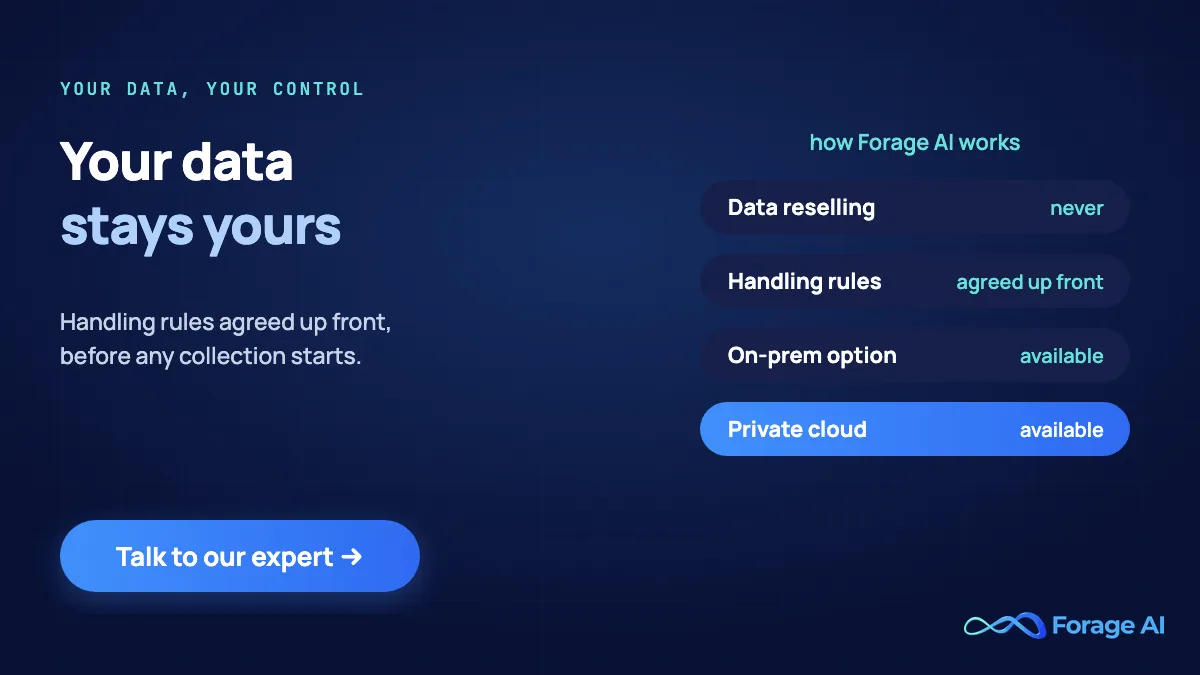
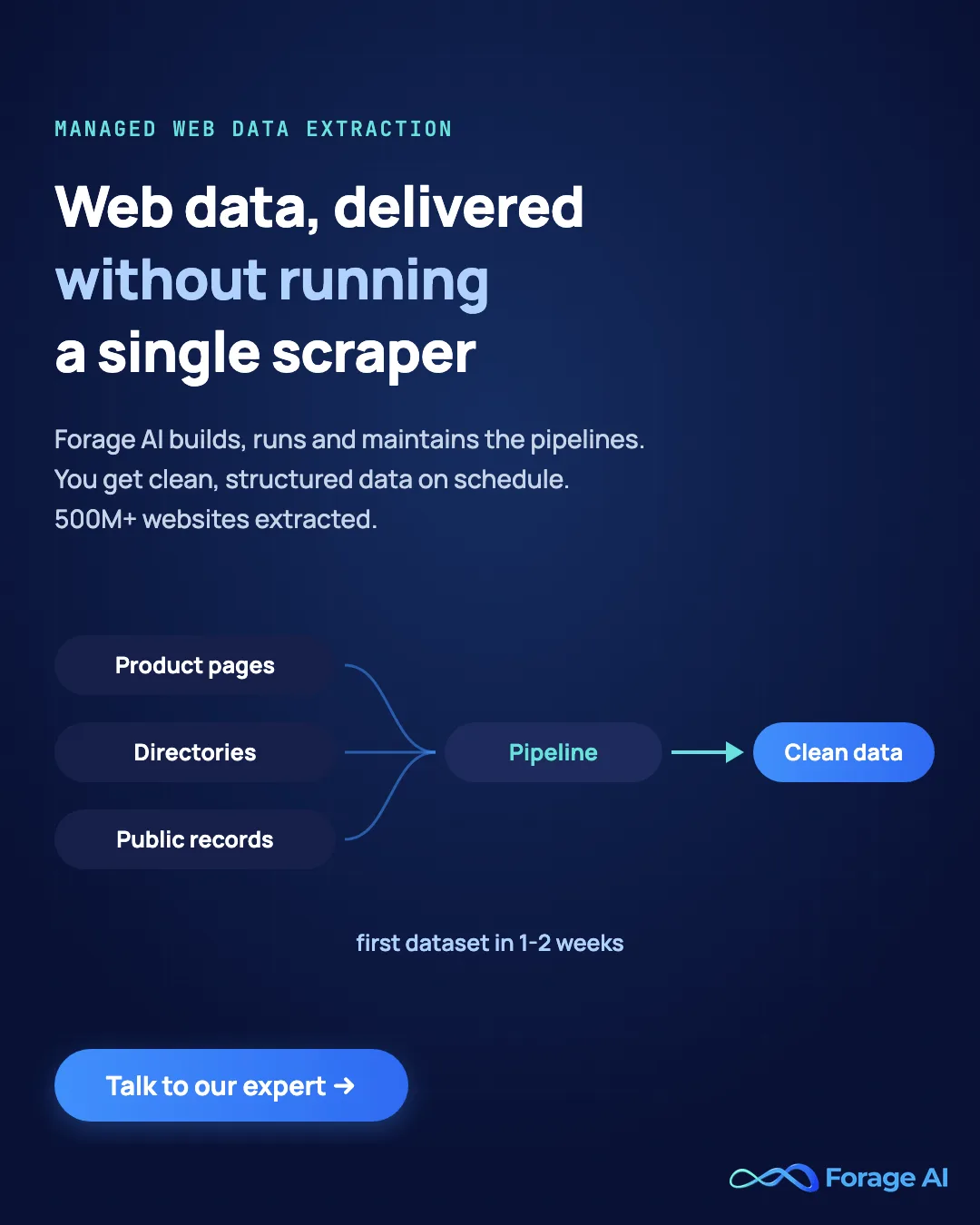
Forage AI is us, so let us be plain about what we are and are not. We run fully managed web data extraction across 500M+ websites and 10M+ documents: source discovery, crawling, extraction logic, cleaning, multi-layer QA, monitoring and delivery into your systems, owned end to end by a dedicated team.
We put ourselves first on this list for one reason: a meaningful share of the teams searching this keyword are not actually shopping for better proxies. They are discovering that proxies were never the product they needed. In practice this shows up as an engineer spending Fridays on selector repairs, or a QA gap nobody owns. Oxylabs sells excellent access infrastructure; everything after access stays on your payroll, and if that downstream work is what hurts, no proxy vendor on this page fixes it. Customers describe the difference better than we can: (Dave Thornton, CEO, Vested).
The honest trade, stated the way we state it on calls: you give up the $6/GB meter for a contract conversation, and self-serve immediacy for a 1-2 week onboarding, and every delivery passes a 3x QA team before it lands. Oxylabs publishes an entry price and lets you start today. We do neither. Different products for different frictions.
Not for: teams who genuinely need raw proxy access under their own code, or anyone whose only friction is the per-GB rate.
Band B: proxy platforms, the like-for-like moves
Answers P1 and P2 while keeping the category you know. What it costs you is nothing structural, and that is the caveat: P5 stays exactly where it was, and two entries here share Oxylabs’ own family tree.
2. Bright Data
| Attribute | Detail |
|---|---|
| Model | Proxy and web-data platform (proxies, unblocker, scraper APIs, datasets) |
| Best for | The premium head-to-head: Oxylabs-class infrastructure with PAYG entry |
| Oxylabs frictions it answers | P1 at entry (PAYG $4/GB vs $6/GB), partially P2 (pay-as-you-go exists) |
| Pricing (as published) | Residential $4/GB pay-as-you-go, from $2.50/GB on volume plans (brightdata.com, Aug 2026) |
| Who owns maintenance | You |
| Watch-out | At contract scale the two premium vendors converge on price; reviewers report cost escalation and a commercial surface complex enough to need an owner |
| Review attribute | Detail |
|---|---|
| What users like | Customer support (48 mentions), ease of use (40), collection reliability (37) |
| What users flag | Cost for smaller teams (8 mentions on expense, 8 on pricing), documentation and debugging (8) |
| Attribute | Detail |
|---|---|
| Ratings (with n, accessed Aug 2026) | Trustpilot 4.4/5 (n≈980; some secondary sources report 4.5), corroborated-via-secondary |
| Evidence quality | Large multi-platform base; the strongest review record in the premium proxy tier |
| What reviewers praise | Network breadth, success rate on aggressively defended targets, delivery into own cloud storage |
| What reviewers complain about | Cost escalation at scale, and a product catalogue broad enough that teams buy more of it than they use |
| Source | Trustpilot (corroborated-via-secondary); pricing from brightdata.com |
Bright Data is the vendor Oxylabs gets compared against in almost every evaluation we see, and for good reason: it is the only entry on this page that matches Oxylabs for network scale and anti-bot capability. It appeared on six of six editorial rosters we analysed, the only vendor with a perfect count.
On the P1 question, the entry math is worth doing on one line: $4/GB pay-as-you-go against Oxylabs’ $6/GB starter, no subscription required. If you are weighing Oxylabs vs Bright Data specifically, here is how we would frame it for your team: at small self-serve volumes Bright Data is cheaper to start and easier to leave; at negotiated enterprise volumes the two converge, and the decision moves to compliance posture, dataset products and account terms. Our Bright Data alternatives guide covers the reverse migration.
What it does not fix, and this matters: P5. Same category, same division of labour. Your team still owns everything downstream of access, and the invoice will not remind you of that until a target site changes its markup.
Not for: teams leaving Oxylabs over complexity. Bright Data’s surface is at least as demanding, and we have watched teams underestimate that.
3. Decodo (formerly Smartproxy)
| Attribute | Detail |
|---|---|
| Model | Mid-market proxy platform (rebranded from Smartproxy, April 2025) |
| Best for | Near-premium performance at a mid-market rate, with a simpler dashboard |
| Oxylabs frictions it answers | P1 (residential $3.75/GB on the 3GB plan, PAYG $4/GB), P3 (simpler UX) |
| Pricing (as published) | Residential from $3.75/GB on plans, $4/GB PAYG, 3-day 100MB trial (decodo.com, Aug 2026) |
| Who owns maintenance | You |
| Watch-out | Same corporate family as Oxylabs (Tesonet). A legitimate product, but not a change of vendor relationship in any meaningful sense |
| Review attribute | Detail |
|---|---|
| What users like | Not checked for this pass. |
| What users flag | Not checked for this pass. |
| Attribute | Detail |
|---|---|
| Ratings (with n, accessed Aug 2026) | Trustpilot 4.4/5 (n≈2,000), corroborated-via-secondary; the largest positive review base in the mid-tier |
| Evidence quality | Strong: high volume, long history under the Smartproxy name |
| What reviewers praise | Price-to-performance, dashboard simplicity, responsive support |
| What reviewers complain about | Pool depth on the hardest targets trails the premium tier; rebrand confusion |
| Source | Trustpilot (corroborated-via-secondary); pricing from decodo.com |
Decodo is the mid-market pick five of six ranking lists recommend, and on the merits they are right: a 4.4 across roughly 2,000 Trustpilot reviews, entry pricing well under Oxylabs’, and a dashboard reviewers actually enjoy using.
What none of those five lists tell you: Decodo and Oxylabs grew out of the same corporate family. Tesonet lists both; Oxylabs runs its own “Decodo alternative” comparison page against its sibling. That does not make Decodo a bad product, and we are not suggesting it is. It makes “switching from Oxylabs to Decodo” a smaller move than it looks: your billing relationship changes, your supply-chain diversification does not. Walk into that decision with the map in hand.
Buy it for P1 and P3 with eyes open: if your friction is price or complexity, this is the shortest move that fixes both. If your friction is the vendor relationship itself, it fixes nothing, and you will be having this conversation again at the next renewal.
Not for: teams whose procurement or risk function requires genuine vendor diversification away from the Oxylabs family.
4. SOAX
| Attribute | Detail |
|---|---|
| Model | Unified proxy pool (residential, mobile, ISP, datacenter) with per-GB tiers |
| Best for | Flexible pool switching and a low-risk trial path |
| Oxylabs frictions it answers | P1 at mid volumes ($200/mo Builder lands at $3/GB), P4 (sandbox before commitment) |
| Pricing (as published) | Free Sandbox; entry tier $5/GB; Builder $200/mo at $3/GB (soax.com, Aug 2026) |
| Who owns maintenance | You |
| Watch-out | The smallest review base in this band: treat the score as a weak signal either way |
| Review attribute | Detail |
|---|---|
| What users like | Support, the most-mentioned theme (5 mentions), pricing clarity (4), easy setup and reliability (3 each) |
| What users flag | Dashboard data mismatch and thin proxy statistics (2 mentions), price for heavy scraping |
| Attribute | Detail |
|---|---|
| Ratings (with n, accessed Aug 2026) | Trustpilot 3.9/5 (n=147), corroborated-via-secondary |
| Evidence quality | Thin. 147 reviews is the smallest sample printed on this page, and it is printed so you can discount it appropriately |
| What reviewers praise | Pool flexibility, geo-targeting granularity, onboarding help |
| What reviewers complain about | Per-GB cost at the entry tier, occasional session instability |
| Source | Trustpilot (corroborated-via-secondary); pricing from soax.com |
SOAX appears on four of six ranking rosters, usually pitched on flexibility: one subscription, four pool types, granular geo-targeting.
Its honest role in your evaluation is the trial path. A free sandbox and a $200/mo tier that works out to $3/GB give a mid-volume team a way to validate a workload before committing, which directly answers the reviewers who found Oxylabs’ commitment mechanics the problem. One caution from us: the 3.9 sits on only 147 reviews, the smallest sample on this page. Treat it as a weak signal in either direction and let your own parallel run be the evidence.
Not for: the hardest anti-bot targets, where the premium pools above it are the reason the premium exists.
5. IPRoyal
| Attribute | Detail |
|---|---|
| Model | Budget proxy provider with genuine pay-as-you-go |
| Best for | Killing the subscription entirely: P2 in its purest form |
| Oxylabs frictions it answers | P2 (no auto-renewal by design: buy traffic, use traffic), P1 at small totals |
| Pricing (as published) | Residential $7.35/GB PAYG at 1GB, falling with volume (iproyal.com, Aug 2026) |
| Who owns maintenance | You |
| Watch-out | Trustpilot 3.6 (n≈3,000) is lower than Oxylabs’ own 3.7: cheaper entry, not better sentiment |
| Review attribute | Detail |
|---|---|
| What users like | Not checked for this pass. |
| What users flag | Not checked for this pass. |
| Attribute | Detail |
|---|---|
| Ratings (with n, accessed Aug 2026) | Trustpilot 3.6/5 (n≈3,000), corroborated-via-secondary, the largest sample in this band and the lowest score on this page |
| Evidence quality | High volume, mixed sentiment: read the distribution, not the average |
| What reviewers praise | True no-subscription purchasing, non-expiring traffic, cheap entry |
| What reviewers complain about | Pool quality variance, support depth, speed on hard targets |
| Source | Trustpilot (corroborated-via-secondary); pricing from iproyal.com |
IPRoyal earns its slot on a single structural feature: you buy gigabytes, not a subscription, and they do not expire. For the Trustpilot reviewer whose entire complaint was auto-renewal machinery, this is the vendor that made the machinery not exist.
Now read the number we are obliged to show you: 3.6 across roughly 3,000 reviews, below Oxylabs’ own 3.7. The per-GB headline is also higher than the premium tier at small volumes ($7.35 vs $6), which surprises every team we walk through it. IPRoyal’s economics only win when the alternative is paying for a subscription you underuse. In practice, treat this as a billing-model fix, not an infrastructure upgrade, because that is what the review record says it is.
Not for: anyone leaving Oxylabs over reliability or pool quality. On the evidence, that would be a move down, not out.
6. Webshare
| Attribute | Detail |
|---|---|
| Model | Self-serve budget proxies (datacenter-led, rotating residential added) |
| Best for | The cheapest legitimate way to test whether your workload needs premium proxies at all |
| Oxylabs frictions it answers | P1 at the extreme low end (free tier, DC from $2.99/mo) |
| Pricing (as published) | Free 10-proxy plan; datacenter from $2.99/mo per 100 proxies; rotating residential $3.50/GB (webshare.io, Aug 2026) |
| Who owns maintenance | You |
| Watch-out | An Oxylabs company since September 2022. Also datacenter-led: success rates on defended targets are not comparable to residential pools |
| Review attribute | Detail |
|---|---|
| What users like | Not checked for this pass. |
| What users flag | Not checked for this pass. |
| Attribute | Detail |
|---|---|
| Ratings (with n, accessed Aug 2026) | Trustpilot 4.1/5 (n≈1,000), corroborated-via-secondary |
| Evidence quality | Solid volume for the budget tier |
| What reviewers praise | Free tier, price, dashboard simplicity |
| What reviewers complain about | Datacenter IPs blocked on harder targets, support depth at the free/low tiers |
| Source | Trustpilot (corroborated-via-secondary); pricing from webshare.io |
Webshare is the budget floor of this roster: a permanently free 10-proxy plan and paid datacenter tiers from $2.99/mo, with a 4.1 across roughly a thousand Trustpilot reviews.
Disclosure first, because the roundups skip it: Webshare has been an Oxylabs company since 2022, announced on both companies’ blogs. Second caveat: it is datacenter-led, so the workloads that pushed you to premium residential access will not survive the downgrade. Where we find it genuinely useful is diagnostic: run your target list through the free tier for a week, and if it holds, you never needed $6/GB residential access in the first place. That is a cheap, honest experiment, and more teams should run it before any migration.
Not for: defended targets, or buyers for whom the ownership question is the point.
Band C: scraping APIs, one level up the stack
Answers P3 by deleting proxy management from your job, and P1-by-unit on ordinary targets. What it costs you is per-request billing models that take one honest cycle to learn.
7. Zyte
| Attribute | Detail |
|---|---|
| Model | Scraping API (by the authors of Scrapy), with a managed Zyte Data tier |
| Best for | Replacing proxy management with a single request-level API under your own code |
| Oxylabs frictions it answers | P3 (no proxy dashboard at all), P1 by unit on easy targets |
| Pricing (as published) | $0.06 to $16.08 per 1,000 requests on an auto-assigned site-difficulty tier; Zyte Data managed from $500/mo; $5 trial credit (zyte.com, accessed July 2026) |
| Who owns maintenance | You (parsing and spiders); Zyte owns access and unblocking |
| Watch-out | The difficulty tier is invisible until you start scraping: a ~268x published spread, and reviewers report billing surprises when protected targets land in high tiers |
| Review attribute | Detail |
|---|---|
| What users like | Ease of use and straightforward setup (24 mentions), reliability for extraction (19 and 17), customer support (17) |
| What users flag | Price for smaller projects (19 mentions on pricing, 7 on expense), a steep curve customising extraction rules (6) |
| Attribute | Detail |
|---|---|
| Ratings (with n, accessed July 2026) | Capterra 4.4/5 (n=43); G2 4.3/5 (n=114), corroborated-via-secondary |
| Evidence quality | The best cross-platform agreement in the API band |
| What reviewers praise | “Extremely reliable, rapidly scalable and has the lowest latency amongst its peers” (Capterra); the deepest Scrapy integration available |
| What reviewers complain about | Billing shock when Cloudflare-protected targets push requests into pricier tiers |
| Source | Capterra; G2 (corroborated-via-secondary); pricing from zyte.com |
Zyte moves the abstraction up a level: instead of buying proxy bandwidth and managing sessions, you send a URL and get the page, with access and unblocking handled per-request by the team that wrote Scrapy.
For P3 it is the cleanest fix in the API band: there is no proxy dashboard to be overwhelmed by, because there are no proxies to manage. We should be straight with you about where the trade reappears, though: pricing runs $0.06 to $16.08 per 1,000 requests on a difficulty tier you cannot see until you start scraping. The surprise-charge pattern from Oxylabs’ Trustpilot record has a cousin here wearing different clothes. Budget with the $5 trial credit against your real targets before you commit volume, not after.
Not for: teams without Python capacity, or anyone who needs raw proxy endpoints for non-scraping traffic.
8. ScraperAPI
| Attribute | Detail |
|---|---|
| Model | Request-level scraping API with credit-based plans |
| Best for | Forecastable monthly spend: a fixed tier ladder you can model in a spreadsheet |
| Oxylabs frictions it answers | P1 predictability, P3 (single endpoint) |
| Pricing (as published) | Hobby $49/mo for 100K credits, tiers to Enterprise; free trial (scraperapi.com, Aug 2026) |
| Who owns maintenance | You |
| Watch-out | JS rendering and premium targets consume multiple credits per request, so the effective rate can run well above the headline |
| Review attribute | Detail |
|---|---|
| What users like | No verified G2 profile located under this name. |
| What users flag | No public review corpus to draw from. |
| Attribute | Detail |
|---|---|
| Ratings (with n, accessed Aug 2026) | Review bases exist on G2 and Capterra; sample sizes not directly corroborated, so no star figure is printed, per the rule stated above |
| Evidence quality | Pricing legibility is first-party and complete, which is the thing this entry is recommended for |
| What reviewers praise | Spend you can model before committing; low-friction start |
| What reviewers complain about | Effective cost drift once rendering and premium flags are on |
| Source | scraperapi.com (pricing, first-party) |
ScraperAPI’s pitch is legibility: named tiers, printed credit counts, a $49 entry. You can model your month in ten minutes, and in an evaluation that is worth more than it sounds.
That directly answers the Oxylabs complaint about pricing that “lacks transparency and predictability for first-time users.” One thing we would insist you do before trusting the spreadsheet: fill in the multiplier column honestly. Rendering-heavy and protected targets consume multiple credits per request, and every credit system looks cheaper than it bills until that column exists.
Not for: raw proxy use-cases, or the hardest anti-bot targets where premium residential pools are the difference.
9. Apify
| Attribute | Detail |
|---|---|
| Model | Developer platform and marketplace of pre-built scrapers (actors) |
| Best for | Skipping the build: thousands of maintained scrapers plus scheduling and storage |
| Oxylabs frictions it answers | P3 for common targets (someone already built it), P5 partially (actors are maintained by authors) |
| Pricing (as published) | Free plan with $5 usage included; Starter $29/mo ($26 annual); Scale $199/mo; Business $999/mo (apify.com, Aug 2026) |
| Who owns maintenance | Shared: platform actors are author-maintained, your custom actors are yours |
| Watch-out | Compute-unit billing is hard to forecast before you have run the workload once, and marketplace actor quality varies by author |
| Review attribute | Detail |
|---|---|
| What users like | Ease of integration (184 mentions), the pre-built actor catalogue (113), scraping speed (113) |
| What users flag | Cost at volume (88 mentions on pricing, 87 on expense), a steep learning curve for beginners (58) |
| Attribute | Detail |
|---|---|
| Ratings (with n, accessed Aug 2026) | Large developer review base across platforms; sample sizes not directly corroborated, so no star figure is printed |
| Evidence quality | Strong qualitative developer sentiment; pricing fully first-party |
| What reviewers praise | The actor marketplace, and orchestration (scheduling, retries, storage) without building it |
| What reviewers complain about | Compute-unit opacity; uneven marketplace quality |
| Source | apify.com (pricing, first-party) |
Apify is what you discover when the thing you were scraping turns out to be a common target: someone already built the scraper, and it is $29/mo to run it on a schedule with storage and retries included.
If your Oxylabs friction was doing everything yourselves, the actor marketplace is a genuine middle path between raw infrastructure and a managed contract. Two things we tell teams going in: give the compute-unit meter one real billing cycle before you judge your run-rate, and expect a niche or defended target to put you back to writing a custom actor. When that happens, compare the custom-actor path honestly against Zyte and the managed band rather than sunk-costing it. The full band comparison is in our Apify alternatives guide.
Not for: pure proxy workloads, or teams that wanted to stop operating tooling entirely.
10. ScrapingBee
| Attribute | Detail |
|---|---|
| Model | Beginner-friendly scraping API, charges only successful requests |
| Best for | The gentlest on-ramp in the API band |
| Oxylabs frictions it answers | P3 directly (one endpoint, readable docs, success-only billing) |
| Pricing (as published) | Freelance $49/mo for 250K credits; 1,000 free credits to start (scrapingbee.com, Aug 2026) |
| Who owns maintenance | You |
| Watch-out | Ceiling on the hardest targets; heavy JS rendering burns credits fast |
| Review attribute | Detail |
|---|---|
| What users like | Not checked for this pass. |
| What users flag | Not checked for this pass. |
| Attribute | Detail |
|---|---|
| Ratings (with n, accessed Aug 2026) | Review base exists; sample sizes not directly corroborated, so no star figure is printed |
| Evidence quality | Thin corroboration; recommended here for documented product traits, not sentiment |
| What reviewers praise | Documentation quality, success-only billing, time-to-first-result |
| What reviewers complain about | Credit burn on rendered pages; depth on defended targets |
| Source | scrapingbee.com (pricing, first-party) |
ScrapingBee is the answer scaled to the smallest version of the problem. The reviewer who found Oxylabs “overwhelming for a newbie” does not need a 175M-IP pool. They need one endpoint, documentation that respects their time, and a bill that only counts successes.
Success-only billing is quietly the P2 answer in miniature: the failure modes that generate surprise charges elsewhere simply do not bill here. The ceiling is real, and we would rather tell you now: the hardest targets will outgrow it. In practice, most workloads that felt heavy on a proxy dashboard never actually reach that ceiling.
Not for: enterprise-scale extraction or heavily defended targets.
Quick Summary
Q: What are the best Oxylabs alternatives?
A: It depends on the friction. For pipeline ownership, a managed extraction partner such as Forage AI. For a like-for-like premium proxy move, Bright Data at $4/GB PAYG. For mid-market price relief, Decodo or SOAX, with the disclosure that Decodo shares Oxylabs’ corporate family. For subscription-free purchasing, IPRoyal. For escaping proxy management entirely, Zyte, ScraperAPI, Apify or ScrapingBee, from $29-49/mo. Every price above is first-party, accessed August 2026.
One name you will still see recommended, and should not touch
NetNut. On 2 July 2026, the FBI seized NetNut’s domains as part of a joint action with Google against a botnet operation reported at roughly two million devices, and netnut.io has displayed the seizure notice since. Its parent company, Alarum Technologies, disputes the allegations, and we note that dispute deliberately. What is not in dispute: as of August 2026 you cannot responsibly route your traffic through it, and pages currently ranking for this exact keyword still list it as a top-three pick. If a list you are reading recommends it, that tells you when the list was last maintained.
The lesson for your team is bigger than one vendor. Proxy supply chains are compliance surfaces: where residential IPs come from, and whether the people behind them consented, is a first-order procurement question now, not an ethics footnote. And it reframes something from earlier in this guide. The KYC friction we filed under P4, the verification requests Oxylabs reviewers grumble about, is the visible cost of the posture that keeps a vendor off seizure notices. We would rather you leave over price than leave over paperwork and land somewhere the paperwork never existed.
A smaller ghost, same cause: at least three ranking pages still quote Oxylabs residential entry at “$8/GB.” The vendor’s page has said $6/GB all year (accessed August 2026). Directories do not re-verify, so make verification dates part of how you read them. This page prints its dates next to every figure so you can hold us to the same rule.
The trade nobody names: a cheaper meter is not a cheaper job
Band B looks like the safe move because it changes the least. In our experience, that is also the case against it. Moving from $6/GB to $4/GB changes the meter by a third and changes the job by nothing: your team still owns parsing, schema, QA, retries, breakage response and the 2am question of why a feed went quiet. We all know that job does not appear on any invoice, which is precisely why it survives every vendor migration untouched. The meter is the visible line item. The job is the budget.
Band C moves the job partway: the API absorbs access and unblocking, you keep parsing and QA. Band A moves it entirely. The bands are not price points on one curve; they are three different answers to who does the work. Decide who should do the work first. Then, and only then, let price break the tie inside the band. Teams that run the decision in that order almost never migrate twice.
“The pricing for residential proxies can be steep if you want to scale up, which might not suit smaller projects or budgets.”
G2 reviewer, Oxylabs review record (accessed August 2026)
The most quoted complaint in the record, and the least diagnostic one. Steep relative to what: a cheaper pool that fails on your targets, an API that absorbs half the work, or a contract that absorbs all of it? The number only means something after the ownership question is answered.
How should you choose between the bands?
1. When a target site changes its markup on a Tuesday, who is awake and responsible? If the answer is “nobody, and that is the problem,” you are shopping for Band A regardless of what the invoice says today. If the answer is “our engineers, and we want it that way,” Bands B and C are your aisle.
2. Does your spend profile fit a subscription, a meter, or a contract? Steady predictable volume suits subscriptions. Spiky or experimental volume suits true PAYG and success-only billing. Volume attached to a business deliverable with an SLA suits a contract. Most Oxylabs billing complaints in the record are a profile mismatch wearing a refund dispute’s clothes.
3. What does your compliance team need from the supply chain? After July 2026, “where do the IPs come from” is a diligence question with a seizure notice attached. If your answer is “we need the strictest posture available,” you may already be at the right vendor, and the honest move is renegotiating the tier rather than leaving.
| If your answer is | Go to | Start with |
|---|---|---|
| Nobody here should own pipeline breakage, ever | Band A | Forage AI |
| We want premium proxies with a PAYG door | Band B | Bright Data |
| The rate is the problem, the model is fine | Band B | Decodo (disclosure noted) or SOAX |
| The subscription machinery is the problem | Band B | IPRoyal (read its 3.6, n≈3,000 first) |
| We never wanted to manage proxies at all | Band C | Zyte, or ScrapingBee at the small end |
| The target is common; someone must have built this | Band C | Apify |
What switching off Oxylabs actually involves
Kill auto-renewal first, before anything else. It is the default, and it is the single most repeated complaint shape in the Trustpilot record. Turn it off in the dashboard the day you decide to evaluate alternatives, and diary the renewal date independently. That one action converts every horror story in the review record into a non-event.
Inventory your targets and their failure history. Which domains, what volumes, which ones needed residential rather than datacenter access, where the blocks happened. This document is what makes vendor trials comparable, and it is also the brief a managed partner would ask for on day one.
Overlap one billing cycle and parallel-run. Run the new provider against your hardest targets while Oxylabs is still live, and diff success rates rather than trusting a sales benchmark. One month of double cost is cheap insurance against discovering in week five that the cheaper pool cannot reach the three domains that justify the whole pipeline.
If you are moving up a band, migrate the schema, not just the traffic. Changing category means the deliverable changes shape. Freeze your field list before the cut, and change vendors or change fields, never both in the same week.
Where this leaves you
Here is the optimistic read of the renewal email that started all this: it forced the audit you were going to need anyway.
The 4.5 and the 3.7 were never in conflict; they are the same building scored from its two doors. If the audit shows you standing at the enterprise door, with an account manager and real volume, renegotiate and stay: 428 G2 reviewers are telling you the truth about that experience. If it shows you at the self-serve door, wrestling the premium rate, the subscription machinery and the verification queue, then you have not been buying the wrong vendor so much as standing at the wrong counter, and every entry on this page is a counter built for someone specific.
So run the process we have laid out, and trust it: name the friction, pick the band, shortlist two, parallel-run against your ten hardest targets with auto-renewal off. A vendor worth committing to will survive a parallel run, and the ones that expect to are visible in their review records above. A quarter from now, the renewal email should be the least interesting thing in your inbox. That is what a well-run migration, or a well-reasoned decision to stay, actually buys you.
Frequently asked questions
Is Oxylabs any good?
Yes, with an asterisk that depends on how you buy it. It holds 4.5/5 on G2 across 428 reviews, with consistent praise for pool quality, success rates and support expertise, and 175M+ residential IPs across 195+ countries. The same company holds 3.7/5 on Trustpilot across roughly 724 reviews, where self-serve customers report auto-renewal defaults and narrow refund windows. The common misconception is that one of those scores must be wrong; they are both accurate measurements of different purchases.
How much does Oxylabs cost?
As of August 2026, residential proxies start from $6/GB, the Web Scraper API from $49/mo, ISP proxies from $16, mobile from $7.5, and datacenter proxies carry a free trial, all per oxylabs.io. Enterprise volumes are negotiated. Note that several ranking comparison pages still cite an $8/GB residential entry; that figure is stale, and the direction of the error is worth noticing: the vendor got cheaper while its critics’ pages stood still.
What is the best Oxylabs alternative?
The one that answers your friction, which is why this page routes by friction rather than rank. For pipeline ownership, a managed extraction partner such as Forage AI. For a like-for-like premium move with PAYG entry, Bright Data. For mid-market pricing, Decodo or SOAX, noting Decodo shares Oxylabs’ corporate family. For subscription-free purchasing, IPRoyal. For leaving proxy management behind, Zyte, ScraperAPI, Apify or ScrapingBee. Picking by star rating without naming the friction is how teams switch twice.
Oxylabs vs Bright Data: which is better?
At self-serve entry, Bright Data starts cheaper ($4/GB PAYG vs $6/GB) and is easier to leave; at negotiated enterprise scale the two converge and the decision moves to compliance posture, dataset products and account terms. Both are premium infrastructure with strong review records: Bright Data at 4.4/5 on Trustpilot (n≈980), Oxylabs at 4.5/5 on G2 (n=428). The counter-intuitive point: if you are choosing between these two specifically, price is probably the wrong axis, because whoever wins your negotiation will land within range of the other.
Should I switch to a proxy provider or a managed service?
Decide on ownership, not price. A proxy provider changes your per-gigabyte rate and leaves parsing, QA, breakage response and monitoring on your team permanently. A managed extraction service moves that entire job to the vendor and delivers the data itself, at a contract price rather than a meter. The counter-intuitive part: the meter is usually the smaller number and the larger total cost for teams without spare engineering capacity, because the maintenance does not vanish when it stops appearing on an invoice.
Related Articles
- Bright Data Alternatives. The premium proxy tier examined from the other direction, same evidence standard.
- Top Zyte Alternatives. The scraping-API band compared in full, including the billing-visibility trade.
- Managed vs Automated Web Scraping Services. The category distinction underneath this article’s three bands.
- Top Proxies for AI Data Extraction. The practitioner guide to operating what Band B sells.
- Data Extraction Company: Enterprise Evaluation Checklist. The full checklist for the vendor conversation this article sets up.
Sai is a data infrastructure enthusiast who has spent the past two to three years following the AI space closely, from the infrastructure layer to the fast-growing world of data for AI. He is genuinely curious about how modern data pipelines get built and where the data industry is heading, and he writes insightful pieces on the core topics that shape this niche.