
Oxylabs vs Bright Data: An Enterprise Head-to-Head Comparison [2026]
![Oxylabs vs Bright Data: An Enterprise Head-to-Head Comparison [2026]](/assets/blog/2026/08/oxylabs-vs-bright-data-featured-1200.webp)
Two quotes are sitting in your procurement queue. One from Oxylabs, one from Bright Data, and the renewal clock on your current contract runs out at the end of the quarter. The two engineers you asked for a recommendation came back with contradictory benchmark screenshots: one shows Oxylabs at 99.93% success, the other shows it at 40 to 50% on protected targets. Both screenshots are real. If you are weighing Oxylabs vs Bright Data right now, that contradiction is the whole evaluation in miniature. Both vendors are capable, the public numbers conflict, and the deciding variables are rarely on the pricing page.
We have watched enterprise data teams run this exact shortlist, and the decision reliably turns on ten factors, not two screenshots. This comparison scores both providers 0 to 5 on each factor, argues each side with cited evidence (prices as of August 2026, review ratings with sample sizes, a patent war that ran to a February 2026 Supreme Court denial), and commits to a winner per factor. By the end, you will know which provider fits your workload, and when the honest answer is neither.
Expert Insights
“Oxylabs remains performant, highly scalable, and sporting an excellent team of account managers to help you thrive.” Dubois adds that while the provider “has begun opening up to a broader audience” with cheaper entry plans, “you’ll still be paying a premium.”
Adam Dubois, proxy reviewer and developer at Proxyway, independent proxy research publication, review based on April 2026 test cycle
Quick Digest
- Head-to-head ratings: No single winner. Bright Data wins six factors: advertised pool size, unblocking (directionally), dataset breadth, agent tooling, trialability, and self-serve sentiment. Oxylabs wins entry pricing, with strong mobile benchmarks, and three of ten factors are honest ties.
- Price: Oxylabs is cheaper at entry list price ($6/GB vs $8/GB residential, as of August 2026); both converge toward $2.50 to $5/GB at volume, and Bright Data’s 50%-off promotion muddies sticker comparisons.
- Proxy pool: Bright Data advertises 400M+ monthly residential IPs vs Oxylabs’ 175M+, but the vendors count differently and no third party audits either number.
- Unblocking and benchmarks: AIMultiple’s July 2026 test puts Bright Data’s Web Unlocker at 68–78% vs Oxylabs’ Web Unblocker at 40–50%; Proxyway’s March to April 2026 benchmark measured Oxylabs residential at 99.93% across 3.6M requests. The tests measure different layers of the stack: raw network health versus hardened-target scraping.
- Scraper APIs and datasets: Bright Data sells per-record retail ($1/1K records, a 5K/month free tier, a 700+ dataset marketplace); Oxylabs sells subscription and contract shapes (API from $49/month, datasets from $400/month).
Oxylabs vs Bright Data: Head-to-Head Ratings
The scorecard below is the article in one block: ten factors, both providers scored 0 to 5, one line of reasoning per row. Each score is anchored to the evidence argued in the factor sections that follow, and each factor ends with a committed winner. We built it this way because the alternative, a single overall score, is how most comparisons go wrong.
| Factor | Oxylabs (0–5) | Bright Data (0–5) | One-line rationale |
|---|---|---|---|
| 1. Price | 4 | 3 | Oxylabs enters at $6/GB list vs $8/GB; both converge near $2.50–5/GB at volume (Aug 2026, first-party). |
| 2. Proxy pool | 3.5 | 4.5 | Bright Data advertises 400M+ monthly residential IPs vs 175M+; both unaudited, counted differently. |
| 3. Unblocking | 3 | 4 | The one 2026 third-party unblocker test favors Bright Data (68–78% vs 40–50%); Oxylabs responds faster. |
| 4. Scraper APIs | 4 | 4 | Per-record retail (BD, $1/1K) vs subscription entry (Oxylabs, from $49/mo); different billing shapes, comparable capability. |
| 5. Datasets | 3 | 4.5 | BD’s marketplace: 700+ datasets, 21B+ records, $0.0025/record retail; Oxylabs sells contract-shaped delivery from $400/mo. |
| 6. AI and agent readiness | 3.5 | 4 | BD’s agent surface is broader (Web MCP, Agent Browser); no independent benchmark of either stack yet. |
| 7. Developer experience | 4 | 4 | Backconnect parity; BD’s zone system is deep but complex, Oxylabs leans on account management. |
| 8. Compliance and vendor risk | 4 | 4 | Both run mature compliance and KYC programs; the 2019–2026 patent war ended without service disruption on either side. |
| 9. Support and trials | 3.5 | 4 | BD’s 7-day company trial and free API tier vs Oxylabs’ sales-gated residential trial; support sentiment positive both sides. |
| 10. User sentiment | 3.5 | 4.5 | Trustpilot 4.4 (n≈970) vs 3.7 (n≈724) favors BD; G2 near-parity (mid-2026, n printed below). |
Oxylabs vs Bright Data: Factor by Factor
This article is for informational purposes only and does not constitute legal advice. Consult a qualified attorney for legal guidance specific to your situation.
Here is the argument behind every row of the scorecard: each factor framed as the question your team is actually asking, argued for both sides, and closed with a committed winner.
Factor 1: Price. Which is cheaper?
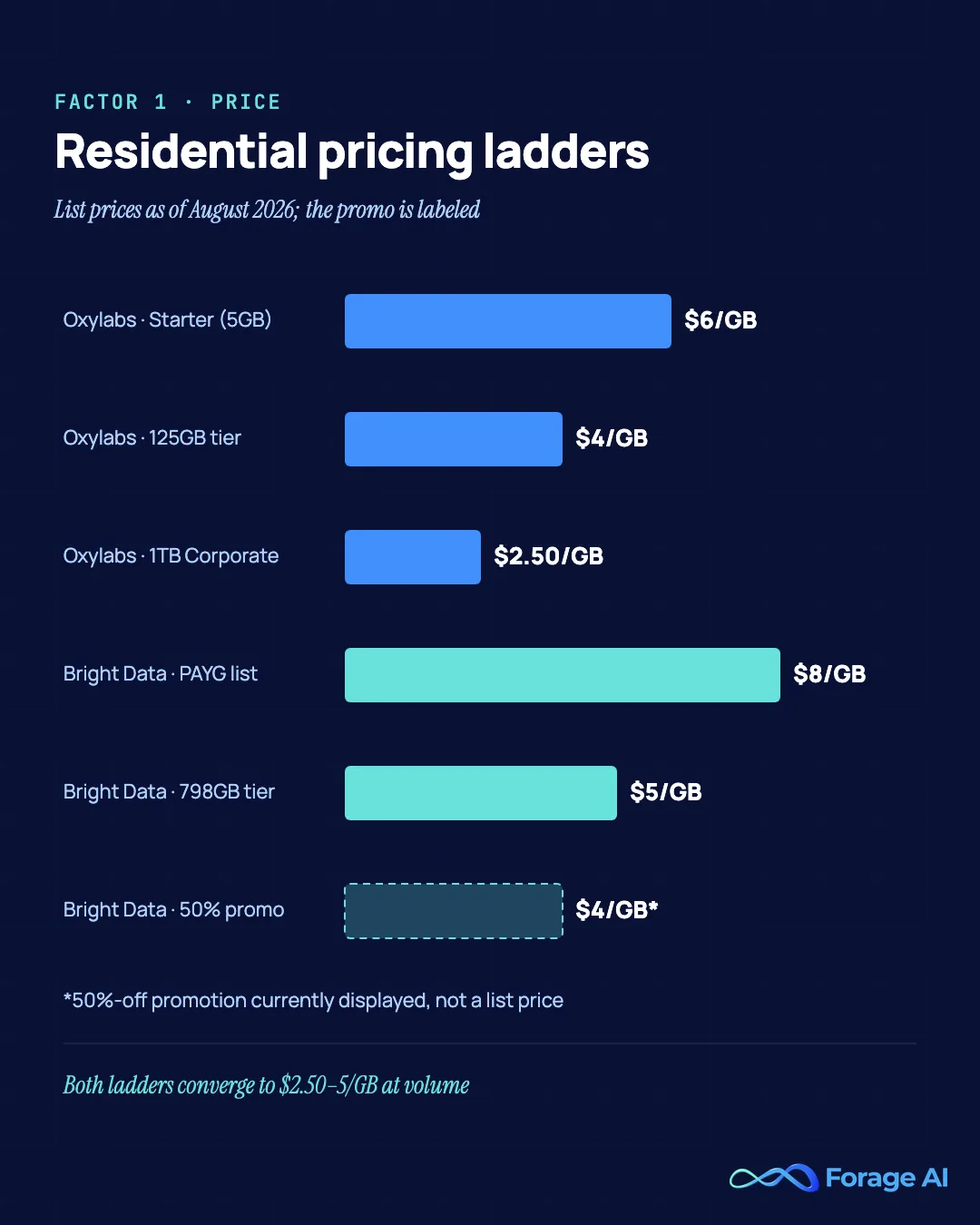
At entry list price, Oxylabs is cheaper. As of August 2026, Oxylabs’ residential proxy ladder runs $6/GB on the Starter plan (5GB minimum), stepping down to $4/GB at 125GB and $2.50/GB on the 1TB Corporate tier. Bright Data lists $8/GB pay-as-you-go, stepping to $5/GB at 798GB. Both are first-party list prices.
The promo complicates the sticker math. Bright Data’s page is currently running a 50%-off promotion showing $4/GB pay-as-you-go. That is a promotion, not a list price, and promotional pricing decays without notice. At committed volume the two ladders converge into the same $2.50 to $5/GB class.
Billing mechanics generate complaints on both sides, reviewer-reported: auto-renewal and refund-window friction for Oxylabs (Trustpilot, 2025–2026), calendar-month commitments with non-rolling balances for Bright Data (June 2026 review synthesis). One Capterra reviewer of Bright Data (2025) reported charges landing even on unsuccessful queries (verbatim in Factor 10).
Winner: Oxylabs at entry list price; effectively a tie at 1TB-class committed volume.
Factor 2: Proxy pool. Which has the larger network?
On advertised numbers, Bright Data’s network is larger. As of August 2026, Bright Data advertises 400M+ monthly ethical residential proxies across 195 countries, plus 1.3M+ datacenter IPs. Oxylabs advertises 175M+ residential IPs across 195+ countries. Both figures are the vendors’ own claims.
The comparison is softer than it looks. The vendors count on different bases (Bright Data counts unique monthly IPs), and no third party audits either number. More telling for buyers: in 2026 third-party testing, residential success rates for the two providers were a statistical tie, fluctuating in the same band with no sustained winner (AIMultiple, July 2026; methodology undisclosed).
Winner: Bright Data on advertised size, with the caveat that the numbers are unaudited and did not translate into a residential success-rate lead in 2026 testing.
Factor 3: Unblocking. Which gets past protected sites?
The product names are nearly identical, so vendor-prefix everything: Bright Data’s product is Web Unlocker, Oxylabs’ is Web Unblocker. Both target hardened, bot-protected websites.
The only 2026 third-party test that separates them favors Bright Data. AIMultiple’s July 2026 benchmark measured Web Unlocker at 68–78% success vs Web Unblocker at 40–50%, while Oxylabs responded faster (7–9s vs 10–12s). AIMultiple discloses no methodology, sample size, or target list; treat the result as directional. Meanwhile Proxyway’s Proxy Market Research 2026 (data collected March to April 2026, 3.6M requests) measured Oxylabs residential success at 99.93% with a 0.60s average response.
Why the divergence? Proxyway measures network health against standard targets at disclosed volume; AIMultiple appears to test hardened targets without disclosing how. A success rate without a methodology is marketing. Note the pricing-unit mismatch too: $1.50 per 1K requests (Bright Data) vs from $9.40/GB (Oxylabs), so page weight decides which is cheaper (first-party, August 2026).
Winner: Bright Data, directionally, on the one 2026 third-party unblocker test; Oxylabs wins on response speed.
Factor 4: Scraper APIs. Which is stronger?
Both vendors sell a product literally named “Web Scraper API,” so keep the vendor prefix on every mention. Capability is comparable: structured extraction from major targets, parsed output, scheduling on both sides.
The real difference is billing shape. As of August 2026, Bright Data’s Web Scraper API retails at $1 per 1K records with a free tier of 5K records per month, no card required. Oxylabs’ Web Scraper API starts at $49/month on subscription.
Which shape fits you is a workload question. Per-record retail favors spiky, experimental, or low-volume usage: you pay for records, not months. Subscription entry favors teams with steady baseline volume who want predictable budget line items. Neither shape is strictly cheaper.
Winner: Tie. Bright Data’s retail shape fits variable workloads; Oxylabs’ subscription shape fits steady ones.
Factor 5: Datasets. Which has better ready-made data?
Bright Data has built the marketplace; Oxylabs sells the contract. As of August 2026, Bright Data’s dataset marketplace advertises 700+ datasets and 21B+ records at up to $0.0025 per record with a $250 minimum order, refreshed on cadences from daily to yearly. Oxylabs sells standard datasets from $400/month and custom datasets from $800/month, delivered as JSON, CSV, Parquet, or XML to any S3-compatible store.
The buying experience differs accordingly. Bright Data’s model is retail: browse, pay per record, download; genuinely useful for exploratory work and common entities. Oxylabs’ model is closer to a data contract: scoped, recurring delivery for teams that know exactly what they need.
One category note before you buy either: off-the-shelf records come as-is. Neither offering includes the bespoke schema design, delivery SLAs, or multi-layer QA of a managed provider; that is a different category, the one Forage AI operates in, and it matters when the dataset feeds a production system.
Winner: Bright Data for breadth and retail flexibility; Oxylabs for contract-shaped custom delivery.
Factor 6: Which provider is ahead on AI and agent readiness?
Bright Data has shipped the broader agent-facing surface: Web MCP, Agent Browser, and Scraping Browser, all aimed at letting AI agents fetch and render live web data. Oxylabs answers with AI Studio and OxyCopilot, an AI-assisted scraping and query-building layer. All of these are vendor-advertised capabilities as of August 2026; no third-party benchmark of either agent stack exists yet, and any comparison claiming otherwise is reading marketing pages.
The market context explains the arms race. Bright Data disclosed roughly $300M in annualized revenue growing 50% year over year, attributed to AI demand, with a $400M target by mid-2026; Oxylabs grew headcount 20% in the same research window (Proxyway, Proxy Market Research 2026, data collected March to April 2026). AI workloads are now the growth engine of this category, and both vendors are rebuilding around agents.
The honest read for a decision-maker: if agent tooling is on your 2026 roadmap, Bright Data currently gives you more surface to test. Whether that surface performs is unproven either way.
Winner: Bright Data on breadth of agent tooling, caveated: unbenchmarked by any third party.
Factor 7: Developer experience. Which is easier to work with?
Integration is near-identical at the wire level. Both networks are backconnect endpoints: your code points at one proxy URL and the vendor rotates IPs behind it. Switching providers is often a one-line change:
# Oxylabs residential (documented endpoint format)
curl -x pr.oxylabs.io:7777 -U "customer-USERNAME:PASSWORD" "https://target.example.com"
# Bright Data residential (zone-based endpoint format)
curl -x brd.superproxy.io:33335 -U "brd-customer-ID-zone-residential:PASSWORD" "https://target.example.com"
Above the wire, the philosophies split. Bright Data’s zone system is deep and configurable; G2 reviewer synthesis (June 2026, corroborated via secondary sources) praises the clean backend integration, while dashboard complexity is the recurring one-star theme among smaller teams. Oxylabs runs a more account-managed motion; Adam Dubois’ Proxyway review, built on April 2026 tests (quoted in the Expert Insights card at the top of this comparison), credits the account management while noting you still pay a premium for it.
Winner: Tie, split by team type. Self-serve tinkerers get further faster with Bright Data’s console; account-managed enterprise teams tend to prefer the Oxylabs motion.
Factor 8: Which vendor is safer to bet on for compliance and vendor risk?
Both vendors run mature compliance programs. Each markets ethically sourced, consent-based residential IPs and applies KYC screening before granting full network access. Bright Data requires a compliance review for full residential access and does not support personal or hobby projects (June 2026 review synthesis); Oxylabs’ verification draws similar friction reports from self-serve users. For enterprise procurement, that screening is a feature. Our enterprise evaluation checklist for data extraction companies covers what to ask both.
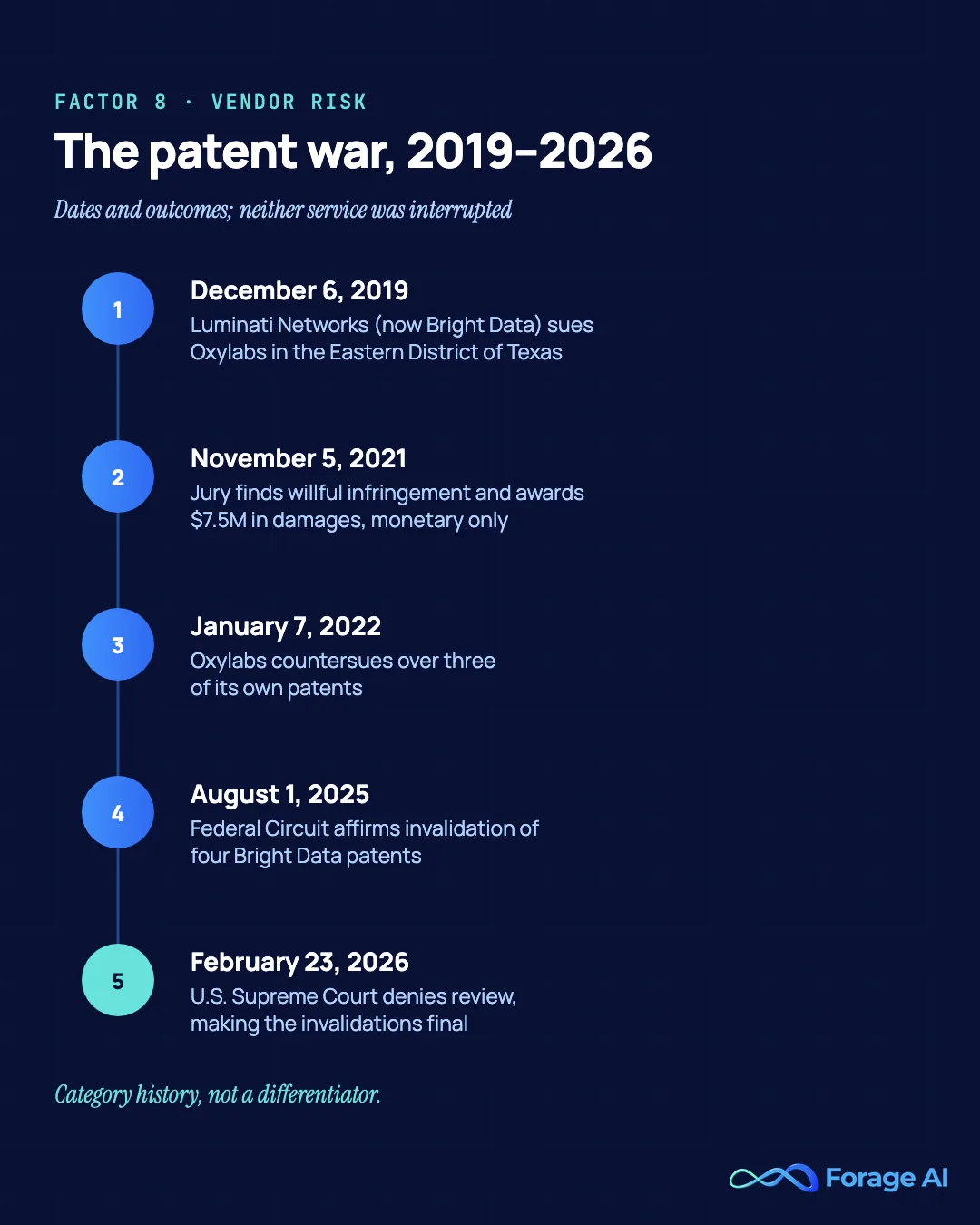
The litigation arc, dates and outcomes only:
Neither vendor’s services were halted by the litigation, and the endgame neutralized the original verdict’s patents: category history, not a differentiator. (Oxylabs’ “12 patents invalidated” is vendor-stated; the corroborated count is four.)
Winner: Tie. Both carry mature compliance postures, and the litigation ended without operational impact on either side.
Factor 9: Support and trials. Which is easier to try and get help from?
Bright Data is easier to try without talking to sales. As of August 2026, it offers a 7-day free trial for registered companies (a payment method is reported to be required, per secondary sources) plus the Web Scraper API free tier of 5K records per month, no card. Oxylabs offers a free datacenter trial, but residential trials and limit increases route through an account manager, a sales-gated path.
Once you are a customer, support sentiment is positive on both sides. Oxylabs’ support is described as “patient and helpful” even inside otherwise negative billing reviews (Trustpilot, 2025–2026); Bright Data reviewers cite support engineers responding quickly (G2 synthesis, April 2026, corroborated via secondary sources). The difference is the model: named account managers at Oxylabs, self-serve depth plus responsive support at Bright Data.
Winner: Bright Data for self-serve trialability; Oxylabs for account-managed support depth.
Factor 10: User sentiment. Which do customers rate higher?
Print the numbers with their sample sizes, because the pattern is in the segmentation. As of mid-2026: Bright Data holds 4.4/5 on Trustpilot (n≈970), roughly 4.6/5 on G2 (n≈240–300), and 4.7/5 on Capterra (n=68, fetched directly August 2026). Oxylabs holds 4.5/5 on G2 (n=428) and 3.7/5 on Trustpilot (n≈724). G2 and Trustpilot figures are corroborated via secondary sources, since both platforms block direct programmatic access.
The Trustpilot gap is the story. On the enterprise-motion platform (G2), the two are near-parity. On the self-serve platform (Trustpilot), Bright Data’s customers rate it far higher, while auto-renewal and verification friction dominate Oxylabs’ negative reviews. That is segmentation, not contradiction: each vendor scores best with the buyer it is built for.
Individual reviews cut both ways. One 2025 Capterra reviewer reported a “very high failure rate” with Bright Data’s unlocker and proxy products and being “charged for unsuccessful queries”; 2026 reviewers on the same platform cite a “lower error rate compared to other solutions.” The r/webscraping consensus: both handle hardened targets; the real choice is billing model plus onboarding.
Winner: Bright Data on self-serve sentiment; near-parity in enterprise reviews.
Quick Summary
Q: What are the biggest differences between Oxylabs and Bright Data?
A: The biggest differences are buying motion and product surface, not raw capability. Bright Data is retail-shaped: per-record pricing, a 700+ dataset marketplace, self-serve trials, broader agent tooling, stronger self-serve sentiment (Trustpilot 4.4 vs 3.7, mid-2026). Oxylabs is contract-shaped: cheaper entry list pricing ($6/GB vs $8/GB residential), account-managed support, stronger mobile results. Residential performance was a statistical tie in 2026 third-party testing.
The Full Comparison at a Glance
Ten factors argued, ten winners committed: here is every verdict, consolidated. Cells carry the actual answer with its key number rather than a bare score, so any row reads as a complete comparison on its own. Prices and claims are as of August 2026; review figures carry their sample sizes in Factor 10.
| Factor | Oxylabs | Bright Data | Winner |
|---|---|---|---|
| Price | Cheaper entry: $6/GB residential list (5GB min), down to $2.50/GB at 1TB. | $8/GB PAYG list, down to $5/GB at 798GB; 50%-off promo currently displayed (promo, not list). | Oxylabs at entry; tie at volume |
| Proxy pool | Advertises 175M+ residential IPs, 195+ countries. | Advertises 400M+ monthly residential IPs, 195 countries, plus 1.3M+ datacenter IPs. Both counts unaudited. | Bright Data (advertised size) |
| Unblocking | Web Unblocker: 40–50% in AIMultiple’s Jul 2026 test, but faster (7–9s); from $9.40/GB. | Web Unlocker: 68–78% in the same test (10–12s); $1.50/1K requests. Methodology undisclosed; directional. | Bright Data (directional) |
| Scraper APIs | Web Scraper API from $49/mo subscription; fits steady baseline volume. | Web Scraper API at $1/1K records retail, 5K/mo free tier, no card; fits variable volume. | Tie (billing shapes) |
| Datasets | Standard from $400/mo, custom from $800/mo; contract-shaped, S3-compatible delivery. | Marketplace of 700+ datasets, 21B+ records, up to $0.0025/record, $250 minimum. | Bright Data (breadth); Oxylabs (custom contract) |
| AI and agent readiness | AI Studio and OxyCopilot; vendor-advertised, unbenchmarked. | Web MCP, Agent Browser, Scraping Browser; broader surface, equally unbenchmarked. | Bright Data (surface breadth) |
| Developer experience | Backconnect endpoint, account-managed onboarding; premium pricing per Proxyway (Apr 2026). | Backconnect endpoint, deep zone system; dashboard complexity is the recurring gripe for small teams. | Tie (split by team type) |
| Compliance and vendor risk | KYC screening, ethical-sourcing posture; countersued in 2022, its patents held through the war’s end. | KYC plus compliance review for full residential access; its asserted patents were invalidated, final Feb 23, 2026. | Tie (category history) |
| Support and trials | Free datacenter trial; residential trial sales-gated; support rated “patient and helpful.” | 7-day company trial (card reported required) plus 5K/mo free API tier; quick support responses reported. | Bright Data (trialability); Oxylabs (managed depth) |
| User sentiment | G2 4.5/5 (n=428); Trustpilot 3.7/5 (n≈724), as of mid-2026. | G2 ≈4.6/5 (n≈240–300); Trustpilot 4.4/5 (n≈970); Capterra 4.7/5 (n=68), as of mid-2026. | Bright Data (self-serve); parity (enterprise) |
When Should You Choose Oxylabs or Bright Data?
The scorecard points to a conditional answer, and we will commit to it rather than hide behind “it depends.”
Choose Oxylabs if:
- Your workload is mobile-heavy. The 2026 third-party mobile numbers favor Oxylabs (90–98% vs 66–85%, AIMultiple, July 2026, methodology caveat applies).
- You run an account-managed procurement motion: named contacts, negotiated committed tiers, a vendor that behaves like a contract partner.
- Entry list price matters and your volume sits in the low-GB tiers, where $6/GB beats $8/GB before promos.
Choose Bright Data if:
- You want breadth in one vendor: datasets, agent tooling, and scraper products in a single account.
- You buy off-the-shelf datasets or expect to; the 700+ dataset, per-record retail model has no Oxylabs equivalent.
- You need to start self-serve today: the trial path and free API tier let your engineers evaluate without a sales call.
- Unblocking hardened targets is the core job and you weight the one 2026 third-party test that separates the two products.
If your factor tally lands within a point or two, break the tie on year-two exposure, not this month’s price. Which factor, if it degrades, costs you most: a price you can renegotiate, or a workload dependency (mobile performance, dataset refresh, agent tooling) with no fallback? Weight the factor you cannot route around.
What If Neither Fits?
There is a question underneath this whole comparison that neither pricing page will ask for you: should your team be buying scraping infrastructure at all?
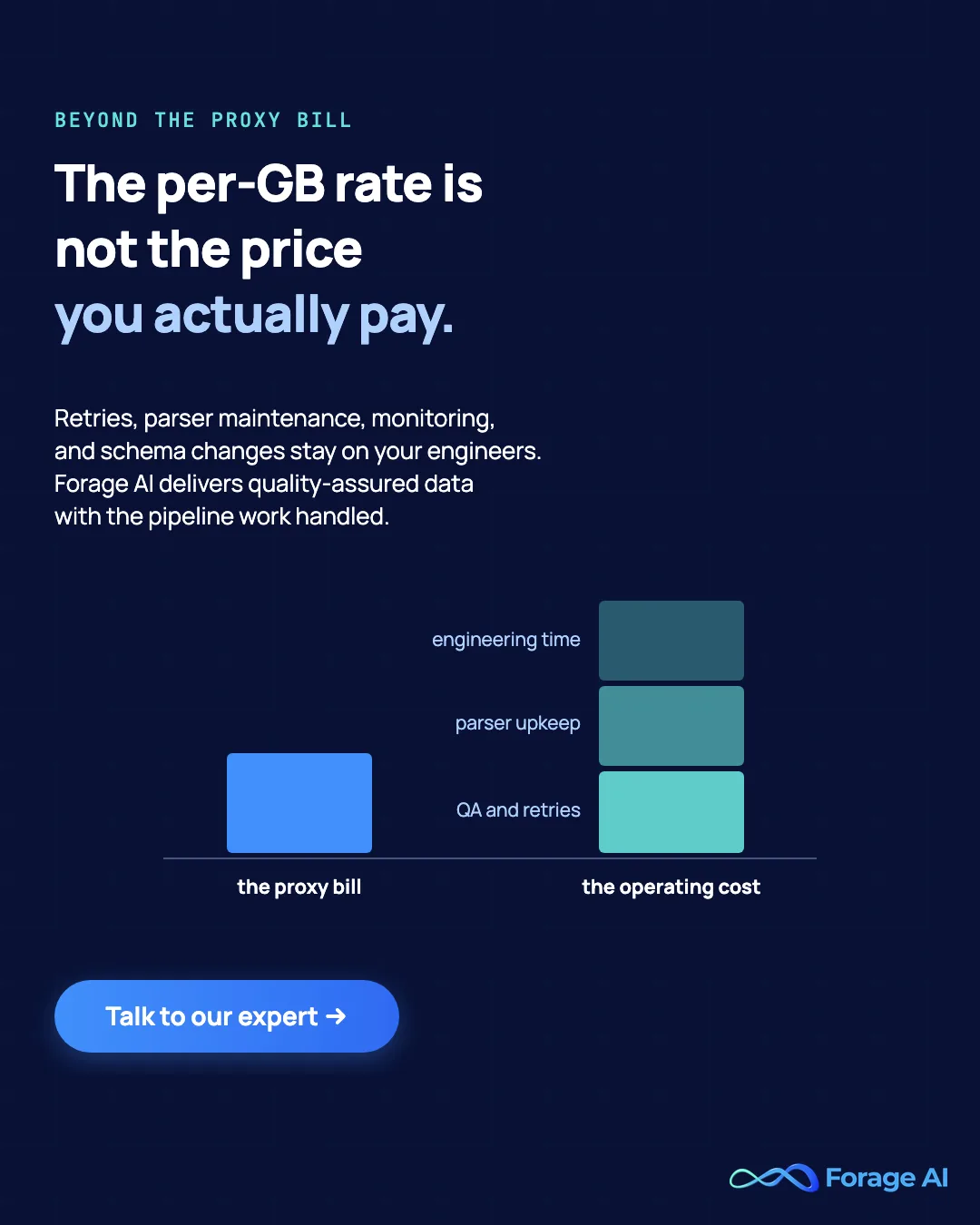
Both vendors sell capable infrastructure. Both also leave the same work on your side of the table: writing and maintaining parsers, retry and failure logic, data quality monitoring, and schema changes when target websites shift. The proxy bill is the visible cost; the engineers operating the platform are the dominant one.
That burden is rising, and DIY scraping infrastructure is a permanent engineering commitment, not a one-time purchase.
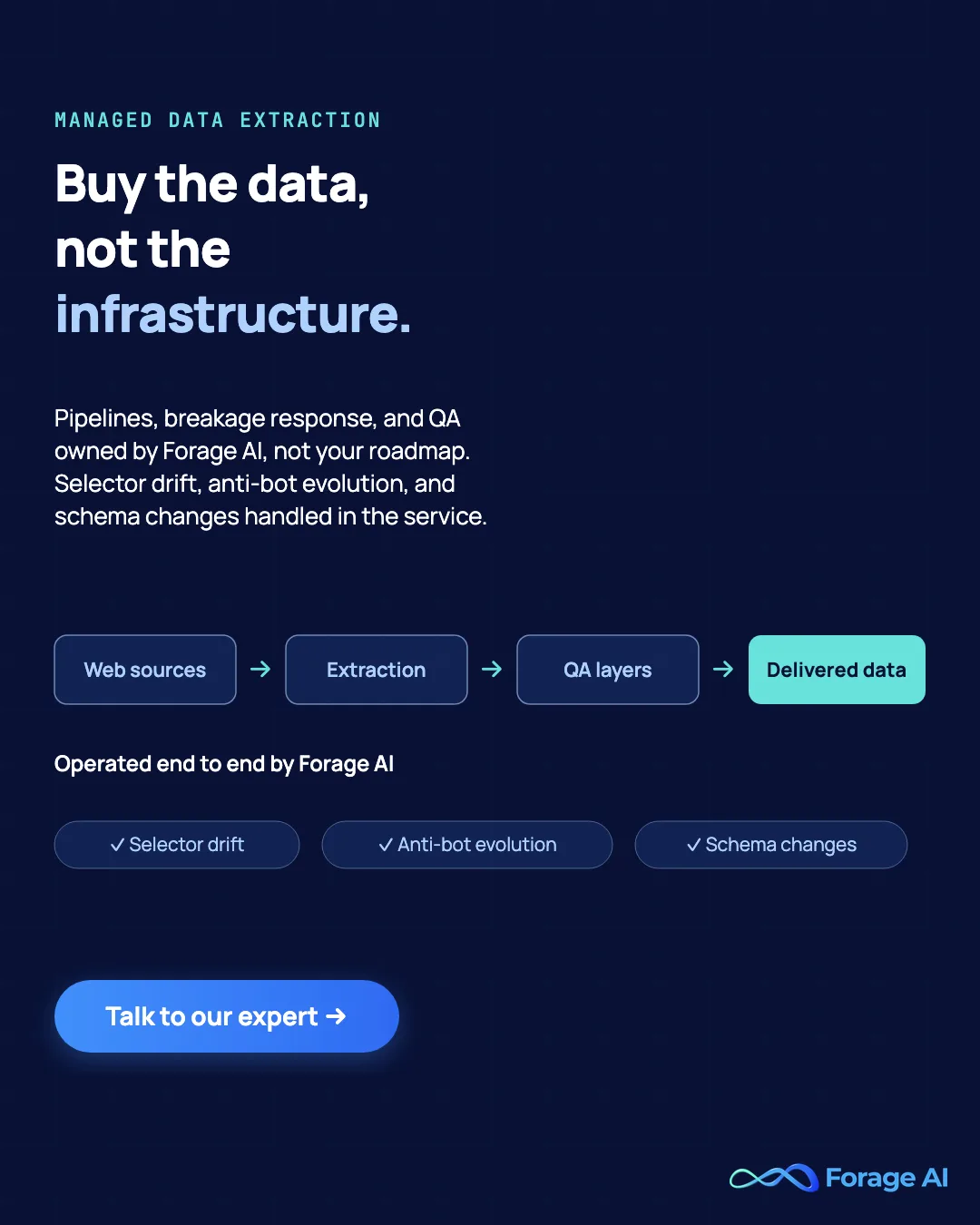
The team-shape test is the honest decision rule. If you have, or want, a scraping team whose job is operating extraction infrastructure, Oxylabs or Bright Data is the right category, and the ten factors in this comparison will pick between them. If your organization needs delivered, quality-assured data with zero scraping headcount, you are an outcome-buyer shopping in an infrastructure aisle. That mismatch is where data extraction services enter: a managed provider owns the pipelines, the breakage response, and the QA. Forage AI delivers the data, not just the pipeline; it handles selector drift, anti-bot evolution, and schema changes as part of the service.
If you are weighing that third path, our guides to Bright Data alternatives and Oxylabs alternatives map the full landscape, and our review of the best AI web scraping tools covers where agent-driven tooling genuinely helps.
FAQ
Is Oxylabs better than Bright Data?
Neither is better across the board. Bright Data wins six factors (advertised pool size, unblocking directionally, datasets, agent tooling, trialability, and self-serve sentiment); Oxylabs wins entry pricing and leads the mobile benchmarks; three factors tie. The answer depends on whether you buy self-serve and retail-shaped (Bright Data) or negotiated and account-managed (Oxylabs).
Which is cheaper, Oxylabs or Bright Data?
At entry list prices, Oxylabs: $6/GB residential vs Bright Data’s $8/GB, as of August 2026, first-party pages. At committed volume both land in the $2.50 to $5/GB class. Bright Data frequently runs steep promotions (currently 50% off residential), so compare list to list and model your actual volume before deciding.
What happened in the Bright Data vs Oxylabs lawsuit?
Bright Data (then Luminati) sued Oxylabs in December 2019 and won a $7.5M willful-infringement jury verdict in November 2021. Oxylabs countersued in January 2022 and challenged the patents at the USPTO. On August 1, 2025 the Federal Circuit affirmed invalidation of four Bright Data patents, including those from the trial; on February 23, 2026 the Supreme Court declined review, making the invalidations final. Neither company’s services were interrupted.
Do Oxylabs and Bright Data offer free trials?
Bright Data offers a 7-day free trial for registered companies (a payment method is reported to be required) and a free Web Scraper API tier of 5K records per month, no card. Oxylabs offers a free datacenter trial; residential trials are sales-gated through an account manager. For evaluation without a sales call, Bright Data is the easier start.
Which has better success rates, Oxylabs or Bright Data?
There is no single number, and any page printing one without methodology is selling something. Proxyway’s March to April 2026 benchmark (3.6M requests) measured Oxylabs residential at 99.93%; AIMultiple’s July 2026 residential testing showed both vendors fluctuating between the mid-50s and low-70s with no sustained winner. The directional reads that survive every source: mobile favors Oxylabs, unblocking favors Bright Data, residential is a tie.
What are the alternatives to Oxylabs and Bright Data?
Within the self-serve proxy and scraping-API category, our Oxylabs alternatives and Bright Data alternatives guides compare the field. The other alternative is a category change: managed data extraction, where a provider like Forage AI operates the pipelines and delivers quality-assured data, fitting teams that need outcomes rather than infrastructure.
The Factor Your Decision Turns On
The screenshots that started this evaluation, 99.93% in one test and 40 to 50% in another, stop being a contradiction once you know what each test measures. The same goes for the whole shortlist. Run the ten factors against your workload and one of these vendors will fit, and fit well. The real progress is what the exercise reveals: once you can name the factor your decision actually turns on, whether that is mobile success rates, dataset refresh cadence, or the headcount operating it all, you have stopped buying a brand and started buying against your own requirements. That position outlasts this shortlist, and it carries into every infrastructure decision after it.
Related Articles
- Bright Data Alternatives: The full landscape of providers competing with Bright Data, compared with ratings and sample sizes.
- Oxylabs Alternatives: Where Oxylabs wins, where it does not, and who else belongs on the shortlist.
- Web Scraping Companies vs Tools: The category decision underneath every vendor comparison: buy a platform or buy an outcome.
- Best AI Web Scraping Tools: How agent-driven scraping tooling actually performs, and where it fits an enterprise stack.
Sai is a data infrastructure enthusiast who has spent the past two to three years following the AI space closely, from the infrastructure layer to the fast-growing world of data for AI. He is genuinely curious about how modern data pipelines get built and where the data industry is heading, and he writes insightful pieces on the core topics that shape this niche.