
PropStream Alternatives for Investor-Grade Property Data
Last updated October 2026. Prices read on each vendor's page, October 2026.
PropStream's renewal email lands, and the figure on it is $99, $199 or $699 a month, depending on whether you sit on Essentials, Pro or Elite (as of October 2026). Or a "free and clear" lead you mailed last month turns out to carry a recorded mortgage.
Either way, you start looking for a PropStream alternative.
The search is harder than it should be. When we searched "propstream alternatives" in October 2026, eight of the ten top results were vendor pages. None of them says whether the replacement's owner, mortgage or equity records are any better in your counties.
Here is the frame we work from. A switch reliably changes your workflow and your bill. Whether it changes your data is a separate question, and you can answer it yourself.
By the end of this guide, you will know which of two lanes you buy in (investor apps, or API and bulk records), which one or two alternatives to trial, what each states about its data and what it costs, and the seven checks to run on your own county before you switch. Jump to the seven checks.
- No API: PropStream publishes no API or bulk-data product, and its terms bar robots, crawlers and AI use.
- Same owner: PropStream has owned BatchLeads since a July 7, 2025 acquisition, so switching to BatchLeads keeps you with the same company.
- Free: Propwire is the only app in this guide with a permanent free plan that returns property records; liens sit on its paid Premium tier.
- Test it: we found no published independent test of these platforms' data, so run seven checks on your own county before you switch.
Lists, skip tracing and outreach in one login? Band A, investor apps. Records delivered into your own systems? Band B, API and bulk data.
Prices read on each vendor's page, October 2026. No vendor paid for placement. Forage AI is not in these tables.
How we judged these PropStream alternatives
Every alternative here had to pass one inclusion test: it gives an investor owner, mortgage or lien, equity, distress or comps data they can act on, reached by app, export, API or bulk file. CRM-only tools and consumer portals are out. Commercial investors are better served by our guide to commercial real estate data tools.
We sorted what passed into two lanes by how you consume data, then listed each lane alphabetically. For a wider, enterprise-led view of the market, see our comparison of real estate data providers.
Between October 20 and 22, 2026, we read each vendor's pricing page, terms and help or API documentation. We did not test any platform hands-on and did not measure accuracy, hit rates or contact rates. Ratings appear only with their review count and date, and review counts under 40 are flagged. G2 and Capterra blocked automated reads for DealMachine, BatchLeads, Propwire and XLeads, so those carry no rating.
Vendors state coverage in properties, records, parcels, multiple listing service (MLS) markets or a population share, so a coverage number is not a coverage test. A "Not stated" cell is a finding, not a blank. Prices are printed as published, with their unit, never converted to a common rate.
Each entry is read against the seven checks of the investor-grade test, run in full further down:
| Check | What it tells you | Where you see it in each entry |
|---|---|---|
| Count your county | Whether the vendor holds your county's parcels, in your property classes | Coverage as stated |
| Check 20 addresses you know | Whether owner and open-mortgage fields match what you know is true | Investor fields stated |
| Ask what "free and clear" means | Whether the label means no recorded loan or a verified payoff | How equity and free-and-clear are defined |
| Ask how equity is computed | Whether the equity figure has a stated formula or a threshold | How equity and free-and-clear are defined |
| Ask for the refresh rate, field by field | How old each field can be | Refresh as stated |
| Ask for the source of record | Whether switching changes the data underneath | Evidence table, Owner |
| Read the terms before you export | What you may do with an export: merge, feed a model, keep | Watch-out; AI or derivative-use terms (Band B) |
Which PropStream alternative fits how you use data?
Pick your lane first, then read the row. The table below answers three questions on one screen: which lane, what it costs as published, and what is missing compared with PropStream.
PropStream alternatives at a glance (prices as of October 2026, as published)
| Alternative | Best for | How you get the data | Price as published | Free option | Biggest gap vs PropStream |
|---|---|---|---|---|---|
| Band A: investor apps | |||||
| DataSift (formerly REISift) | Investors whose bottleneck is exports | App, unlimited export | $149 / $299 / $499 a month (fourth plan $1,250) | 7-day trial | No API; equity by threshold only |
| DealMachine | API access on a self-serve plan, plus driving for dollars | App, export, API | $119 per seat, $179 per bundle, $599 per package, a month | No trial; free account shows counts only | No trial |
| Deal Sauce | An app with an unlimited skip-tracing tier | App | MILD $97, HOT $297 a month | 14-day free trial, per its terms | Export limits and API not stated |
| PropertyRadar | Seeing how equity is computed, with API on a self-serve plan | App, export, API | $119 / $249 / $599 a month ($99 / $199 / $549 prepaid annually) | 5-day trial | No exports during the trial |
| Propwire | Investors for whom cost is the wall | App, download | Free; Gold $119 a month | Free plan | Liens on Premium only |
| XLeads | Skip-traced downloads inside the plan | App, skip-traced downloads | $97 / $199 / $249 a month | None stated | Equity, mortgage and coverage not stated |
| Band B: API and bulk data | |||||
| ATTOM | Records by API or bulk licence, with a trial key | API, bulk, cloud | API quote only | 30-day trial for an API key | No outreach tools |
| BatchData | Published bulk pricing with warehouse delivery | API, bulk (S3, Snowflake, file) | $1,000 to $10,000 a month | None stated | No trial; no outreach bundle |
| Cotality (formerly CoreLogic) | Open-lien positions per property | API, cloud, file | Quote only | None stated | No published price |
| First American DataTree | Coverage stated in counties, release records in the feed | API, bulk, web platform | Reports $4 to $22; API and bulk unpublished | Trial behind a sales form | No self-serve bulk price |
| RealEstateAPI | Documented investor filters in an API | API | $599 to $2,500 a month on an annual subscription, billed monthly | $200 in credits for 14 days | No outreach tools |
| Regrid | Counting parcels in your county | API, bulk files, tiles | $375 / $500 a month | 30-day, 7-county sandbox | No mortgage, lien, equity or distress fields |
| Often recommended, not true alternatives (shaded) | |||||
| BatchLeads | n/a | App | $119 / $349 / $749 a month | 7-day trial | Same owner as PropStream |
| ListSource | n/a | Per-list purchase | $50 minimum per transaction | Free sample leads | One-time use; licence forbids merging |
| Privy | n/a | App (MLS-led) | $97 / $149 / $249 a month | No trial as policy; 30-day money-back | Owner and distress fields not stated |
| REsimpli | n/a | CRM with data pulling | $299 / $899 / $2,199 a month | 14-day trial | Names no property-data source |
Of the six investor apps in this guide, DealMachine and PropertyRadar are the two that list API access on their self-serve plans (pricing pages read October 2026).
We grouped by lane rather than ranking because a solo wholesaler and a fund should not read one list. The shaded rows are not peers, for reasons covered further down.
Is there a free PropStream alternative?
Yes, in three forms, and each one has a cost. PropStream itself has no free plan. It offers a "7-Day Free Trial" with 50 leads, and its FAQ says the trial includes "50 Imports/Exports of Properties" (as of October 2026).
Free is not automatically worse, and paid is not automatically better. A free plan disclaims accuracy exactly as a paid one does.
One app with a real free plan. Propwire advertises "Search 157+ Million MLS & Off-Market Properties. 100% Free." Free downloads cap at 10,000 properties per download. Liens (mechanic's, HOA and tax) sit on its Premium tier, whose price Propwire does not publish. Premium leads cover "over 1000 counties", and Propwire says "we don't have 100% of the country covered yet".
Free tiers for teams. As of October 2026, RentCast offers "a free API plan which includes 50 free API calls per month", though it carries no mortgage, lien, equity or distress fields, so it is not an entry here. Regrid's API sandbox is $0 for 30 days across 7 counties and 2,000 parcel records, with "No credit card required". RealEstateAPI offers a "Free trial with $200 in API credits for 14 days, no credit card required." ATTOM offers "a free 30-day trial to receive an API key".
County data, paid in time. Not every county charges for its roll. Maricopa County's assessor, for one, lets anyone download its parcel master file at no cost, but you format it yourself and the county "does not guarantee the accuracy of the data". Access is not uniform: Kansas limits its real estate sales-validation questionnaire data to nine listed categories of user (K.S.A. 79-1437f).
If check 1 passes in your county, free may be enough. Free API tiers suit a team testing fields, not a wholesaler pulling lists. The trade is fields, caps and coverage, with premium leads in "over 1000" of 3,143 counties. Before you rely on a free file, run check 6 below.
Why do investors leave PropStream?
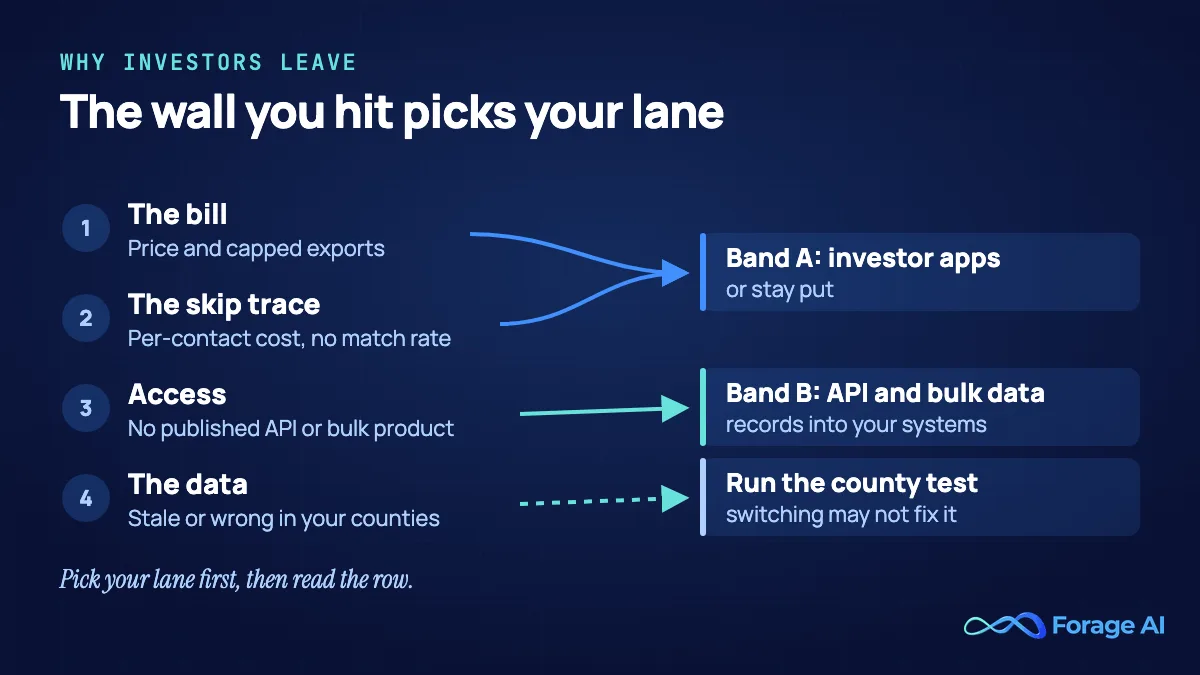
PropStream earns its place before anyone leaves it. It puts lists, filters, skip tracing and outreach in one subscription, and Stewart Information Services announced its $175 million agreement to acquire PropStream in November 2021. Investors still leave, and they usually hit one of four walls.
- The bill: $99 / $199 / $699 a month, or $972 / $1,980 / $6,996 a year, as of October 2026. Saves and exports run 25,000 / 50,000 / 100,000 a month, and "Unused saves and exports don't roll over. Each month your account resets to your regular limit." Extra exports cost "from 10¢ each".
- The data: stale or wrong records in your counties. It is reported by investors, not measured. PropStream's own FAQ concedes "A small number of counties across the U.S. restrict certain information from Public Records".
- The skip trace: 12¢ a contact on Essentials, 10¢ on Pro and Elite (as of October 2026). PropStream publishes no match rate and says "PropStream engages an independent third party to perform skip-tracing".
- Access: no published API or bulk product. The address propstream.com/api returns a 404, and the pricing page offers "Custom Pricing ... CONTACT SALES" with the scope unstated. The terms bar access "with any robot, spider, web crawler, extraction software, automated process" and use by "any form of artificial intelligence technologies such as large language models and generative AI".
The wall you hit picks your lane. The bill or the skip trace points to Band A, or to staying put. Access points to Band B. The data points to the test, because switching may not fix it.
Investor apps for solo investors and small teams
Band A is for investors who want lists, filters, skip tracing and outreach in one login. Listed alphabetically. Nothing here is a ranking.
All eleven investor-app vendors whose terms we read in October 2026, PropStream included, disclaim the accuracy of their data. Each table shows what the vendor states. A wholesaler can stop at the fourth row; an analyst should keep reading.
DataSift (formerly REISift)
| Attribute | Detail |
|---|---|
| Best for | Investors whose bottleneck is exports |
| How you get the data | App with "Unlimited Data Export"; Zapier connections |
| Price as published | Professional $149, Business $299, Expert $499 a month; a fourth plan at $1,250 (as of October 2026) |
| Free plan or trial | 7-day trial |
| Investor fields stated | Owner Y · liens on SiftMap Pro · equity threshold Y · distress Y · comps Y · MLS not stated |
| How equity and free-and-clear are defined | Thresholds only: "High Equity - properties that have 30% or greater equity"; "Free and Clear - properties that are owned outright and do not have any mortgage (100% equity)". No computation method |
| Coverage as stated | Not stated ("Nationwide") |
| Refresh as stated | Not stated; a "free monthly vacancy check" is listed |
| Outreach included | Not stated |
| Skip tracing | $0.15 / $0.12 per skip, unlimited on the top plans, or a "$97 a month unlimited skiptracing add on" |
| Biggest gap vs PropStream | No API; equity by threshold only |
| Watch-out | Annual prices contradict each other on the pricing page; compare on monthly |
| Owner | Not stated on the pages we read; reisift.io redirects to datasift.ai |
| Claim | Source, read date and status |
|---|---|
| Monthly plan prices | DataSift pricing page, read 2026-10-22. Vendor statement |
| Annual pricing | DataSift pricing page, read 2026-10-22. Self-contradicting (Business "$2870/yearly" against "Save $598 annually") |
| Equity and free-and-clear thresholds | DataSift help article, read 2026-10-22. Vendor statement |
| Accuracy disclaimer | DataSift terms, read 2026-10-22. Vendor statement |
| G2 4.6, n = 18 (listed as REISift) | G2, read 2026-10-22. Review platform; n under 40 |
DataSift, formerly REISift, is built for investors who work their lists hard. The headline feature is "Unlimited Data Export", alongside a monthly new-property allowance of 10k / 25k / 50k / 100k, "then $5 for every 10K records" (as of October 2026).
On data, it states thresholds rather than a method: you know where "high equity" starts (30%), not how the figure behind it is computed. Its terms are blunt: "DATASIFT MAKES NO WARRANTY REGARDING THE ACCURACY, TIMELINESS, COMPLETENESS, OR CURRENTNESS OF THE DATA".
Choose it if exports are your bottleneck, since unlimited export answers PropStream's capped saves. Skip it if you need records by API.
Where it is weaker than PropStream: no published equity method, and no API, so it does not fix the access wall either.
Not for: teams that need records by API.
DealMachine
| Attribute | Detail |
|---|---|
| Best for | API access on a self-serve plan, plus driving for dollars |
| How you get the data | App, export, API ("API, CLI & webhook access" on Basic, Pro and Scale) |
| Price as published | Basic $119 per seat a month (10,000 data credits), Pro $179 per bundle a month (20,000 credits, 3 users), Scale $599 per package a month (100K records, 10 seats); billed monthly (as of October 2026) |
| Free plan or trial | No trial; a free account shows counts only |
| Investor fields stated | Owner Y · mortgage Y · liens Y · equity Y · distress Y · comps Y · MLS not stated |
| How equity and free-and-clear are defined | Not stated |
| Coverage as stated | "150M+ properties & 240M+ people" |
| Refresh as stated | Not stated |
| Outreach included | Mail app with pay-as-you-go postcards; Driving for Dollars app on every plan |
| Skip tracing | Not recorded for this guide |
| Biggest gap vs PropStream | No trial |
| Watch-out | Data credits are counted per seat |
| Owner | Not stated on the pages we read |
| Claim | Source, read date and status |
|---|---|
| Plan prices and units | DealMachine pricing page, read 2026-10-22. Vendor statement |
| API on Basic, Pro and Scale | DealMachine pricing page, read 2026-10-22. Vendor statement |
| 60 requests a minute, 5,000 a day; 1,000,000 records per export | DealMachine API documentation, read 2026-10-22. Vendor statement |
| "AS IS" and "WITH ALL FAULTS" | DealMachine terms, read 2026-10-22. Vendor statement |
| Rating | G2 / Capterra, read 2026-10-22. Not read (automated reads blocked) |
DealMachine is named on most of the comparison pages we read. It pairs records with outreach, including driving for dollars. It also lists "API, CLI & webhook access" under Basic, Pro and Scale, and its documentation sets default limits of 60 requests a minute and 5,000 a day, with a maximum of 1,000,000 records per export.
On data, DealMachine says you can "Append 100+ fields from county and lender records", covering mortgage, equity, liens and tax history. The method behind its equity figure is not stated. Its terms say "THE SERVICES ARE PROVIDED 'AS IS' AND 'WITH ALL FAULTS'".
Choose it if you want API access on a self-serve plan plus driving for dollars. Skip it if you need to see records first: a free account shows "property and people counts ... Enrichment and record retrieval require paid access."
Where it is weaker than PropStream: no trial at all, where PropStream offers seven days, and credits counted per seat.
Not for: anyone who must see records before paying.
Deal Sauce
| Attribute | Detail |
|---|---|
| Best for | An app with an unlimited skip-tracing tier ("Unlimited Skip Tracing" on HOT) |
| How you get the data | App; export limits and API not stated |
| Price as published | MILD $97, HOT $297 a month; $78 / $238 billed annually (as of October 2026) |
| Free plan or trial | "a 14-day free trial", per its terms |
| Biggest gap vs PropStream | Export limits and API not stated |
| Owner | Boom Sauce LLC of Tempe, Arizona, per its terms; co-founders named on its about page: Jamil Damji and Pace Morby; no PropStream link found |
Deal Sauce's terms say it plainly: "Platform Data may differ materially from actual property conditions, ownership records, recorded liens, current mortgage balances, and other facts." It advertises "160M+ Up-To-Date Property Records" as a vendor statement.
PropertyRadar
| Attribute | Detail |
|---|---|
| Best for | Seeing how equity is computed, with API on a self-serve plan |
| How you get the data | App; monthly exports 10,000 / 25,000 / 50,000; "API Access" in all three plan blocks |
| Price as published | Solo $119, Team $249, Business $599 a month; prepaid annually $99, $199, $549 a month (as of October 2026) |
| Free plan or trial | "Start with a 5-day free trial"; "Exports are not available during the free 5-day trial." |
| Investor fields stated | Owner Y · mortgage and lien Y · equity Y · distress Y (trustee sales) · comps Y · MLS not stated |
| How equity and free-and-clear are defined | Formula published: estimated value "minus the sum of all loans which are modeled to be open on the property" |
| Coverage as stated | "160+ million properties nationwide"; trustee-sale tracking "available in 270 counties" |
| Refresh as stated | "Acquired daily"; time from recording to appearance not stated |
| Outreach included | Not stated |
| Skip tracing | Not recorded for this guide |
| Biggest gap vs PropStream | No exports during the trial |
| Watch-out | Equity and loan positions "have not been manually reviewed"; its FAQ and terms require a card for the trial |
| Owner | Not stated on the pages we read |
| Claim | Source, read date and status |
|---|---|
| Plan prices and export caps | PropertyRadar pricing page, read 2026-10-22. Vendor statement |
| "API access is now included in every PropertyRadar paid plan" | PropertyRadar API page, read 2026-10-22. Vendor statement |
| Equity formula and worked example | PropertyRadar Criteria Glossary (dated January 21, 2026), read 2026-10-22. Vendor statement |
| Loan-term, rate and value fallbacks | PropertyRadar help-centre note (2015), read 2026-10-22. Vendor statement; dated |
| G2 4.5, n = 35 | G2, read 2026-10-22. Review platform; n under 40 |
Among the investor apps we read, PropertyRadar is the one that publishes how it computes estimated equity. Its glossary defines Estimated Equity as "calculated as estimated property value minus the sum of all loans which are modeled to be open on the property". The vendor's own example: a $100,000 value, a $50,000 first and a $30,000 second give $20,000 of equity.
A 2015 help-centre note adds the assumptions. It assumes a 30-year term when the loan term is unknown, uses "the Freddie Mac 30 year rate at the time the loan was originated" when the rate is missing, and, with no confident automated valuation model (AVM) estimate, falls back to the last market sale within three years and then to assessed value. Treat that note as dated, not as current practice.
The company is candid about limits. It says equity and loan positions "have not been manually reviewed. As such, they should be used with caution", and adds: "we are not aware of any service other than an insured title policy that reliably provides complete lien and loan information."
Choose it if you want to see the equity arithmetic and need API on a self-serve plan. Skip it if you must export during the trial.
Where it is weaker than PropStream: a 5-day trial with no exports, against PropStream's 7-day trial.
Not for: buyers who must export on day one.
Propwire
| Attribute | Detail |
|---|---|
| Best for | Investors for whom cost is the wall |
| How you get the data | App; free downloads of up to 10,000 properties each; Gold "Unlimited Property Downloads" |
| Price as published | Free; Gold "$119 / month"; Premium price not published; month-to-month (as of October 2026) |
| Free plan or trial | Free plan |
| Investor fields stated | Owner Y · mortgage Y · liens (mechanic's, HOA, tax) Premium · equity threshold Y · distress Y · comps Y · MLS Y ("MLS & Off-Market Properties") |
| How equity and free-and-clear are defined | Threshold: "High Equity People with a lot of equity in their homes (over 60%)"; comp formula published |
| Coverage as stated | "157+ Million MLS & Off-Market Properties"; premium leads "in over 1000 counties" |
| Refresh as stated | Not stated |
| Outreach included | Not stated |
| Skip tracing | "10 cents per successful trace"; Gold includes "10,000 Free Skip Traces Per Month" |
| Biggest gap vs PropStream | Liens on Premium only |
| Watch-out | "WE DO NOT INDEPENDENTLY VERIFY THE ACCURACY OF THE INFORMATION" |
| Owner | Propwire, LLC; terms also name JLN Group, LLC and Flipster Systems, LLC; no PropStream link found |
| Claim | Source, read date and status |
|---|---|
| Gold price, skip traces, downloads | Propwire Gold page, read 2026-10-22. Vendor statement (supersedes the FAQ's older "2,500") |
| "over 60%" high-equity threshold | Propwire Premium page, read 2026-10-22. Vendor statement |
| Premium coverage and "100% of the country" line | Propwire FAQ, read 2026-10-22. Vendor statement |
| "same national data providers" | Propwire FAQ, read 2026-10-22. Vendor statement about itself |
| Rating | G2 / Capterra, read 2026-10-22. Not read (automated reads blocked) |
Propwire's pitch is price: a free plan that returns property records, capped at 10,000 per download, skip tracing at "10 cents per successful trace", and Gold at "$119 / month" with "10,000 Free Skip Traces Per Month, Unlimited Property Downloads", per its Gold page (as of October 2026). Premium, where the liens sit, has no published price.
Propwire states two of its formulas. "High equity" means owners with "a lot of equity in their homes (over 60%)", and "The Comp-Based Value equals the average price per square foot of the comps multiplied by the square footage of the subject property." It also says "Propwire aggregates data from the same national data providers as other real estate software tools". That is Propwire's statement about Propwire, not a finding about every app.
Choose it if cost is the wall. Skip it if your strategy runs on lien data in counties outside its premium coverage.
Where it is weaker than PropStream: liens behind an unpriced Premium tier, and premium coverage that Propwire itself says does not reach the whole country.
Not for: strategies that depend on lien data outside its premium counties.
XLeads
| Attribute | Detail |
|---|---|
| Best for | Skip-traced downloads inside the plan |
| How you get the data | App; 25,000 / 40,000 / 60,000 "Skiptraced Record Download/month"; API not stated |
| Price as published | Basic $97, Pro $199, X Plan $249 a month (as of October 2026) |
| Free plan or trial | None stated |
| Biggest gap vs PropStream | Equity, mortgage and coverage not stated |
| Owner | Not stated on the pages we read; no PropStream link found |
The "Free Unlimited Skiptracing" headline is capped by plan at those download limits. The terms put verification on you: "XLeads does not guarantee that lead, property, contact, ownership ... data is complete, current, or accurate. You are responsible for independently verifying information when appropriate."
That closes the app lane; the API and bulk lane follows.
Does PropStream have an API?
PropStream publishes no API or bulk-data product. That is the careful wording: a custom deal may exist behind its "CONTACT SALES" button, but nothing is published. Band B is API and bulk property data for funds, lenders, iBuyers and proptech teams: records delivered into your own systems. For how API, bulk and managed delivery differ, see our guide to real estate data APIs.
The six entries below are data inputs for a team that builds its own workflow, not like-for-like apps. None of the six bundles mail or a dialer; BatchData and RealEstateAPI sell skip tracing as separate add-ons. If your wall was access, this is the lane. If it was the bill, these cost more. Listed alphabetically. Nothing here is a ranking.
Read the AI-terms row before you plan a model. Regrid's terms bar putting its data into an AI model; BatchData's bar machine-learning development unless the AI runs entirely inside your own infrastructure. We did not read the AI terms of the other four. Each price row gives one line; the full picture sits in our real estate API pricing breakdown.
ATTOM
| Attribute | Detail |
|---|---|
| Best for | Records by API or bulk licence, with a trial key |
| How you get the data | "Bulk Data Licensing, Cloud Delivery ... Real Estate Data APIs, MCP Server, Property Navigator" |
| Price as published | API and bulk quote only; $499 a year is Property Navigator, not the API (as of October 2026). API pricing compared |
| Free plan or trial | "Sign up for a free 30-day trial to receive an API key." |
| Investor fields stated | Owner Y · mortgage Y · equity Y · distress Y · comps Y |
| How equity and free-and-clear are defined | Method stated in its own Q2 2026 equity report: a "record-level loan model estimating position and amount of loans" plus a record-level AVM |
| Coverage as stated | "more than 160+ million U.S. properties"; "99% Population Coverage" (population-weighted) |
| Refresh as stated | Not stated |
| Delivery | API (200 calls a minute, per vendor documentation), bulk licence, cloud delivery |
| AI or derivative-use terms | Not read for this guide |
| Biggest gap vs PropStream | No outreach tools |
| Watch-out | A population share is not a parcel count for your county |
| Owner | Not stated on the pages we read |
| Claim | Source, read date and status |
|---|---|
| Delivery modes; trial for an API key | ATTOM pages, read 2026-10-22. Vendor statement |
| Equity method and 2026 jumbo-loan change | ATTOM Q2 2026 equity report (2026-08-20), read 2026-10-22. Vendor statement |
| 200 calls a minute | ATTOM API documentation, read 2026-10-22. Vendor statement |
| Estated (ATTOM) G2 4.6, n = 28 | G2, read 2026-10-22. Review platform; n under 40 |
ATTOM sells the same records several ways, from a bulk licence to an API. The API and bulk products are quote-only, and the $499 a year price belongs to Property Navigator, not the API (as of October 2026). A 30-day trial gets you an API key.
Its equity method is stated in ATTOM's own Q2 2026 equity report: a "record-level loan model estimating position and amount of loans" plus a record-level AVM. In 2026 it began excluding multi-property sales financed by one jumbo loan, because in investor-heavy markets they "would offset the loan to value ratio".
Choose it if you want records by API with a trial key. Skip it if you need a published price.
Where it is weaker than PropStream: no lists-to-outreach workflow; you build the front end yourself.
Not for: a solo investor who wants lists and mail.
BatchData
| Attribute | Detail |
|---|---|
| Best for | Published bulk pricing with warehouse delivery |
| How you get the data | "Real-Time API"; bulk "via S3, Snowflake, or flat file" |
| Price as published | Growth $1,000 a month (100,000 records), Professional $2,500 (300,000), Scale $5,000 (750,000), Enterprise $10,000 (3,000,000) (as of October 2026). API pricing compared |
| Free plan or trial | None stated |
| Investor fields stated | Owner Y · "Open Lien Counts & Balances" · "Estimated Equity & LTV Ratios" · distress Y · comps as an add-on |
| How equity and free-and-clear are defined | Not documented |
| Coverage as stated | "155 million properties" (home page) |
| Refresh as stated | Not stated; its pages conflict |
| Delivery | API (3,000 requests a minute, per vendor documentation); S3, Snowflake or flat file |
| AI or derivative-use terms | Bars machine-learning development unless the AI runs entirely inside your own infrastructure |
| Biggest gap vs PropStream | No trial; no outreach bundle |
| Watch-out | Skip tracing is a separate product |
| Owner | Not stated on the pages we read |
| Claim | Source, read date and status |
|---|---|
| Plan prices and record allowances | BatchData pricing page, read 2026-10-22. Vendor statement |
| "155 million properties" | BatchData home page, read 2026-10-22. Vendor statement; its pages give more than one count |
| Refresh cadence | BatchData pages, read 2026-10-22. Self-contradicting; not printed |
| AI and machine-learning terms | BatchData terms, read 2026-10-08. Vendor statement |
BatchData publishes plan prices with record allowances, from Growth at $1,000 a month for 100,000 records to Enterprise at $10,000 a month for 3,000,000 (as of October 2026). Delivery runs through a "Real-Time API" or bulk files "via S3, Snowflake, or flat file", which suits a team that already works in a warehouse.
Its field names cover the investor basics, including "Open Lien Counts & Balances" and "Estimated Equity & LTV Ratios", but the equity method is not documented. It states no single refresh cadence and no trial.
Choose it if you want published bulk pricing and warehouse delivery. Skip it if you need to see data before committing.
Where it is weaker than PropStream: no trial and no outreach bundle.
Not for: teams that need a trial before a $1,000 a month commitment.
Cotality (formerly CoreLogic)
| Attribute | Detail |
|---|---|
| Best for | Open-lien positions per property |
| How you get the data | API, cloud, file |
| Price as published | Quote only: "Pricing varies based on history, geography, and delivery frequency." (as of October 2026). API pricing compared |
| Free plan or trial | None stated |
| Investor fields stated | Owner Y · "up to four open voluntary (mortgage) liens per property" · equity, distress and comps not stated |
| How equity and free-and-clear are defined | Not stated |
| Coverage as stated | "5.5 Billion U.S. property records spanning 50 years" (records, not properties) |
| Refresh as stated | Not stated |
| Delivery | API, cloud, file |
| AI or derivative-use terms | Not read for this guide |
| Biggest gap vs PropStream | No published price |
| Watch-out | Its valuation tunings trade hit rate against accuracy |
| Owner | Formerly CoreLogic; owns ListSource |
| Claim | Source, read date and status |
|---|---|
| Voluntary Lien Status scope | Cotality product page, read 2026-10-22. Vendor statement |
| Quote-only pricing | Cotality product page, read 2026-10-22. Vendor statement |
| "5.5 Billion U.S. property records" | Cotality pages, read 2026-10-22. Vendor statement; unit is records |
| "Highest hit-rate" and "Highest level of accuracy" tunings | Cotality valuation product page, read 2026-10-22. Vendor statement |
Cotality is the company that traded as CoreLogic. For investors, the useful product is Voluntary Lien Status, which "identifies up to four open voluntary (mortgage) liens per property" and is delivered for all properties "including those with no open liens".
One detail matters for check 4. Cotality's valuation product offers tunings labelled "Highest hit-rate" (for marketing) and "Highest level of accuracy" (for originations): the vendor's own admission that hit rate and accuracy trade off. Cotality also owns ListSource, covered further down.
Choose it if lien positions are the field you care about most. Skip it if you need a published price.
Where it is weaker than PropStream: no published price, no trial stated and no outreach.
Not for: buyers who need a published price.
First American DataTree
| Attribute | Detail |
|---|---|
| Best for | Coverage stated in counties, release records in the feed |
| How you get the data | API, bulk, web platform |
| Price as published | Store reports $4.00 to $22.00; API and bulk unpublished (as of October 2026). API pricing compared |
| Free plan or trial | Trial behind a sales form |
| Investor fields stated | Owner Y · mortgage Y, including "Mortgage Releases" and "Mortgage Assignments" · "Equity dollar and %" · "Total open liens" · distress Y · comps not stated |
| How equity and free-and-clear are defined | "Logic applied", no formula published |
| Coverage as stated | "Property Assessment data covers 100% of U.S. counties. Approximately 150 million property records, with more than 200 attributes available." |
| Refresh as stated | Not stated |
| Delivery | API, bulk, web platform |
| AI or derivative-use terms | Not read for this guide |
| Biggest gap vs PropStream | No self-serve bulk price |
| Watch-out | datatree.com redirects to dna.firstam.com; footer disclaims warranty |
| Owner | First American |
| Claim | Source, read date and status |
|---|---|
| County coverage and record count | DataTree pages, read 2026-10-22. Vendor statement |
| Recorder inputs and "logic applied" fields | DataTree pages, read 2026-10-22. Vendor statement |
| Store report prices | DataTree store, read 2026-10-22. Vendor statement |
| Warranty disclaimer | DataTree footer, read 2026-10-22. Vendor statement |
DataTree is the one vendor here that states its core property-record coverage in counties: "100% of U.S. counties", with approximately 150 million property records. Its recorder inputs include "Mortgage Releases" and "Mortgage Assignments", which is the raw material for the free-and-clear question in check 3. Its "logic applied" fields include "Equity dollar and %" and "Total open liens", with no published formula. The footer reads: "make no express or implied warranty regarding the information presented and assume no responsibility for errors or omissions."
Choose it if you want county-level coverage stated plainly and release records in the feed. Skip it if you want to price bulk data without a sales call.
Where it is weaker than PropStream: no self-serve price for bulk records, and the trial sits behind a sales form.
Not for: buyers who want self-serve bulk pricing.
RealEstateAPI
| Attribute | Detail |
|---|---|
| Best for | Documented investor filters in an API |
| How you get the data | API |
| Price as published | Starter $599, Growth $1,200, Pro $2,500 a month (30,000 / 150,000 / 400,000 credits); "Rates assume annual subscription, billed monthly." Pay-as-you-go $0.10 a record, labelled "Limited-time promo pricing" (as of October 2026). API pricing compared |
| Free plan or trial | "Free trial with $200 in API credits for 14 days, no credit card required." |
| Investor fields stated | Owner Y · mortgage and lien Y · equity Y · distress Y · comps not stated |
| How equity and free-and-clear are defined | Documented thresholds: free_clear "if set to true, results will have no .currentMortgages"; "high_equity: true is equivalent to equity_percent > 70" |
| Coverage as stated | "159M US properties" |
| Refresh as stated | Not stated |
| Delivery | API |
| AI or derivative-use terms | Not read for this guide |
| Biggest gap vs PropStream | No outreach tools |
| Watch-out | The monthly figure assumes an annual subscription |
| Owner | Not stated on the pages we read |
| Claim | Source, read date and status |
|---|---|
| Plan prices, credits, billing basis | RealEstateAPI pricing page, read 2026-10-22. Vendor statement |
free_clear and high_equity definitions | RealEstateAPI API documentation, read 2026-10-22. Vendor statement |
county and absentee_owner search parameters | RealEstateAPI property-search field guide, read 2026-10-22. Vendor statement |
| G2 4.8, n = 38 | G2, read 2026-10-22. Review platform; n under 40 |
RealEstateAPI prices by credits and states its billing basis: the monthly rates "assume annual subscription, billed monthly."
Its documentation defines the investor labels precisely. In one API vendor's documented schema, "free and clear" is a filter meaning no open mortgage on file, not a verified payoff. "High equity" is "equity_percent > 70". A search for absentee-owned, free-and-clear properties in one Florida county uses fields from its documented property-search guide:
{
  "state": "FL",
  "county": "Hillsborough",
  "free_clear": true,
  "absentee_owner": true,
  "size": 250
}
Choose it if you want documented filters and a no-card trial. Skip it if you need outreach in the same tool.
Where it is weaker than PropStream: no outreach tools, and the monthly price rests on an annual commitment.
Not for: investors who want lists and outreach without building anything.
Regrid
| Attribute | Detail |
|---|---|
| Best for | Counting parcels in your county |
| How you get the data | API, bulk files, tiles |
| Price as published | Standard $375 a month, Premium $500 a month, each with 2,000 parcel records and 200,000 tiles; extra parcel records $0.10 / $0.15 (as of October 2026). API pricing compared |
| Free plan or trial | Sandbox: 30 days, 7 counties, 2,000 parcel records, no card |
| Investor fields stated | Owner Y · mortgage N · lien N · AVM N · equity N · distress N |
| How equity and free-and-clear are defined | Not applicable (no mortgage or equity fields) |
| Coverage as stated | Parcels; sourced "directly from each county or whom they designate as the official source" |
| Refresh as stated | "On average 94% of our parcels have been refreshed in the last 12 months"; 200 to 400 counties a month |
| Delivery | API, bulk files, tiles |
| AI or derivative-use terms | Bars putting its data into an AI model |
| Biggest gap vs PropStream | No mortgage, lien, equity or distress fields |
| Watch-out | A parcel layer, not a lead source |
| Owner | Not stated on the pages we read |
| Claim | Source, read date and status |
|---|---|
| Plan prices and allowances | Regrid API plans page, read 2026-10-22. Vendor statement |
| Sandbox terms | Regrid API plans page, read 2026-10-22. Vendor statement |
| 94% refreshed in 12 months | Regrid documentation, read 2026-10-22. Vendor statement |
| AI-use restriction | Regrid terms, read 2026-10-08. Vendor statement |
Not for: anyone who needs mortgage, lien, AVM, equity or distress fields. Regrid is a parcel and owner layer, and it carries none of them.
It earns its entry as the denominator for check 1. Regrid says "We source our data directly from each county or whom they designate as the official source", and its documentation states "On average 94% of our parcels have been refreshed in the last 12 months". That makes its sandbox a practical way to count parcels in a county your assessor does not publish.
Choose it if you need to count your county before you trust anyone's coverage number. Skip it if you want leads.
Where it is weaker than PropStream: no mortgage, equity or distress data at all.
PropStream alternatives compared by investor data field
The at-a-glance table answered which lane and what it costs. This one answers what each alternative states about its data, as stated on vendor pages in October 2026. A "Y" is a vendor statement, not a quality grade. The investor-grade test further down is how you grade the rest.
| Alternative | Owner | Mortgage / lien | Equity method published? | Distress | Comps | API or bulk | Coverage unit |
|---|---|---|---|---|---|---|---|
| DataSift | Y | Liens on SiftMap Pro | Threshold only (30%) | Y | Y | N (Zapier) | Not stated ("Nationwide") |
| DealMachine | Y | Y | Not stated | Y | Y | API | Properties |
| Deal Sauce | Y (terms) | Y (terms) | Not stated | Not stated beyond auctions | Y | Not stated | Records |
| PropertyRadar | Y | Y | Formula published | Y | Y | API | Properties |
| Propwire | Y | Mortgage Y; liens Premium | Threshold only (over 60%); comp formula published | Y | Y | N | Properties; premium leads in counties |
| XLeads | Implied | Not stated | Not stated | Y | Y | Not stated | Not stated |
| ATTOM | Y | Y | Method stated in its research | Y | Y | API, bulk | Properties; population share |
| BatchData | Y | Y | Not documented | Y | Add-on | API, bulk | Properties (three counts) |
| Cotality | Y | Up to four open liens | Not stated | Not stated | Not stated | API, cloud, file | Records |
| DataTree | Y | Y, incl. releases | "Logic applied", no formula | Y | Not stated | API, bulk | Counties |
| RealEstateAPI | Y | Y | Documented thresholds (over 70%) | Y | Not stated | API | Properties |
| Regrid | Y | N | N | N | N | API, bulk | Parcels |
Often recommended, but not true alternatives
Four names appear on most lists but fail the switch, each for a stated reason: same owner, one-time licence, comps-led, and CRM.
BatchLeads
BatchLeads belongs to PropStream. In a release dated July 7, 2025, PropStream "today announced its acquisition of BatchLeads and BatchDialer". The BatchLeads terms cover "the 'BatchLeads' and 'BatchDialer' Products owned by Equimine, Inc. d/b/a PropStream", and its pricing-page logo reads "BATCHLEADS Powered by PROPSTREAM". Whether BatchLeads' data differs from PropStream's is not stated, so we claim neither. Of the 13 comparison pages we read that list BatchLeads, three mention that PropStream owns it.
For the record: Growth $119, Professional $349, Scale $749 a month, with leads and exports of 10,000 / 20,000, 35,000 / 70,000 and 75,000 / 150,000, and "Try risk free for 7 days" on individual plans (as of October 2026).
BatchLeads is not an independent alternative: PropStream acquired it on July 7, 2025, and its terms name Equimine, Inc. d/b/a PropStream.
ListSource (Cotality)
ListSource sells lists, not a platform. "Each purchased list is good for one-time use only. This agreement is part of the ListSource User License Agreement." Its terms (last updated December 9, 2021) say users may not "merge or incorporate the Services with any other file" or process them "with other data from any other source", which collides with loading a list into a CRM. The minimum is "$50.00" per credit-card transaction (as of October 2026), and the footer still says CoreLogic.
Privy
Privy is an MLS-led comps and investor-activity tool: One Market $97, Three States $149, Nationwide $249 a month (as of October 2026). "Privy does not generally offer free trials", though it offers a "30-day money-back guarantee on all investor plans". Owner, mortgage, equity, distress lists, skip tracing, exports and API are not stated on its pages, so it cannot do the job of a PropStream replacement for list building.
REsimpli
REsimpli is a CRM with data pulling: Solo $299, Team $899, Business $2,199 a month, with a 14-day trial that requires a card (as of October 2026). It names no property-data source on its marketing pages, and its "Open API" is CRM sync. If the CRM is what you want, it may fit; if you are replacing PropStream's records, you cannot tell from its pages what you would be buying.
The investor-grade test for any PropStream alternative
We found no published independent test of the owner, mortgage, equity or distress data in these platforms, and every investor app's terms we read disclaim accuracy. So the test is yours. Run it before you switch and at every renewal, and run it on PropStream too.
| Check | How to run it | What a pass looks like |
|---|---|---|
| 1. Count your county | Download the county parcel roll where the assessor publishes it, filter to the property classes you buy, count the rows, and compare with the platform's count for the same county and classes. No published roll: use Regrid's 7-county sandbox | The platform's count is within a few percent of the roll for your classes (you set the tolerance) |
| 2. Check 20 addresses you know | Pull the same 20 known addresses from every platform on your shortlist, PropStream included; score owner, open mortgage and last sale as match, miss or blank | Owner and open-mortgage fields match on addresses whose payoff or sale has had time to record |
| 3. Ask what "free and clear" means | Ask how the vendor treats loans recorded as satisfied; check your known payoffs | The vendor can explain it, and payoffs older than about two to three months show as released |
| 4. Ask how equity is computed | Ask for the formula, the loan-balance assumptions and the fallback when no value can be estimated | All three are stated |
| 5. Ask for the refresh rate, field by field | Ask separately for owner, mortgage, distress and value | A stated cadence per field, not one word for the whole file |
| 6. Ask for the source of record | Ask which source class feeds each field: assessor, recorder, MLS or a licensed aggregator | The vendor names the source per field and the refresh of each |
| 7. Read the terms before you export | Read caps, merge clauses and AI-use clauses against what you plan to do | You can do what you plan with the export: merge it into a CRM, feed a model, keep it after cancelling |
The 20-address file is the core of the test. Pick 20 addresses in one county whose facts you know: about 5 with a payoff in the last six months (a refinance or a sale), 5 sold in the last 90 days, 3 known vacant, 3 with a recent foreclosure filing or auction, and 4 owned by an LLC or trust. For the distress addresses, our piece on why foreclosure counts differ by source explains the gaps.
Units flatter, which is why check 1 comes first. A layer can look complete and miss a fifth of a county: an OpenAddresses import for Westchester County, NY, covers only residential parcels, 203,337 of the county's 258,145 total tax parcels, while 201,715 of those 203,337 rows were valid (99.2%). Nationally, the denominator is 3,143 counties and county-equivalents (U.S. Census Bureau, Vintage 2025).
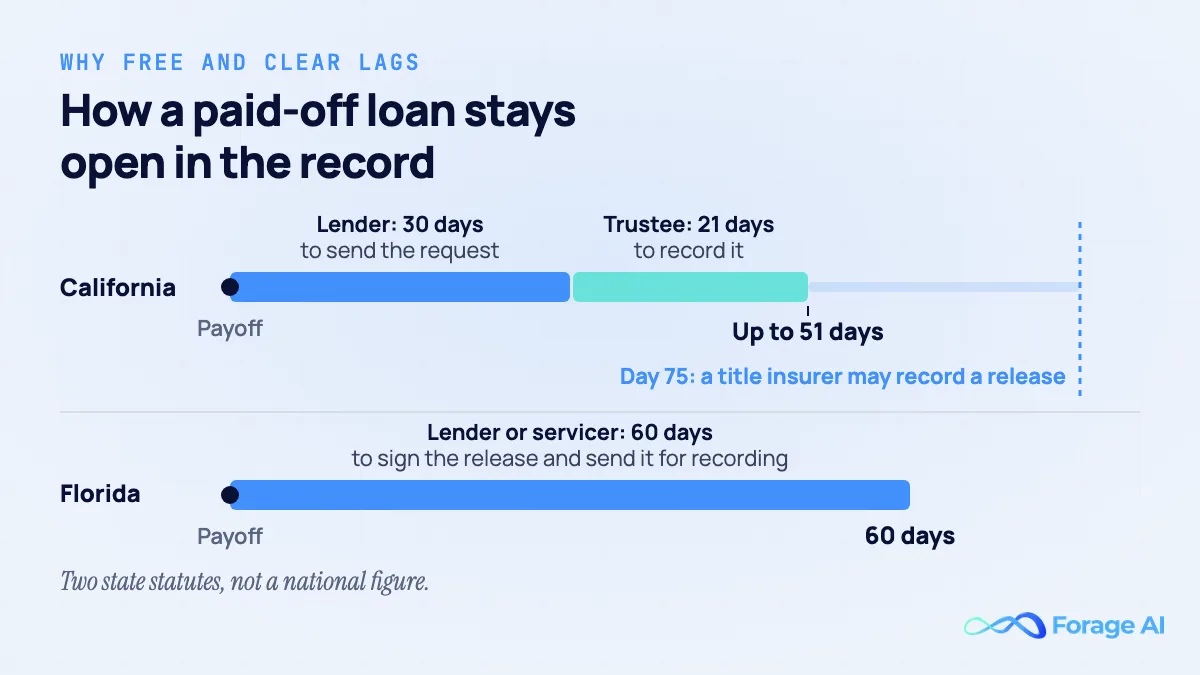
Sources disagree, and check 2 catches it: assessor, recorder and MLS records are different records on different calendars. The mailed "free and clear" lead goes wrong at check 3. On a platform, free and clear means no recorded open loan, not a verified payoff, and the record lags the payoff by law. In California, the lender has 30 days after payoff to send the reconveyance request to the trustee, and the trustee then has 21 days from receipt to record it: up to 51 days on the statute's own deadlines. If nothing is recorded within 75 days of payoff, a title insurer may record a release (Cal. Civ. Code §2941). In Florida, the lender or servicer has 60 days after payoff to sign the release and send it for recording (Fla. Stat. §701.04). Both clocks end before the recorder indexes the document, and they are two states' rules, not a national figure. Distress records lag too. In Philadelphia, sheriff-sale deeds are "supposed to take 70 days to record", but in February to March 2024 the sheriff's office "had submitted just 29 deeds for recording, nearly all of which corresponded to auctions that took place 200 to 300 days prior" (The Philadelphia Inquirer, March 22, 2026). That is one office, and sheriff deeds, not the recorder.
Equity, the subject of check 4, is a model on a model: a modelled loan balance against a modelled value. One label, four definitions: "high equity" means 30% or more at DataSift, over 60% at Propwire, over 70% in RealEstateAPI's documented filter, and at PropStream any of 50% or more equity, under 50% loan-to-value or $100,000 or more in equity.
Zillow puts the Zestimate's nationwide median error at 1.77% for homes on the market and 7.20% for off-market homes (as of the September 30, 2026 refresh). Redfin reports 1.90% for homes for sale (n = 3,328,255) and 7.46% off-market (n = 135,051,865) (as of October 21, 2026). Investors buy off-market.
None of the investor platforms we read publishes an off-market valuation error. Lenders must test their models: the interagency final rule Quality Control Standards for Automated Valuation Models (OCC, Federal Reserve Board, FDIC, NCUA, CFPB and FHFA; 89 FR 64538; effective October 1, 2025) requires covered mortgage originators and secondary market issuers to "require random sample testing and reviews". Its scope is credit decisions on a consumer's principal dwelling. Nothing requires the same of the equity figure your list was filtered on.
Check 5 separates a database cycle from recording lag. PropStream's FAQ says "Vacant data is updated monthly" and also lists "Vacant Properties" under "PropStream provides daily updates to:", so we print the contradiction, not a cadence. A "daily" claim does not state the time from recording to appearance either, and the tax roll underneath may carry characteristics data four to six years old under the IAAO standard.
Check 6 asks whether switching changes anything underneath. PropStream names no licensor. Propwire's "same national data providers" line sits against PropertyRadar's claim that it tests "multiple source providers head-to-head per county". Ask yours.
The contract is check 7: caps that do not roll over (PropStream), a merge ban (ListSource) and AI-use bars (PropStream, Regrid, and BatchData with its self-hosted carve-out). For skip tracing, compare right-party connects on the same records, never a vendor's match rate. Vendors' terms put Telephone Consumer Protection Act (TCPA), Do-Not-Call and similar compliance on you: PropStream's name TCPA, TSR/DNC, ECPA and UDAP, and XLeads' say a phone number "does not constitute legal permission ... to contact that person". The seven checks are the general dimensions of data quality, applied to one county.
A vendor may be better in your county, and the test can come out in PropStream's favour. Disclaimers are standard. The point is who carries the risk: you, the buyer, not that these vendors are worse than others.
When no platform is enough
Past a threshold, you stop accepting a vendor's sources and start specifying your own. A platform is a national file built county by county on the vendor's refresh calendar, and from outside you cannot see which counties are stale. Check 1 is usually where that threshold shows up.
Custom collection beats a platform when:
- Check 1 fails: your markets or fields are ones no platform carries, or carries stale.
- You need refresh you control: your schedule, not the vendor's calendar.
- You need to own the data in bulk where licences forbid it: PropStream bars AI use, and ListSource forbids merging "with any other file".
It does not when:
- You are a solo investor pulling lists: custom collection has no outreach half.
- The county count passes: keep the platform that holds it.
- You need data this week: custom work has setup time.
The constraints bind custom collection too. Every county is its own publisher and its files change; Maricopa warns that "The scheduled updates to the datasets may change. Please check the file dates", and that "you will need to format and organize it". Access varies by statute, as Kansas shows. The recording lag in check 3 binds every collector. And do not collect from the platforms themselves: PropStream's terms bar robots and crawlers, and Propwire's forbid "automated processes to copy Content". Lawfulness turns on the data, the access and the use; our overview of US web scraping laws covers the ground. Custom moves who owns the breakage. It does not remove it.
For the wider build, buy or partner decision on property data, see our guide to real estate data analytics, and for extraction specifically, our build vs buy decision guide.
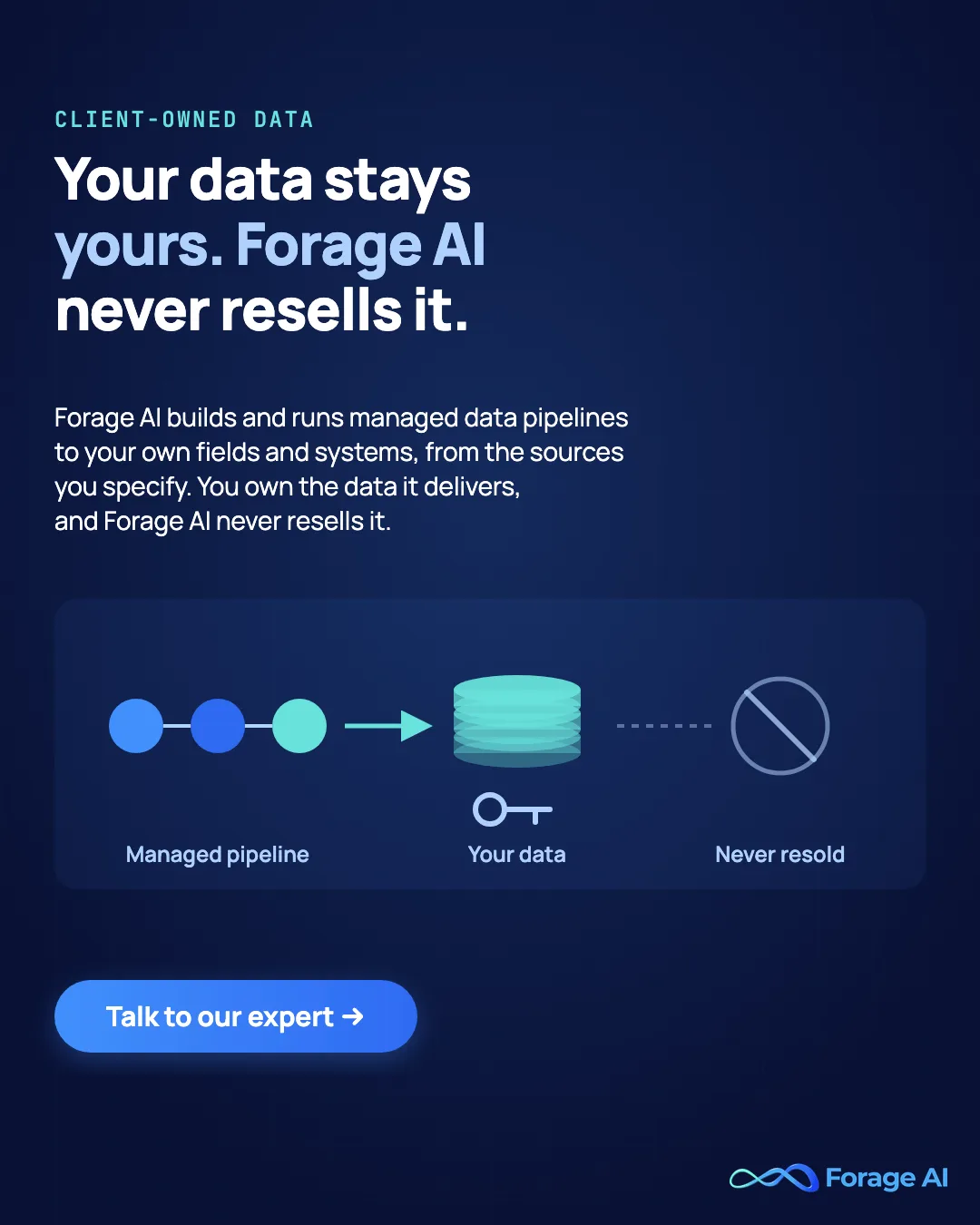
Forage AI builds and runs managed property data pipelines that collect property records from the sources you specify, to your own fields and on your schedule, and deliver them by API, file or cloud integration into your systems. You own the data, and Forage AI never resells it.
When is PropStream still the right call?
Often, if your counties hold up. A switch made for the bill alone may land you on the same records, so stay unless you can name the wall you hit.
Stay if: your counties pass checks 1 to 3, you use the bundle (lists, skip tracing and outreach), and your volume fits a tier: $99 / $199 / $699 a month with 25,000 / 50,000 / 100,000 saves and exports, at October 2026 prices.
Look elsewhere if: you hit one of the four walls: the bill, the data, the skip trace or access. Then the wall tells you the lane.
One caution: switching to BatchLeads is not leaving, because PropStream owns it.
What switching platforms does not change
Switching changes your workflow and your bill, not necessarily your records. You keep the same county record system, the same lawful lag, a modelled equity figure, and an accuracy disclaimer in every investor app's terms we read. Where a platform's beds, baths and square footage come from the assessor's roll, they inherit that record's limits, and an assessor's office is clear about what the record does not decide.
"The Assessor's role and that of its staff is not to make a legal determination as to whether or not an improvement is permitted (or legal). That is the role of the building department."
Jim Glickman, MAI, Chief Real Property Appraiser, Sacramento County Assessor's Office (quoted in Ryan Lundquist, "Tax Records is not the definitive source for square footage", Sacramento Appraisal Blog, January 22, 2020)
That does not mean every alternative sells the same data. Propwire says it uses the same providers as its competitors; PropertyRadar says it tests multiple providers per county, and neither claim proves the other wrong. What you can change is how you test (the seven checks) and which lane you buy in: those two decisions are where your records can change.
Which three questions should decide your choice?
There is no single winner for wholesaling, flipping or a fund. Three questions get you to a shortlist:
- Do you need outreach in the same login, or records in your systems? That picks the band.
- Does the platform pass checks 1 and 3 in the counties you work? That decides whether its records are worth acting on.
- What does the licence let you do with exports? Merging, AI use and caps decide what the data is worth after you pull it.
Trial a shortlist of one or two on the same 20 addresses. Do not pick on the sticker. Prices sit on different units (per seat, per bundle, per package, per credit, per record), so compare them on your own monthly volume, not the headline figure.
How do you switch from PropStream without losing work?
Once you have a shortlist, time the switch to the billing date, and move in this order:
- Export first. Stay inside your plan's monthly export limit (25,000 / 50,000 / 100,000), because "Unused saves and exports don't roll over". PropStream's pages do not list which objects (lists, skip-trace results, marketing history) export, so check in-app what you need before you cancel.
- Trial the new platform on the same 20 addresses. Trials are short: PropertyRadar 5 days with no exports, DataSift and BatchLeads 7 days, Deal Sauce 14 days per its terms, and DealMachine none.
- Cancel before the billing date. PropStream's FAQ: "To cancel your subscription, please contact our Customer Support during business hours ... prior to your next billing cycle date." Confirm the support number in your account, since the FAQ lists two.
- Keep the test file. You will need it at the next renewal, wherever you land.
If you are tempted by BatchLeads' offer of "UNLIMITED imports" for the first month to users moving from PropStream, read the BatchLeads entry first. And remember that exported skip-trace results carry your compliance obligations with them. The last decision is what to do if no platform passes in your counties.
Why Forage AI for PropStream alternatives
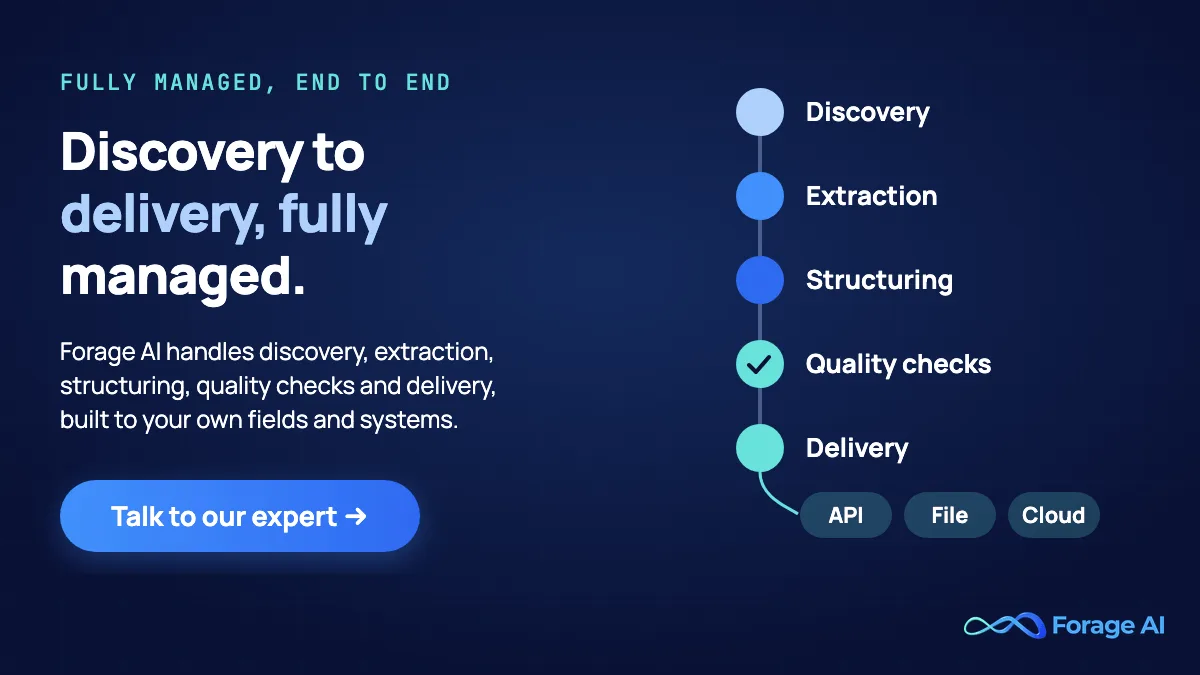
Forage AI builds end-to-end managed data pipelines that handle discovery, extraction, structuring, quality checks and delivery, built to your own fields and systems. It is a fully managed service, never self-serve, and you own the data: Forage AI never resells it. Delivery is CSV, JSON or XML by API, direct download or cloud integration into CRMs, warehouses or webhooks, with contractual controls and client-specific handling rules agreed up front.
Choose Forage AI if you need property records from specific sources and markets, built to your own fields and schedule, delivered into your systems, and you want to own the data.
Choose a self-serve investor platform if you want lists, filters, skip tracing and outreach in one subscription and a national file holds up in your counties. For most solo wholesalers, that is the right buy.
Frequently asked questions
Is there a free alternative to PropStream?
Propwire is the only app in this guide with a permanent free plan that returns property records, capped at 10,000 per download, with liens on its paid Premium tier. RentCast, Regrid and RealEstateAPI offer free tiers or trials for teams, and Maricopa County's assessor publishes its parcel master file free. Before you rely on any free file, run check 6.
Does PropStream have an API?
PropStream publishes no API or bulk-data product, as of October 2026, and its terms bar automated access and AI use. A custom arrangement may sit behind its sales contact, but nothing is published. If you need records in your own systems, the Band B vendors are the route.
Is BatchLeads the same company as PropStream?
Yes. PropStream announced its acquisition of BatchLeads and BatchDialer on July 7, 2025, and the BatchLeads terms name "Equimine, Inc. d/b/a PropStream". Whether BatchLeads' data differs from PropStream's is not stated, so switching between them changes the product, not the company.
What is the best PropStream alternative for wholesaling?
There is no single winner; the answer depends on your lane and the wall you hit. If you need lists, skip tracing and outreach in one login, start with Band A: Propwire if cost is the wall (a free plan, with liens on Premium), DataSift if exports are ("Unlimited Data Export"), and DealMachine or PropertyRadar if you also want API access on a self-serve plan. Then run the county test on your shortlist, because a cheaper app that fails check 1 in your county is not a saving.
How accurate is PropStream's data?
We found no published independent test. PropStream's terms say "THE INFORMATION IS NOT GUARANTEED TO BE 100% ACCURATE." That is a standard disclaimer, not an admission of poor data; it means you carry the risk. Run the seven checks on your own county to find out.
Why do two platforms show different owners for the same house?
Assessor, recorder and MLS records are different records updated on different calendars, and a sale or payoff takes weeks to record. California allows up to 51 days on the statute's deadlines; Florida gives a lender 60 days to send a release. Two platforms can catch the same house at different points.
Does PropStream have MLS data?
Per PropStream, its data is "multi-sourced from county recordings, MLS records, and private data sources", and "MLS data is updated daily" (FAQ, read October 2026). It names no licensor. MLS fields can still disagree with county records, which is why check 2 compares both against what you know.
How much does PropStream cost per month?
As of October 2026, PropStream costs $99, $199 or $699 a month for Essentials, Pro and Elite, or $972, $1,980 or $6,996 a year, with a 7-day free trial. Saves and exports run 25,000, 50,000 or 100,000 a month and do not roll over.
Keep the 20-address file, and rerun the seven checks at every renewal, PropStream included. Records change when the recorder catches up, not when you switch. Before you sign anything new, send the same 20 addresses to every vendor on your shortlist and compare what comes back, field by field. And if your counties fail the test and you need records built to your own fields, a managed property-data pipeline from Forage AI is the conversation to have.
Related articles
- The best real estate data providers in 2026: the wider, enterprise-led comparison of property data providers
- Real estate API pricing: what property data APIs cost and how their pricing units differ
- Real estate data analytics: how to decide between building, buying or partnering for property data
Sai is a data infrastructure enthusiast who has spent the past two to three years following the AI space closely, from the infrastructure layer to the fast-growing world of data for AI. He is genuinely curious about how modern data pipelines get built and where the data industry is heading, and he writes insightful pieces on the core topics that shape this niche.