
Top 10 ScrapeHero Alternatives: Match the Friction to the Fix (2026)
ScrapeHero sells a self-serve product at $5 a month. It sells a managed extraction service with a floor of $550 per website, per refresh. And it sells an enterprise tier that starts at $8,000 a month (scrapehero.com, accessed July 2026).
Three products. One brand. No page on this search result tells you which one you are actually leaving.
That gap matters, because the ten lists of ScrapeHero alternatives currently ranking sort vendors by category and hand you an inventory. An inventory cannot help you, because a cost friction and a control friction point in opposite directions. This page starts from the six frictions ScrapeHero customers wrote down in public reviews, then routes each one to the band of provider that structurally resolves it. Every rating below is printed with its sample size. Every price comes from the vendor’s own page.
Quick Digest
- Why teams leave a 4.7: ScrapeHero rates 4.7 out of 5 on Capterra across 26 reviews, with support scored 4.8. The rating describes the median customer, not your workload, so the frame here is fit rather than failure.
- The two-product split: ScrapeHero Cloud ($0 to $750/mo) and ScrapeHero full-service ($199/mo per site to $8,000/mo) are different purchases with different frictions. Naming which one you are on changes the answer.
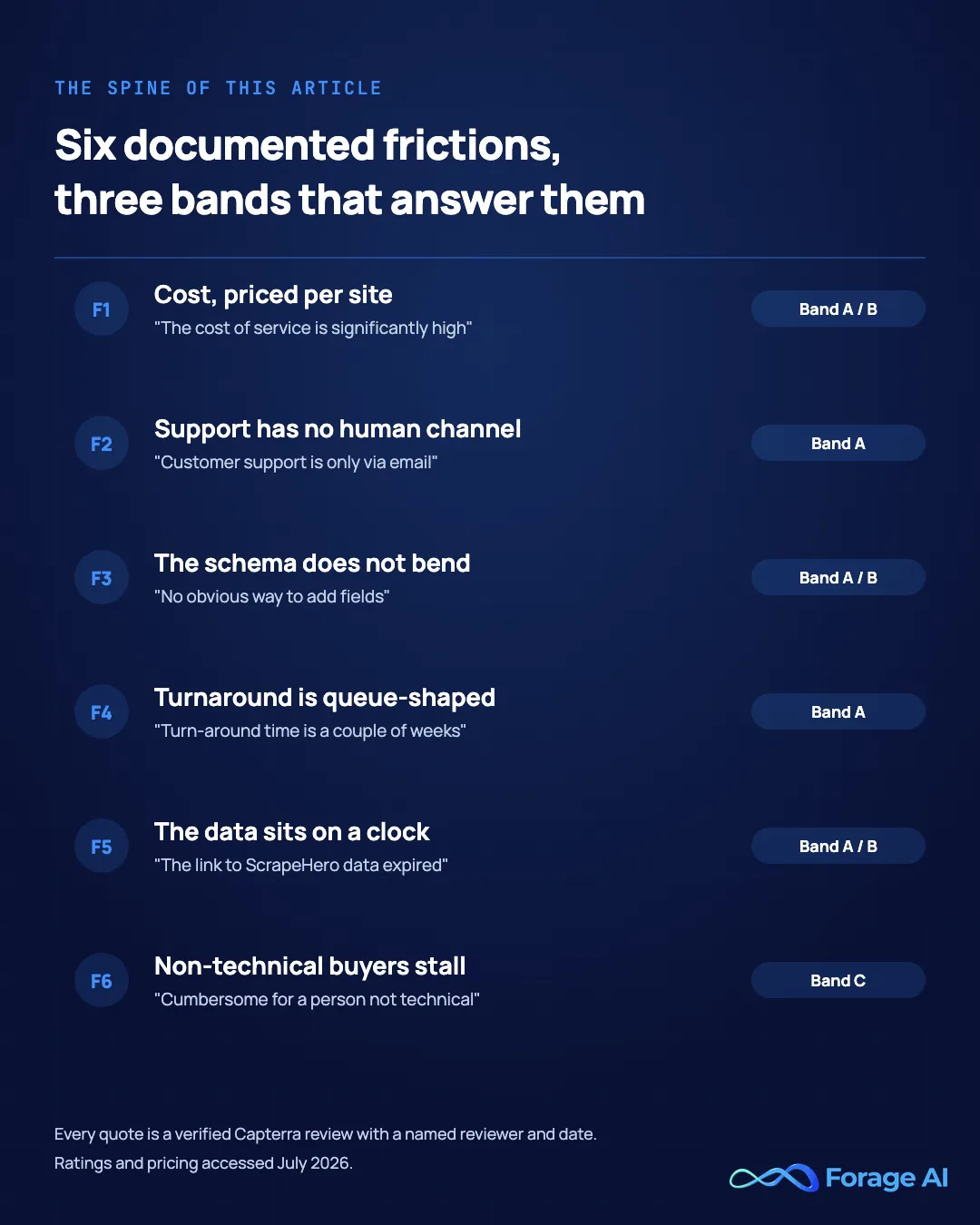
- The six frictions: per-site cost, written-only support, a schema that will not bend, multi-week turnaround, data on a retention clock, and friction for non-technical buyers. Each traces to a dated, attributed review plus a first-party ScrapeHero page.
- The structural read: all six frictions are downstream of one decision. ScrapeHero is productised managed scraping, and productisation is exactly what makes a $550 price point possible.
- The 10 alternatives: grouped into managed partners, scraping and data APIs, and no-code self-serve, each tagged with the friction it answers, each carrying published pricing and review evidence with its sample size.
Why do teams leave a provider they rate 4.7 out of 5?
The rating is not the question. Teams leave managed data vendors on one specific edge that an aggregate score is designed to smooth over.
ScrapeHero has run managed web scraping since 2014, owning crawling infrastructure, extraction logic, QA and delivery, with a self-serve Cloud tier sitting underneath the done-for-you service. You receive data, not a pipeline.
The 4.7 is real, and it is better than several vendors that follow on this page. Reviewers repeatedly cite speed, data quality and responsiveness. One calls the service “very competitively priced in the market” for the level of service delivered (Capterra, April 2024). ScrapeHero reports sub-one-hour support response during business hours.
Expert Insights
“Dataset prices are competitive with peers, but higher than I would like.”
David D., Principal, Government Relations (Capterra, March 2024)
“For the level of service they offer, they are very competitively priced in the market.”
Verified Capterra reviewer, April 2024
Two reviewers, six weeks apart, on the same pricing. Both are right, because they were buying different products.
So the frame is fit, not failure. Changing a managed data vendor is ordinary procurement, not an indictment. What follows treats it that way: the six frictions below are the predictable edges of a productised service model, and naming yours is the whole job.
Which ScrapeHero friction did you actually hit?
Six frictions recur across ScrapeHero’s public review record. Each one below carries the reviewer who reported it, the date, and the line on ScrapeHero’s own site that makes it structural rather than anecdotal.
Expert Insights
“Missing data and no obvious way to add fields.”
Gerard M., Owner, Real Estate (Capterra, March 2024)
“Cumbersome to engage for a person not technical.”
Mitchell S., Sales Manager, Business Supplies (Capterra, March 2024, the profile’s only 2-star review)
Two reviewers, both five-star and two-star respectively, describing the same boundary from opposite ends. One wanted more control over the output; the other wanted less exposure to the machinery. A productised catalogue struggles to serve both at once, which is why they route to different bands below.
| Friction | What a reviewer said | What ScrapeHero’s own pages confirm | Band that answers it |
|---|---|---|---|
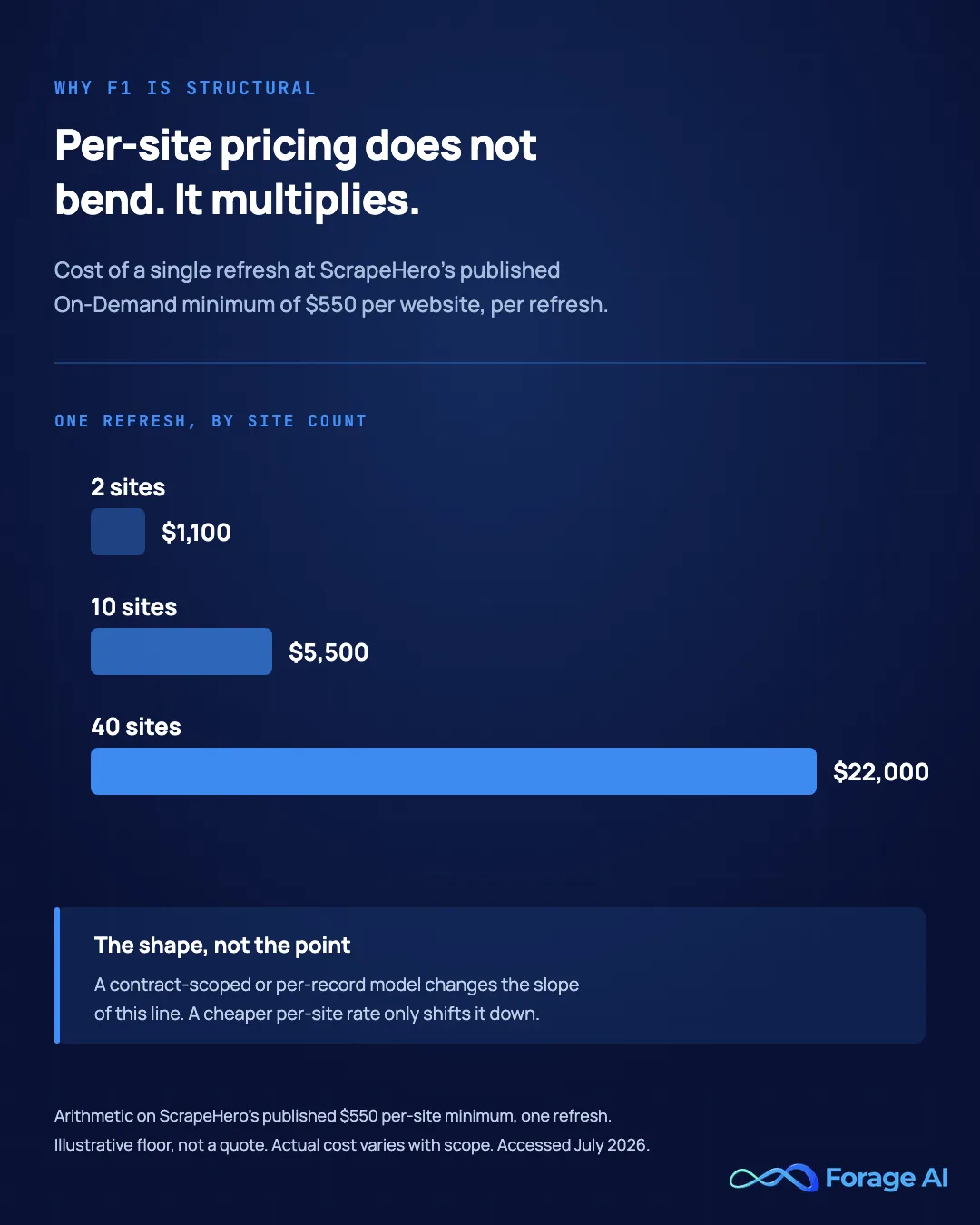
| F1. Cost, priced per site | “The cost of service is significantly high” (Balaji S., VP of Data Operations, Feb 2024). “Expensive, money, paying large amount for a list” (David R., VP Brokerage, Mar 2024) | “Minimum price per site is $550”, charged per website per refresh. Business “starts at $199 per month per website”, capped at 2 sites | A (contract-scoped) or B (per-unit) |
| F2. Support has no human channel | “Contact or customer support is only via email” (Bart K., BI Developer, Mar 2024). “I have never had actual phone or video contact with the company” (Joshua D., Partner, Oct 2023) | Plan matrix lists “Email support” or “Priority Support”. Dedicated resources and support appear at the $8,000/mo tier | A |
| F3. The schema does not bend | “Missing data and no obvious way to add fields” (Gerard M., Owner, Mar 2024). “Could benefit from more granular targeting options to extract specific elements based on attributes or CSS selectors” (Philip P., Consultant, Apr 2024) | The Cloud product is a catalogue of pre-built scrapers with fixed output schemas | A (custom schema) or B (selector control) |
| F4. Turnaround is queue-shaped | “Turn-around time is generally a couple of weeks” (Mary A., Senior Director, Aug 2023). “Some back and forth could have been avoided by more closely reviewing my scraping brief at the outset” (Carly M., Operations Manager, Aug 2023) | Requirements arrive as a written brief. No scoping call is included below the top tier | A |
| F5. The data sits on a clock | “The link to ScrapeHero data expired. This was an unpleasant surprise” (Tony L., President, Mar 2024) | “7 days data retention” on Free through Starter, “30 days data retention” on Standard and above. Credits run “until the end of your current subscription period” | A or B (delivery into your own storage) |
| F6. Non-technical buyers stall | “Cumbersome to engage for a person not technical” (Mitchell S., Sales Manager, Mar 2024, the profile’s only 2-star review) | Cloud tiers expose credits, concurrency caps and API call limits as the primary controls | C |
All six are downstream of a single design decision. ScrapeHero productised managed scraping. It prices by the site, ships a fixed schema, supports in writing, and delivers on a retention clock, because that is what makes a $550 entry price arithmetically possible. A concierge service with custom schemas, scoping calls and a named engineer does not start at $550.
Which means the frictions are not defects. They are the bill for the productisation, and you only stop paying it by changing what you are buying.
Quick Summary
Q: Which friction are you actually leaving?
A: Six recur in the public review record: per-site cost, email-only support, a schema that does not bend, queue-shaped turnaround, a retention clock on delivered data, and a self-serve tier that stalls non-technical buyers. None of them is a defect. Each is the bill for productised managed scraping, so the fix is to change what you buy rather than to look for a cheaper version of the same product.
How we picked these alternatives
Four rules governed the roster, and they are worth stating because they explain why this list is shorter than most.
One. A vendor earns a slot by answering a named friction. Not by market share, not by star rating. If a provider does not resolve F1 through F6, it is not an alternative to anything, it is just another company that scrapes.
Two. Every rating is printed with its sample size. A 4.9 across 7 reviews and a 4.4 across 114 are not comparable quantities, and lists that print both as bare stars are hiding the only number that matters. Capterra, GetApp and Software Advice share one Gartner-owned review corpus, so treat agreement between them as one source rather than three.
Three. Prices come from vendor pages, never aggregators. Aggregator pricing goes stale silently. It also propagates errors: the figure of “89 ScrapeHero reviews on G2” circulating across comparison sites appears to be the G2 count and the Capterra count added together, so this page uses the directly verified Capterra 26.
Four. Every vendor was checked as operating in July 2026. That sounds like a low bar. It is not: a top-ranking 2026-dated roundup of ScrapeHero alternatives still recommends Kimono, which shut down in 2016 after the Palantir acquisition, and Crawlera, which stopped being a standalone product when it became Zyte Smart Proxy Manager. Directories do not re-verify. Treat an unverified list as a snapshot of whenever it was first written.
10 ScrapeHero alternatives, mapped to the friction each one answers
Three bands, ten entries. Find your friction in the second column and start there rather than reading top to bottom.
| # | Alternative | Band | Frictions it answers | Published entry price |
|---|---|---|---|---|
| 1 | Forage AI | A. Managed | F1, F2, F3, F4, F5 | Not published, custom contract |
| 2 | Grepsr | A. Managed | F2, F4 | From $350 one-time |
| 3 | PromptCloud | A. Managed | F3 | Reported $250 to $5,000+/mo |
| 4 | Datahut | A. Managed | F1 | From $99/mo |
| 5 | Zyte | B. API | F3 | $0.06 to $16.08 per 1,000 requests |
| 6 | Bright Data | B. API | F5, F1 by unit | From ~$1.50 per 1,000 records |
| 7 | Apify | B. API | F3, F5 | Free, then $29/mo |
| 8 | ScraperAPI | B. API | F1 | $49/mo |
| 9 | Octoparse | C. No-code | F6, F3 | Free, then $69/mo |
| 10 | Browse AI | C. No-code | F6 | Free, then $19/mo annually |
Band A: managed, with the seams closed
Answers F1, F2, F3 and F4 while keeping the model you already bought. You still receive data rather than a pipeline. What it costs you is a published price card, because contract-scoped work does not have one.
1. Forage AI
| Attribute | Detail |
|---|---|
| Model | Managed, fully custom contract with a dedicated team |
| Best for | Teams whose field list, site count or delivery target stopped fitting a productised catalogue |
| ScrapeHero frictions it answers | F1, F2, F3, F4, F5 |
| Pricing (as published) | Not published. Custom contract scoped to the work, with no per-site card |
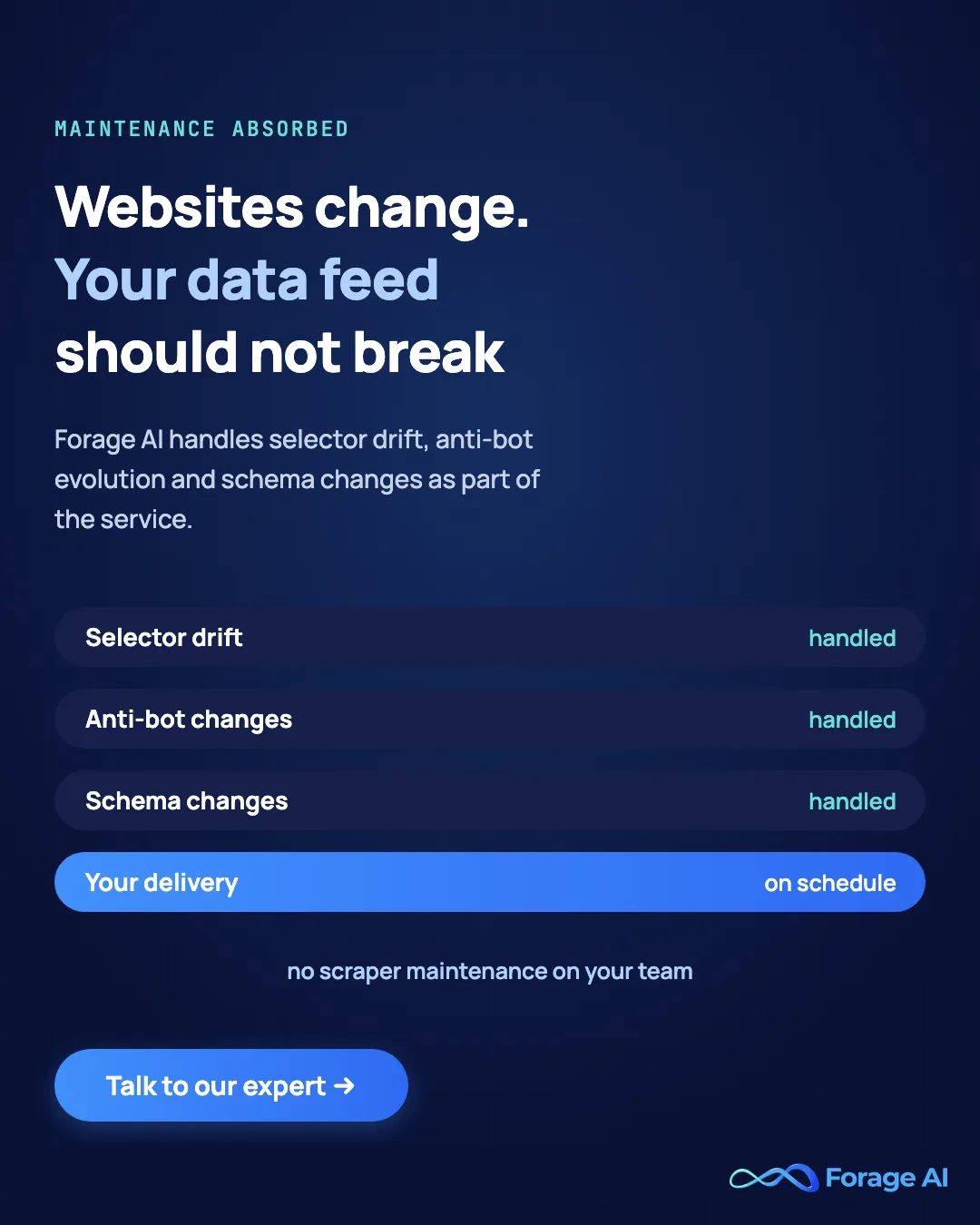
| Who owns maintenance | The vendor, including selector drift, anti-bot evolution and schema changes |
| Watch-out | Not self-serve, no price card, no sandbox. Every engagement starts with a conversation, and onboarding runs 1-2 weeks rather than an afternoon |
| Review attribute | Detail |
|---|---|
| What users like | No verified public reviews. |
| What users flag | No public review corpus to draw from. |
| Attribute | Detail |
|---|---|
| Ratings (with n, accessed July 2026) | G2 4.8 / 5, shown first-party on forage.ai. We hold no third-party review count comparable to the Capterra samples printed elsewhere on this page, and we say so rather than manufacture one |
| Evidence quality | Named first-party client testimonials. This is a different evidence class from the third-party platform sentiment used for every competitor row here, and it is labelled as such rather than passed off as anonymous platform reviews |
| What customers are saying | “Forage AI’s consistent performance and reliability in maintaining the pipelines they’ve set up for us have exceeded our expectations.” Dave Thornton, CEO, Vested. “What sets Forage AI apart is that they don’t just provide off-the-shelf solutions; instead, they delve deep into our requirements.” Rachel DeMel, Director of Product & Content Strategy, Expert Institute |
| What customers complain about | No self-serve access, no published pricing, and no free trial to evaluate independently. If you want to swipe a card and start tonight, this is the wrong band entirely |
| Source | G2 (first-party display) and named client testimonials on forage.ai |
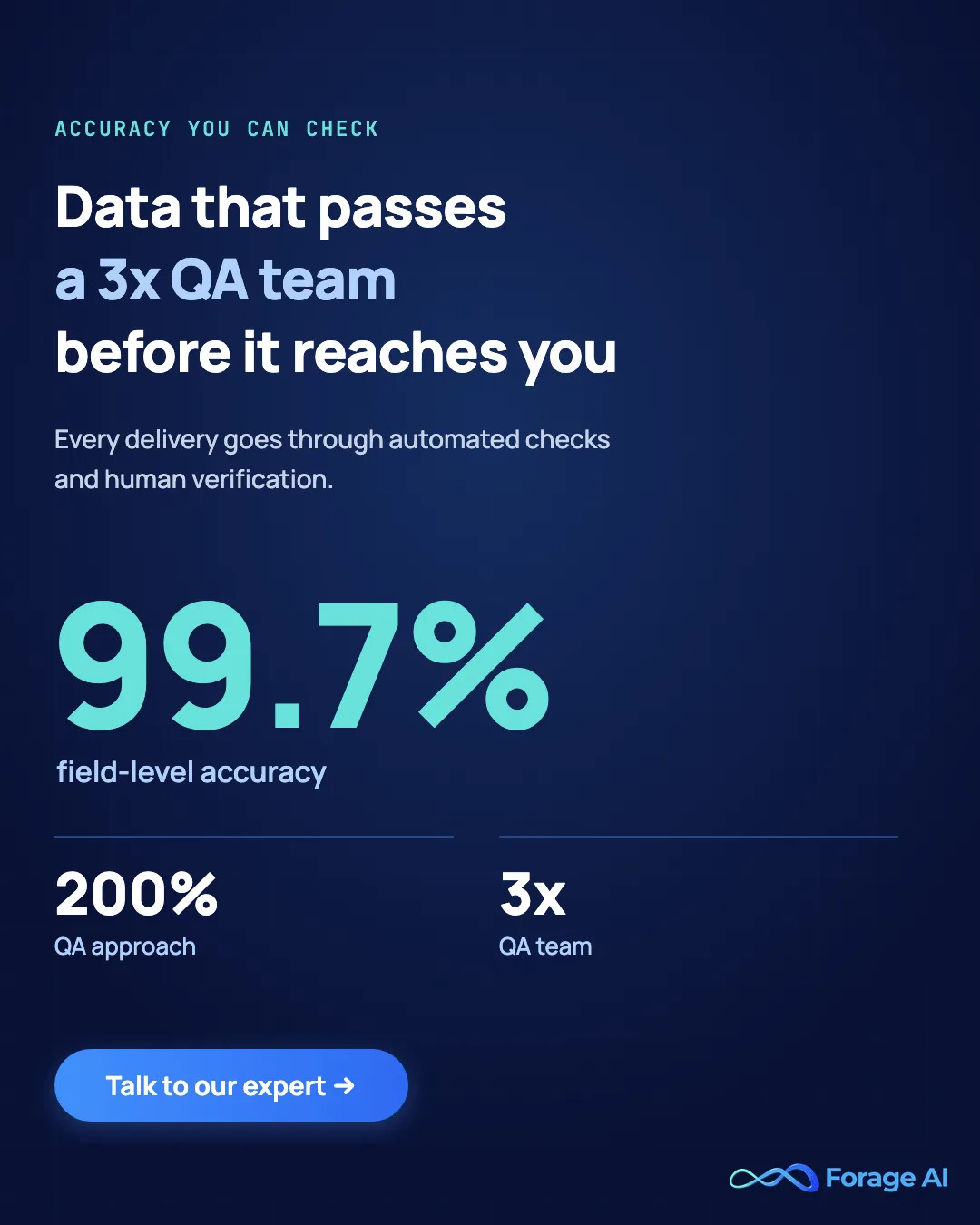
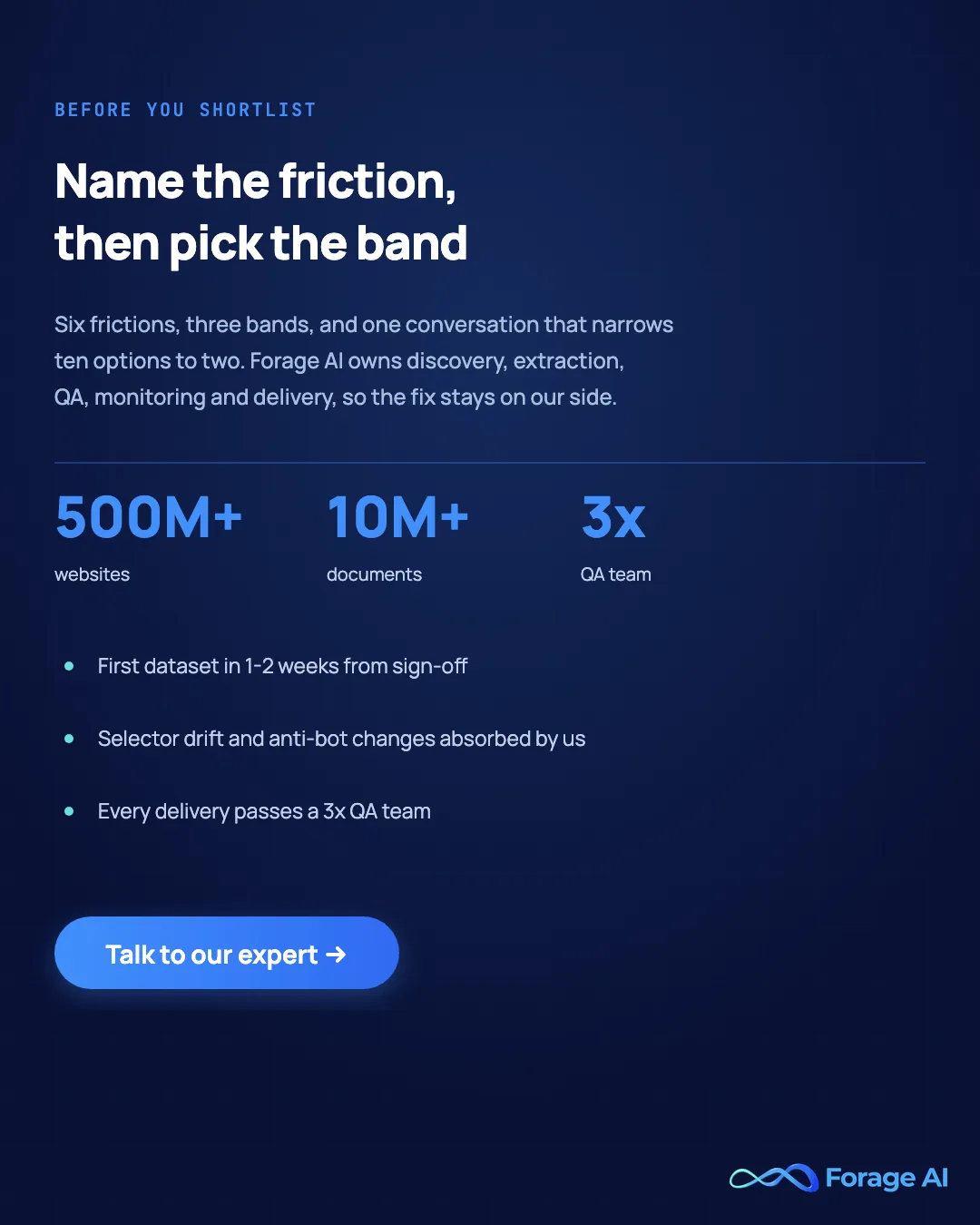
Forage AI runs fully managed web data extraction on a custom-contract, dedicated-team model across 500M+ websites and 10M+ documents. The team owns the chain end to end: source discovery, crawling infrastructure, extraction logic combining XPath, NLP and custom-trained models, cleaning and normalization, multi-layer QA, monitoring, and delivery shaped to land in your systems.
It answers the most ScrapeHero frictions of anything on this page, and the reason is structural rather than promotional. Your business rules and taxonomies are built into the extraction logic instead of bolted onto a fixed output, which is F3. Pricing is scoped to the contract rather than multiplied by the site, which is F1 at 40 domains. A dedicated team means a named human on a call rather than a written ticket, which is F2 and F4. Delivery lands in your infrastructure, so the 7-day and 30-day retention clocks stop being your concern, which is F5.
Here is the honest exchange. Everything above is bought with legibility. There is no price card to compare, no sandbox to poke at over a weekend, and first dataset lands in 1-2 weeks rather than the same day. Against ScrapeHero specifically: ScrapeHero tells you the number before you talk to anyone, and Forage AI does not. If a published entry price is what you actually need, Grepsr or Datahut below will serve you better.
Not for: teams scraping two or three stable sites on a standard schema, where a productised catalogue is genuinely the cheaper answer.
2. Grepsr
| Attribute | Detail |
|---|---|
| Model | Managed data-as-a-service |
| Best for | Teams that want a published entry price and a named account manager on recurring feeds |
| ScrapeHero frictions it answers | F2, F4 |
| Pricing (as published) | Starter Pack from $350 for a one-time extraction. Recurring pricing is custom-quote, so you cannot comparison-shop it without a call |
| Who owns maintenance | The vendor |
| Watch-out | Advanced changes route through their team, the same concierge ceiling ScrapeHero has. F3 does not move here |
| Review attribute | Detail |
|---|---|
| What users like | No pros-and-cons summary published on its G2 profile. |
| What users flag | No public review corpus to draw from. |
| Attribute | Detail |
|---|---|
| Ratings (with n, accessed July 2026) | Capterra 4.8 (n=85), with Customer Support scored 5.0, the highest support sub-score in this roster |
| Evidence quality | Strongest sample on the page: 85 reviews, none below four stars |
| What reviewers praise | Delivery reliability and account management responsiveness. The 5.0 support score is earned across a large base rather than a handful of ratings |
| What reviewers complain about | Customization requests route through the vendor’s team rather than being self-served, reported as the most-cited limitation |
| Source | Capterra |
Grepsr has run fully managed extraction since 2012 and is the closest structural peer to ScrapeHero on this page. Same model, same you-receive-data posture, different service texture.
It earns its slot on the support channel, which is F2. Every engagement carries a dedicated account manager with defined delivery windows and a stated fix process, against ScrapeHero’s email-only channel below the $8,000 tier. Its Capterra 4.8 across 85 reviews with a 5.0 support sub-score is the best-evidenced support record here, and it beats ScrapeHero’s 4.8 across 26 on sample size by more than three to one.
What it does not fix is the schema. Grepsr is the same concierge model, so advanced changes still route through their team. If you left ScrapeHero over F3, moving here relocates the ceiling without raising it.
Not for: teams whose friction was schema control or an inability to forecast recurring cost without a sales call.
3. PromptCloud
| Attribute | Detail |
|---|---|
| Model | Managed data-as-a-service, enterprise programme shaped |
| Best for | Long-running multi-source feeds where compliance posture is part of the purchase |
| ScrapeHero frictions it answers | F3 |
| Pricing (as published) | Reported in the $250 to $5,000+ per month range once setup fees and per-record volume are layered in. Not a simple card |
| Who owns maintenance | The vendor |
| Watch-out | Programme weight. Setup is a project, and the commercial shape suits a committed multi-quarter feed rather than an experiment |
| Review attribute | Detail |
|---|---|
| What users like | No pros-and-cons summary published on its G2 profile. |
| What users flag | No public review corpus to draw from. |
| Attribute | Detail |
|---|---|
| Ratings (with n, accessed July 2026) | Capterra n=14, with the most recent review dating to 2023 |
| Evidence quality | Thin and stale. Fourteen reviews with nothing recent is the weakest public evidence base in this roster, and it is printed here rather than hidden |
| What reviewers praise | Feed reliability at volume and depth of requirement-gathering on custom schemas |
| What reviewers complain about | Onboarding weight and commercial minimums that suit programmes rather than pilots |
| Source | Capterra |
PromptCloud has run managed extraction since 2009, built around recurring custom feeds for market-intelligence and pricing teams, with GDPR and CCPA posture and a documented QC layer combining automated checks and human verification.
It answers F3 by building the schema to your requirement instead of shipping you a catalogue entry. That is the specific thing a reviewer meant by “missing data and no obvious way to add fields”, and a custom-feed provider does not have that failure mode because there is no fixed catalogue to fall outside of.
The evidence base deserves a flag. Fourteen Capterra reviews with nothing since 2023 is thin, and a sixteen-year-old company with that little recent public sentiment is a gap you should probe on a reference call rather than assume away.
Not for: teams under $250 a month of extraction spend, or anyone wanting to start this quarter without a scoping project.
4. Datahut
| Attribute | Detail |
|---|---|
| Model | Managed, mid-market turnkey |
| Best for | Teams whose only friction was the $550-per-site floor |
| ScrapeHero frictions it answers | F1 |
| Pricing (as published) | Plans from $99/mo on the pricing page. High-volume work quoted at roughly $500 to $3,000 per million records |
| Who owns maintenance | The vendor |
| Watch-out | Small public review base. Less to verify against than any managed peer here |
| Review attribute | Detail |
|---|---|
| What users like | No pros-and-cons summary published on its G2 profile. |
| What users flag | No public review corpus to draw from. |
| Attribute | Detail |
|---|---|
| Ratings (with n, accessed July 2026) | Public review base is small enough that no sample-size-backed score is printed here. Where we cannot verify n, we omit the number |
| Evidence quality | Weak by volume. Judge this one on a pilot rather than on sentiment |
| What reviewers praise | Price-to-delivery ratio at mid-market volumes, and an unusually low friction commercial entry |
| What reviewers complain about | Limited public record. Depth on complex or heavily defended targets is the open question |
| Source | Vendor pricing page; Capterra and G2 listings exist but with samples too small to print responsibly |
Datahut is managed extraction aimed squarely at the mid-market, with a published entry point roughly one fifth of ScrapeHero’s per-site On-Demand floor and record-volume pricing above that.
It exists on this page for one reason, and F1 is that reason. If your review of ScrapeHero would have read “expensive, money, paying large amount for a list”, and the work itself is standard retail or directory extraction, the cost delta is real and the model is the same.
Verify depth before you commit. The public evidence base is too small to tell you how it performs on aggressively defended targets, which is exactly where a managed provider earns its margin.
Not for: teams whose friction was schema control, turnaround, or anything other than the invoice.
Band B: scraping and data APIs
Answers F3 and F5 decisively, and F1 by making the unit legible. What it costs you is the service itself: parsing, QA, breakage response and anti-bot work all move back to your team.
5. Zyte
| Attribute | Detail |
|---|---|
| Model | Scraping API, with a managed Zyte Data tier as fallback |
| Best for | Teams already running Scrapy who want to own the parsing layer |
| ScrapeHero frictions it answers | F3 |
| Pricing (as published) | $0.06 to $16.08 per 1,000 requests on an auto-assigned site-difficulty tier. Zyte Data managed at $500/mo Standard and $1,000/mo Custom. $5 trial credit |
| Who owns maintenance | You, on the API tier |
| Watch-out | The per-request price depends on a difficulty tier you cannot see until you start scraping. The published spread is roughly a 268x range |
| Review attribute | Detail |
|---|---|
| What users like | Ease of use and straightforward setup (24 mentions), reliability for extraction (19 and 17), customer support (17) |
| What users flag | Price for smaller projects (19 mentions on pricing, 7 on expense), a steep curve customising extraction rules (6) |
| Attribute | Detail |
|---|---|
| Ratings (with n, accessed July 2026) | Capterra 4.4 (n=43); G2 4.3 (n=114), corroborated-via-secondary as G2 returns HTTP 403 to direct fetch |
| Evidence quality | The best cross-platform agreement in this roster, across the largest combined sample |
| What reviewers praise | “The service is extremely reliable, rapidly scalable and has the lowest latency amongst its peers” (Capterra). Deepest Scrapy integration available anywhere, since Zyte authored Scrapy |
| What reviewers complain about | Billing shock is the sharpest recent negative in the dataset, with reviewers citing charges far above expectation when protected targets push them into pricier tiers |
| Source | Capterra; G2 (corroborated-via-secondary) |
Zyte was founded as Scrapinghub in 2010 by the team that wrote Scrapy, and rebranded in 2020. Teams already running spiders treat the API as managed egress and unblocking underneath code they own.
It is the cleanest escape from F3 on this page. You change the extraction logic yourself, today, without a ticket. The reviewer who wanted “more granular targeting options to extract specific elements based on attributes or CSS selectors” is describing precisely what an API tier hands back.
And it swaps ScrapeHero’s F1 for a worse version of the same thing. ScrapeHero’s $550 is at least a number you can read before you sign. Zyte’s per-request price is invisible until you start scraping, because the difficulty tier is auto-assigned. You escape the schema ceiling and walk into a billing one, which is the sharpest single trade on this page.
Not for: teams without Python and Scrapy capacity, or without appetite to own parsing, QA and breakage.
6. Bright Data
| Attribute | Detail |
|---|---|
| Model | Enterprise data platform: proxies, unblocking, scraper APIs, dataset marketplace |
| Best for | Teams whose friction was where the data lands and how long it lives |
| ScrapeHero frictions it answers | F5, and F1 by unit at volume |
| Pricing (as published) | Web Scraper API from roughly $1.50 per 1,000 records pay-as-you-go, a $499/mo Scale tier with overage around $1.30 per 1,000, and a 5,000-result monthly free tier |
| Who owns maintenance | You |
| Watch-out | Breadth is the point and also the cost. The product surface is large enough that teams routinely buy more of it than they use |
| Review attribute | Detail |
|---|---|
| What users like | Customer support (48 mentions), ease of use (40), collection reliability (37) |
| What users flag | Cost for smaller teams (8 mentions on expense, 8 on pricing), documentation and debugging (8) |
| Attribute | Detail |
|---|---|
| Ratings (with n, accessed July 2026) | Large multi-platform review base. Sample sizes were not directly verified for this page, so no star figure is printed here |
| Evidence quality | High volume, but not verified to our own standard, so it is omitted rather than borrowed from an aggregator |
| What reviewers praise | Proxy network breadth and success rate against aggressive anti-bot systems, plus delivery straight into cloud storage and warehouses |
| What reviewers complain about | Cost escalation at scale and a commercial surface complex enough to need an owner |
| Source | Vendor pricing pages (accessed July 2026) |
Bright Data operates one of the largest proxy networks in the public market alongside scraper APIs and a dataset catalogue. It is infrastructure, not a service, and that distinction is the whole reason it appears here.
It answers F5 directly. The reviewer whose “link to ScrapeHero data expired” ran into a 7-day retention window on a delivery pipe. Bright Data delivers into storage you control, so retention becomes a setting in your own S3 bucket or warehouse rather than a line on someone’s plan matrix. If your extraction feeds a model or a warehouse, that difference is the difference between a vendor and a dependency.
The exchange is the pipeline. Everything ScrapeHero was doing for you now has an owner on your side of the line. For a fuller read on the proxy-led band, see our Bright Data alternatives comparison.
Not for: teams without in-house engineering to operate it, which is most teams who bought a managed service in the first place.
7. Apify
| Attribute | Detail |
|---|---|
| Model | Developer platform and ready-made scraper marketplace |
| Best for | Teams blocked by concurrency ceilings or wanting orchestration they control |
| ScrapeHero frictions it answers | F3, F5 |
| Pricing (as published) | Free with $5 platform credit, Starter $29/mo, Scale $199/mo, Business $999/mo. Compute billed at $0.20 down to $0.13 per compute unit by tier |
| Who owns maintenance | You, though marketplace actors are maintained by their authors |
| Watch-out | Compute-unit billing is genuinely hard to forecast before you have run the workload once |
| Review attribute | Detail |
|---|---|
| What users like | Ease of integration (184 mentions), the pre-built actor catalogue (113), scraping speed (113) |
| What users flag | Cost at volume (88 mentions on pricing, 87 on expense), a steep learning curve for beginners (58) |
| Attribute | Detail |
|---|---|
| Ratings (with n, accessed July 2026) | Large review base across platforms. Sample sizes not directly verified for this page, so no star figure is printed |
| Evidence quality | Strong developer sentiment, unverified n. Omitted rather than borrowed |
| What reviewers praise | The breadth of the ready-made actor marketplace and the ability to schedule, chain and monitor runs without building the orchestration layer |
| What reviewers complain about | Compute-unit pricing opacity, and marketplace actor quality varying by author |
| Source | Vendor pricing page (accessed July 2026) |
Apify is a developer platform with the largest marketplace of ready-made scrapers, plus scheduling, storage and orchestration around them.
Its clearest answer is to a limit most ScrapeHero buyers do not discover until month three. ScrapeHero Cloud caps concurrent jobs between 1 and 8 and API calls between 10 and 300 per minute depending on tier. Apify’s plans run 25, 32, 128 and 256 concurrent runs. If your workload stalled against a concurrency ceiling rather than a price, this is the band that removes it.
It also loosens F5, because datasets live in your account with your retention rules and export cleanly to storage you own. The full band comparison sits in our Apify alternatives guide.
Not for: teams that wanted to stop thinking about runs, retries and compute entirely.
8. ScraperAPI
| Attribute | Detail |
|---|---|
| Model | Scraping API with published per-credit pricing |
| Best for | Teams whose friction was forecastability rather than the absolute number |
| ScrapeHero frictions it answers | F1 |
| Pricing (as published) | 7-day trial with 5,000 credits, then Hobby $49/mo, Startup $149, Scaling $475, Professional $975, Advanced $1,975, Enterprise custom |
| Who owns maintenance | You |
| Watch-out | JavaScript rendering consumes 5 to 10 credits per request instead of 1, so the headline credit count is not the effective one |
| Review attribute | Detail |
|---|---|
| What users like | No verified G2 profile located under this name. |
| What users flag | No public review corpus to draw from. |
| Attribute | Detail |
|---|---|
| Ratings (with n, accessed July 2026) | Review base exists on Capterra and G2; sample sizes not directly verified for this page, so no star figure is printed |
| Evidence quality | Unverified n. Pricing, however, is published in full detail on the vendor page, which is the thing this entry is being recommended for |
| What reviewers praise | Pricing you can model in a spreadsheet before you commit, and a low-friction start |
| What reviewers complain about | Effective cost drifting well above the headline once rendering and premium targets are enabled |
| Source | Vendor pricing page (accessed July 2026) |
ScraperAPI is a request-level scraping API with the most legible price ladder in this band: six named tiers with credit counts printed against each.
It answers F1 in a specific way that is easy to misread. It is not necessarily cheaper than ScrapeHero. What it is, is forecastable. A team that could not model what 40 sites at $550 per refresh would cost across a year can model this in an afternoon, and for several buyers the budgeting friction was the actual friction.
Read the rendering multiplier before you build the model. Enabling JavaScript rendering moves a request from 1 credit to between 5 and 10, which is a five-to-tenfold swing on the number your spreadsheet is built on.
Not for: teams who need someone else to write and maintain the parsing logic.
Band C: no-code self-serve
Answers F6 and hands selector-level control to someone who does not write code. What it costs you is the operator seat: when a target site changes, you are the one who notices and the one who fixes it.
9. Octoparse
| Attribute | Detail |
|---|---|
| Model | No-code desktop and cloud scraper |
| Best for | The non-technical buyer who stalled on setup |
| ScrapeHero frictions it answers | F6, and F3 at the selector level |
| Pricing (as published) | Free forever with 10 tasks and 50,000 rows exported per month, Standard $69/mo, Professional $249/mo |
| Who owns maintenance | You, though templates absorb some of it |
| Watch-out | Point-and-click breaks when a site’s markup changes, and then you are the one fixing it |
| Review attribute | Detail |
|---|---|
| What users like | Scheduling and background automation (11 mentions), ease of use (11), the no-code interface (10) |
| What users flag | A steep learning curve despite the no-code promise (7 mentions), slow performance at large scale (3) |
| Attribute | Detail |
|---|---|
| Ratings (with n, accessed July 2026) | Large review base across Capterra and G2; sample sizes not directly verified for this page, so no star figure is printed |
| Evidence quality | High volume, unverified n |
| What reviewers praise | Visual selection with no code, a large template library covering common targets, and a free tier substantial enough to prove the workflow |
| What reviewers complain about | Maintenance burden when target sites change, and cloud-run limits on lower tiers |
| Source | Vendor pricing page (accessed July 2026) |
Octoparse is point-and-click extraction with a template library, a desktop client, and a free tier that runs 10 tasks and exports 50,000 rows a month.
It is the direct answer to the only 2-star review on ScrapeHero’s Capterra profile. A sales manager wrote that ScrapeHero was “cumbersome to engage for a person not technical”. Octoparse is built for exactly that reader: you select fields on the page visually, and the free tier means the evaluation costs nothing, which also addresses the reported difficulty of testing ScrapeHero on trial.
It quietly fixes F3 too. The reviewer who could not add fields to a productised schema can add them here, because they are choosing the selectors. The no-code band is compared in full separately.
Not for: anyone who wanted to receive data rather than operate a tool. This band trades service for control, and the maintenance lands on you.
10. Browse AI
| Attribute | Detail |
|---|---|
| Model | No-code extraction and change monitoring |
| Best for | Non-technical teams whose actual job is watching pages change |
| ScrapeHero frictions it answers | F6 |
| Pricing (as published) | Free with 50 credits/mo, Personal $48/mo ($19/mo billed annually), Professional $87/mo ($69/mo annually), Premium from $500/mo |
| Who owns maintenance | You, with self-healing robots absorbing routine drift |
| Watch-out | Credit-based billing on a monitoring workload adds up faster than the headline plan price suggests |
| Review attribute | Detail |
|---|---|
| What users like | Ease of use with no technical skill needed (11 mentions), automation (6), customer support (6 and 5), the no-code model (5) |
| What users flag | Setup can get complex and need extra effort to run smoothly (2 mentions) |
| Attribute | Detail |
|---|---|
| Ratings (with n, accessed July 2026) | Review base exists across platforms; sample sizes not directly verified for this page, so no star figure is printed |
| Evidence quality | Unverified n |
| What reviewers praise | Recording a robot by demonstration in minutes, and scheduled monitoring with change alerts as a first-class feature rather than an add-on |
| What reviewers complain about | Credit consumption on frequent monitoring schedules, and depth limits on complex multi-step targets |
| Source | Vendor pricing page (accessed July 2026) |
Browse AI records a robot by watching you perform the task once, then reruns it on a schedule and alerts on changes.
It belongs here because a meaningful share of ScrapeHero Cloud usage is monitoring rather than bulk extraction. Price checks, inventory changes, directory updates. If that is the workload, a monitoring-native product answers F6 and removes the mismatch of running a bulk-extraction tool on a change-detection job.
Model the credits against your schedule before committing. An hourly check across 50 targets is a different consumption profile from a weekly one, and the plan tiers are priced on credits rather than robots.
Not for: bulk historical extraction, or any workload where volume rather than frequency is the driver.
Quick Summary
Q: What are the best ScrapeHero alternatives?
A: There is no single best one, because the frictions point in opposite directions. For per-site cost and schema rigidity together, a contract-scoped managed partner such as Forage AI. For a published entry price and a named account manager, Grepsr from $350 or Datahut from $99/mo. For selector-level control, Zyte or Apify. For forecastable unit pricing, ScraperAPI at $49/mo. For a non-technical operator, Octoparse or Browse AI, both with usable free tiers.
Two names you will see recommended that are not alternatives anymore
Both of these appear on 2026-dated roundups of ScrapeHero alternatives. Neither is something you can buy.
Kimono. Kimono Labs shut down in 2016 following its acquisition by Palantir. It has not been a purchasable product for a decade, and it is still listed as a live option on a page currently ranking for this keyword.
Crawlera. Not dead, but not a product under that name. Crawlera became Zyte Smart Proxy Manager and now sits inside the Zyte API, which is entry 5 above. Recommending both as separate options double-counts one vendor.
The reason to name them is not to score a point. It is that a list which has not been re-verified in ten years is telling you exactly how much checking went into the rest of its recommendations. Ask any comparison page when it last confirmed its vendors were operating. This one did so in July 2026.
The trade nobody names: every fix hands something back
Bands B and C look cheaper per unit than a $550 per-site refresh. On the invoice, they usually are. The invoice is not the whole cost.
A managed provider absorbs work that does not disappear when you leave. Selector drift when a target changes its markup. Anti-bot evolution. Retry logic and failure triage. Schema validation before bad rows reach your warehouse. Someone noticing at 2am that a feed went quiet. Moving to an API does not delete that work, it reassigns it to your team, and the reassignment is permanent while the price saving is only as durable as the target sites are stable.
This is why the bands matter more than the rankings. Band C fixes the non-technical wall by putting a non-technical person in the operator seat, which works until a site changes. Band B fixes control by handing you the pipeline, which works if you have engineers to hand it to. Band A is the only band where the answer to “who fixes it” stays the same as it is today.
“Some back and forth could have been avoided by more closely reviewing my scraping brief at the outset.”
Carly M., Operations Manager, Retail (Capterra, August 2023)
This is the most instructive complaint in the entire ScrapeHero review record, because the reviewer is describing a missing scoping conversation rather than a missing feature. It is also the friction that no amount of switching to a cheaper API will fix, since an API has no brief to misread and no one to review it.
How should you choose between the bands?
Vendor checklists ask about uptime and integrations. Those rarely decide anything. These three do.
1. When a target site changes its markup on a Tuesday, who is awake and responsible? If the honest answer is “nobody on my team, and that is why we bought a service,” Band B and Band C are off the table regardless of price. If the answer is “we have engineers and we would rather they owned it,” Band A is overpaying for something you do not need.
2. How many sites am I on, and does my provider’s price bend with volume or multiply by it? This is the question ScrapeHero’s model answers unfavourably at scale. At two sites, $199 a month per website is competitive. At forty, per-site pricing is the dominant term in your budget and a contract-scoped or per-record model changes the shape of the curve rather than the point on it.
3. Where does the data land, and who owns it after 30 days? If extraction feeds a warehouse or a training set, a 7-day or 30-day retention window means your vendor is a delivery pipe and durability is your job. Ask where the data is written, in what format, and what happens to it when an invoice lapses.
| If your answer is | Go to | Start with |
|---|---|---|
| Nobody on my team can own breakage, and my schema keeps changing | Band A | Forage AI, then Grepsr |
| Nobody can own breakage, but I need a published price today | Band A | Grepsr or Datahut |
| We have engineers and we want the parsing layer back | Band B | Zyte, or Apify if concurrency was the ceiling |
| The data needs to live in our own storage indefinitely | Band B | Bright Data |
| I could not forecast the bill, and that was the whole issue | Band B | ScraperAPI |
| The person who needs the data does not write code | Band C | Octoparse, or Browse AI for monitoring |
What switching off ScrapeHero actually involves
Four steps, in this order. The first one is the one teams skip.
Export before the retention window closes. Free through Starter tiers hold data for 7 days, Standard and above for 30. If your historical series lives only in ScrapeHero, it stops existing on that schedule after you stop paying. Pull the full archive first, not last.
Inventory the sites and their schemas. Write down every domain, every field, and every refresh frequency. This document is what you hand to the next vendor, and it is also the artefact that would have prevented the brief-review round trips reviewers described.
Hold the schema constant across the cut. Change vendors or change fields, never both at once. If the column names shift in the same week the provider does, you cannot tell a migration bug from a quality regression.
Parallel-run one full refresh cycle. Both feeds live, diffed row by row, before you cancel anything. On a weekly refresh that is one week of double cost, which is inexpensive insurance against discovering in month two that coverage silently dropped.
Where this leaves you
ScrapeHero’s $550 floor and ScrapeHero’s fixed schema are not two separate complaints. They are the same decision read from two sides.
Productising managed scraping is what makes a legible entry price possible, and a fixed schema, a written support channel and a retention clock are what productisation costs. Every reviewer quoted on this page was describing that one trade from wherever they happened to be standing. The vendors that fix it are the ones that unbundle it, either by scoping the work to a contract instead of a catalogue, or by handing you the pipeline and letting you build the catalogue yourself.
So the question is not which alternative ranks highest. It is which half of that trade you are willing to keep paying. Name the friction, pick the band, then shortlist two. A vendor worth hiring will tell you where its own ceiling sits when you ask.
Frequently asked questions
How much does ScrapeHero cost?
It depends which of the two products you mean. ScrapeHero Cloud runs from free to $750 a month across eight self-serve tiers. The full-service managed offering starts at $199 per month per website on Business (capped at two sites), $550 per website per refresh on On Demand, $1,500 a month on Enterprise Basic, and $8,000 a month on Enterprise Premium. ScrapeHero’s own page notes these are baselines rather than absolutes, with final cost depending on scope (accessed July 2026).
Is ScrapeHero any good?
Yes, on the evidence available. It holds 4.7 out of 5 on Capterra across 26 reviews, with customer support scored 4.8 and functionality 4.8, and 21 of those 26 are five-star. The common misconception is that a switching-intent search implies a bad vendor. The frictions documented on this page are properties of a productised service model rather than failures of execution, and reviewers who praise the service and reviewers who find it expensive are frequently describing different tiers.
What is the best ScrapeHero alternative?
The one that answers your friction, which is why this page is organised by friction rather than by rank. Teams leaving over per-site cost and schema rigidity together are looking for a contract-scoped managed partner. Teams leaving over control are looking at Zyte or Apify. Teams leaving because a non-technical colleague could not get started are looking at Octoparse or Browse AI. Picking the highest-rated vendor without naming the friction first is how teams end up switching twice.
Do ScrapeHero credits roll over between months?
ScrapeHero’s plan page states that remaining data credits can be used until either the end of your current subscription period or until all available credits are consumed, whichever comes first. Several comparison sites describe this as monthly expiry with no rollover, which the vendor’s page does not say. Treat the subscription period as the boundary and confirm the specifics with ScrapeHero for your plan, since the distinction affects how you budget.
Should I move to a managed provider or a scraping API?
Decide it on ownership, not on price. A scraping API is cheaper per request and hands parsing, QA, breakage response and anti-bot work back to your team permanently. A managed provider keeps that work on the vendor’s side and costs more per unit. The counter-intuitive part is that the API route often costs more in total for teams without engineering capacity to spare, because the maintenance does not vanish, it stops appearing on an invoice.
Related Articles
- Managed vs Automated Web Scraping Services. The service-model divide underneath this article’s three bands.
- Grepsr Alternatives. The same evidence standard applied to ScrapeHero’s closest managed peer.
- Octoparse Alternatives. The no-code band examined on its own terms.
- Custom Web Scraping. What “custom” actually means once a productised schema stops fitting.
- Data Extraction Company: Enterprise Evaluation Checklist. The full checklist for the vendor conversation this article sets up.
Sai is a data infrastructure enthusiast who has spent the past two to three years following the AI space closely, from the infrastructure layer to the fast-growing world of data for AI. He is genuinely curious about how modern data pipelines get built and where the data industry is heading, and he writes insightful pieces on the core topics that shape this niche.