
Healthcare Data Providers: How to Evaluate Coverage, Compliance, and Freshness
Definitive Healthcare lists more than 3 million US healthcare professionals and 310,000 healthcare organizations (Definitive Healthcare, 2026). IQVIA estimates that roughly 90-93 percent of US retail pharmacy claims are covered (IQVIA, 2026). Komodo Health maps 330 million patients across 65 billion-plus encounters (Komodo Health, 2026). Those are three of the biggest names in healthcare data providers, and the numbers make one thing clear before you compare a single price: they are not substitutes for each other. One is a provider directory, one is a claims dataset, and one is a patient-journey map.
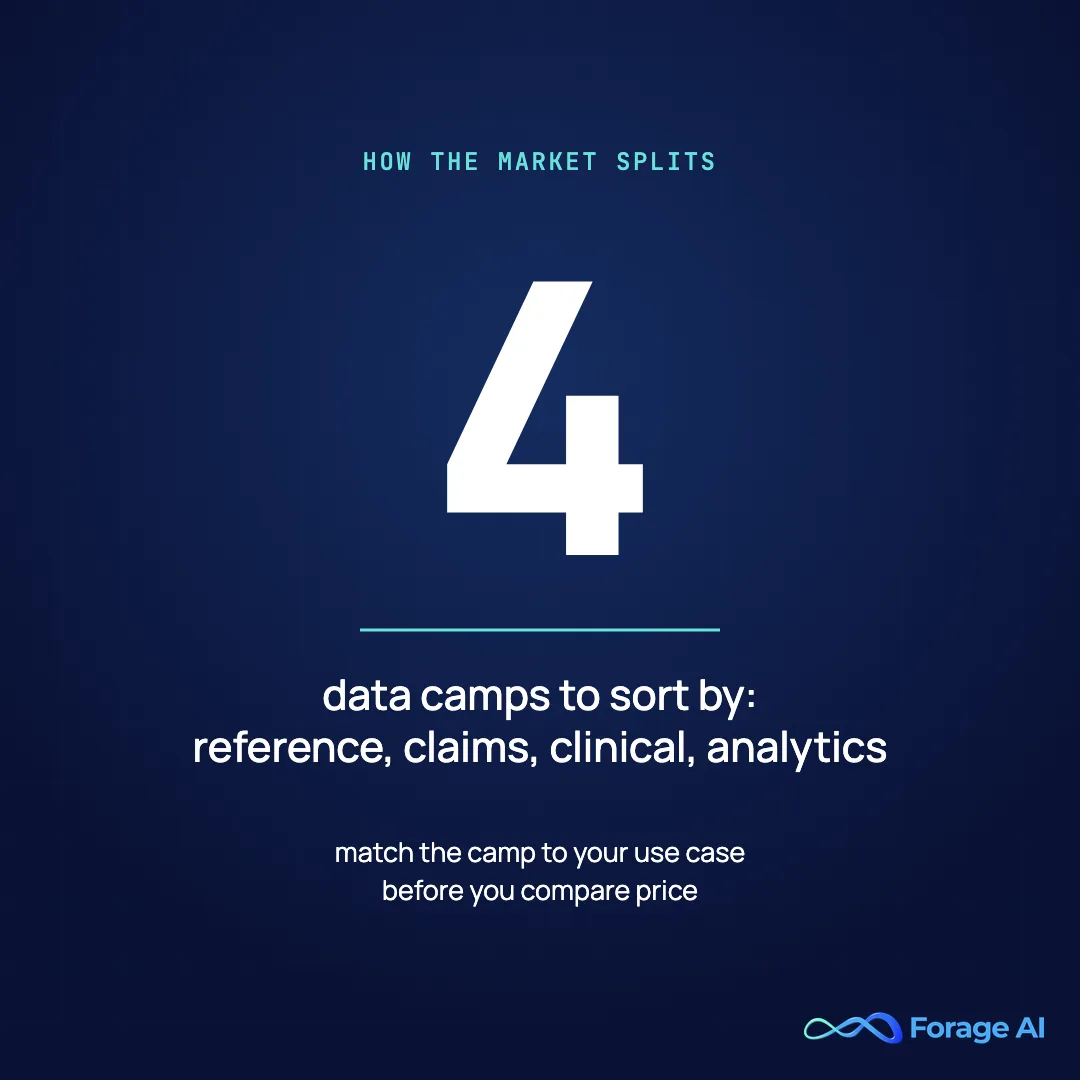
That is the mistake most buyers make. They shortlist “the top healthcare data providers” as if they were ranking the same product, then discover three months in that the vendor with the biggest headline number does not cover their segment, or refreshes too slowly, or licenses the data in a way that blocks their use case. The data shows the market splits into camps: provider and reference data, claims data, clinical and real-world data, and the analytics platforms that sit on top.
This guide categorizes the major healthcare data providers by the types of data they sell, then assesses each on four axes that predict whether a vendor will break into production: coverage, freshness, compliance, and ownership. We lead with Forage AI, then work through the field, with what public reviews say about each. By the end, you will know which camp your use case belongs in, and which provider fits it.
Quick Digest
- Healthcare data splits into four camps: provider/reference directories, claims data, clinical/real-world data, and analytics platforms that unify them. Most buyers need more than one.
- Headline record counts are the weakest signal. Coverage of your segment, freshness, compliance posture, and license terms predict production fit.
- Claims data is divided into open (broad, faster, less complete) and closed (adjudicated, complete within a payer).
- Pricing ranges from free public registries (NPPES/NPI, CMS) to budget-contract databases ($50 to roughly $859 per month) to six-figure enterprise contracts. For what each of those free public sources actually contains and how fresh it is, see our ranking of every public US healthcare provider data source.
- HIPAA fit is not automatic. Verify de-identification, business associate agreements, and resale or AI-training terms per vendor.
Healthcare data providers at a glance
Managed / build-to-spec
- Forage AI: managed extraction, build-to-spec coverage on your schema and cadence, no resale.
Provider / reference data
- Definitive Healthcare: healthcare commercial intelligence, HCP/HCO reference and market sizing.
- IQVIA: pharma commercial, prescriber-level Rx and patient-flow analysis.
- Veeva OpenData: reference and master data for life-sciences CRM.
- LexisNexis Health Care: provider identity, credentialing, fraud and risk linkage.
- H1: global research and engagement coverage, KOL identification.
- Symphony Health: Rx and medical claims analytics, an IQVIA alternative.
- Doximity: verified US physician identity and engagement.
- CarePrecise: budget bulk US provider data.
- Ampliz: budget healthcare B2B contact data.
- ZoomInfo (Healthcare): horizontal B2B contact data with healthcare filters.
Claims, clinical and real-world data
- Komodo Health: patient-journey analysis and real-world evidence.
- HealthVerity: real-world data marketplace spanning open and closed claims.
- Datavant: privacy-preserving data linkage across partners.
- Truveta: de-identified EHR-based real-world data.
- Clarify Health: claims-based analytics for cost, outcomes and referrals.
- Trilliant Health: all-payer market intelligence and referral patterns.
- Inovalon: payer analytics, quality and risk adjustment.
Analytics platforms
- Arcadia: unifying clinical and claims for provider/payer analytics.
- Innovaccer: healthcare data unification and population health.
Free / public
- NPPES/NPI and CMS: free, authoritative baseline for provider identity and Medicare-derived data.
The kinds of healthcare data
Before ranking providers, sort them by what they sell. A provider that is excellent at one data type is often absent in another, so the category is the first filter.
| Data type | What it is | Who sells it |
|---|---|---|
| Provider / reference (HCP & HCO) | Directories of clinicians and organizations: NPI, specialty, license/DEA, affiliations, locations | Definitive, Veeva OpenData, LexisNexis, H1, IQVIA OneKey |
| Claims | Medical (Dx) and pharmacy (Rx) claims; prescribing and patient flow | IQVIA, Symphony, Komodo, HealthVerity, Trilliant |
| Clinical / real-world (RWD) | De-identified records from EHRs and health systems | Truveta, Datavant, HealthVerity, Komodo |
| Analytics platforms | Unify claims + clinical + reference into applications | Arcadia, Innovaccer, Clarify, Inovalon |
| Public / free | National registries and government datasets | NPPES/NPI, CMS |
Two distinctions matter most. The first is open versus closed claims: open claims are broader and arrive faster but are less completely adjudicated, while closed claims are fully adjudicated and complete within a payer but narrower in scope (Journal of Health Economics and Outcomes Research, 2026). The second is reference data versus claims data. A directory tells you who a provider is; claims tell you what they do. Pharma commercial teams usually need both, and few vendors lead in both.
Q: What are the main types of healthcare data providers?
A: Four camps. Provider/reference data (HCP and HCO directories), claims data (medical and pharmacy, open or closed), clinical and real-world data (de-identified EHR records), and analytics platforms that unify the others. Public registries like NPPES/NPI and CMS are a free fifth option. Most buyers need two or more, so categorize providers by data type before comparing price.
How do you evaluate a healthcare data provider?
Four axes predict whether a healthcare data provider holds up after you sign. Run every vendor through them.
Coverage. Headline counts hide gaps. Ask for coverage in your segment: your specialties, your geographies, your facility types. A national claim can be accurate in aggregate and thin in the long tail where your product operates. The same coverage discipline applies when location matters: if you are evaluating point-of-interest data providers for facility footprints or site-level analysis, test density in your markets before you trust a national count.
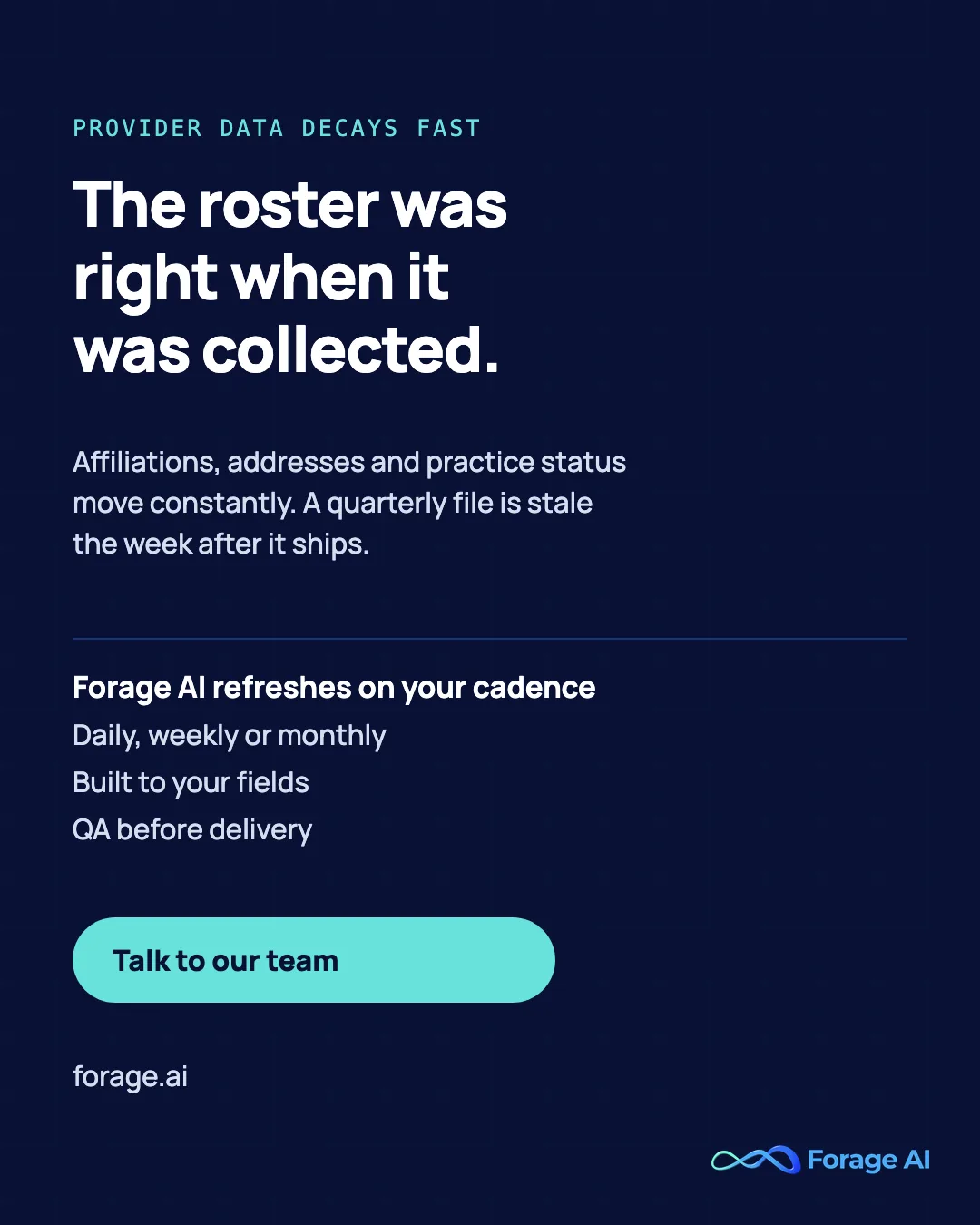
Freshness. Provider rosters and affiliations decay fast. Physicians move, practices merge, affiliations change. A directory refreshed quarterly will show a stale address within weeks, and stale provider data drives misrouted outreach and broken referrals. Ask for the refresh cadence per data type, in writing.
Compliance. Real-world data runs on de-identification, business associate agreements, and data-use terms. The posture is a real evaluation axis, not a checkbox.
Ownership and license. Can you use the data in your product, resell or syndicate it, train models on it, and retain it? The license decides what your roadmap is allowed to do.
This is also where managed extraction enters the comparison. When a packaged feed is stale in your markets, or its license blocks your use case, the alternative is to extract the data to your own schema and cadence. That is Forage AI’s lane, and it is why the list starts there.
Q: How do you evaluate a healthcare data provider?
A: On four axes: coverage in your specific segment (not headline counts), freshness per data type (rosters decay fast), compliance posture (de-identification, BAAs, license terms), and ownership rights (resale, AI-training, retention). Match those against your use case and data type before comparing price.
The healthcare data providers, compared
Twenty providers, grouped by camp, Forage AI first. Each carries a comparison table and a read on what public reviews say. Counts and ratings are cited and dated; where a figure is not publicly verifiable, the pricing model is described rather than invented.
1. Forage AI
| Field | Detail |
|---|---|
| Best for | Build-to-spec coverage, long-tail providers, compliance-sensitive teams, custom schema |
| Key use cases | Provider-directory building, claims-form and clinical-document extraction, firmographic enrichment |
| Pricing model | Managed service, quote-based (per-source / per-scope) |
| Privacy/compliance | Contractual handling controls; audit trails + encryption |
| Data types & coverage | Provider directories, physician data, clinical records, claims-form IDP, healthcare firmographic |
| Standout / Watch-out | Provider-directory building, claims-form and clinical-document extraction, and firmographic enrichment |
Forage AI is not a packaged-feed vendor, and that is the point of putting it first. The other entries on this list sell you a fixed dataset on their schema and refresh cycle. Forage AI extracts the data you actually need, from provider directories and physician sources to clinical and claims documents, normalized to your taxonomy and refreshed on your cadence, through managed workflows governed by contractual controls and client-specific handling rules. You own the output, and it is never resold.
That makes it the right choice in a specific situation: when bought feed is stale in your markets, misses your long-tail segment, or is licensed in a way that blocks your use case. It is the wrong choice if you want an off-the-shelf national claims warehouse tomorrow, because managed extraction is built to spec, not pulled from a shelf. For teams whose evaluations keep surfacing coverage and freshness gaps, build-to-spec control is the differentiator.
Provider and reference data
2. Definitive Healthcare
| Field | Detail |
|---|---|
| Best for | Healthcare commercial intelligence, HCP/HCO reference, market sizing |
| Pricing model | Enterprise subscription, quote-based |
| Privacy/compliance | Commercial reference + claims; standard data-use terms |
| Data types & coverage | 3M+ US HCP profiles, 310k+ HCOs, ~28B annual Rx claims (Definitive Healthcare, 2026) |
| Standout / Watch-out | Standout: breadth of intelligence; often cited as the best overall IQVIA alternative. Watch-out: enterprise pricing |
Definitive Healthcare (Nasdaq: DH) is the default starting point for healthcare commercial intelligence, pairing a large HCP and HCO reference base with claims and prescribing records. Reviewers value the breadth and the analytics layered on top; the common complaint is cost and the learning curve on the platform. It is a strong fit for pharma and medtech commercial teams that need reference and intelligence in one place.
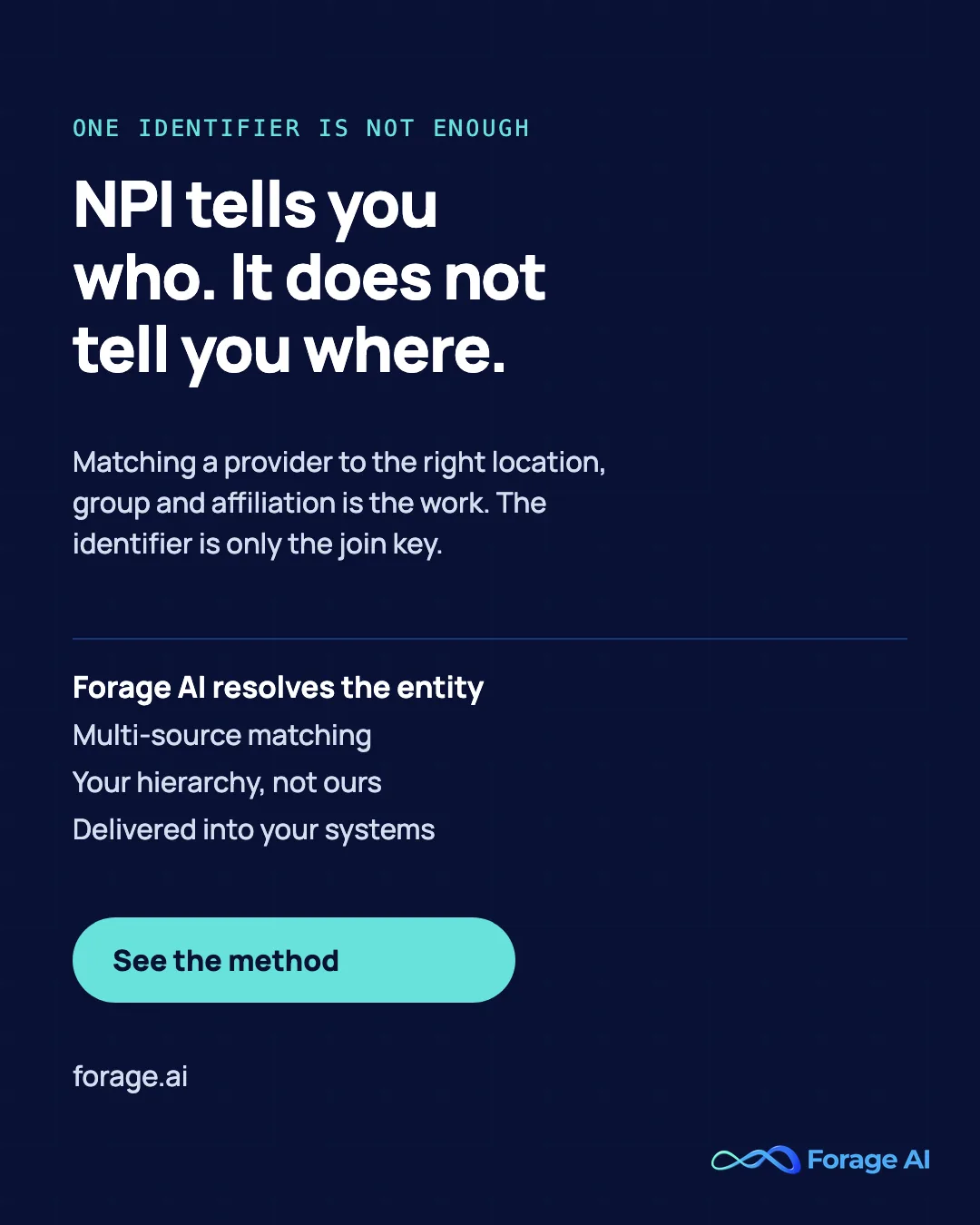
3. IQVIA
| Field | Detail |
|---|---|
| Best for | Pharma commercial, prescriber-level Rx and patient-flow analysis |
| Pricing model | Enterprise, quote-based (typically high) |
| Privacy/compliance | De-identified claims; mature governance |
| Data types & coverage | ~90–93% of US retail pharmacy claims; Xponent, LRx, OneKey reference (IQVIA, 2026) |
| Standout / Watch-out | Pharma commercial, prescriber-level Rx, and patient-flow analysis |
IQVIA is the reference standard for prescription and claims data, and reviews reflect it: a 4.3 rating on Gartner Peer Insights, with G2 reviewers praising the data assets, the prescribing and patient-flow granularity, and accurate, usable data (G2; Gartner Peer Insights, 2026). The trade-off is price and complexity. For commercial pharma analytics where prescriber-level precision is the whole game, IQVIA is hard to displace, which is also why “IQVIA alternative” is a common search.
4. Veeva OpenData
| Field | Detail |
|---|---|
| Best for | Reference/master data for life-sciences CRM |
| Pricing model | Enterprise subscription |
| Privacy/compliance | License/DEA, affiliations, compliance flags |
| Data types & coverage | ~12M global HCP/HCO records (Veeva, 2026) |
| Standout / Watch-out | Reference/master data for life sciences CRM |
Veeva OpenData supplies HCP and HCO reference data tightly integrated with Veeva’s life sciences CRM. Veeva Systems rates 4.3 on G2 across 500-plus reviews and 3.8 on Gartner Peer Insights (G2; Gartner, 2026). On the data specifically, some reviewers find the quality less complete than IQVIA’s, note gaps in HCP and HCO lists across several European countries, find segment filtering harder than expected, and large pharma buyers flag the cost (TrustRadius; G2, 2026). It is a natural choice where the team is already standardized on Veeva CRM.
5. LexisNexis Health Care
| Field | Detail |
|---|---|
| Best for | Provider identity, credentialing, fraud/risk linkage |
| Pricing model | Enterprise, quote-based |
| Privacy/compliance | Regulated-data governance; licensure + legal + financial linkage |
| Data types & coverage | ~125 fields per provider in Provider Data MasterFile / Enclarity (LexisNexis Risk Solutions, 2026) |
| Standout / Watch-out | Standout: identity depth per provider. Watch-out: built for risk/identity, not commercial targeting |
LexisNexis Health Care builds deep provider identity profiles by linking licensure, legal, and financial records, with roughly 125 fields per provider. It is strongest for credentialing, provider validation, and fraud and risk work rather than commercial outreach. Buyers in payer and risk functions value the identity resolution; it is over-built if all you need is a contact list.
6. H1
| Field | Detail |
|---|---|
| Best for | Standout: global research/engagement coverage. Watch out: less claims depth than IQVIA |
| Pricing model | Enterprise subscription |
| Privacy/compliance | Standard data-use terms |
| Data types & coverage | ~11M worldwide HCP/HCO records (H1, 2026) |
| Standout / Watch-out | Standout: global research/engagement coverage. Watch out: fewer claims depth than IQVIA |
H1 aggregates around 11 million HCP and HCO records worldwide and is widely used for medical affairs and key opinion leader identification. Reviewers like the global breadth and the research workflow; it is a reference and engagement tool, not a claims warehouse.
7. Symphony Health (ICON)
| Field | Detail |
|---|---|
| Best for | Rx and medical claims analytics, an IQVIA alternative |
| Pricing model | Enterprise, quote-based |
| Privacy/compliance | De-identified claims |
| Data types & coverage | Prescription and medical claims, prescriber analytics |
| Standout / Watch-out | Standout: claims depth at often lower cost than IQVIA. Watch-out: smaller ecosystem |
Symphony Health, part of ICON, is the most common direct alternative to IQVIA for prescription and medical claims, often at a more accessible price point. Teams that need claims depth without IQVIA’s full footprint shortlist it; the ecosystem and tooling are narrower.
8. Doximity
| Field | Detail |
|---|---|
| Best for | Verified US physician identity and engagement |
| Pricing model | Platform/advertising and data products |
| Privacy/compliance | Self-reported professional network data |
| Data types & coverage | Large verified US physician network |
| Standout / Watch-out | Standout: verified, engaged physician identities. Watch-out: US physicians, not broad HCO/claims |
Doximity is the largest professional network for US physicians, which makes its identity data unusually clean and current for that population. It is a strong fit for physician verification and engagement, and a poor fit if you need organizations, claims, or non-physician providers.
9. CarePrecise
| Field | Detail |
|---|---|
| Best for | Budget bulk US provider data |
| Pricing model | One-time/bulk from ~$859 (CarePrecise, 2026) |
| Privacy/compliance | Public-source provider data |
| Data types & coverage | 9M+ US provider records |
| Standout / Watch-out | Standout: low-cost bulk file. Watch out: depth and enrichment are limited |
CarePrecise sells bulk US provider files built largely on public sources, starting around $859 (CarePrecise, 2026). It is the value option when you need a broad provider list and can do your own enrichment. Reviewers treat it as exactly that: affordable and serviceable, not a premium intelligence platform.
10. Ampliz
| Field | Detail |
|---|---|
| Best for | Budget healthcare B2B contact data |
| Pricing model | Subscription from ~$50/mo (Ampliz, 2026) |
| Privacy/compliance | B2B contact data; standard terms |
| Data types & coverage | Healthcare-specific contact records and filters |
| Standout / Watch-out | Standout: lowest entry price with healthcare filters. Watch-out: contact data, not claims/clinical |
Ampliz is among the lowest-cost entry points for B2B healthcare contact data, starting at around $50 per month with healthcare-specific filters (Ampliz, 2026). It is built for outreach and lead generation, not analytics, and reviews position it as a budget contact database that does that job adequately.
11. ZoomInfo (Healthcare)
| Field | Detail |
|---|---|
| Best for | Horizontal B2B contact data with healthcare filters |
| Pricing model | ~$25,000–60,000/yr (industry pricing, 2026) |
| Privacy/compliance | B2B contact data |
| Data types & coverage | Broad B2B with healthcare segmentation |
| Standout / Watch-out | Standout: strong horizontal coverage + tooling. Watch-out: not healthcare-native depth |
ZoomInfo is the strongest horizontal B2B database for healthcare, with enterprise pricing in the $25,000 to $60,000 per year range. It wins on tooling and integrations; it loses to healthcare-native vendors on clinical depth, specialty granularity, and provider-specific attributes.
Claims, clinical, and real-world data
12. Komodo Health
| Field | Detail |
|---|---|
| Best for | Patient-journey and real-world evidence |
| Pricing model | Enterprise, quote-based |
| Privacy/compliance | De-identified patient data |
| Data types & coverage | Healthcare Map: 330M patients, 65B+ encounters (Komodo Health, 2026) |
| Standout / Watch-out | Standout: longitudinal patient journeys at scale. Watch-out: enterprise commitment |
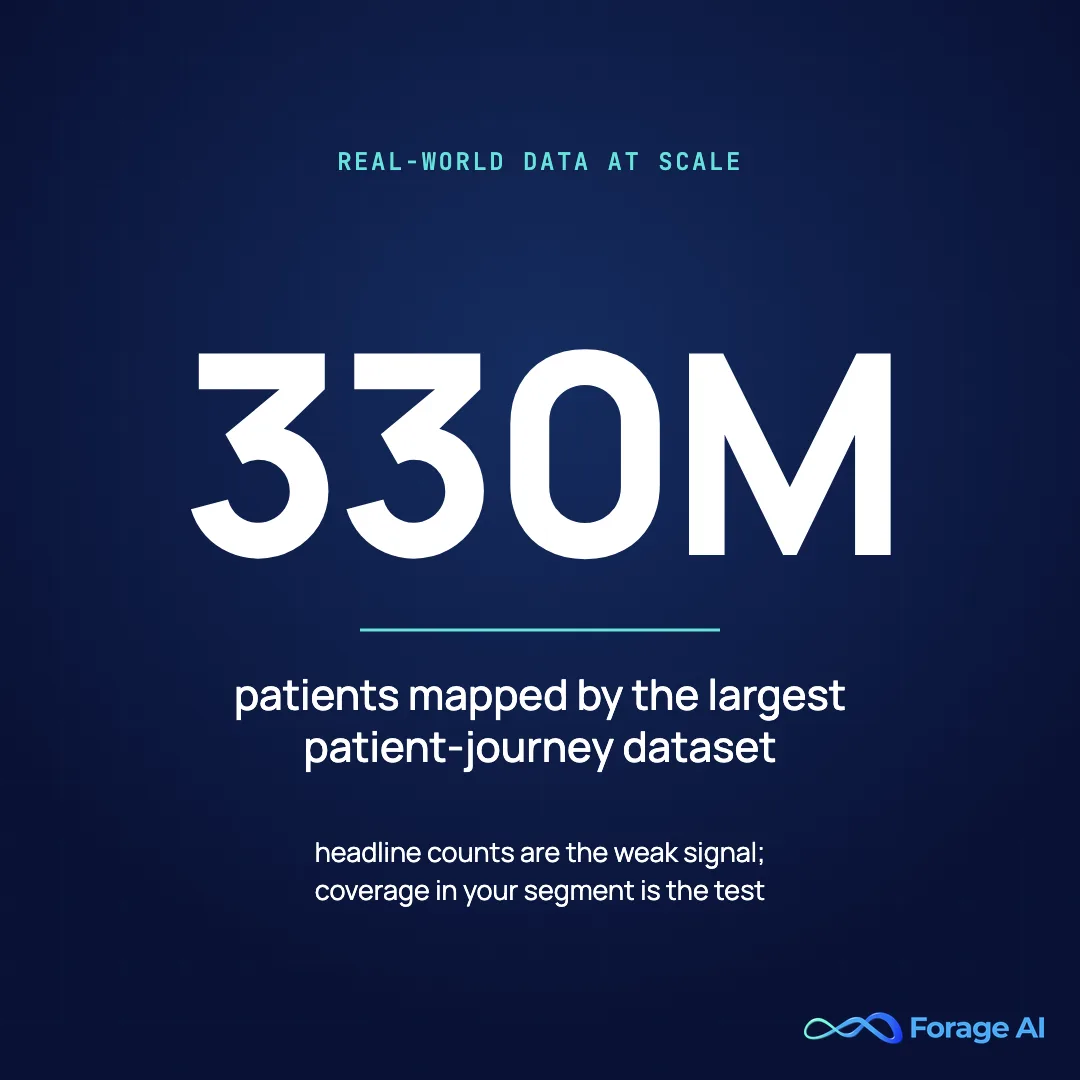
Komodo Health’s Healthcare Map links 330 million patients across more than 65 billion encounters, built for patient-journey analysis and real-world evidence (Komodo Health, 2026). It is a strong fit for life sciences RWE and commercial analytics that need patient-level longitudinal data, and an enterprise commitment in both price and onboarding.
13. HealthVerity
| Field | Detail |
|---|---|
| Best for | Real-world data marketplace, open + closed claims |
| Pricing model | Enterprise, modular |
| Privacy/compliance | Privacy-preserving linkage, governance-forward |
| Data types & coverage | 75+ RWD sources; used by ~80% of top US pharma (HealthVerity, 2026) |
| Standout / Watch-out | Standout: source breadth + governance. Watch-out: assembly complexity |
HealthVerity operates a real-world data ecosystem of more than 75 sources with privacy-preserving linkage, and reports that around 80 percent of top US pharma and biotech use it (HealthVerity, 2026). The strength is breadth and governance; the trade-off is that assembling the right combination of sources takes work. It is a fit for RWD-heavy pharma programs.
14. Datavant
| Field | Detail |
|---|---|
| Best for | Privacy-preserving data linkage across partners |
| Pricing model | Enterprise/platform |
| Privacy/compliance | Tokenization, de-identified linkage |
| Data types & coverage | 300+ data partners, 80,000+ hospitals connected (Datavant, 2026) |
| Standout / Watch-out | Standout: connectivity layer across the ecosystem. Watch-out: a connector, not a single dataset |
Datavant is the connectivity layer of the healthcare data ecosystem, linking de-identified records across more than 300 partners and 80,000-plus hospitals through tokenization (Datavant, 2026). You use it to join data you and your partners already hold, not to buy a dataset off the shelf. For organizations stitching together multi-source RWD, it is close to a standard.
15. Truveta
| Field | Detail |
|---|---|
| Best for | De-identified EHR-based real-world data |
| Pricing model | Enterprise subscription |
| Privacy/compliance | Provider-collective de-identified EHR |
| Data types & coverage | EHR data contributed by a collective of US health systems |
| Standout / Watch-out | Standout: structured + clinical-note depth from EHRs. Watch-out: EHR-collective scope |
Truveta aggregates de-identified EHR data contributed directly by a collective of US health systems, which gives it clinical depth, including notes that claims data lacks. It is a strong fit for clinical research and RWE that needs EHR-level detail, bounded by the health systems in the collective.
16. Clarify Health
| Field | Detail |
|---|---|
| Best for | Claims-based analytics: cost, outcomes, referrals |
| Pricing model | Enterprise platform |
| Privacy/compliance | De-identified claims analytics |
| Data types & coverage | Large claims dataset with analytics applications |
| Standout / Watch-out | Standout: analytics on top of claims. Watch out: platform, not raw data licensing |
Clarify Health pairs a large claims dataset with analytics to analyze costs, outcomes, and referrals. Buyers choose it when they want answers rather than raw files; teams that need to own the underlying data find the platform model limiting.
17. Trilliant Health
| Field | Detail |
|---|---|
| Best for | All-payer market intelligence and referral patterns |
| Pricing model | Enterprise subscription |
| Privacy/compliance | De-identified all-payer claims |
| Data types & coverage | National all-payer claims, market/referral analytics |
| Standout / Watch-out | Standout: provider strategy + referral mapping. Watch-out: strategy focus, not contact data |
Trilliant Health uses national all-payer claims to map market dynamics, referral patterns, and competitive positioning, primarily for provider strategy teams. It is a strategic-intelligence tool, not an outreach database, and reviewers value the referral and market analytics most.
18. Inovalon
| Field | Detail |
|---|---|
| Best for | Payer analytics, quality, and risk adjustment |
| Pricing model | Enterprise platform |
| Privacy/compliance | Regulated payer data, governance-forward |
| Data types & coverage | Large claims dataset + quality/risk applications |
| Standout / Watch-out | Standout: payer/quality depth. Watch-out: payer focus |
Inovalon combines a large claims dataset with quality and risk adjustment applications for payers and value-based care. It is strongest inside the payer and quality-measurement world and less relevant to commercial or outreach use cases.
Analytics platforms that unify the data
19. Arcadia
| Field | Detail |
|---|---|
| Best for | Unifying clinical + claims for provider/payer analytics |
| Pricing model | Enterprise platform |
| Privacy/compliance | Health-system-grade governance |
| Data types & coverage | 3,000+ source systems, 170M+ patients, 200+ orgs; KLAS Major Contender (Arcadia, 2026) |
| Standout / Watch-out | Standout: deep clinical+claims unification. Watch-out: a platform you adopt, not a feed you buy |
Arcadia unifies clinical and claims data from more than 3,000 source systems, managing data for over 170 million patients across 200-plus provider and payer organizations, and is recognized by KLAS (Arcadia, 2026). It is an analytics platform you adopt, not a dataset you license, and it fits health systems and payers that are building population health and value-based care programs.
20. Innovaccer
| Field | Detail |
|---|---|
| Best for | Healthcare data unification and population health |
| Pricing model | Enterprise platform |
| Privacy/compliance | Health-system-grade governance |
| Data types & coverage | Data-activation platform across clinical/claims sources |
| Standout / Watch-out | Standout: unification + population-health apps. Watch-out: platform adoption, not raw data |
Innovaccer is a data unification and activation platform, strong in population health, care management, and value-based care. Like Arcadia, it is something you implement across your sources, not a file you buy, and it suits provider organizations standardizing their data layer.
Free and public options: NPPES/NPI and CMS
| Field | Detail |
|---|---|
| Best for | Baseline provider identity and Medicare-derived data |
| Pricing model | Free |
| Privacy/compliance | Public government data |
| Data types & coverage | NPPES/NPI registry; CMS/Medicare provider + claims-derived datasets |
| Standout / Watch-out | Standout: free, authoritative baseline. Watch-out: no enrichment, freshness gaps, assembly required |
The NPPES/NPI registry and CMS datasets are free, authoritative, and the right baseline for provider identity and Medicare-derived analysis, which is where most evaluations of NPI data tools start. They carry no enrichment, refresh on government cycles, and require real work to assemble and keep up to date. Many teams start here and layer a commercial provider or a managed-extraction layer on top to fill the gaps. Our guide to healthcare data management covers how to build that layer.
Q: Which healthcare data provider is best?
A: There is no single best. The best provider depends on your data type and use case: IQVIA or Symphony for prescription claims; Definitive or Veeva for reference and commercial intelligence; Komodo, Truveta, or HealthVerity for real-world data; Arcadia or Innovaccer to unify it; and Forage AI when you need build-to-spec coverage that your bought feed cannot supply.
Which provider fits your use case?
The fastest way to shortlist is to start from the use case, not the vendor. The table makes clear that the camps map cleanly onto buyer needs.
| Use case | Camp to start in | Representative providers |
|---|---|---|
| Pharma commercial targeting | Claims + reference | IQVIA, Symphony, Definitive, Veeva |
| Payer & value-based analytics | Claims + analytics | Inovalon, Clarify, Arcadia, Innovaccer |
| Provider outreach & directories | Reference / contact | Definitive, Doximity, CarePrecise, Ampliz |
| Market intelligence & referrals | All-payer claims | Trilliant, Definitive |
| Real-world evidence & research | Clinical / RWD | Komodo, Truveta, HealthVerity, Datavant |
| Build-to-spec & long-tail coverage | Managed extraction | Forage AI |
Two notes on the edges. If your use case is in the bottom row, where a packaged feed is stale in your markets, missing your long-tail segment, or licensed against your roadmap, managed extraction is the durable path: you define the schema, the sources, and the cadence, and you own the result. And if you are comparing managed services rather than packaged data, our breakdown of healthcare data extraction services sits alongside this list.
Q: How do I match a healthcare data provider to my use case?
A: Start from the use case. Pharma commercial needs claims plus reference (IQVIA, Definitive). Payer and value-based work needs claims plus analytics (Inovalon, Arcadia). Outreach needs reference and contact data (Definitive, Doximity). Real-world research needs clinical/RWD (Komodo, Truveta, HealthVerity). Build-to-spec or long-tail coverage points to managed extraction (Forage AI).
Frequently asked questions
What is the difference between open and closed claims data?
Open claims are sourced broadly across the system, arrive faster, and cover more of the market, but are less completely adjudicated. Closed claims are fully adjudicated and complete within a given payer, but narrower in scope (Journal of Health Economics and Outcomes Research, 2026). Pharma and commercial teams often use open claims for breadth and closed claims for accuracy on specific questions.
How much do healthcare data providers cost?
Pricing spans a wide range. Public registries (NPPES/NPI, CMS) are free. Budget contact databases start near $50 a month (Ampliz) or around $859 for a bulk file (CarePrecise). Horizontal B2B platforms run roughly $25,000 to $60,000 a year (ZoomInfo). Enterprise claims and intelligence platforms (IQVIA, Definitive, Komodo) are six-figure, quote-based contracts. Price tracks data type and depth, so scope the use case first.
Are healthcare data providers HIPAA-compliant?
Real-world data vendors operate on de-identified data under business associate agreements and data-use terms, but their postures vary by vendor. Verify the de-identification method, the agreements offered, and the resale or AI-training rights before building on any provider’s data, and account for the CCPA implications for external data use once that data lands in your environment. Compliance is an evaluation axis, not a guarantee.
Are there free healthcare data providers?
Yes. The NPPES/NPI registry and CMS/Medicare datasets are free and authoritative for provider identity and Medicare-derived analysis. They lack enrichment and refresh cycles for government data, so most teams use them as a baseline and layer a commercial or managed-extraction source on top.
Which provider is best for pharma, payers, or outreach?
Pharma commercial leans on IQVIA, Symphony, Definitive, and Veeva. Payer and value-based analytics lean on Inovalon, Clarify, Arcadia, and Innovaccer. Provider outreach leans toward Definitive, Doximity, CarePrecise, and Ampliz. Real-world research leans toward Komodo, Truveta, HealthVerity, and Datavant.
The data shows what the headline counts hide: there is no single best healthcare data provider. There is the provider whose data type, coverage, freshness, and license match your use case, and the provider whose data does not. Sort the field by camp, test coverage, and freshness in your own segment, read the license before you sign, and when the packaged options leave a gap, build the missing layer to spec. For the layer above the data, start with healthcare data analytics.