
Public Web Data vs Private Data in AI Training
As AI initiatives transition from pilot projects to full-scale production, a strategic decision arises: Which data should we use to train our models?
The answer is rarely binary. Using public data provides a wider range of insights and trends, while private data offers specific, trusted information that enhances accuracy and relevance. The choice between public data, which offers breadth, and private data, which provides depth, directly impacts model performance, competitive advantage, and regulatory compliance.
In this guide, we break down the silos between these two data worlds to help you understand:
- What public and private data really mean in the context of AI training.
- Where each data source works best.
- How to navigate risks and the compliance landscape for each data type.
- Why a hybrid approach, supported by managed data extraction, has become the standard for scalable, reliable AI in enterprises.
Quick Digest
- Public web data: Openly accessible listings, news, filings, job posts and directories, unmatched on scale and freshness, blind to your own context
- Private data: ERP, CRM, proprietary research, licensed sets and transaction history, accurate and domain-specific but narrow on its own
- The split: Reach for public data when a model needs breadth and external awareness, private data when accuracy and trust decide the outcome
- Hybrid wins: Proprietary depth plus market context lowers bias and improves how a model generalises to new situations
- The risk list: Quality, bias, privacy, security, scalability and reputation, each with a control the data team has to own
What Counts as Public and Private Data for AI?
What Is Public Web Data in AI Training?
Public Web Data refers to information that is openly accessible without authorization. Think of it as the digital ecosystem your business operates within.
Examples:
- Product listings & e-commerce prices
- News articles and financial reports
- Job postings and company directories
- Government and regulatory filings
- Public reviews and forum discussions
This data offers unmatched scale and provides real-time market context, making it essential for use cases like understanding competitive landscapes and consumer sentiment.
What Is Private Data in AI Training?
Private data includes any information that your organization owns, licenses, or manages through contractual agreements.
Examples:
- Internal ERP, CRM, and financial systems
- Proprietary research and analytics
- Licensed market intelligence datasets
- Customer transaction histories
- Confidential business documents
This type of data provides accurate, domain-specific insights that contribute to your competitive advantage. It embodies your institutional knowledge in a manner that can be acted upon.
These distinctions influence how enterprises develop AI training datasets.
Why Public Web Data Matters in AI Training
Publicly available web data is vital for training AI models. It provides essential real-world context, preventing isolation in proprietary information and enhancing understanding of diverse perspectives.
Key Business Use Cases:
- Market Intelligence at Scale: Incorporate millions of competitor, customer, and supplier data points to build models that understand market dynamics.
- Real-Time Relevance: Continuously update training datasets with current trends, news, and pricing shifts to keep AI models timely and accurate.
- Cost-Effective Breadth: Source vast amounts of text, image, and video data across formats, languages, and regions without proprietary licensing barriers, though domain-specific corpora such as open ecommerce datasets often carry licence terms that restrict commercial training.
- Pattern Recognition: Train data models to recognize broad consumer behaviors, public sentiment shifts, and cross-industry trends from open sources.
Why Private Data Is Your Business Advantage
Private data represents your unique business insights, the proprietary knowledge that separates you from competitors/outside the environment.
Business Applications:
- Mission-Critical Accuracy: AI is trained on proprietary risk algorithms, internal fraud patterns, and compliance logic to enhance models for financial forecasting, fraud detection, and regulatory operations.
- Customer Intelligence: AI is trained on unique customer journey logic, segmentation models, and brand interaction history to create models for hyper-personalized recommendations, churn prediction, and loyalty analytics.
- Proprietary Optimization: AI trained on internal process data, supply chain variables, and inventory efficiency models is utilized for logistics optimization, demand forecasting, and operational cost reduction.
- Regulated Industries: The AI is trained on specialized diagnostic frameworks, proprietary actuarial models, and compliance rule sets for use in healthcare diagnostics, insurance underwriting, and personalized financial services.
Governance Imperatives:
Private corporate data, such as intellectual property, requires strict access controls and tracking to prevent financial losses and competitive issues. This data is protected through internal policies and non-disclosure agreements (NDAs). If the data is both private and personal, the Digital Personal Data Protection Act (DPDPA), etc applies. Public data is governed by regulations such as GDPR. Follow the basic guidelines for scraping and always consult your lawyer before initiating your data project.
Public Web Data vs Private Data: Key Differences
| Dimension | Public Web Data | Private Data |
| Accessibility | Publicly available | Restricted, internal only |
| Scale | Extremely large | Limited |
| Freshness | High (frequent updates) | Varies, controllable internally |
| Context specificity | Broad | Narrow but deep and specific |
| Compliance complexity | Medium and manageable | High and risky |
| Ideal for | Market intelligence, RAG on generalized info | Personalization, internal workflows |
When Should You Use Each One?
Public web data shines when AI systems need breadth, freshness, and external awareness. While private data excels when accuracy, trust, and business specificity are critical. Here are some examples to show the capabilities of different data types.
| Use Case | Primary Data Source | Why It Works |
| Pricing Intelligence | Public Web Data | Captures real-time competitor pricing across markets |
| Customer Analytics | Private Data | Leverages proprietary transaction and engagement history |
| Market Trend Analysis | Public Web Data | Identifies industry shifts from news, forums, and job postings |
| Fraud Detection | Private + Public | Combines internal transaction data with external threat intelligence |
| Lead Enrichment | Public Web Data | Augments CRM data with firmographics and executive movements |
Using private data alone creates accurate but narrow models. Conversely, public data offers context, though it lacks proprietary insights. Either sources have their own purposes; however, the most effective approach combines both types of data.
Why Do Hybrid Pipelines Win?
Leading enterprises don’t choose between data types; they build systems that leverage both simultaneously.
The Hybrid Advantage:
- Balanced Intelligence: Proprietary accuracy enhanced by market context
- Reduced Bias: Multiple data sources prevent isolated worldview formation
- Superior Generalization: Models that perform well both internally and in market environments
- Competitive Resilience: Systems that adapt as market conditions change
Basically, a hybrid approach offers the benefit of both private, accurate, and specific data with market context.
Expert Insights
Shijie Wu, Ozan Irsoy, Steven Lu and colleagues at Bloomberg described the hybrid recipe with numbers attached in 2023. They “construct a 363 billion token dataset based on Bloomberg's extensive data sources, perhaps the largest domain-specific dataset yet”, augmented with “345 billion tokens from general purpose datasets”, and found that “our mixed dataset training leads to a model that outperforms existing models on financial tasks by significant margins without sacrificing performance on general LLM benchmarks”. Private depth, public breadth, one corpus.
How Do Enterprises Operationalize These Pipelines?
Forward-thinking organizations treat hybrid data pipelines as core infrastructure, not experimental projects. Operationalizing a modern data pipeline involves transitioning from manual scripting to automated systems that convert raw data into AI-ready resources through orchestrated workflows.
Key Components of Operationalized Data Pipelines:
- Automated Orchestration: Tools such as Airflow and Prefect are used to schedule and manage the entire data journey, from extraction to delivery.
- Intelligent Processing: Frameworks that clean, normalize, and validate data at scale, ensuring consistency across sources
- Feature Management: Centralized stores for curated AI data that prevent inconsistencies between training and production
- Continuous Monitoring: Automated quality checks that detect anomalies or source changes in real-time
The Operational Shift:
Enterprises implement CI/CD practices for data, treating pipelines like production software. They establish unified governance for access control and compliance tracking. Most importantly, they often partner with managed data extraction providers such as Forage AI to handle the complex public data layer, freeing their teams to focus on higher-value tasks like feature engineering and model development.
The Outcome: This approach transforms data management from an engineering burden into a strategic advantage. Financial institutions, for example, can seamlessly blend real-time market data with private transactions, ensuring their AI systems are both market-aware and compliant.
Minimizing Risks Associated with Data for AI
Data strategy is inherently a risk management exercise. To build trustworthy and effective AI, you must proactively address the following key risk areas across both public and private data sources.
1. Data Quality & Integrity Risks: Inaccurate or inconsistent data results in unreliable AI models, so robust validation, cleaning, and standardization processes are essential for ensuring high data quality.
2. Bias & Fairness Risks: Historical or sampling bias in training data can lead to unfair AI decisions, so it’s crucial to audit datasets for bias and use diverse sampling techniques.
3. Privacy & Compliance Risks: Improper handling of personal or regulated data can breach laws like GDPR and HIPAA, leading to severe penalties and loss of trust; thus, it’s crucial to classify data by sensitivity, enforce access controls, maintain audit trails, and ensure compliance with all relevant regulations.
4. Security & Breach Risks: Data repositories and AI models face cyberattack risks that could leak sensitive information, so it’s crucial to implement strong cybersecurity measures, encryption, and strict access controls throughout the entire AI pipeline.
5. Operational & Scalability Risks: Data silos, incompatible formats, and growing data volumes create integration challenges that slow projects, so it’s crucial to plan for scalable data infrastructure, prioritize interoperability, and establish clear data lineage.
6. Reputational & Ethical Risks: Mismanagement of data can harm public trust and brand reputation, so adopting transparent and ethical practices is essential by clearly communicating data sources and the intended use of AI systems.
Crucial Guidelines:
- For Public Data: Respect website Terms of Service, copyright, and robots.txt. Scrape responsibly and maintain transparency in sourcing.
- For Private Data: Govern access strictly, track all data movement, and adhere to industry-specific regulations. Governance is not bureaucracy; it’s the foundation for scalable, defensible AI.
Expert Insights
Shayne Longpre, Robert Mahari, Anthony Chen, Naana Obeng-Marnu and their co-authors in the Data Provenance Initiative audited dataset licensing and attribution in 2023 and reported “frequent miscategorization of licenses on widely used dataset hosting sites”, with “license omission of 70%+ and error rates of 50%+”. Sourcing discipline is not paperwork. It is what separates a corpus you can account for from one you cannot.
By systematically addressing these risks, organizations can build a resilient data foundation that unlocks AI’s potential while protecting their assets, users, and reputation.
Why Data for AI Needs Special Attention
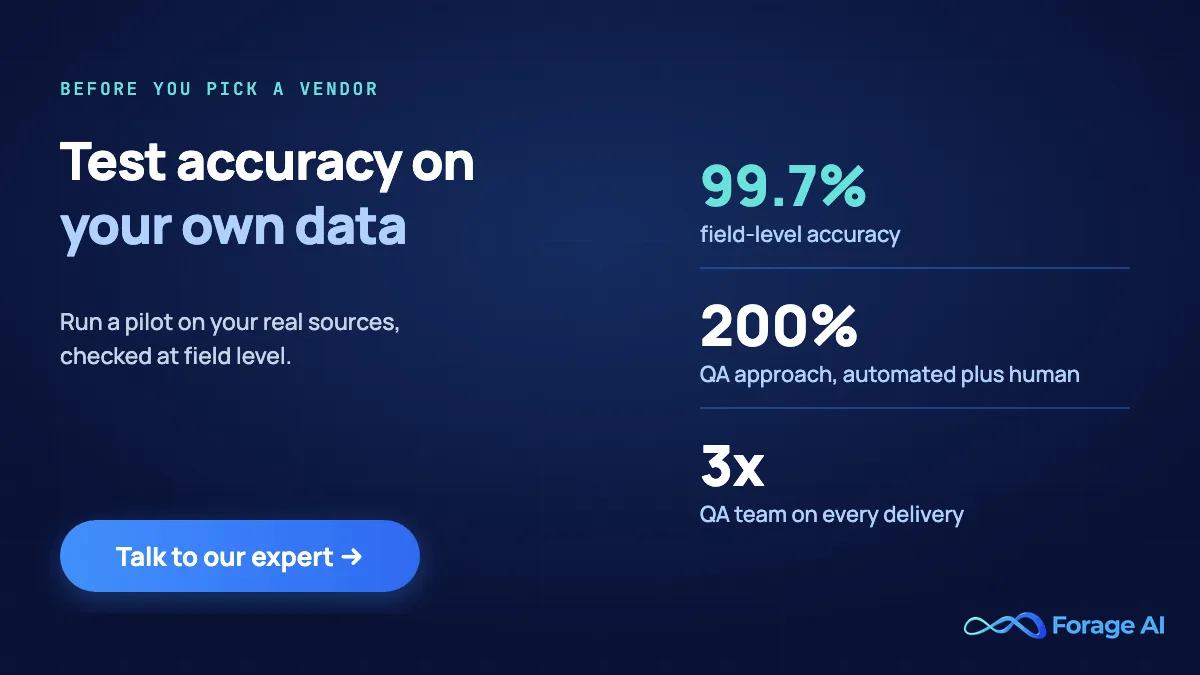
Not all web data is suitable for AI applications. Unlike human analysts, AI systems cannot interpret nuances, filter out irrelevant information, or correct inconsistencies independently. For effective AI training and Retrieval-Augmented Generation (RAG), public web data must be structured, cleaned, and labeled by internal teams or external data labeling services, which is a resource-intensive process.
The gap between raw and AI-ready data is where many projects struggle. Sourcing and refining data to meet the necessary scale and quality is a significant challenge in modern machine learning.
To truly understand how to bridge this gap, from sourcing and processing to operationalizing data for AI, we’ve dedicated a blog to ” What is data for AI?
Managed Data Extraction for AI Training Data
Managing public data extraction internally creates significant strategic drag. With high scale, speed, and quality expectations come greater complications.
Challenges of DIY or In-House Data Extraction:
- Talent Diversion: Engineering teams focused on maintenance instead of innovation
- Infrastructure Overhead: Proxy networks, parsing systems, and monitoring tools
- Quality Assurance Burden: Deduplication, validation, and normalization at scale
- Compliance Risk: Navigating evolving legal landscapes without specialized expertise
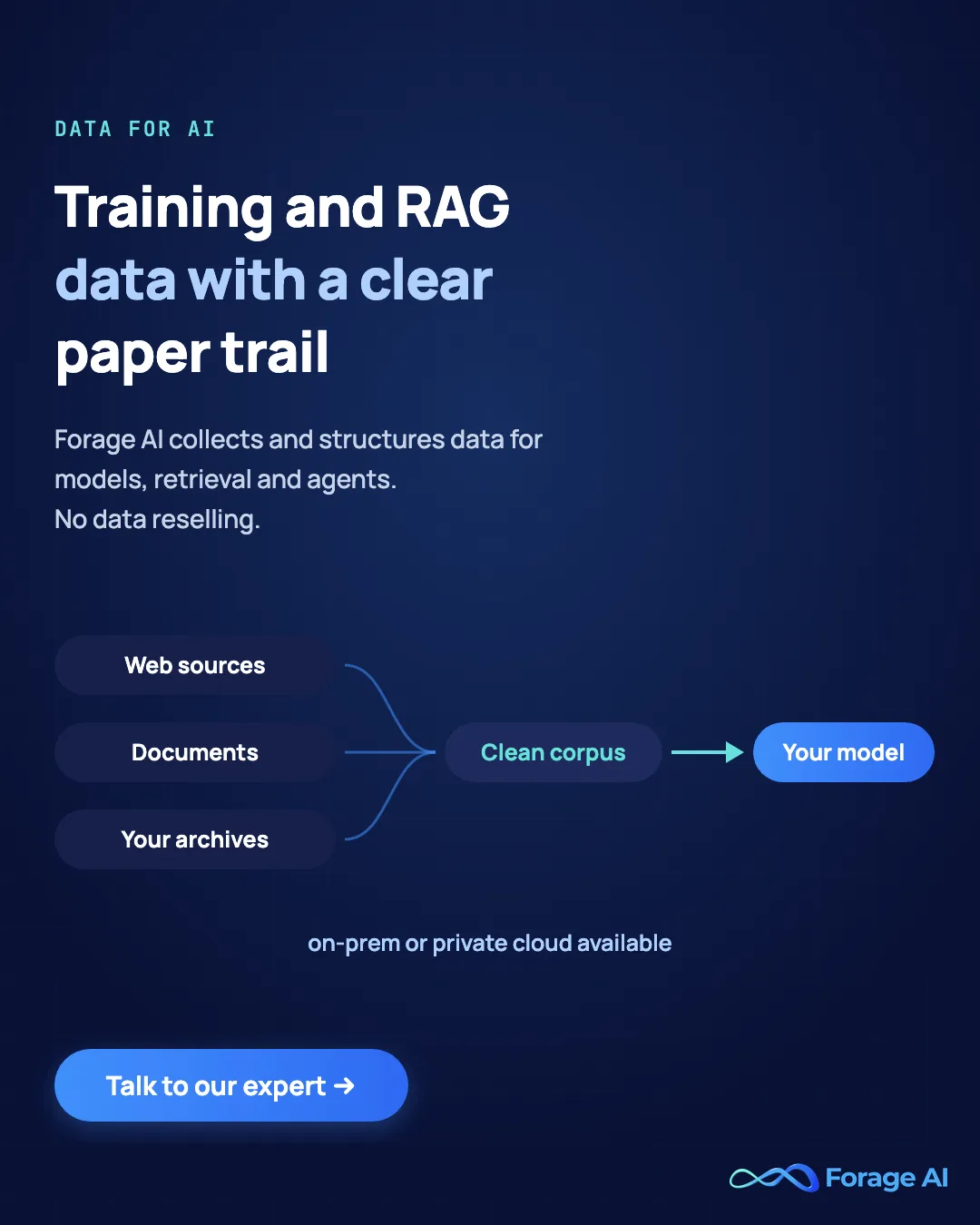
Working with a managed data extraction partner with expertise in data for AI, like Forage AI, transforms the operational burden of data extraction into a reliable strategic asset. Our managed service delivers:
- Compliance-first Architecture: Extraction frameworks built to ensure legal compliance
- Scalable Infrastructure: Adaptive crawling systems that scale as you wish. Large-scale and custom data is our forte.
- Structured Delivery: Clean, normalized datasets in AI ingestible formats
- Continuous Maintenance: Proactive monitoring and adjustment to source changes
- Hybrid Pipeline Support: Integrated ingestion of both public and licensed private data, including document data extraction.
This approach allows your team to focus on generating insights and developing models, not on data logistics.
This combination reduces model bias, improves generalization to new scenarios, and creates systems that understand both your business specifics and the external market environment.
To navigate these complexities and source high-quality data efficiently, learn how the leading providers compare in our analysis: Top 5 Web Scraping Companies for Data for AI. And if you would rather license ready-made datasets than commission a custom pipeline, our guide to the top AI dataset marketplaces compares where to buy them.
Frequently asked questions
Is public web data legally safe to use for training our enterprise AI models?
Yes, when accessed responsibly and ethically. Ensure data compliance with copyright laws, website Terms of Service, and ethical data-use frameworks, and always consult your lawyer before initiating your data project. Enterprise-grade providers like Forage AI implement compliance-first extraction practices by default, including respecting robots.txt, rate limiting, and data usage guidelines, to mitigate legal risk.
How does hybrid data extraction for AI actually improve model performance?
A hybrid approach to data for AI combines the accuracy of proprietary structured information with the contextual insights of public data, thereby reducing model bias, improving generalization to new scenarios, and creating systems that effectively understand both business specifics and the external market environment.
How does Forage AI ensure compliance with evolving global data regulations?
We maintain a compliance-first architecture that treats compliance as a core feature, including legal supervision of extraction practices, adaptable systems for regulatory changes, ethical proxy management, transparent documentation of sources, and adherence to international ethical use frameworks.
What compliance frameworks should we consider for each data type?
Public data must comply with copyright, website Terms of Service, robot exclusion protocols, and privacy laws like GDPR/CCPA, while private data requires strict internal governance, adherence to industry regulations such as HIPAA or SOC 2, and compliance with applicable laws and contractual obligations, with privacy laws applying based on data content rather than just the source, so always consult legal counsel
S
Written by
Sai Subramaniam
Data Infrastructure Enthusiast, Forage AI
Sai is a data infrastructure enthusiast who has spent the past two to three years following the AI space closely, from the infrastructure layer to the fast-growing world of data for AI. He is genuinely curious about how modern data pipelines get built and where the data industry is heading, and he writes insightful pieces on the core topics that shape this niche.
Reviewed by the team of experts at Forage AI for accuracy and clarity.