
AI for Web Scraping: A Practitioner’s Guide
The pitch for ai web scraping is seductive, and mostly wrong. Every vendor guide tells the same story: the model replaced the scraper, describe the fields you want in plain English, collect clean JSON. Then you run it at volume and the honest version shows up. The model extracts well, but it never fetched the page, it did nothing about the block you were already hitting, and roughly one text value in six came back confidently wrong.
None of that means an LLM has no place in a scraping pipeline. It means the place is narrow and specific, and the teams who win with it know exactly where the model earns its keep and where it changes nothing.
This is the version the tool demos skip: where the LLM plugs in, what it costs at real volume, what it will not solve no matter how large the model, and the hybrid pattern most teams land on. By the end you will be able to place the LLM in your pipeline, price it per thousand pages, measure whether its output is right, and design the deterministic-first fallback that holds as you scale.
Quick Digest
- Extraction, not fetching: An LLM upgrades the parse step only. It reads a page you already fetched and returns structured data; it touches none of the fetch, render, anti-bot, or session layers.
- How extraction works: You hand the model cleaned content plus a target schema and let constrained decoding return valid JSON. Input format is the biggest accuracy lever, swinging the same model roughly 9x on identical data.
- Three build patterns: A managed extraction API, an AI-native open-source framework, or a DIY Playwright-plus-LLM-plus-Pydantic pipeline. You own the fetch layer, the schema, and the validation in all three.
- Cost at scale: Roughly $0.45 to $25 per 1,000 cleaned pages depending on model, a ~55x swing, with preprocessing as a second multiplier that can cut the token bill again.
- The blocking limit: AI does not get you past anti-bot, CAPTCHAs, or proxies. That is infrastructure, and the model never sees a page you could not fetch.
What AI web scraping actually means (and what it doesn’t)
AI web scraping replaces the extraction step and nothing else. The model reads content you already fetched and returns structured data by meaning instead of by CSS or XPath position. It is a parsing upgrade, not a new way to reach the web.
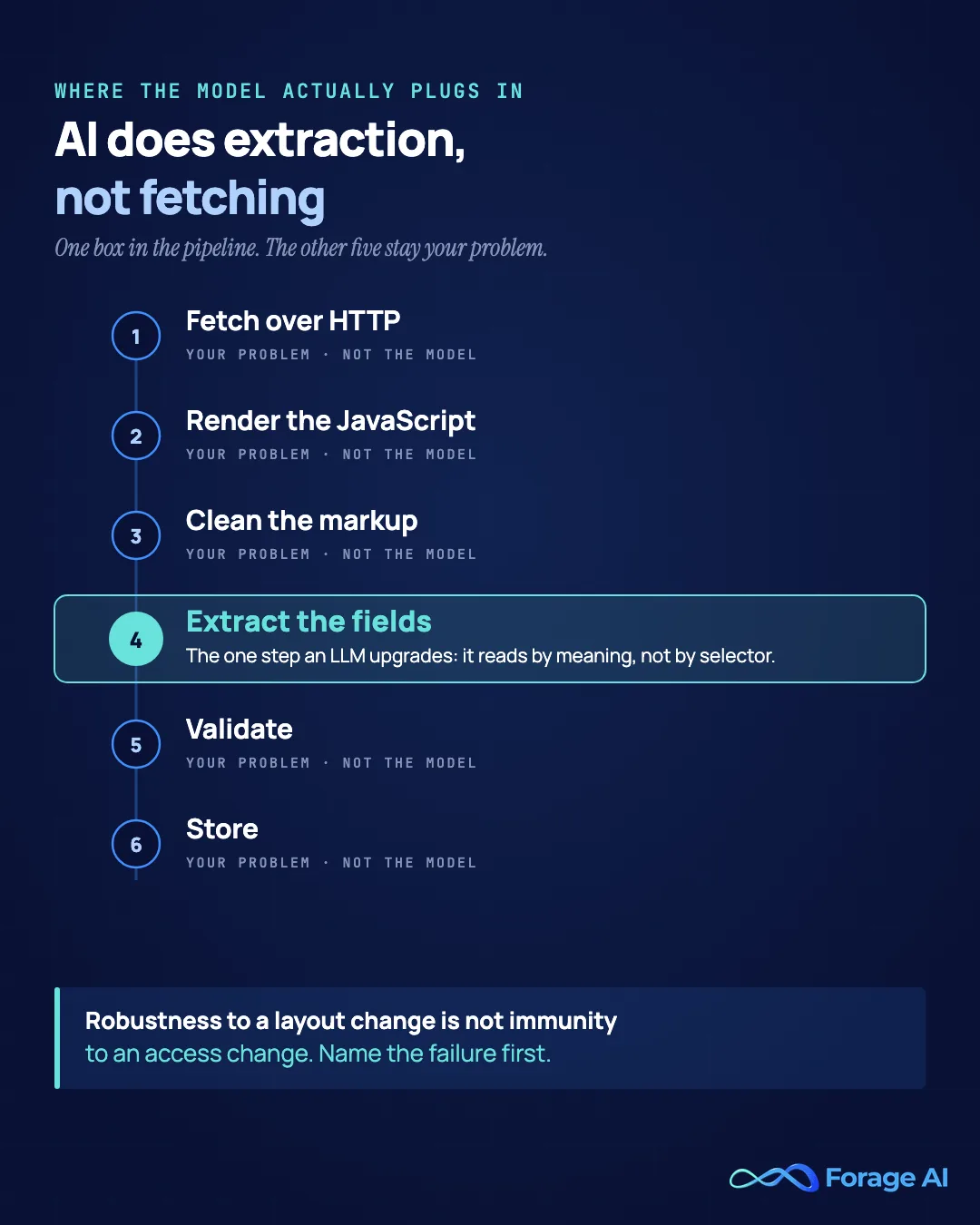
That distinction is the one everything else hangs on. Picture the pipeline a scraper runs: fetch over HTTP, render the JavaScript, clean the markup, extract the fields, validate, then store. The LLM plugs into exactly one box, the extract step. The four it never touches, fetch and HTTP, JavaScript rendering, anti-bot and access control, and rate and session management, stay your problem.
So name the failure before reaching for a model. If your scraper broke on a class name change, an LLM helps, because it binds to meaning and shrugs off the rename. If it broke because you got blocked, the model does nothing. Robustness to a layout change is not immunity to an access change. For the upstream half of that split, see the difference between scraping and crawling.
A model alone barely gets structured data off hard sites: on complex interactive websites, plain LLMs with search hit only 3% recall and the strongest web agents 31%, despite far higher scores on question-answering. The gap is navigation and access friction, not language ability.
Expert Insights
Bohra, Saroyan, Melkozerov and colleagues at Bardeen, testing extraction on complex interactive websites, found that “both LLMs with search capabilities and SOTA web agents struggle with these tasks, with a recall of 3% and 31%, respectively, despite higher performance on question-answering tasks” (WebLists, arXiv:2504.12682, 2025). A model that can answer questions about a page can still fail to get structured data off it, because the hard part was never the reading.
How AI extraction works under the hood
An AI extractor needs three inputs: page content, an extraction spec, and an LLM endpoint. Selectors bind to structure, something like `div.price > span:nth-child(2)`; the LLM binds to meaning, so a class rename that shatters a selector leaves it unbothered. It was never looking at the class.
The extraction spec is where you exert control: a natural-language prompt, a JSON Schema, or a Pydantic model. Modern implementations use constrained decoding, also called structured-output decoding, so the returned JSON is guaranteed to parse. Required fields, explicit types, and enums hold hallucination down, because a field typed as a required number is one the model cannot quietly drop or fill with prose.
The input format is the single biggest accuracy lever, and the one practitioners underweight. Do not feed the model raw HTML; convert first, to slimmed HTML, a DOM-to-JSON tree, or clean markdown. The same model can swing roughly 9x on identical data purely on formatting. In the NEXT-EVAL study, Gemini 2.5 Pro scored an F1 of 0.9567 on flat JSON versus 0.1014 on slimmed HTML and 0.4048 on hierarchical JSON. The model infers schema and paths far more readily from JSON than from tag soup, which also lowers its tendency to invent values.
Expert Insights
Kim, Kim and Jeong at Wordbricks, who built the NEXT-EVAL benchmark, put it directly: “the choice of input format directly influences not only the model’s accuracy but also its propensity for hallucination, with structured formats like JSON offering more reliable pathways for information retrieval” (arXiv:2505.17125, 2025). Preprocessing is not hygiene you do after the model works. It is what makes the model work.
Here is the mechanism as code: clean the page, define the schema, extract by intent.
# 1. Preprocess: strip HTML to clean markdown BEFORE the model (cuts tokens ~90%+)
clean = html_to_markdown(raw_html)   # e.g. via a markdownify/readability step

# 2. Define the target schema (constrained decoding guarantees valid JSON)
schema = {
  "type": "object",
  "properties": {
    "product_name": {"type": "string"},
    "price":        {"type": "number"},
    "in_stock":     {"type": "boolean"}
  },
  "required": ["product_name", "price"]
}

# 3. Extract by intent, not by selector position.
#    On the Responses API the schema goes under text.format,
#    which forces the model to return JSON matching your schema.
response = client.responses.create(
    model="gpt-5.4-nano",
    input=f"Extract product data from:\n{clean}",
    text={"format": {"type": "json_schema", "name": "product", "schema": schema}}
)
One more fork: vision and multimodal extraction. When the DOM is unusable, canvas content, heavy JavaScript, deliberately anti-scrape markup, a screenshot fed to a vision model sidesteps parsing, at a higher token cost you reach for only when text extraction cannot see the data.
How the two approaches compare, on the dimensions that decide which fits a page:
| Dimension | Traditional selectors | AI / LLM extraction |
|---|---|---|
| Binds to | Position in the DOM | Meaning of the content |
| Survives layout change? | No, breaks on a class rename | Yes, reads intent not structure |
| Marginal cost per page | Near zero, CPU-bound parse | Per token, recurring |
| Typical failure mode | Breaks obviously, returns null | Fails silently, returns a wrong value |
| Best-fit pages | Stable, high-volume, templated | Messy, changing, long-tail |
Quick Summary
Q: How does an LLM actually extract structured data from a page?
A: You hand it cleaned page content plus a target schema and let constrained decoding return valid JSON. Because it binds to meaning, it survives layout changes that break a selector. The catch is that input format can swing accuracy roughly 9x, so convert HTML to markdown or JSON before the model sees it, never raw.
The three build patterns (and when to reach for each)
Three patterns get shipped, and they trade the same two things: how much control you need against how much maintenance you can own. Pattern 1 is a managed extraction API where AI is a parameter and you pass a schema, least code and least control. Pattern 2 is an AI-native open-source framework, options like Crawl4AI or llm-scraper. Pattern 3 is the DIY pipeline: Playwright or Requests for the fetch, an HTML-to-markdown clean, the LLM call, Pydantic on the way out, most control and you own every part.
The decision rule is short. Low volume or exploratory work goes to a managed API or an OSS framework, because the maintenance you save beats the control you give up. Contract-quality data at volume goes to DIY or hybrid, because you need to own the fetch layer and the eval loop anyway. If your real question is which specific tool, see the best AI web scraping tools; for the fully bespoke end, custom web scraping covers what building your own involves.
One point holds across all three: an OSS framework is not maintenance-free, and a managed API does not make the fetch layer disappear. You still own the schema, the validation, and usually the infrastructure that reaches the page. What matters more than the raw model is the engineering around it. On real interactive websites, a purpose-built LLM-agent framework reached 66% recall on structured extraction and delivered a 3x reduction in cost per output row versus prior web agents.
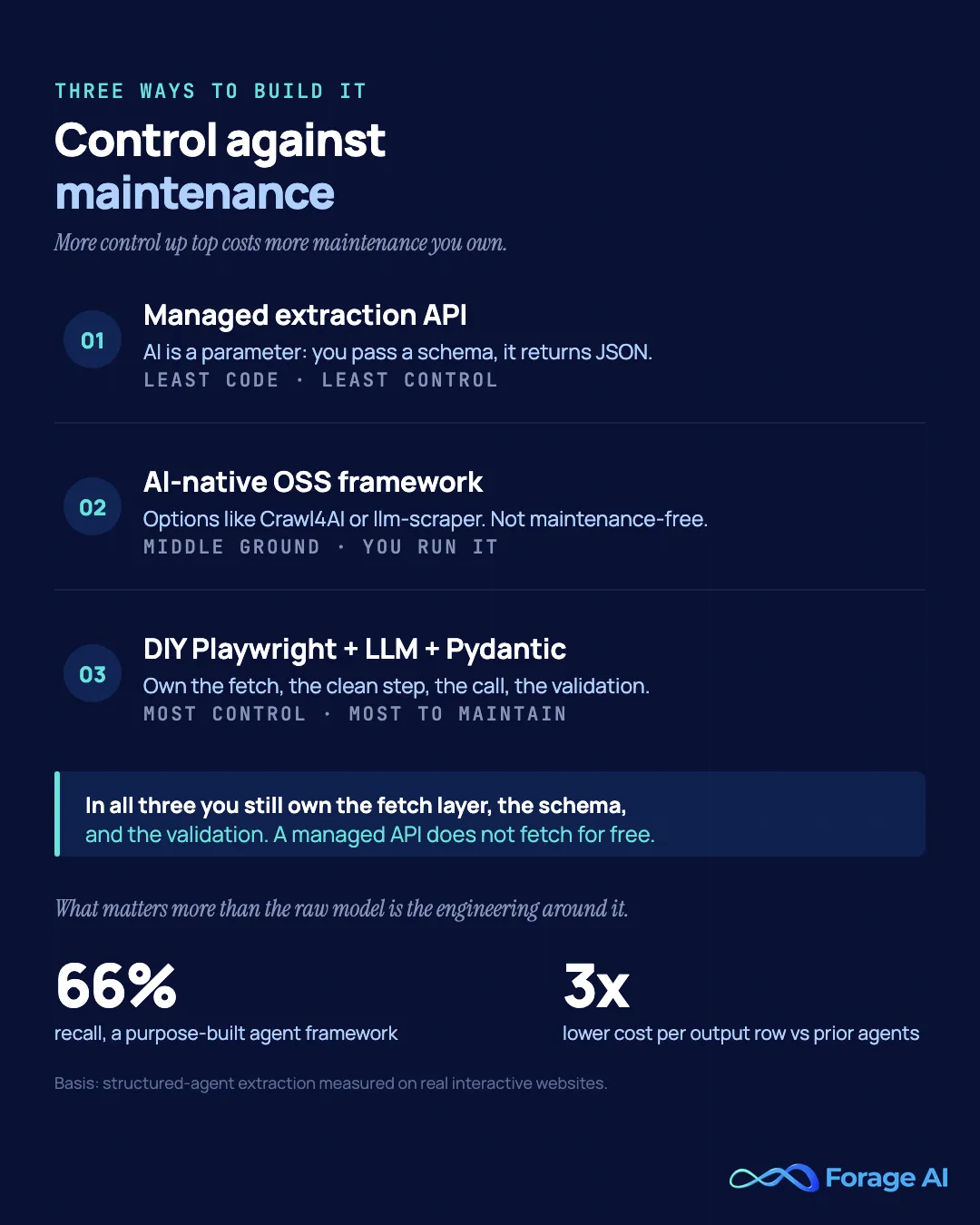
Bohra and colleagues at Bardeen, reporting the BardeenAgent results, showed a structured agent framework beat prior web agents by 3x on cost per output row while lifting recall to 66% (WebLists, arXiv:2504.12682, 2025). The lesson practitioners keep relearning: when extraction underperforms, the fix is usually better orchestration around the model, not a bigger model or a harder prompt.
How much does LLM web scraping cost at scale?
Whichever of the three patterns you pick, the LLM in the loop bills the same way, so the useful number is dollars per 1,000 pages, not dollars per page. The “$0.03 a page” figure quoted and abandoned is the biggest cost dodge in the vendor guides, because per-page pricing hides the two levers that move the bill: model choice and preprocessing. Unlike a compiled selector, whose cost is one-time engineering, the LLM’s cost recurs on every page forever.
Start with transparent token assumptions. A cleaned, markdown page runs about 2,500 input tokens, using Anthropic’s reference of roughly 10 kB to 2,500 tokens, plus around 500 output tokens of JSON. That is 2.5M input and 0.5M output per 1,000 pages. Multiply against current published prices (as of July 2026) for a table you can re-run with your own token counts. Treat it as an illustrative calculation from list prices, not a sourced benchmark.
| Model (tier) | Input cost | Output cost | Per 1,000 pages |
|---|---|---|---|
| Gemini 2.5 Flash-Lite | $0.25 | $0.20 | ~$0.45 |
| gpt-5.4-nano | $0.50 | $0.63 | ~$1.13 |
| Claude Haiku 4.5 | $2.50 | $2.50 | ~$5.00 |
| gpt-5.4 (flagship) | $6.25 | $7.50 | ~$13.75 |
| Claude Opus 4.8 (frontier) | $12.50 | $12.50 | ~$25.00 |
Illustrative calculation from provider list prices retrieved 2026-07-19 (2,500 input + 500 output tokens per page). Batch APIs cut both directions by roughly 50%.
Two punchlines fall out. First, model choice is a ~55x swing for the identical job, $0.45 against $25 per 1,000 pages. The cheap tier makes LLM extraction viable at volume; frontier models are for the hard minority of pages that need them. Second, preprocessing is a cost multiplier, not a nicety. Skip DOM pruning and feed raw HTML, often 5 to 15 times larger, and the input bill alone rises roughly 6.6x. A flagship model’s input can climb past $41 per 1,000 pages before a single output token.
That is where the earlier preprocessing result becomes a budget one. DOM pruning cut average context from 16,581 tokens to 350.6, a 97.9% reduction on the SWDE benchmark, while a 0.6-billion-parameter model held the best measured accuracy. A compiled CSS or XPath parse, by contrast, has near-zero marginal cost, which is exactly why the answer is hybrid rather than “LLM everything.” The LLM round-trip also adds seconds per page against sub-millisecond parsing, so it is a latency cost too.
The AXE researchers (arXiv:2602.01838, 2026) showed a 0.6-billion-parameter model holding the best measured extraction accuracy after a 97.9% DOM-pruning token cut on the SWDE benchmark. The token reduction, not model size, carried the result. That reframes the spend: the money is in the preprocessing, and the cheapest reliable model that clears your accuracy bar is almost always the right one.
Does AI get you past blocking, CAPTCHAs, and anti-bot?
No. This is the uncomfortable core of the topic, so it is worth stating without hedging: an LLM never sees a page you could not fetch. Anti-bot lives entirely in the fetch and render layer, IP reputation, TLS and JA3 fingerprints, the `navigator.webdriver` flag, browser fingerprinting, rate limits, and CAPTCHAs. The model decides what to extract. It has no say in how you get in.
That gives you a clean diagnostic: a scrape that dies before extraction is a fetch problem, not a prompt problem. If the response is a 403, a challenge page, or a CAPTCHA, no schema change and no larger model helps, because the model is downstream of the thing that failed. What gets you the page is infrastructure, headless browsers, residential proxies, and fingerprint management, and that is a separate budget line from your token spend. If you are fighting access, the proxy layer for AI data extraction is where that spend goes.
AI extraction is not AI evasion. The model reads the page; it does not get you past the bouncer.
And the access layer is getting harder, not easier. DataDome operates over 85,000 machine-learning models and 300,000-plus rules, and processes 5 trillion signals per day to score traffic in real time. The volume hitting those defenses is climbing too: DataDome recorded 7.9 billion AI-agent requests in early 2026, and nearly 1.7 billion requests from OpenAI crawlers in August 2025 alone.
This is also the honest reason managed extraction exists. A fully managed data extraction pipeline, the kind Forage AI runs, bundles the fetch and infrastructure layer, the browsers, proxies, and fingerprint management, that DIY LLM scraping leaves unsolved.
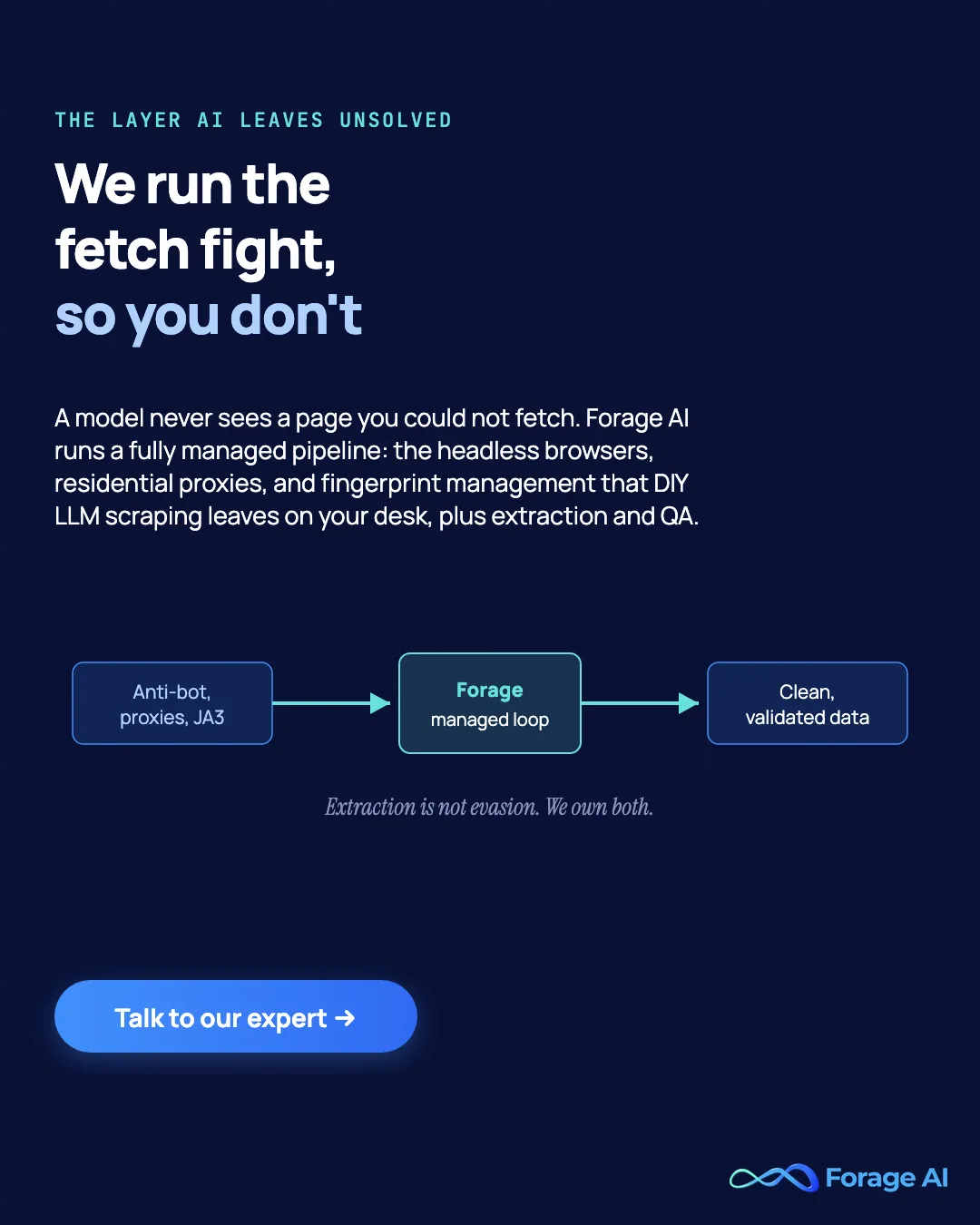
DataDome’s published detection-engine figures, over 85,000 ML models and 5 trillion signals scored per day (datadome.co, 2026), make the scale of the access problem concrete. The corroborating research signal is the recall gap from complex-site testing, 3% for plain LLMs and 31% for web agents, dominated by navigation and anti-bot friction rather than the model’s language ability. Together they explain why “just add an LLM” does nothing for a blocked scrape.
Accuracy: measuring it instead of assuming it
Suppose you win the fetch fight and the page is in hand. The dangerous failure that remains is not a crash. It is confidently wrong data that passes JSON validation, lands in your dataset, and looks exactly like every correct record around it. Schema compliance and value correctness are different things, and models are near-perfect at the first while unreliable at the second.
Three failure modes recur: invented values, a price that is not on the page; missing fields, partial records that still validate; and structural drift, a string where you asked for a number. The insidious one is invented values, because a hallucination inside well-formed JSON looks structurally correct and your parser waves it through. The number to sit with comes from the Structured Output Benchmark, which tested 21 models: they “achieve near-perfect schema compliance, yet the best Value Accuracy (exact leaf-value match) reaches only 83.0% on text, 67.2% on images, and 23.7% on audio.” The same benchmark found longer context makes extraction substantially harder, one more reason to prune rather than dump whole pages at the model.
Valid JSON is not correct data. A model can return perfectly-structured output with a hallucinated value that looks right, and schema validation will not catch it.
So you measure at the field level. Build a labelled gold set and score field-level accuracy with F1 or exact-value match rather than a document-level pass or fail, because a record can be 90% right and still poison the one field that mattered. Add confidence thresholds, a working range around 0.75 to 0.90, routing anything below the line to human review, and where stakes are high run consensus extraction, the same document through more than one model, flagging disagreements. This is the same discipline as any data quality framework; the difference is that here the errors are invisible until you look for them.
The cheapest guard, and the one to add first, is deterministic post-validation: if a value must appear on the source page, verify that it does before you trust it.
def validate_extraction(field_value, source_text):
    # A price/name the model returns must be present in the fetched page.
    # Catches "invented value" hallucinations before they reach your DB.
    if field_value is None:
        return None
    if str(field_value) not in source_text:
        raise ValueError(f"Hallucination guard: '{field_value}' not found in source")
    return field_value
That guard will not catch everything; whitespace, currency, and date normalization need per-field handling. But it catches the pure inventions, and those do the most quiet damage. “Close enough” is fine for exploratory work and a liability for contract-quality data.
Singh, Khurdula, Khemlani and Agarwal, authors of the Structured Output Benchmark (arXiv:2604.25359, 2026), found across 21 models that “models achieve near-perfect schema compliance, yet the best Value Accuracy reaches only 83.0% on text, 67.2% on images, and 23.7% on audio.” That single result reorders priorities for a scraping team: the JSON parsing is not where your data quality risk lives. The value inside the JSON is.
When should you not use an LLM?
The mature answer in 2026 is not “LLM versus selectors.” It is both, in the right order. Use the LLM as a repair technician, not a factory worker, and the economics and the accuracy both come out ahead.
The hybrid architecture has four steps. Deterministic parsing goes first: compiled selectors handle the stable, templated majority at near-zero marginal cost. Detect breakage: when a selector returns null or fails a schema or validation check, flag that page. The LLM runs only on flagged pages, fed the cleaned page plus schema to a cheap model, the Flash-Lite or nano tier from the cost table. Guard every LLM value with the deterministic post-validation from the accuracy section, plus confidence thresholds. Optionally, have the LLM propose a new selector when it succeeds, so the deterministic path self-heals and the next run of that page is free again.
def extract(page_html, schema, selectors):
    clean = html_to_markdown(page_html)

    # 1. Deterministic first: cheap, fast, near-zero marginal cost
    record = apply_selectors(page_html, selectors)

    # 2. Detect breakage: null or schema-invalid means the template moved
    if is_valid(record, schema):
        return record

    # 3. LLM fallback ONLY on the flagged page, to a cheap model
    record = llm_extract(clean, schema, model="gemini-2.5-flash-lite")

    # 4. Guard every LLM-produced value against the source
    for field, value in record.items():
        validate_extraction(value, clean)

    # Optional self-heal: let the LLM propose a new selector for next time
    update_selectors(selectors, propose_selector(clean, schema))
    return record
That makes the “when not to use an LLM” list concrete. Skip it when the layout is stable and volume is high, because selectors are orders of magnitude cheaper and you should not pay per-page inference for a page that never changes. Skip it when the blocker is anti-bot, because no model gets you past fingerprinting or proxies. Skip it when exact-value fidelity is non-negotiable and you cannot validate it, because the 83% / 67% / 23.7% reality is a liability the moment you cannot check the value. And skip it on latency-sensitive paths, because seconds-per-page inference breaks a real-time SLA. When a template moves and you need to see it fast, the mechanics of why extraction pipelines break are worth having on hand.
Don’t pay per-page inference forever for a page that never changes. If the layout is stable and the volume is high, a compiled selector wins on cost and speed by orders of magnitude.
The self-healing research (arXiv:2603.20358, 2026) frames the repair-layer role precisely: when a selector silently breaks, an LLM fed the current page can propose new selector candidates with confidence scores, tested against the live page, and a cheaper non-LLM accessibility-tree approach exists where it applies. That is the hybrid verdict in one mechanism. The model earns its cost fixing the pages that changed, not re-reading the ones that did not.
Build vs buy: where AI scraping stops being your problem
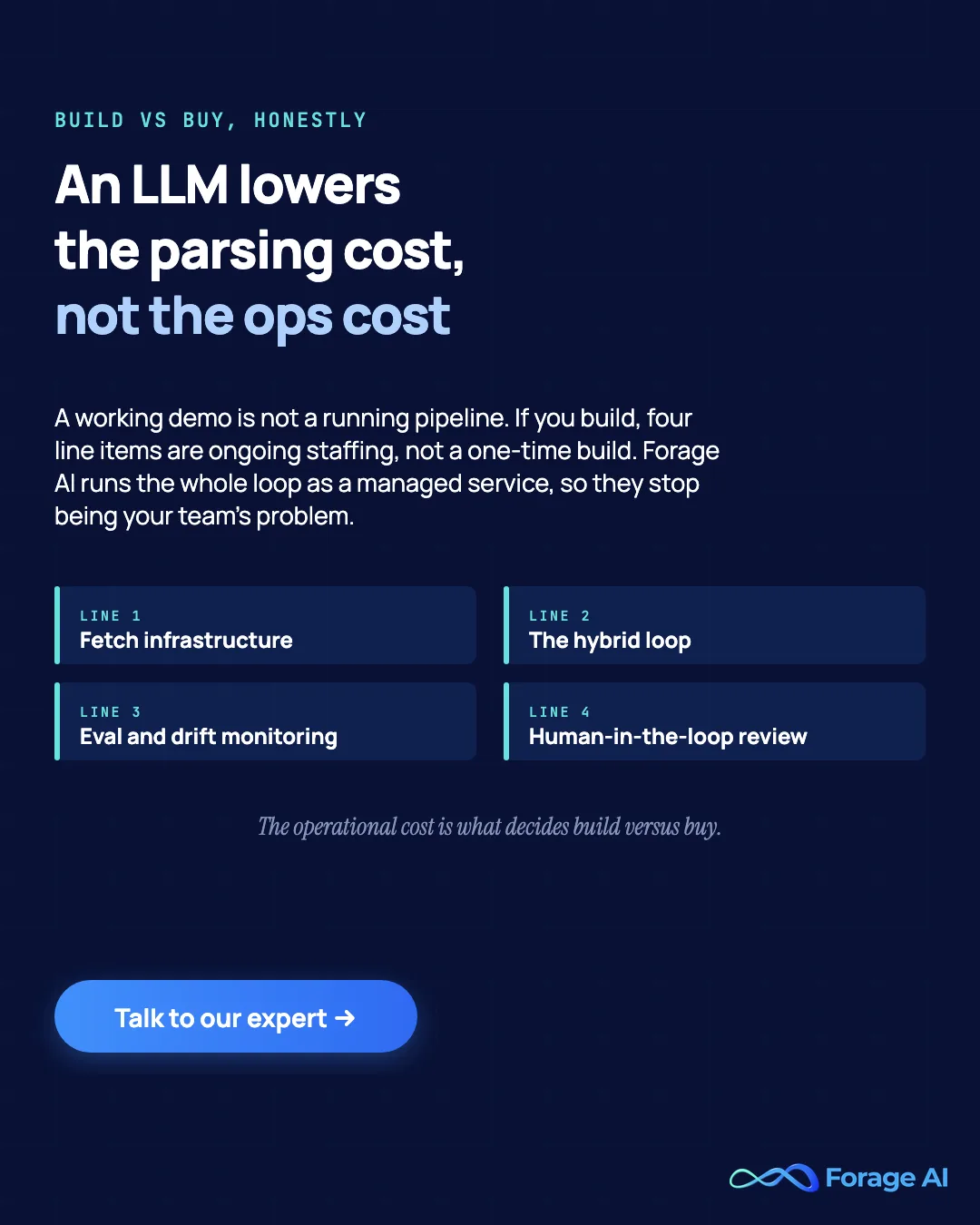
The cost nobody quotes is the operational one. A working demo is not a running pipeline, and the gap is maintenance, monitoring, evaluation, and the fetch and anti-bot fight that never fully ends. Putting an LLM in the loop lowers the parsing cost. It does nothing for the operational cost, and the operational cost is what decides build versus buy.
If you build, you own four ongoing line items: fetch infrastructure, the proxies, browsers, and fingerprint management; the hybrid loop, deterministic parsers plus the LLM fallback and its self-heal; the eval layer, the gold set and drift monitoring that catch silent wrong extraction; and the human-in-the-loop review for the low-confidence tail, the annotation work covered in our breakdown of the data labeling vendor market. None of those is a one-time build. All of them are staffing.
So the call is a straight trade. Build when the pipeline is core IP and you have the ops depth to carry those four costs. Buy when the maintenance, blocking, and eval burden outweighs the control. When volume and complexity climb, the question becomes an architecture one, which is where AI agent solutions for large-scale web data extraction and the broader build vs buy decision for web data extraction pick up the thread. This is the point where a managed pipeline becomes rational rather than a concession: Forage AI runs the whole loop as a managed service, the fetch infrastructure, the hybrid extraction, and the QA and validation, so those four costs stop being your team’s problem.
One brief legal note. Using an LLM to parse a page does not change the legality of collecting it. Public availability is not the same as free of copyright, contract, or privacy questions, and the model in the loop neither adds nor removes any of that. This article is for informational purposes only and is not legal advice. Consult qualified counsel for your organization’s specific situation.
The BardeenAgent result cuts the same way on the buy side: a structured framework delivered 3x lower cost per output row than prior web agents (WebLists, arXiv:2504.12682, 2025). Whether you engineer that orchestration yourself or hand it to a team that already has, the case is the same. Calling the model harder is the expensive path; the value is in the system around it.
The pattern that keeps working
The hybrid loop is the part of this that survives price changes and model releases. Deterministic parsing on the stable majority, an LLM on the pages that broke or changed, every value guarded, the model as a repair layer rather than the whole factory. It holds because it rests on two things that do not move: selectors are near-free on stable pages, and value accuracy has to be measured rather than assumed.
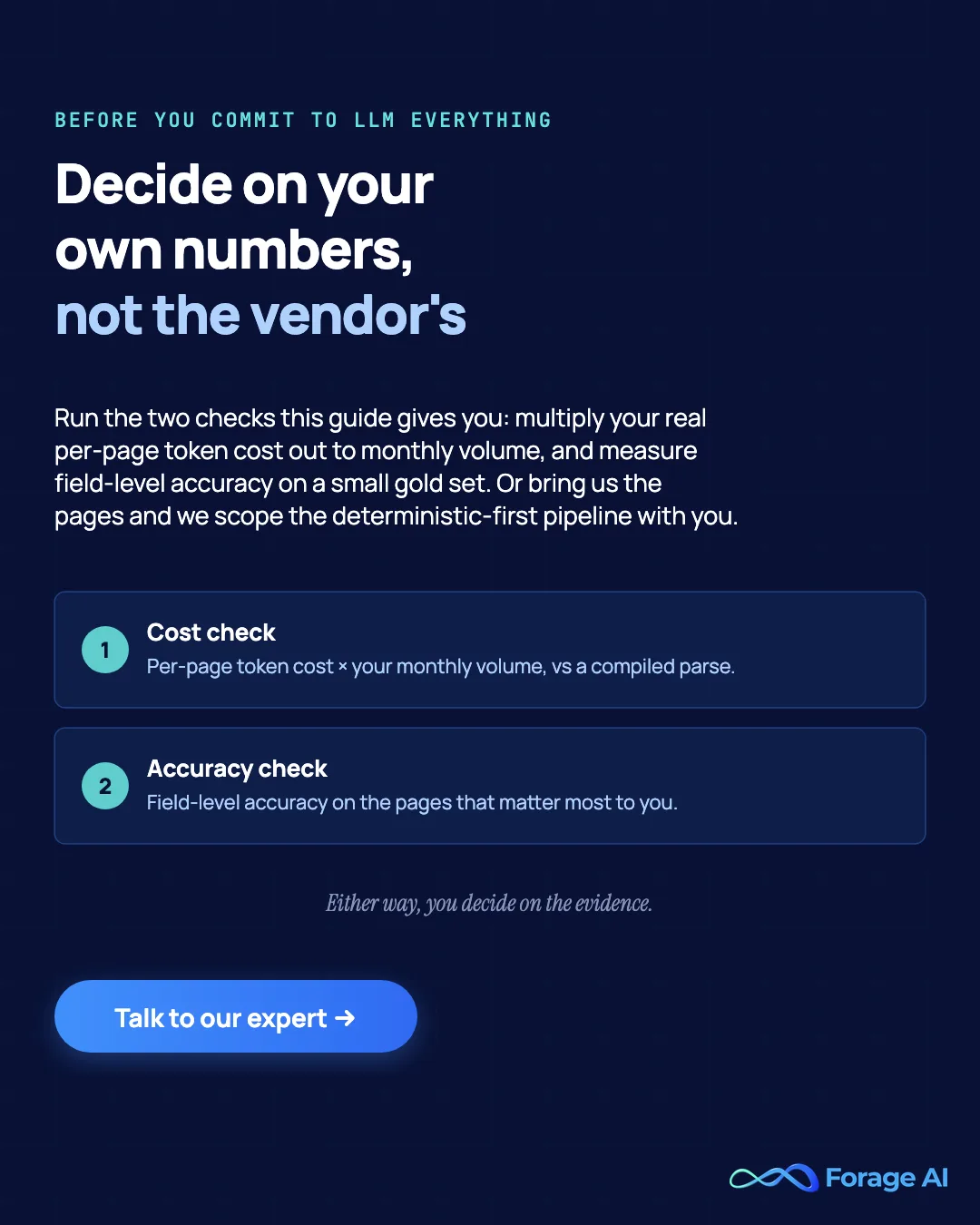
Before you commit to “LLM everything,” run the two checks this guide gives you against your own numbers. Multiply your real per-page token cost out to your monthly volume and compare it to a compiled parse. Then build a small gold set and measure field-level accuracy on the pages that matter most. High volume and stable layouts point to deterministic-first; messy, always-changing pages are where the LLM fallback earns its cost. Either way you decide on your own numbers, not the vendor’s headline.
Frequently asked questions
Can ChatGPT or GPT-4 scrape a website directly?
Not in the sense most people mean. A model extracts structure from content you supply; it does not fetch the page or bypass access controls on its own. Paste page text in and it parses well. Ask it to go get a protected page and the fetch and anti-bot layer still decides whether that succeeds.
Does AI web scraping get past anti-bot and CAPTCHAs?
No. Anti-bot is an infrastructure fight, IP reputation, fingerprints, headless browsers, and proxies, and the LLM never sees a page you could not fetch. Systems like DataDome score traffic against tens of thousands of models and trillions of daily signals, none of which a prompt addresses. If you are being blocked, the spend goes to infrastructure, not a larger model.
How much does LLM web scraping cost at scale?
Roughly $0.45 to $25 per 1,000 cleaned pages depending on the model, with preprocessing as a second multiplier that can cut the token bill again. The useful unit is dollars per 1,000 pages, not the per-page figure vendors quote and then abandon. Model choice alone is about a 55x swing, so the cheap tier plus aggressive preprocessing is what makes LLM extraction viable at volume.
Do I still need proxies or a headless browser if I use AI?
Yes. The fetch layer is entirely separate from extraction, and it is a separate budget. The LLM handles the parse step only, so whatever you needed to reach and render the page before, proxies, a headless browser, session and rate management, you still need. Adding a model removes none of it.
How do I stop the LLM from hallucinating fields?
Constrain it, then verify it. Use structured-output decoding with explicit types and enums so the JSON has to conform, then add a deterministic guard that rejects any value not present on the source page. Measure the result against a labelled gold set at the field level, and route low-confidence fields to human review. Schema validation alone will not catch a hallucinated value that happens to be well-formed.
Is AI better than traditional CSS or XPath scraping?
Wrong framing. It is better for messy, changing, and long-tail pages where selectors are brittle or not worth maintaining, and worse on cost and speed for stable, high-volume pages where a compiled selector runs at near-zero marginal cost. The production answer is hybrid: selectors first, an LLM only on the pages that broke, every value validated.
Related Articles
- Best AI Web Scraping Tools: A side-by-side comparison of the managed and open-source options when you have decided what to buy.
- Best AI Agent Solutions for Large-Scale Web Data Extraction: The architecture question once extraction moves to real scale.
- Web Data Extraction: Build vs Buy Decision Guide: A fuller framework for the ownership trade this guide raises.
- Data Quality Framework: How to stand up the measurement layer that catches silent wrong extraction.
- Scraping vs Crawling: The upstream distinction for how sites get reached before anything gets parsed.
S
Written by
Sai Subramaniam
Data Infrastructure Enthusiast, Forage AI
Sai is a data infrastructure enthusiast who has spent the past two to three years following the AI space closely, from the infrastructure layer to the fast-growing world of data for AI. He is genuinely curious about how modern data pipelines get built and where the data industry is heading, and he writes insightful pieces on the core topics that shape this niche.
Reviewed by the team of experts at Forage AI for accuracy and clarity.