
The Best Data as a Service (DaaS) Companies in 2026
License a pre-built dataset that misses your schema, and you will spend the next quarter discovering the gap one field at a time. We have watched real data teams run this exact play: sign on the strength of a household name and a headline record count, then find the fields that actually differentiate their product were never in the vendor’s coverage to begin with. The failure is rarely the vendor’s honesty. It is sequencing. The team compared data as a service companies before deciding which type of DaaS offering they needed.
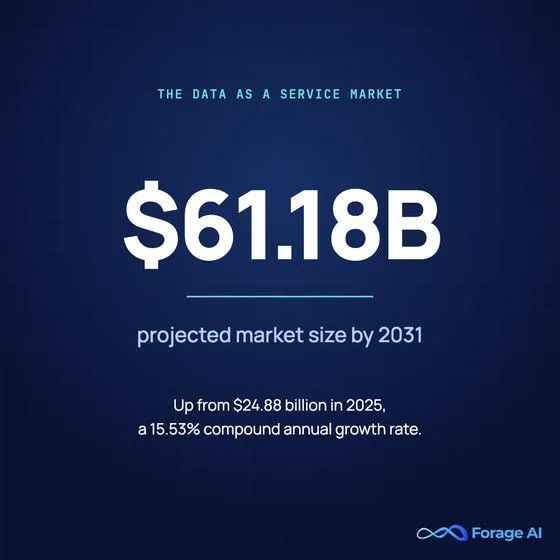
This guide fixes the sequence. We cover 20 real providers across six categories, plus the category-first method for choosing between them: what each type of DaaS company sells, when to pick it, how the pricing models work in practice, and what users on G2, Trustpilot, and TrustRadius say about each vendor, review counts included. The category rewards the diligence. Mordor Intelligence values the data as a service market at USD 24.88 billion in 2025, on track for USD 61.18 billion by 2031 at a 15.53% CAGR (as of March 2026).
A note on how we chose: no vendor paid for placement. Every entry had to be a genuine data seller or data-service provider with verifiable, platform-attributed review sentiment as of July 2026, and we cut recognizable names that failed that bar. Rankings within categories reflect fit for the category’s core buyer, not raw star ratings, because review samples across these vendors differ by two orders of magnitude.
By the end of this article, you will know which DaaS category fits your use case, which providers belong on your shortlist, and the one test to run before you sign anything.
Quick Digest
- What a DaaS company is: a business selling ready-to-consume, continuously refreshed data on a service model (API, file, warehouse share, or managed feed), so you consume data without building collection infrastructure.
- The 4 offering types: pre-built dataset vendors, API/feed providers, data marketplaces, and custom/managed DaaS partners. The type you need decides which vendors are worth comparing at all.
- When DaaS beats building in-house: when external data is a production input but pipeline engineering is not your core competency; the use-case table maps nine buying scenarios to the category that fits each.
- How to compare providers: seven factors, led by match rate against your own records and refresh SLA, plus one non-negotiable step: test a sample against your own data before contract.
- The 20-provider roster: Forage AI leads the custom/managed category; ZoomInfo, Dun & Bradstreet, Apollo.io, and Cognism anchor B2B data; Bright Data, Oxylabs, and Apify cover web-scale infrastructure; Bloomberg, S&P Global, YipitData, and Similarweb cover financial and digital intelligence.
What Is a Data as a Service (DaaS) Company?
A data as a service company sells ready-to-use, continuously refreshed data on demand, delivered as a subscription, API, feed, or fully managed pipeline, instead of selling software or raw infrastructure. The buyer pays for a data outcome, not tooling. Delivery arrives in whatever form the consuming system needs: an API call, a flat file, a cloud warehouse share, or a managed feed that lands on your schedule.
The category exists because external data has become a production input for products, analytics, and AI systems, and collection infrastructure is expensive to build and worse to maintain. The market numbers show the shift: Mordor Intelligence values the DaaS market at USD 24.88 billion in 2025, forecast to reach USD 61.18 billion by 2031 at a 15.53% CAGR (March 2026 report).
> USD 24.88 billion: the global data as a service market in 2025, forecast to reach USD 61.18 billion by 2031 at a 15.53% CAGR. Source: Mordor Intelligence, March 2026.
The SaaS distinction fits in one line: SaaS delivers the tool, DaaS delivers the outcome the tool would produce. If the model itself is new territory, start with our primer on what data as a service is and how delivery models work rather than re-learning it inside a vendor list.
Expert Insights
– “By 2028, the data management markets will converge into a single market around data ecosystems enabled by data fabric and GenAI reducing technology complexity.” Ramke Ramakrishnan, VP Analyst, Gartner (June 2025). The practical read: the line between data seller, platform, and marketplace keeps blurring, which is why we sort providers by what you buy, not by what the vendor calls itself.
> Data as a Service is not Desktop as a Service. The acronym collides with desktop virtualization (Citrix and Azure Virtual Desktop territory), and roughly half the search results for the bare acronym belong to the other DaaS. Everything in this article is about data.
The Main Types of DaaS Offerings
Before any vendor comparison makes sense, you need the classification this article is organized around. We call it the 4-Type DaaS Offering Classification, and it is our editorial framework, built from how buying decisions actually run rather than from an analyst taxonomy.
| Offering type | What you get | Typical delivery | Best when | Example companies |
|---|---|---|---|---|
| Pre-built dataset vendors | Existing datasets with fixed schemas | Download, subscription refresh | You need standard fields, fast | ZoomInfo, Dun & Bradstreet, Coresignal |
| API/feed providers | Programmatic access, per-call or per-record | REST API, streaming feed | You are building data into a product | People Data Labs, Similarweb, Apify |
| Data marketplaces | A distribution layer over many sellers | Warehouse-native shares, cloud billing | You already live on that cloud | Snowflake Marketplace, AWS Data Exchange |
| Custom/managed DaaS partners | A pipeline built to your schema, run as a service | Managed feed to your system | No pre-built dataset matches your requirement | Forage AI, PromptCloud, Grepsr |
Two clarifications keep this honest. First, the types describe the offering you buy, not a box the company lives in; the same vendor can span types (Bright Data sells pre-built datasets and collection infrastructure; ScrapeHero runs managed feeds and a ready-made Data Store). Second, if your need maps to type 4, the evaluation itself changes: you stop comparing record counts and start comparing service operations, QA process, and maintenance ownership.
Analytics-as-a-service sits adjacent to all four: vendors selling analysis on top of data rather than the data itself. Worth knowing the term, but this list ranks data providers.
One misconception to retire: modern DaaS is not a one-time static file purchase. Continuous feeds, APIs, and managed pipelines are the operating model now, and the segment data backs it. Mordor’s March 2026 report puts BFSI at 21.47% of 2025 DaaS market share, public cloud delivery at 56.91% of revenue, large enterprises at 62.71% of spending, and North America at 40.62% of revenue, with unstructured-data DaaS the fastest-growing data-type segment at a 15.71% CAGR through 2031. That last number matters most here: unstructured sources are exactly where pre-built schemas run out and extraction-led custom feeds take over.
> 15.71% CAGR: unstructured-data DaaS is the fastest-growing data-type segment through 2031, the point where pre-built schemas run out and custom feeds take over. Source: Mordor Intelligence, March 2026.
When Should You Choose DaaS, and What Do Companies Use It For?
And so the sorting question becomes practical: when does buying data as a service beat building the pipeline yourself? The triggers we see across real data teams are consistent: no pipeline engineers to spare, source volume or maintenance burden past what the team can sustain, contractual time-to-data pressure, or an AI initiative that suddenly needs continuously fresh external data at a quality bar ad-hoc scripts cannot hold. We have argued the full logic in our build vs buy decision guide for web data extraction, so here it stays condensed: if the data is a production input but pipeline-building is not your core competency, buy the outcome.
The 2026 lens sharpening all of this is AI demand. Mordor’s 2026 report names RAG frameworks pulling continuously refreshed external data as a key market driver, and the economics are now public: News Corp’s OpenAI licensing deal averages roughly USD 50 million per year, and the New York Times–Amazon agreement is worth USD 20–25 million per year, per 2026 reporting from Quartz. Data is being priced as a product at enterprise scale. Two anchors give the demand shape: Precedence Research values the alternative data market at USD 14.16 billion in 2025, with hedge fund operators taking over 71% of end-user revenue (December 2025), and Grand View Research estimates the AI training data market at USD 3.195 billion in 2025, growing at a 22.6% CAGR toward 2033. The upside is documented too: Gartner research from 2021 found organizations that share data externally generate three times more measurable economic benefit than those that do not.
Expert Insights
The budget behind that demand is documented. Randy Bean's 2025 AI & Data Leadership Executive Benchmark Survey, fielded across 125 organizations with DataIQ, reports that "Investments in data and AI are a top organizational priority for 91% of companies, up slightly from 88% last year." That is the spending climate every provider on this list is selling into, which is why the sorting question matters more than the ranking.
> USD 3.195 billion: the AI training dataset market in 2025, projected to grow at a 22.6% CAGR toward 2033. Source: Grand View Research.
Here is the map every ranking list skips: which use case needs which data category, which offering type fits, and when custom beats pre-built.
| Use case | Data category needed | Offering type that fits | Example providers | When custom beats pre-built |
|---|---|---|---|---|
| GTM enrichment / TAM sizing | Firmographic, contact | Pre-built dataset | ZoomInfo, Cognism, D&B | Niche ICP fields no vendor carries |
| KYC / risk & compliance | Business identity, hierarchies | Pre-built + API | D&B, S&P Global | Jurisdiction-specific sources |
| Investment research / alt-data | Alternative data, transactions | Pre-built + feeds | YipitData, Coresignal | Proprietary signal nobody licenses |
| Price & product intelligence | Web/ecommerce data | Custom/managed or infra | Forage AI, Bright Data | Your competitor set, your cadence |
| AI training data / RAG feeds | Web-scale, unstructured | Custom/managed | Forage AI, Zyte | Your domain, your refresh SLA |
| Industry directories & data products | Multi-source web data | Custom/managed | Forage AI, ScrapeHero | The dataset IS your product |
| Location analytics | POI, foot traffic | Pre-built dataset | Placer.ai | Custom geographies or venues |
| News / media monitoring | News, sentiment | API/feed | Similarweb (digital), custom feeds | Source lists unique to you |
| Identity resolution / audiences | Consumer identity | Platform + marketplace | LiveRamp | First-party-anchored graphs |
Each row points to a category section below, so you can jump straight to the vendors that fit.
> Buying pre-built is not the safe default. When your differentiating fields are not in the vendor’s schema, coverage gaps and stale records surface after the contract is signed, not before. And your competitors can license the same records you did. That commoditization pressure is why custom-built feeds exist as a category.
Quick Summary
Q: When does buying data beat building the pipeline yourself?
A: Buy when the fields are standard, when coverage matters more than depth, and when the data is not the thing that differentiates your product. Commission a custom feed when your differentiating fields are missing from every vendor schema, when the refresh cadence has to match your decision speed, or when the delivery format has to fit your stack. Pre-built is not the safe default.
How to Compare Data as a Service Companies
Evaluating a DaaS vendor is not software evaluation. You are testing the data itself, not the features around it, and the one non-negotiable step is testing a vendor sample against your own records before contract. Match rate against your ICP, measured on your data, beats every coverage claim on a pricing page. In 12+ years of building managed data pipelines, the pattern we see most often is a team licensing a pre-built dataset and then spending months reconciling it against their own schema; a two-week sample test would have surfaced the mismatch before the invoice.
| Factor | What to check | Question to ask |
|---|---|---|
| Coverage & match rate | Overlap with YOUR records, not global counts | “What match rate did our sample produce?” |
| Freshness & refresh SLA | Update cadence, contractual not aspirational | “What is the refresh SLA, in writing?” |
| Sourcing transparency & compliance | GDPR, CCPA, SOC 2; sourcing methods | “Where does each field come from?” |
| Delivery & integration fit | API, warehouse-native, file formats | “Can you deliver into our existing stack?” |
| Pricing model | Which of the five models, and unit economics | “What does this cost at 10x volume?” |
| QA process & error handling | Who catches bad records, and how | “What happens to records that fail QA?” |
| Support & service model | Dedicated team vs ticket queue | “Who maintains the pipeline when sources change?” |
The pricing taxonomy deserves one plain paragraph, because every ranking list hand-waves it as “contact sales.” Five models cover the market: per-record (web-scale datasets, from fractions of a cent), per-seat (B2B platforms, ~$49–119/user/month at published tiers), subscription (dataset refreshes), usage credits (APIs and marketplaces), and managed-service retainers (custom/managed partners, quoted after scoping). Knowing the model tells you where cost surprises hide: seats hide in renewals, credits hide in overage, retainers hide in scope changes.
The stakes on the QA factor are documented. Gartner predicted in February 2025 that through 2026, organizations will abandon 60% of AI projects unsupported by AI-ready data; in the same release, a Q3 2024 survey of 248 data management leaders found 63% either lack or are unsure they have the right data management practices for AI. Practitioners corroborate: 56% report poor data quality as their most frequent challenge, the top-reported challenge in dbt Labs’ 2025 State of Analytics Engineering report (459 practitioners surveyed). And Gartner has estimated, in research first published in 2020, that poor data quality costs organizations an average of USD 12.9 million per year. This is why the QA and maintenance questions belong in the contract, not the demo. Managed partners absorb selector drift and schema changes as part of the service; Forage AI, for example, runs a 3x QA team on every delivery, the kind of specific answer the “what happens to records that fail QA?” question should produce from any vendor.
> 60% of AI projects: Gartner predicts organizations will abandon this share through 2026 for lack of AI-ready data; in a Q3 2024 survey of 248 data leaders, 63% lacked or were unsure of the right data management practices for AI. Source: Gartner, February 2025.
> More records does not mean a better provider. “500M contacts” and “375M companies” are marketing-led coverage claims. Match rate against your ICP and the refresh SLA decide the value of a dataset; a smaller, fresher, better-matched feed beats a bigger stale one every time.
For a working checklist, our enterprise evaluation checklist for data extraction vendors extends these seven factors into a full scoping worksheet.
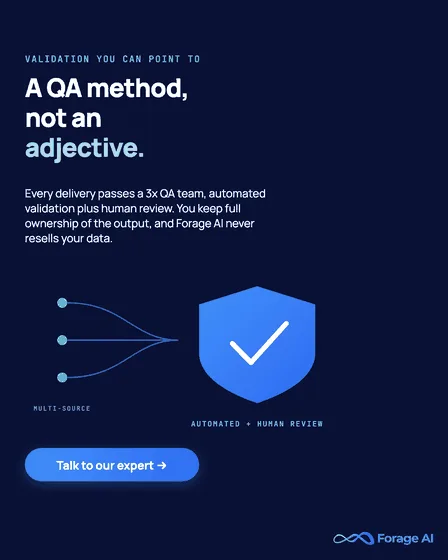
– When we scope custom DaaS engagements, the two questions that expose weak providers fastest are “who maintains the pipeline when the source changes?” and “what happens to records that fail QA?” Vendors with real operations answer in specifics; vendors reselling someone else’s collection answer in adjectives.
Quick Summary
Q: What should you test before you sign?
A: You are testing the data, not the features around it. Check overlap and match rate against your own records rather than global counts, then refresh cadence, QA method, delivery fit, pricing model and the ownership and resale terms. Run a sample test on your records first, and treat headline record counts as marketing until a sample says otherwise.
The 20 Best Data as a Service Companies by Category
Pick the category first, then the vendor inside it; the roster below is organized to make that one motion. Every entry carries the same table schema, a bolded best-for, and review sentiment attributed to the platform it came from, with counts shown beside scores.
Last updated: July 2026. Review scores and counts captured from G2, Trustpilot, TrustRadius, and Capterra as of July 2026.
The 20 best DaaS companies at a glance
| # | Provider | Category | Best for |
|---|---|---|---|
| 1 | Forage AI | Custom & managed | Bespoke, quality-guaranteed feeds to your exact schema |
| 2 | PromptCloud | Custom & managed | Managed custom web feeds with dedicated AM |
| 3 | Grepsr | Custom & managed | Hands-off QA’d recurring feeds, per-record billing |
| 4 | ScrapeHero | Custom & managed | Managed enterprise feeds + ready-made Data Store |
| 5 | Zyte | Custom & managed | Technical teams extracting heavily protected websites |
| 6 | Bright Data | Web-scale data & infra | Large pre-built dataset marketplace + collection infra |
| 7 | Oxylabs | Web-scale data & infra | Enterprise managed datasets with compliance emphasis |
| 8 | Apify | Web-scale data & infra | Self-serve, pay-per-result scrapers for developers |
| 9 | ZoomInfo | B2B & sales intelligence | Broadest US B2B contact + intent data |
| 10 | Dun & Bradstreet | B2B & sales intelligence | Authoritative firmographics and hierarchies (D-U-N-S) |
| 11 | Apollo.io | B2B & sales intelligence | Budget email-first US outbound, data + engagement |
| 12 | Cognism | B2B & sales intelligence | GDPR-compliant, phone-verified EU/UK contacts |
| 13 | People Data Labs | B2B & sales intelligence | Developer APIs for person/company enrichment |
| 14 | Coresignal | B2B & sales intelligence | Bulk workforce, company, and jobs data |
| 15 | Bloomberg (Data License) | Financial & alt-data | Licensed enterprise security-master and pricing feeds |
| 16 | S&P Global Market Intelligence | Financial & alt-data | Linked fundamentals + alt-data, warehouse-ready |
| 17 | YipitData | Financial & alt-data | Ticker-level alternative-data research |
| 18 | Similarweb | Financial & alt-data | Digital traffic and behavior data via feeds/APIs |
| 19 | Placer.ai | Location intelligence | Foot-traffic analytics for retail and CRE |
| 20 | LiveRamp | Consumer & identity | Identity resolution + third-party segment marketplace |
Custom & Managed DaaS Partners
Choose this category when no pre-built dataset matches your schema, your sources, or your QA bar. These partners build and run the pipeline and deliver the output as a service; our guide to managed web data extraction explains the operating model end to end. One reading note first: managed-service shops carry 5–25 G2 reviews while platform vendors carry hundreds or thousands, so read counts alongside stars rather than ranking on stars alone.
1. Forage AI
Best for: bespoke, quality-guaranteed data feeds built to your exact schema, fully managed end to end.
| Attribute | Detail |
|---|---|
| Best for | Custom feeds to your schema, sources, and QA bar |
| Top services | Web Data Extraction, Intelligent Document Processing (IDP), Firmographic Data |
| Pricing | Custom quote |
| User reviews | G2 4.8/5 |
| Watch-out | Built for ongoing managed engagements, not one-off small datasets |
| Review attribute | Detail |
|---|---|
| What users like | No verified public reviews. |
| What users flag | No public review corpus to draw from. |
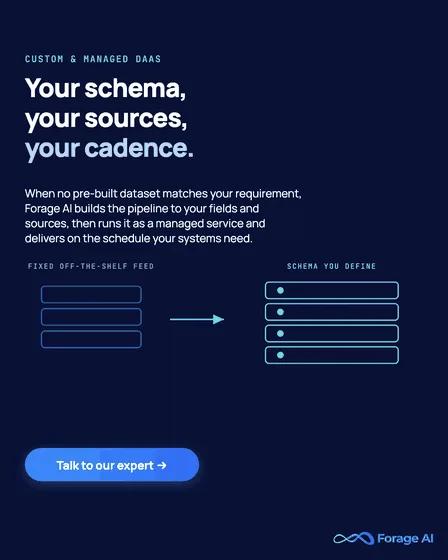
Forage AI has spent 12+ years building fully managed data pipelines, and the model inverts the dataset license: you define the schema, the sources, and the refresh cadence, and a dedicated team drawn from 100+ data experts builds and runs the pipeline end to end. Delivery lands as CSV, JSON, XML, API, or direct cloud integration. Which one is right depends on how the data gets consumed downstream, a tradeoff we work through in Parquet vs CSV vs JSON. The operating scale is real: 500M+ websites, 10M+ documents, and 5M+ professionals across Web Data Extraction, Intelligent Document Processing (IDP), and Firmographic Data.
Two things separate this entry from the category. First, Forage AI delivers the data, not just the pipeline: selector drift, anti-bot evolution, and schema changes are handled as part of the service, and every delivery passes a 3x QA team combining automated validation with human review. Second, governance: you retain full ownership of the output, and Forage AI never resells client data. Onboarding runs 1-2 weeks from brief to live pipeline, and handling rules are agreed per engagement. Users on G2 rate Forage AI 4.8/5.
The watch-out, stated plainly: Forage AI is built for ongoing managed engagements. If you need a one-off, small, standard-schema dataset today, a pre-built vendor below will serve you faster and cheaper.
2. PromptCloud
Best for: fully managed custom web-data feeds with a dedicated account manager.
| Attribute | Detail |
|---|---|
| Best for | Managed custom feeds, enterprise scoping |
| Top services | Custom web extraction; DataStock pre-built datasets |
| Pricing | Custom quote; DataStock priced per dataset |
| User reviews | G2 ~4.6/5 (~16 reviews) |
| Watch-out | Delivery delays when source websites change |
| Review attribute | Detail |
|---|---|
| What users like | No pros-and-cons summary published on its G2 profile. |
| What users flag | No public review corpus to draw from. |
PromptCloud runs the classic managed model: you define sources, fields, and frequency; delivery arrives via API, S3, FTP, or webhook. Its DataStock arm adds pre-built retail, healthcare, recruitment, and travel datasets, so it spans types 1 and 4 of our classification.
G2 reviewers (~16, a small sample worth naming) praise responsive, fast support and dependable delivery of clean, organized data. The recurring criticism: delivery delays when source websites change, plus a learning curve on the managed workflow.
3. Grepsr
Best for: hands-off, QA’d recurring data feeds billed per record delivered.
| Attribute | Detail |
|---|---|
| Best for | Hands-off recurring feeds |
| Top services | Managed web scraping via cloud platform |
| Pricing | From $350 starter projects; enterprise custom |
| User reviews | G2 ~4.5/5 (~23 reviews) |
| Watch-out | Limited self-serve control over extraction logic |
| Review attribute | Detail |
|---|---|
| What users like | No pros-and-cons summary published on its G2 profile. |
| What users flag | No public review corpus to draw from. |
Grepsr’s team builds and runs the extractions while you schedule, QA, and download through its platform, billed per record delivered. Published starter projects begin at $350; ongoing enterprise work is custom-quoted.
G2 reviewers highlight consistent data quality and support that flags problems before the customer notices them. The trade-off is control: extraction logic cannot be tweaked on the fly, and complex change requests route through Grepsr’s team, which takes time.
4. ScrapeHero
Best for: managed enterprise feeds plus a ready-made Data Store for store-location and POI data.
| Attribute | Detail |
|---|---|
| Best for | Managed feeds + off-the-shelf datasets |
| Top services | Managed extraction; ScrapeHero Cloud; Data Store |
| Pricing | Cloud from ~$199/mo; managed ~$1,500/mo minimums; enterprise from ~$8,000/mo |
| User reviews | G2 ~4.6/5 (63 seller-level reviews) |
| Watch-out | Cloud-vs-managed pricing confusion; credits expire |
| Review attribute | Detail |
|---|---|
| What users like | No pros-and-cons summary published on its G2 profile. |
| What users flag | No public review corpus to draw from. |
ScrapeHero layers three offerings: fully managed enterprise scraping, a no-code Cloud of pre-built scrapers, and a Data Store of ready-made dataset subscriptions, strongest in US store-location data. That spread suits buyers straddling custom and pre-built needs, and it is the reason most alternatives to ScrapeHero only match one half of it.
G2 reviewers call out the easy interface, responsive support, and flexibility in structuring datasets. Watch the pricing boundaries: reviewers report confusion between Cloud and managed tiers, and Cloud credits expire without rollover.
5. Zyte
Best for: technical teams extracting from heavily protected websites.
| Attribute | Detail |
|---|---|
| Best for | Hard-to-extract websites |
| Top services | Zyte Data managed feeds; Zyte API; Scrapy Cloud |
| Pricing | API pay-as-you-go (public); managed feeds reported from ~$500/mo |
| User reviews | G2 ~4.4/5 (~114 reviews) |
| Watch-out | UI polish; billing predictability |
| Review attribute | Detail |
|---|---|
| What users like | Ease of use and straightforward setup (24 mentions), reliability for extraction (19 and 17), customer support (17) |
| What users flag | Price for smaller projects (19 mentions on pricing, 7 on expense), a steep curve customising extraction rules (6) |
Zyte, maintainer of the open-source Scrapy framework, pairs managed data feeds (Zyte Data) with a usage-based extraction API. Its standout credential is independent: Proxyway’s 2025 Web Scraping API report ranked it #1 for unblocking, with a 93.14% success rate across heavily protected websites.
G2 reviewers confirm it handles difficult websites better than lighter tools and call Scrapy Cloud the best place to host Scrapy spiders. The criticisms are operational: a workflow that reads functional rather than smooth, and billing that surprises at volume.
Web-Scale Datasets & Data Infrastructure
Choose this category for large-scale pre-built web datasets or high-volume collection infrastructure. These vendors sell records and requests at scale, and you keep more of the integration and QA work than in the managed category.
6. Bright Data
Best for: large pre-built dataset purchases plus maximum-reliability collection infrastructure.
| Attribute | Detail |
|---|---|
| Best for | Web-scale datasets + infra |
| Top services | Dataset Marketplace; Web Scraper APIs; proxy network |
| Pricing | Datasets from $2.5/1K records; subscriptions from ~$250/mo |
| User reviews | G2 ~4.6–4.7/5 (320+ reviews); Trustpilot 4.5/5 (~997) |
| Watch-out | Costs run steep for small teams |
| Review attribute | Detail |
|---|---|
| What users like | Customer support (48 mentions), ease of use (40), collection reliability (37) |
| What users flag | Cost for smaller teams (8 mentions on expense, 8 on pricing), documentation and debugging (8) |
Bright Data’s Dataset Marketplace sells pre-collected web datasets, with custom dataset delivery on top, all riding the proxy and scraper-API infrastructure the company is best known for. Dataset pricing starts at $2.5 per 1,000 records, with subscriptions from roughly $250/month.
G2 reviewers rate the proxy reliability and support highly, and Trustpilot (4.5/5, ~997 reviews) corroborates. The consistent complaint is cost: small teams and high-volume users both report bills climbing fast, with billing friction concentrated among smaller customers.
7. Oxylabs
Best for: enterprise managed dataset delivery with a compliance emphasis.
| Attribute | Detail |
|---|---|
| Best for | Enterprise datasets, compliance posture |
| Top services | Custom + standard datasets; proxy/scraper infra |
| Pricing | Custom datasets from $800/mo; standard from $400/mo |
| User reviews | G2 ~4.5/5 (~400 reviews); Trustpilot 3.7/5 (~724) |
| Watch-out | Pricing at scale is the most-cited concern |
| Review attribute | Detail |
|---|---|
| What users like | Easy setup (116 mentions), ease of use (114), privacy and security (114), integration speed (100) |
| What users flag | Pricing for small projects (89 mentions), unused requests on a fixed plan (56), mobile proxy reliability |
Oxylabs sells custom datasets (managed acquisition to your schema) and standard pre-built datasets, delivered to GCS, S3, or Azure in JSON, CSV, Parquet, or XML on daily-to-quarterly schedules, with a visible legal-compliance layer. It acquired ScrapingBee in June 2025.
G2 reviewers praise reliability, global coverage, and support. Note the platform split: Trustpilot (3.7/5) runs well below the G2 profile, with billing complaints concentrated there, and pricing at scale is the most-cited concern on both.
8. Apify
Best for: developers and lean teams wanting self-serve, pay-per-result data from pre-built scrapers.
| Attribute | Detail |
|---|---|
| Best for | Self-serve developer extraction |
| Top services | Apify Store (49,000+ tools); custom Actor hosting |
| Pricing | Free tier; Starter $29–39/mo + usage |
| User reviews | G2 ~4.7/5 (~500 reviews); Trustpilot 4.8/5 |
| Watch-out | Layered pricing (compute units + per-Actor fees) confuses |
| Review attribute | Detail |
|---|---|
| What users like | Ease of integration (184 mentions), the pre-built actor catalogue (113), scraping speed (113) |
| What users flag | Cost at volume (88 mentions on pricing, 87 on expense), a steep learning curve for beginners (58) |
Apify’s Store lists 49,000+ ready-made “Actors” (scrapers and automations, July 2026 count), most billed pay-per-result, on infrastructure that also hosts custom builds. For a developer who needs data this afternoon, it is the fastest on-ramp in this article.
G2 and Trustpilot reviewers cite the marketplace speed and a developer experience they rate above the category. The friction is pricing math: compute units, platform fees, and per-Actor fees stack, and per-event charges can outgrow the base subscription.
B2B, Firmographic & Sales Intelligence Data
Choose this category for the company, contact, and intent data that powers GTM motions and enrichment. It is the most crowded DaaS segment and the one with the widest review-platform splits, so we cite G2 and Trustpilot together where they diverge. Freshness note: Clearbit no longer exists standalone; HubSpot absorbed it into Breeze Intelligence, and that enrichment now lives inside HubSpot only. For how this data is sourced and structured, our firmographic data guide goes deeper than any vendor page will.
9. ZoomInfo
Best for: the broadest US B2B contact and intent dataset, as a platform or as warehouse-native bulk data.
| Attribute | Detail |
|---|---|
| Best for | Broadest US B2B data |
| Top services | Data Cubes (warehouse-native); Enterprise API; GTM platform |
| Pricing | Custom quote (~$30K–60K/yr third-party estimates, unofficial) |
| User reviews | G2 4.5/5 (~9,000+ reviews); Trustpilot 1.5/5 (~298) |
| Watch-out | Auto-renewal terms (~60-day cancellation window) |
| Review attribute | Detail |
|---|---|
| What users like | Contact breadth (413 mentions), ease of use (403), data accuracy (384), bulk download for targeted lists (334) |
| What users flag | Inaccurate contacts, unassigned numbers and stale job data (232 mentions), outdated records. Note: the G2 profile is now titled GTM Workspace, Powered by ZoomInfo. |
ZoomInfo’s DaaS line is distinct from its sales platform: Data Cubes deliver large pre-built or custom account and contact datasets, refreshed quarterly, into Snowflake, BigQuery, S3, Databricks, or flat files, alongside a real-time Enterprise API. In 2025 the company repositioned as “Go-to-Market Intelligence” and re-tickered on Nasdaq as GTM.
G2 reviewers rate the database breadth and intent signals highly across an enormous sample. The split is stark: Trustpilot sits at 1.5/5, and the most-cited G2 frustration is contract auto-renewal; reviewers advise calendaring the ~60-day cancellation window. Price ranks second.
10. Dun & Bradstreet
Best for: authoritative firmographics, corporate hierarchies, and risk data keyed to D-U-N-S numbers.
| Attribute | Detail |
|---|---|
| Best for | Business identity + hierarchies |
| Top services | D&B Direct+ APIs, Data Blocks over 500M+ companies |
| Pricing | Custom quote |
| User reviews | G2 4.1/5 (792 reviews, Hoovers) |
| Watch-out | Contact-level accuracy lags |
| Review attribute | Detail |
|---|---|
| What users like | Ease of use in credit decisioning (43 mentions), predictive analysis on supplier creditworthiness (22), real-time data (16) |
| What users flag | Data accuracy: stale updates and missing detail (20 mentions), outdated information delaying risk assessment (14) |
Dun & Bradstreet remains the reference spine for business identity: D-U-N-S-keyed records on 500M+ companies, delivered through Direct+ APIs as topic-based Data Blocks spanning firmographics, hierarchies, financials, ownership, and risk. Clearlake Capital took the company private in August 2025 ($7.7 billion).
G2 reviewers (on the Hoovers layer) value the company data and the corporate family-tree views specifically. The known weakness is contact data: reviewers report outdated contacts and say they trust LinkedIn over Hoovers records. Buy the firmographic spine, not the phone numbers.
11. Apollo.io
Best for: SMB and startup teams running high-volume, email-first US outbound on a budget.
| Attribute | Detail |
|---|---|
| Best for | Budget data + engagement in one |
| Top services | 270M+ contact database; sequencing; API on paid plans |
| Pricing | Free tier; $49–119/user/mo published |
| User reviews | G2 4.7/5 (~9,500 reviews); Trustpilot 2.9/5 (~1,049) |
| Watch-out | Data accuracy is the #1 G2 complaint category |
| Review attribute | Detail |
|---|---|
| What users like | Ease of use for lead generation and CRM sync (1,587 mentions), the interface and automation (1,349), search and filtering (1,321), prospecting flow (1,317) |
| What users flag | Missing features in layout, templates and integrations (559 mentions), data inaccuracy affecting lead quality |
Apollo.io bundles a 270M+ contact database with engagement tooling at published per-seat prices, which is why it dominates the value conversation. It is a platform with data access rather than a bulk-data licensor; there is no flat-file product.
G2 reviewers love the consolidation and value for money. Read the accuracy record honestly: data accuracy is the top G2 complaint category by volume, and independent tests cited on G2 and Reddit put email accuracy around 65–80% against the claimed 91%, with EU/APAC coverage and direct dials weaker still.
12. Cognism
Best for: GDPR-compliant, phone-verified contact data for teams selling into the UK and EU.
| Attribute | Detail |
|---|---|
| Best for | EU/UK compliant contact data |
| Top services | 440M+ contacts; Diamond Data verified mobiles; enrichment |
| Pricing | Custom quote |
| User reviews | G2 4.6/5 (~500–1,200 reviews, approximate) |
| Watch-out | Weaker US/APAC coverage; strict auto-renewal |
| Review attribute | Detail |
|---|---|
| What users like | Ease of use with quick access to data (216 mentions), contact accuracy (193, 169, 126 and 108 across related themes) |
| What users flag | Inaccurate company names, emails and contact details (99 mentions), incorrect phone numbers affecting outreach |
Cognism’s wedge is Diamond Data: human phone-verified mobile numbers layered over 440M+ contact profiles, with GDPR and do-not-call screening built into the workflow. For European pipelines, G2 reviewers repeatedly call the coverage the strongest in the category, reporting 2–3x higher connect rates on verified mobiles.
The mirror image is the watch-out: US and APAC coverage runs weaker, pricing is quote-only, and reviewers flag strict auto-renewal terms. Review counts vary across 2026 sources (roughly 500–1,200), so treat the score as directional rather than precise.
13. People Data Labs
Best for: engineering teams building enrichment or data products directly on person and company APIs.
| Attribute | Detail |
|---|---|
| Best for | Developer-first enrichment |
| Top services | APIs over 3B+ person profiles, 100M+ companies; flat-file licensing |
| Pricing | Free tier; Pro from $98/mo; ~$0.28/match |
| User reviews | G2 ~4.3–4.6/5 (~16 reviews, small sample) |
| Watch-out | Monthly refresh lags job changes; no app layer |
| Review attribute | Detail |
|---|---|
| What users like | Not checked for this pass. |
| What users flag | Not checked for this pass. |
People Data Labs is pure data infrastructure: REST APIs for person and company enrichment over 3B+ profiles, plus full dataset licensing, with no UI or CRM attached. Published pricing is unusually transparent for the category, down to a per-match rate.
The ~16 G2 reviews (small sample; scores conflict slightly across sources) praise data quality, documentation, and API design. Two structural limits: the dataset refreshes monthly, so job changes lag, and there is deliberately no application layer for non-engineering teams.
14. Coresignal
Best for: bulk workforce, company, and jobs data for teams with engineering capacity to process it.
| Attribute | Detail |
|---|---|
| Best for | Bulk raw workforce/jobs data |
| Top services | 859M+ employee records; APIs + flat files (JSON, CSV, Parquet) |
| Pricing | API from $49/mo; datasets from $1,000 |
| User reviews | Thin: Datarade 4.8/5 (12 reviews); no established G2 base |
| Watch-out | Raw data needs processing; $49-to-$800 plan gap |
| Review attribute | Detail |
|---|---|
| What users like | Not checked for this pass. |
| What users flag | Not checked for this pass. |
Coresignal ships raw, multi-source public-web data in bulk: 859M+ employee records plus company and job-postings data, via credit-based APIs and flat files. Investment intelligence and HR-tech teams are the natural buyers.
Its review presence is thin, so we describe rather than badge it: Datarade reviewers score it 4.8/5 on 12 reviews, and practitioner commentary on Reddit specifically praises the schema consistency, data that pipes into ML models without reformatting. Budget for raw-data reality: meaningful preprocessing is on you, and pricing jumps from the $49 entry API to ~$800/month with little in between.
Financial & Alternative Data
Choose this category for market, fundamentals, and alternative datasets feeding research and models. One honesty requirement upfront: product-level reviews barely exist for enterprise financial data feeds, so where we use an adjacent product as a proxy, we label it.
15. Bloomberg (Data License)
Best for: licensed enterprise security-master, pricing, and regulatory feeds.
| Attribute | Detail |
|---|---|
| Best for | Enterprise financial reference data |
| Top services | Data License feeds: 70M+ securities, 40,000 fields; DL+ managed tier |
| Pricing | Custom, usage-based per-security licensing |
| User reviews | No product-level reviews; Terminal proxy: TrustRadius 8.4/10 (58 reviews) |
| Watch-out | Cost; per-security licensing complexity |
| Review attribute | Detail |
|---|---|
| What users like | Breadth of financial information and its accuracy and timeliness (2 mentions each), customer support (2) |
| What users flag | Navigation and information overload (1 mention each), cost (1) |
Bloomberg Data License delivers curated pricing, reference, regulatory, ESG, and fundamentals data covering 70M+ securities and 40,000 fields, via SFTP, REST API, or warehouse-ready cloud delivery, with DL+ as the managed-service tier.
No product-level review base exists for Data License on the major platforms, so the sentiment proxy is the Bloomberg Terminal (TrustRadius 8.4/10 across 58 reviews), where reviewers consistently cite data depth and reliability. The watch-outs are the classics: cost, and per-security licensing complexity that takes real contract discipline to forecast.
16. S&P Global Market Intelligence
Best for: linked company fundamentals plus alternative datasets delivered warehouse-ready.
| Attribute | Detail |
|---|---|
| Best for | Linked fundamentals, cloud-native delivery |
| Top services | Marketplace catalog; Xpressfeed bulk delivery; Snowflake/Databricks access |
| Pricing | Custom quote |
| User reviews | TrustRadius 7.6/10 (112 reviews, Capital IQ proxy) |
| Watch-out | Renewal costs; learning curve |
| Review attribute | Detail |
|---|---|
| What users like | Not checked for this pass. |
| What users flag | Not checked for this pass. |
S&P Global Market Intelligence pairs a dataset marketplace with Xpressfeed, its bulk-delivery loader that automates ingestion into client environments, plus query-ready cloud delivery through Snowflake, Databricks, AWS, Azure, and GCP.
Review sentiment attaches to the Capital IQ workstation rather than the feeds (TrustRadius 7.6/10 across 112 reviews, labeled as a proxy): reviewers value the Excel integration and the depth of financials. Recurring criticisms: renewal costs that climb, and a learning curve on the pro tooling.
17. YipitData
Best for: ticker-level alternative-data research for investors and corporate strategy teams.
| Attribute | Detail |
|---|---|
| Best for | Investor-grade alt-data research |
| Top services | Email receipts, card panels, web data across ~2,000 companies |
| Pricing | Custom quote; ~6-month minimums |
| User reviews | G2 4.8/5 (176 reviews) |
| Watch-out | Among the most expensive alt-data subscriptions |
| Review attribute | Detail |
|---|---|
| What users like | Not checked for this pass. |
| What users flag | Not checked for this pass. |
YipitData turns a proprietary data network (email receipt panels, card transactions, web data, and 40+ sources) into analyst-ready research and licensed feeds covering roughly 2,000 tickers. Its G2 4.8/5 across 176 reviews is the strongest score in this category.
Reviewers single out accuracy, clean analysis-ready outputs, and the analyst support layer. Price is the entry gate: industry directories place it among the most expensive alternative-data subscriptions, typically with ~6-month minimums.
18. Similarweb
Best for: digital traffic and behavior data delivered as feeds into your cloud or via credit-based APIs.
| Attribute | Detail |
|---|---|
| Best for | Web/app traffic intelligence |
| Top services | DaaS Data Feeds (AWS, Snowflake); REST APIs on data credits |
| Pricing | Credit model documented; feeds custom quote |
| User reviews | G2 4.5/5 (1,577 reviews) |
| Watch-out | Accuracy thins for websites under ~100K monthly visits |
| Review attribute | Detail |
|---|---|
| What users like | Not checked for this pass. |
| What users flag | Not checked for this pass. |
Similarweb runs an explicit DaaS line: pre-configured or custom Data Feeds delivered into the customer’s cloud, plus credit-based APIs spanning traffic, keywords, apps, and technographics. It is the rare digital-intelligence vendor with a documented per-endpoint credit model.
G2 reviewers (1,577 of them) rate ease of use and competitive-insight depth highly. Know the floor: reviewers report accuracy thinning for websites under roughly 100K monthly visits, and advanced features carry real incremental cost.
Location Intelligence
Choose this category for POI and foot-traffic context around physical locations.
19. Placer.ai
Best for: foot-traffic and visitation analytics for retail and commercial real estate. It also shows up in our roundup of commercial property data vendors.
| Attribute | Detail |
|---|---|
| Best for | Foot-traffic analytics |
| Top services | Visit trends, trade areas, demographics; Location API |
| Pricing | Free limited tier; paid custom (~$5K–30K/yr unofficial estimates) |
| User reviews | G2 4.3/5 (10 reviews, small sample) |
| Watch-out | Training curve on filters and chart types |
| Review attribute | Detail |
|---|---|
| What users like | Not checked for this pass. |
| What users flag | Not checked for this pass. |
Placer.ai carries the foot-traffic mantle in 2026 (SafeGraph, the other name buyers remember here, exited foot-traffic at the end of 2022 and now focuses on POI data). Visitation trends, trade areas, and demographics ship through the platform and a Location API.
The G2 sample is small (10 reviews, flag it accordingly) but positive: reviewers cite accurate, deep foot-traffic data, an intuitive UI, and responsive support. Budget onboarding time: the breadth of filters and chart types takes training to use well.
Consumer & Identity Data
Choose this category for person-level identity resolution and audience activation.
20. LiveRamp
Best for: identity resolution plus a one-stop marketplace to buy and activate third-party audience segments.
| Attribute | Detail |
|---|---|
| Best for | Identity + audience activation |
| Top services | RampID identity resolution; Data Marketplace segments; clean rooms |
| Pricing | Custom quote |
| User reviews | G2 4.2/5 (114 reviews) |
| Watch-out | Platform performance; ticket-heavy support |
| Review attribute | Detail |
|---|---|
| What users like | Not checked for this pass. |
| What users flag | Not checked for this pass. |
LiveRamp anchors the consumer side of this list: RampID identity resolution, a Data Marketplace of third-party segments activated to hundreds of destinations, and clean-room collaboration on top.
G2 reviewers value the partner and integration network and report improved match rates for custom audience activation. The operational gripes are consistent: a platform that can run slow or freeze, and support reviewers describe as ticket-heavy.
Data marketplaces worth knowing (non-ranked)
Marketplaces are distribution channels, not data sellers, and their review sentiment attaches to the parent platform, so we list them here rather than ranking them against vendors. This is also the honest answer to a common question: Snowflake distributes other companies’ data; it does not sell its own.
- Snowflake Marketplace connects 820+ providers offering more than 3,400 live, AI-ready listings (as of July 31, 2025, per Snowflake). The momentum is unambiguous: Marketplace partners earned more than USD 100 million in gross bookings in the first half of 2026, up 277% year over year across 1,700+ transactions, and over 42% of Snowflake customers have at least one stable data-sharing edge (Snowflake, June 2026).
- Databricks Marketplace lists 2,500+ datasets, models, and accelerators from 250+ providers (Databricks, November 2024 count), built on open-source Delta Sharing, so consumers do not need to be Databricks customers.
- AWS Data Exchange carries 3,500+ data products from 300+ providers (1,000+ free), delivered as files, Amazon Redshift tables, or APIs, billed through the AWS invoice.
- Datarade is the discovery and broker layer: 2,600+ verified providers across 560+ categories, free for buyers, useful for scoping the long tail before you commit.
> USD 100 million+: gross bookings earned by Snowflake Marketplace partners in H1 2026, up 277% year over year across 1,700+ transactions. Source: Snowflake, June 2026.
The master comparison table: all 20 DaaS companies
| Provider | Category | Best for | Pricing model | User reviews (as of July 2026) |
|---|---|---|---|---|
| Forage AI | Custom & managed | Bespoke feeds to your schema | Managed retainer, custom quote | G2 4.8/5 |
| PromptCloud | Custom & managed | Managed feeds + DataStock | Custom quote | G2 ~4.6/5 (~16) |
| Grepsr | Custom & managed | Per-record managed feeds | Per-record; from $350 | G2 ~4.5/5 (~23) |
| ScrapeHero | Custom & managed | Managed + Data Store | Subscription + retainer; from ~$199/mo | G2 ~4.6/5 (63) |
| Zyte | Custom & managed | Protected-website extraction | Usage-based; managed custom | G2 ~4.4/5 (~114) |
| Bright Data | Web-scale & infra | Pre-built web datasets | Per-record; from $2.5/1K records | G2 ~4.6–4.7/5 (320+); Trustpilot 4.5/5 |
| Oxylabs | Web-scale & infra | Enterprise managed datasets | Subscription; from $400/mo | G2 ~4.5/5 (~400); Trustpilot 3.7/5 |
| Apify | Web-scale & infra | Self-serve scrapers | Usage credits; from $29/mo | G2 ~4.7/5 (~500); Trustpilot 4.8/5 |
| ZoomInfo | B2B & sales intel | Broadest US B2B data | Custom quote (seat + DaaS) | G2 4.5/5 (~9,000+); Trustpilot 1.5/5 |
| Dun & Bradstreet | B2B & sales intel | Firmographics + hierarchies | Custom quote | G2 4.1/5 (792) |
| Apollo.io | B2B & sales intel | Budget outbound data | Per-seat; $0–119/user/mo | G2 4.7/5 (~9,500); Trustpilot 2.9/5 |
| Cognism | B2B & sales intel | EU/UK verified contacts | Custom quote | G2 4.6/5 (~500–1,200) |
| People Data Labs | B2B & sales intel | Enrichment APIs | Usage; from $98/mo | G2 ~4.3–4.6/5 (~16) |
| Coresignal | B2B & sales intel | Bulk workforce data | Usage + datasets; from $49/mo | Datarade 4.8/5 (12) |
| Bloomberg Data License | Financial & alt-data | Security-master feeds | Usage-based licensing | Terminal proxy: TrustRadius 8.4/10 (58) |
| S&P Global MI | Financial & alt-data | Warehouse-ready fundamentals | Custom quote | TrustRadius 7.6/10 (112, Capital IQ) |
| YipitData | Financial & alt-data | Alt-data research | Subscription, custom quote | G2 4.8/5 (176) |
| Similarweb | Financial & alt-data | Traffic intelligence feeds | Usage credits; feeds custom | G2 4.5/5 (1,577) |
| Placer.ai | Location intelligence | Foot-traffic analytics | Free tier; paid custom | G2 4.3/5 (10) |
| LiveRamp | Consumer & identity | Identity + segments | Custom quote | G2 4.2/5 (114) |
Which are the best data as a service companies in 2026?
Forage AI leads the custom/managed category for bespoke, quality-guaranteed feeds. Beyond it, the right pick depends on offering type: – ZoomInfo, Dun & Bradstreet, Apollo.io, and Cognism anchor B2B and firmographic data – Bright Data, Oxylabs, and Apify cover web-scale datasets and infrastructure – Bloomberg, S&P Global, YipitData, and Similarweb cover financial and digital intelligence – Placer.ai and LiveRamp cover location and identity data respectively – Snowflake, Databricks, AWS Data Exchange, and Datarade distribute rather than sell, so treat them as channels
– Review-count asymmetry is the trap in every provider comparison we run: managed-service shops carry 5–25 G2 reviews while platform vendors carry thousands, so a naive stars-only sort buries the category built for bespoke requirements. Read the count, then the score.
– Where G2 and Trustpilot diverge sharply (ZoomInfo 4.5 vs 1.5, Apollo 4.7 vs 2.9, Oxylabs 4.5 vs 3.7), the split usually maps to buyer segment. Cite both before concluding anything. And note that G2 closed its acquisition of Capterra in February 2026, so those two scores are no longer independent checks; pair G2 with Trustpilot or TrustRadius instead.
Which DaaS Company Is Right for You?
The master table gives you the field; this closes the loop on the method we promised. Match your situation to a category, then run the next step that category demands.
- You need standard GTM fields, fast: pick a pre-built B2B vendor (ZoomInfo for breadth, Apollo.io for budget) and sample test against your ICP before signing.
- Your pipeline sells into the EU: Cognism’s verified-mobile, GDPR-screened data is the shortlist of one; sample test on your target accounts.
- You need investor-grade alternative data: YipitData or S&P Global, budgeted for premium pricing and minimum terms.
- You are building a product on data APIs: People Data Labs, Coresignal, or Apify; prototype on the free tiers before committing volume.
- You already run on Snowflake, Databricks, or AWS: check the marketplace listings first; a pilot listing costs almost nothing to evaluate.
- Your requirement does not match any pre-built schema, or QA and freshness must be contractual: that is the custom/managed category, and the next step is a scoping call, not a license. Forage AI runs custom web data extraction engagements that go from scoping to first delivery in 1-2 weeks, built to your schema rather than a schema you inherit. Talk to us and bring the requirement no dataset has matched yet.
Whatever the path, keep the discipline that outperforms every ranking: sample test on your own records, and weigh match rate over record counts.
– “D&A leaders must cultivate an adaptable ecosystem that scales in order to meet the demands of creating the best AI offerings possible.” Gareth Herschel, VP Analyst, Gartner (March 2025). The 2026 read: with Gartner also predicting that 60% of AI projects unsupported by AI-ready data will be abandoned through 2026, the data-sourcing decision now sits inside the AI strategy, not beside it.
Rankings Change. The Method Holds.
The durable takeaway from this list is not the ranking; it is the method. Category first, sample test always, match rate over record counts. That sequence survives every market shift, and the market keeps shifting: within roughly the past year, Dun & Bradstreet went private, ZoomInfo re-tickered as GTM, Oxylabs absorbed ScrapingBee, and Clearbit dissolved into HubSpot’s Breeze Intelligence. A frozen top-10 written before those moves is already misleading its readers.
So treat this roster as a starting field, re-run the category logic whenever your requirement changes, and hold every vendor, including us, to the seven factors and the sample test. Providers who operate real pipelines will welcome the scrutiny; providers reselling someone else’s collection will change the subject.
And if the requirement on your desk is genuinely bespoke (your schema, your sources, your QA bar), then you are not shopping for a dataset at all. That is a scoping conversation with a custom/managed partner, and it is a shorter conversation than most teams expect.
Frequently Asked Questions
What is a data as a service company?
A data as a service company sells ready-to-use, continuously refreshed data on a service model, delivered by API, flat file, cloud warehouse share, or managed feed. Buyers pay for the data outcome instead of building and maintaining collection infrastructure. The market stood at USD 24.88 billion in 2025 per Mordor Intelligence’s March 2026 report.
What are examples of data as a service companies?
The categories carry the examples: Forage AI, PromptCloud, and Grepsr in custom/managed DaaS; ZoomInfo, Dun & Bradstreet, and Cognism in B2B data; Bright Data and Oxylabs in web-scale datasets; Bloomberg, S&P Global, and YipitData in financial and alternative data; Placer.ai in location intelligence; LiveRamp in consumer identity.
Is DaaS the same as Desktop as a Service?
No. The acronym collides: Desktop as a Service is virtual desktop infrastructure (Citrix and Azure Virtual Desktop territory), while data as a service delivers datasets and data feeds. Roughly half the search results for the bare acronym belong to desktop virtualization, which is why this article spells the term out.
What is the difference between DaaS and SaaS?
SaaS delivers software you operate; DaaS delivers the data outcome directly. With SaaS, you buy a tool and produce results yourself. With DaaS, the provider runs the collection, processing, and QA, and you consume the finished data through an API, file, or feed.
How much does data as a service cost?
Five pricing models cover the market: per-record (from ~$0.0025 per record at web-dataset scale), per-seat (~$49–119/user/month at published B2B tiers), subscriptions, usage credits, and managed-service retainers. Most enterprise DaaS is custom-quoted after scoping, which is why testing a sample against your own records matters more than any rate card.
Is Snowflake a DaaS company?
Not in the data-seller sense. Snowflake is a data platform whose Marketplace distributes data from 820+ third-party providers as live, queryable listings. You buy data through Snowflake, from providers, so evaluate the provider behind the listing the same way you would evaluate them directly.
Related Articles
- What Is Data as a Service (DaaS)? A Practical Guide for Buyers: the concept deep-dive on how the DaaS model and its delivery mechanisms work before you compare vendors.
- Top Alternative Data Vendors: a focused ranking of the alternative-data niche for investment and research teams.
- Top Ecommerce Data Providers: category-specific provider comparison for pricing, product, and marketplace data.
- Data Extraction Company: Enterprise Evaluation Checklist: the seven evaluation factors expanded into a full scoping worksheet.
- What Is Managed Web Data Extraction?: how the custom/managed operating model works end to end.
S
Written by
Sai Subramaniam
Data Infrastructure Enthusiast, Forage AI
Sai is a data infrastructure enthusiast who has spent the past two to three years following the AI space closely, from the infrastructure layer to the fast-growing world of data for AI. He is genuinely curious about how modern data pipelines get built and where the data industry is heading, and he writes insightful pieces on the core topics that shape this niche.
Reviewed by the team of experts at Forage AI for accuracy and clarity.